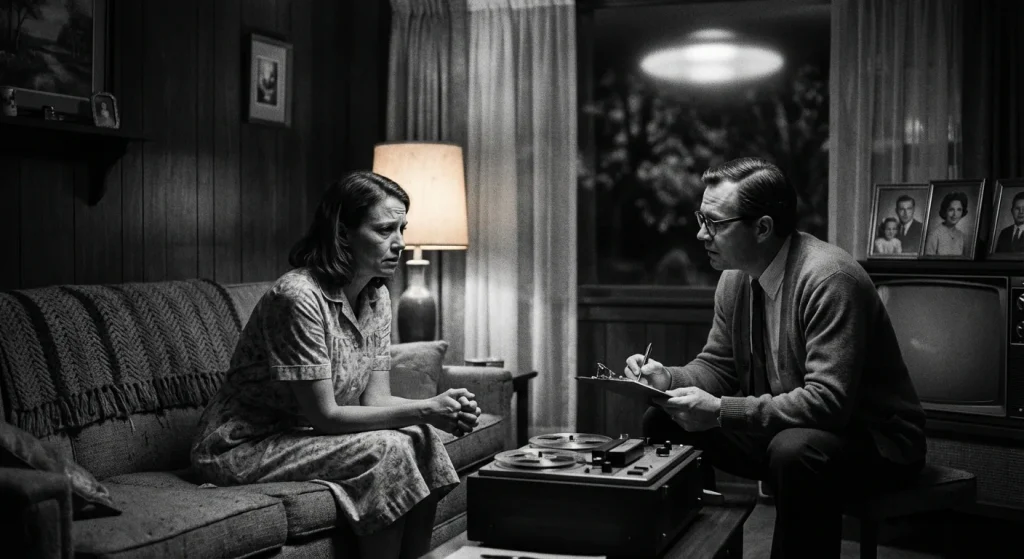
You keep seeing “alien disclosure,” “government UFO cover-up,” and “non-human intelligence” claims recycled as UFO news, and the real question is simple: what is actually documented, and what is merely repeated. The 1967 Betty Andreasson story persists for a specific reason: it was reconstructed through 14 hypnosis sessions and then given cultural reach through a mainstream-published UFO book, which is exactly how abduction narratives keep re-entering the modern attention cycle.
The frustration is legitimate. Legacy cases get cited as if they are settled proof, yet the record is uneven because the story most people recognize is an editorial product, not a lab report. Raymond E. Fowler functioned as the case’s central amplifier, publishing The Andreasson Affair in 1979 with Prentice-Hall, then following with The Andreasson Affair, Phase Two in 1982, with publisher credits that vary by citation. Those dates matter because they mark the mechanism by which a localized account becomes portable, quotable, and repeatedly reintroduced to new audiences.
The core tension is influence versus provenance. An abduction claim is a reported experience that typically has limited independent verification, so narrative vividness cannot be treated as evidentiary weight. A primary source is the closest available record to what was said and captured at the time, such as audio recordings, transcripts, investigator notes, and case files, and its chain of custody matters more than a polished retelling that already bakes in interpretation.
You will leave with a method to separate the timeline from the hypnosis-derived material, sort what exists as record from what exists as summary, and recognize how primary sources versus secondary retellings turn a case into recurring “news” without relitigating what happened.
Who Betty was and what happened
The backbone of the Andreasson case is a reported household event with multiple people in the home that later became structured into a before, during, and after timeline. The complication is that the record is layered: some elements are tied to waking statements taken closer to the report, while other elements enter only after later reconstruction work.
Because the case is so dependent on when a detail first appears, the most useful starting point is still the closest-in-time witness material available-things like written statements, questionnaires, and interviews preserved in the witness’s own words-before later interpretation reshapes the sequence.
The source set provided for this section does not include the actual 1967-era household roster, addresses, or the earliest verbatim statements. That means this background can only describe the reporting structure and the claimed sequence at a high level, without pretending we can quote or pin down names, times, or room-by-room positions from documents not in-source.
The earliest layer, as the case is typically summarized, begins with Betty Andreasson reporting unusual lights and a sense that something abnormal was occurring around the home. In a disciplined timeline, those observations sit in the “waking” bucket only when they are traceable to an initial questionnaire, an early interview, or a written statement collected before any later memory work.
Investigators commonly attempt independent context checks at this stage, because normal sky phenomena can create striking light displays without any local cause. The kind of checks typically pursued include astronomical conditions (moon phase and prominent planets), aurora forecasts, satellite or rocket activity, and local weather records for cloud cover and visibility. The research context supplied with this draft includes examples of routine explanations investigators sometimes uncover in other cases, such as a rocket launch producing a glowing spiral identified by astronomers, and public guidance noting heightened aurora visibility in an urban area; those examples illustrate the method, not a solution for Andreasson’s report.
The minimally defensible scaffold for the “during” window, based on how such cases are built, is: (1) an exterior light or presence is noticed, (2) normal household activity is reportedly disrupted, (3) the witness later reports an event sequence she could not fully account for in real time, and (4) ordinary conditions resume. When the timeline includes missing time, meaning a claimed gap between what a witness can account for before and after the episode, that gap becomes the pivot that pushes investigators toward reconstruction methods because it is the part of the narrative least supported by continuous, timestamped observation.
This is also where source layering becomes operational: waking documentation can preserve what was said before later frameworks solidify, while secondary syntheses can organize material without substituting for it.
The source set here does not provide dates for the first questionnaire, the first investigator interview, or any contemporaneous police logs, medical notes, or local news items tied to the night in question. It also does not include the session-by-session record that would let a reader see exactly when each detail first appeared. What is available in-source is limited to bibliographic context that a later, dedicated analysis of the Andreasson-Luca family case was published as a second book in 1982, which places at least one major synthesis well after the original 1967 claim.
Use two tags when reading any Andreasson timeline: WAKING (pre-hypnosis) for items traceable to initial questionnaires, written statements, or early interviews, and HYPNOSIS-DERIVED (post-hypnosis) for items that first appear only later or expand substantially only after hypnosis. Later recollections require extra caution because hypnosis is documented in investigative contexts as increasing the risk of false recollection, so a detail’s first appearance in the record matters as much as the detail itself. The actionable takeaway is simple: track “when this enters the record” before treating any single timeline point as stable evidence.
Fourteen hypnosis sessions and their goals
That tagging system leads directly to the case feature that gets cited most often: the hypnosis work itself. The hypnosis record is central, but its evidentiary value depends on documentation and protocol. The intended payoff of “14 sessions” is straightforward: convert a fragmented narrative into a time-ordered account with repeatable details investigators can test against external facts. In practice, the target outputs tend to be (1) a cleaner sequence of events, (2) richer sensory descriptors that can be checked for consistency, (3) a clearer emotional state profile that distinguishes perception from interpretation, and (4) bridges over timeline gaps where the witness reports discontinuity or “missing” intervals.
That aim is also the catch. “Regression hypnosis” is the use of hypnosis specifically to retrieve earlier memories, and it sits on a fault line: the same focused, imaginative state used to “access” recall also increases suggestibility and the risk of memory errors. “Hypnotically refreshed testimony” raises the stakes further because it converts a highly malleable recall process into confident-sounding statements that can be contaminated by leading prompts, expectations, or later discussion.
A hypnosis session only becomes usable for readers if it leaves primary-source artifacts you can audit: recordings, transcripts, practitioner notes, and protocol details that preserve what was asked and answered. Without that underlying record, later summaries dominate, and the reader cannot independently evaluate what was actually captured.
| Evidentiary requirement | What it must establish | What it prevents |
|---|---|---|
| Session metadata (date, start/stop time, location) | When and where recall was elicited | Timeline drift and retroactive reconstruction |
| Attendee list (hypnotist, witness, observers) | Who could influence questioning or interpretation | Hidden coaching, group contamination |
| Recording method (audio/video), file identifiers | Whether the record captures exact wording and tone | “Trust me” paraphrase as the only record |
| Full transcript with completeness notes | What is verbatim vs summarized or omitted | Cherry-picked excerpts presented as totality |
| Interviewer notes and protocol description | Whether prompts were neutral and standardized | Leading questions disguised as “clarifying” |
| Chain-of-custody indicators (storage, edits, access) | Whether recordings and transcripts are intact | Undisclosed alteration or selective loss |
| Credential and scope-of-practice disclosure | Training, licensure, and role clarity | Unqualified practice presented as forensic method |
Credential and protocol transparency is the decisive quality marker. Serious clinical training pathways exist and typically require documented coursework and standards; for example, professional membership frameworks and standardized training programs publish baseline requirements. A reader should expect to see the practitioner’s qualifications, the session protocol, and explicit efforts to minimize leading prompts.
No provided source in the research set contains verifiable session metadata about Fowler’s files or books for the Andreasson hypnosis work. That includes the exact session dates, locations, durations, who attended each session, the recording method (audio, video, notes), and whether complete, verbatim transcripts exist for all sessions. The number “14 sessions” can be repeated as a reported figure, but this research set does not let us audit the underlying session record that would determine what that figure actually represents.
Peer-reviewed reviews and experimental findings link hypnosis used as a memory-refreshing technique to increased errors and false memories, including confident confabulation. That is why hypnosis is controversial for memory: it can increase the amount of recall while also reducing the reliability of what is recalled. Court treatment of hypnotically refreshed testimony reflects that tension and remains contested and evolving, with admissibility and weight varying by jurisdiction and standards rather than resting on any single consensus rule.
Use hypnosis-derived material as claim material, not proof. A session can be valuable for mapping a witness’s internal narrative, filling in reported sequence, or surfacing additional descriptors, but it only earns evidentiary weight when (1) the session record is complete and auditable and (2) key points are corroborated externally. Vividness, coherence, and emotional intensity are not verification; recordings, transcripts, protocol transparency, and independent cross-checks are.
Corroboration claims and skeptical challenges
Once hypnosis enters the picture, the evaluation question becomes narrower and more concrete: what, if anything, is anchored outside the same memory stream. This case turns on documentation quality, not narrative confidence. The difference between a story that feels coherent and a claim that is anchored is simple: contemporaneous, first-hand materials such as dated documents and interview transcripts are the only starting point strong enough to carry extraordinary assertions.
Supporters argue: The strongest human corroboration is the recollection of family members who were present in the home and later affirmed that something unusual happened, in broadly compatible ways. In practice, what is documented tends to be secondhand reporting about those recollections (notes, interviews, published summaries). What is claimed is independent, near-contemporaneous witnessing that stands on its own without later reconstruction.
Skeptics respond: Memory is not a passive recording device, and family recollections are especially vulnerable to reinforcement effects once an interpretation hardens. Without independently dated statements taken close to the event and preserved without coaching, “the family remembers” mostly measures later consensus, not original observation.
Supporters argue: Physical traces are treated as the cleanest category because they are, in principle, separable from belief: marks on the body, environmental anomalies, or object-level remnants. Supporters point to accounts asserting that such traces existed and were noticed.
Skeptics respond: The friction is that “trace” only becomes evidence when it is documented with photos, chain-of-custody, measurements, and independent analysis. If the public record only preserves the assertion that traces were present, skeptics treat that as a narrative support, not a material anchor.
Supporters argue: Supporters cite medical aftereffects as corroboration because medicine generates paperwork: exams, imaging, clinician notes, and lab results. They also point to the plausibility that distress would produce real symptoms.
Skeptics respond: Symptoms are real without establishing cause. The evidentiary gap is usually documentary: absent retrievable medical records that can be dated, reviewed, and interpreted by independent clinicians, medical claims remain asserted rather than demonstrated. Even when records exist, they typically document condition and complaint, not the origin story attached later.
Supporters argue: Missing time is treated as a quasi-quantitative marker because clocks, routines, and other people’s schedules can box in a time window. Supporters cite reported time discontinuities as a structured feature that repeats across accounts.
Skeptics respond: “Roughly how long” is not the same as a documented timeline. Without an external time-stamp (phone logs, receipts, dispatch records, independently recorded start and end points), missing time becomes a subjective impression, and subjective impressions are exactly what later interpretive frameworks tend to organize and stabilize.
Supporters argue: Consistency across multiple tellings, including across many hypnosis sessions, is presented as an integrity signal: stable elements look less like fabrication and more like recall.
Skeptics respond: This is where the hypnosis dispute matters most. Skeptical challenges commonly center on hypnosis reliability and false-memory risk, especially when questioning is leading or when the subject already holds strong expectations. Hypnotically refreshed testimony also has contested treatment in courts and forensic contexts, precisely because confidence can increase without accuracy increasing. Consistency can reflect rehearsal and consolidation, not independent verification.
Cultural contamination is a live critique in abduction literature because motifs spread and then get re-encoded as “what this kind of event looks like.” The Barney and Betty Hill case (1961) is widely cited as the first widely reported modern U.S. UFO abduction, and it is frequently described as involving a roughly three-hour loss of time plus a Zeta Reticuli linkage. Once an influential template exists, later accounts do not have to copy it consciously to converge on its structure; investigators, media, and witnesses can all pull a story toward the same familiar scaffolding.
Upward movement comes from records that are independently dated, independently observed, and still retrievable now: contemporaneous written statements from multiple witnesses taken separately; original session recordings and full transcripts with clear provenance; medical records that can be produced and reviewed (not summarized); and time-stamped artifacts that bound the timeline. More anecdotes add volume. Documentation adds weight.
Why the case resurfaces in UAP news
The same imbalance-high narrative reach, limited auditable record-is also why Andreasson keeps resurfacing when the broader UAP conversation heats up. When UFO news and UAP news spike, legacy names like Andreasson re-enter feeds because they are culturally legible shortcuts for “the big questions,” not because a new headline retroactively strengthens what a 1960s-era claim can prove. The attention shift is real: it changes search behavior and editorial incentives far faster than it changes the evidentiary status of any single historical narrative.
The current cycle runs on two lanes that routinely get blurred. The institutional lane is the Pentagon UAP office (AARO) and related DoD reporting: intake processes, incident analysis, and how UAP reports move through military and intelligence channels. That lane is designed to handle modern incident pipelines, not to validate or invalidate historical abduction narratives built from personal testimony. The narrative lane is the older encounter literature and its afterlives online, where “non-human intelligence” speculation and government UFO cover-up framing travel well regardless of what any office is actually tasked to do.
Algorithms reward familiar keywords and recognizable story frames, so a burst of “UAP sightings” content quickly pulls in “classic” cases, anniversaries, and testimony-adjacent explainers. High-profile names like David Grusch, Ryan Graves, and David Fravor also function as attention magnets: when their testimony is back in the conversation, editors and creators rebuild context libraries, and older cases get repackaged for “UFO sightings 2025” and “UFO sightings 2026” audiences.
Much of the actionable “disclosure” talk is records-access talk. Secondary commentary and coverage has pointed to lawmakers discussing a mandated “Unidentified Anomalous Phenomena Records” repository, and readers also see H.R.1187 (119th Congress), titled to require release to the public of all documents, reports, and other records relating to unidentified anomalous phenomena. In this Term Sheet, “UAP disclosure” means government-facing transparency and reporting normalization around UAP records and processes; it does not guarantee confirmation of non-human intelligence, and it does not authenticate any specific legacy abduction account.
Use disclosure headlines as navigation for where documents might live and how reporting is structured. Keep Andreasson in the narrative lane: a historically influential story, not a proxy indicator that today’s institutional UAP work has verified it.
How to read abduction accounts critically
You can stay open-minded and still be strict: treat every abduction account like an evidence file. The most viral version is usually the least source-faithful, because it compresses timelines, drops qualifiers, and swaps uncertainty for certainty. Your job is to rebuild the source chain, then decide what the chain can actually support.
Start by separating primary material from secondary retellings that summarize and interpret earlier material, often adding the author’s perspective. That “helpful” framing is exactly where context gets omitted and conclusions get smuggled in.
- Collect primary items first: original audio, full transcripts, contemporaneous notes, letters, dated medical records, and unedited video. Save files locally, not just links.
- Verify chain of custody: who created the record, who held it, when it was copied, and whether edits are documented. A clean custody trail beats a polished montage.
- Prioritize timestamped contemporaneous documentation: notes written the same day, recordings made at the time, logs with dates. Later memoir-style reconstructions are lower value even when sincere.
- Screenshot what disappears: URLs, upload dates, channel descriptions, captions, and any claim that a clip is “unedited.” Capture the full context around the quoted segment.
- Ignore isolated quote cards, “thread summaries,” and highlight reels unless they point back to full primary material you can inspect.
Corroboration has one job: add independent anchors that do not rely on the same memory stream. “Independent” means separate access to the event, separate incentives, and separate documentation paths. Two people repeating the same story after talking for years is one source line, not two.
High-value anchors look like: independent witnesses interviewed separately; independent records with dates (call logs, travel receipts, dispatch records, weather data, medical intake forms); and physical artifacts tied to time and handling (photos with provenance, lab reports with documented custody). If the only support is repeated retellings, the case has volume, not structure.
Stress narrows attention and disrupts encoding, so later recall often fills gaps with inference. Time compounds that reconstruction: each retelling rehearses a version, not the original perception.
Hypnosis-based “memory refreshing” (including regression-style sessions) performs worse than its confidence suggests. Peer-reviewed literature reviews link hypnosis to the creation of false memories, and multiple studies find that using hypnosis to enhance eyewitness recall produces errors. This has been tested head-to-head: an experimental study comparing cognitive interviews and hypnosis used 72 volunteers, reflecting a long-running finding in eyewitness research that confidence can rise while accuracy does not.
Policy keywords are navigation terms, not confirmations of non-human intelligence. Treat phrases like UAP Disclosure Act, Schumer UAP Disclosure Act, NDAA UAP provisions, and House Oversight Committee UFO hearing as pointers to documents, hearings, definitions, and reporting requirements. They tell you where to look, not what is true.
Capture primary material, map each claim to a timestamped record, then demand independent anchors with documented custody before upgrading belief. Run that workflow on the Andreasson case, and it works just as cleanly on the next viral “UAP sightings” clip that shows up in your feed.
What the Andreasson case ultimately shows
The Andreasson case stays influential because it is narratively rich and publication-amplified, yet it remains constrained by what can be independently checked across time and sources.
The publication mechanism previewed at the start holds: a 1967 report becomes durable lore largely because it is later packaged for wide readership, with influence tied to Raymond E. Fowler’s publications beginning in 1979 and continuing with the 1982 Phase Two volume.
What those books can legitimately support is bounded by the hypnosis-section limits you already saw: without complete, unedited session records and stable metadata, reconstruction becomes difficult to audit, even when the narrative is internally detailed.
The evidence-category assessment explains why this matters, and the disclosure-context section adds the modern risk: resurfacing claims get misread as “new disclosure” when the underlying record has not materially changed. In the provided research set, no confirmed excerpts of Fowler’s later hindsight commentary are available, so later interpretive shifts should not be attributed here.
Confidence upgrades come from missing artifacts, not further retellings: complete unedited recordings of the hypnosis work, contemporaneous records created at the time of the original report, and independently dated documents or photographs that can be verified outside the narrative.
Apply the same source-layer and artifact-first standard to the next burst of UFO or UAP news before treating a revived story as a stronger historical claim.
Frequently Asked Questions
-
What is the Betty Andreasson abduction case (1967) and why is it still discussed?
It’s a reported 1967 household encounter that later became widely known through Raymond E. Fowler’s mainstream-published books, starting with The Andreasson Affair (1979, Prentice-Hall) and followed by Phase Two (1982). The case persists because it was reconstructed through 14 hypnosis sessions and then packaged into a portable, repeatable narrative.
-
What’s the difference between a primary source and a secondary retelling in UFO abduction cases?
Primary sources are closest-to-event records like audio recordings, transcripts, investigator notes, and case files, where chain of custody matters. Secondary retellings are later summaries (including books) that organize and interpret the story but can’t substitute for the original artifacts.
-
What does “missing time” mean in abduction reports?
Missing time is a claimed gap between what a witness can account for before and after an episode, making it the pivot point that often drives later reconstruction attempts. The article notes it only becomes strong when bounded by external timestamps like phone logs, receipts, or dispatch records.
-
What were the goals of the 14 hypnosis sessions in the Andreasson case?
The intended outputs were a cleaner sequence of events, richer sensory details for consistency checks, a clearer emotional-state profile, and “bridges” over timeline gaps such as missing intervals. The article emphasizes the evidentiary value depends on complete, auditable session documentation.
-
What documentation should a hypnosis session include to be evidence-grade?
The article lists requirements including session metadata (date, start/stop time, location), attendee list, recording method and file identifiers, full transcripts with completeness notes, protocol/interviewer notes, chain-of-custody indicators, and credential/scope-of-practice disclosure. These details prevent timeline drift, hidden coaching, and “trust me” paraphrase-only records.
-
Does the article provide verifiable metadata or full transcripts for the 14 Andreasson hypnosis sessions?
No- it explicitly says the provided research set does not contain verifiable session dates, locations, durations, who attended, recording methods, or confirmation that complete verbatim transcripts exist for all 14 sessions. As a result, “14 sessions” can be repeated as a reported figure but cannot be audited from the included sources.
-
How should I evaluate a legacy abduction case like Andreasson when it resurfaces in UAP disclosure news?
The article’s decision rule is to tag claims as WAKING (pre-hypnosis) versus HYPNOSIS-DERIVED (post-hypnosis) and only upgrade confidence with independently dated, retrievable anchors (separate witness statements, medical records, timestamped logs, or physical evidence with chain of custody). It also stresses that modern institutional UAP activity (like AARO processes or records-repository talk) doesn’t authenticate a 1967 hypnosis-built narrative.
