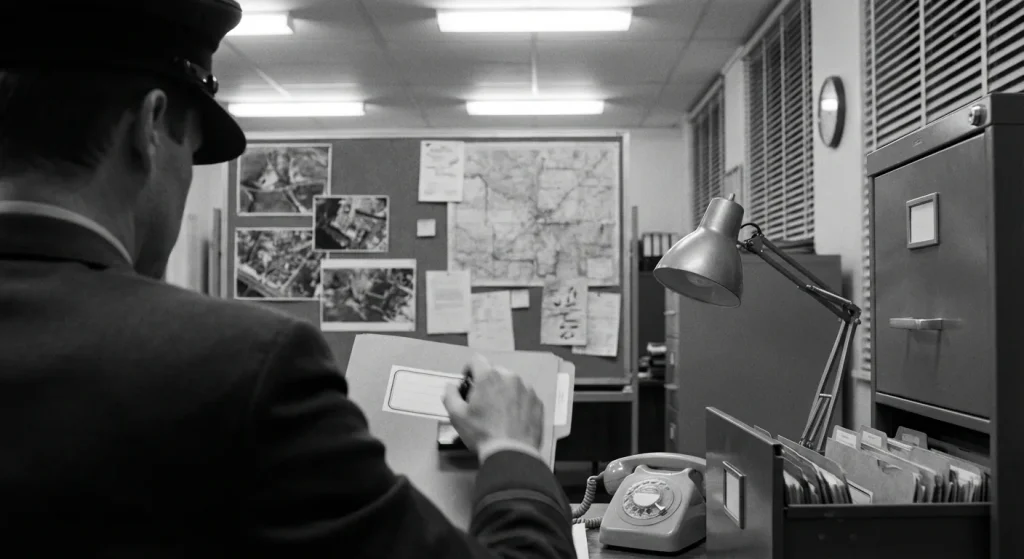
If you follow the daily UAP disclosure churn, the default storylines feel binary: governments either investigate seriously or they cover it up. Australia does not fit that script, because it quietly stepped back decades ago, long before today’s headline cadence trained people to expect press conferences, task forces, and neatly branded reporting channels.
Department of Defence records indicate the Royal Australian Air Force effectively curtailed its official role in investigating UFO reports in 1984. It reads as an administrative stand-down, not a dramatic public shutdown announcement, and public reporting based on the file trail has not preserved a single, widely cited directive title that everyone can point to as the one clean “order” ending the pre-1984 RAAF UFO role.
The record is easy to misread because the friction points are exactly the ones people treat as “gotcha” proof: some Defence documents connected to the 1984 change were previously marked SECRET, and the paperwork does not present itself as a single, cinematic before-and-after memo. Classification markings signal handling requirements, not automatically extraordinary content, so the only responsible move is to judge what the documents actually say and what they do not.
Fast-forward to the present and the posture is visible in plain language: modern Defence material uses both “Unidentified Aerial Phenomena (UAP)” and “Unidentified Flying Objects (UFO),” and states Defence does not have a protocol for reporting or recording them. Defence also notes there are still reporting pathways for personnel to report unusual or unexpected events, including UAPs, but that is not the same thing as a dedicated UAP intake and case-tracking system.
No dedicated investigation can be read as bureaucratic triage or as a government UFO cover-up; the difference comes down to how you read the record and how hard you are on your own standards. To place 1984 correctly, you first have to understand what “investigation” meant inside the RAAF before the stand-down and what modern statements do-and do not-commit Defence to today.
How the RAAF Handled UFO Reports
Before 1984, the RAAF’s “official investigation” posture functioned as institutional filtering: air safety and national security triage, not an “alien disclosure” mission. A reported Unidentified Flying Object (UFO) was simply an aerial sighting that had not been identified at the time, which immediately frames the work as identification and risk-screening rather than validation of extraordinary claims.
In practice, “official investigation” at a high level meant receiving reports, gathering the basic facts available, checking those facts against known explanations (aircraft, balloons, astronomical objects, weather, misperception, hoaxes), then recording an outcome. The constraint for readers is straightforward: the provided sources for this section do not contain verifiable details of a standardized, step-by-step pre-1984 RAAF process (no confirmed unit names, specific forms, or routing charts), so any attempt to describe a single fixed workflow as “the” procedure would be fabrication.
The clearest signal that this was an evaluative filter comes from a commonly cited Australian report summary: roughly 80% of sightings were attributed to natural phenomena, hoaxes, birds, or man-made objects, and about 17% were assessed as having insufficient data to permit a thorough investigation. Read literally, that distribution describes a system optimized to close cases through identification when the available information supported it, and to stop at “insufficient data” when it did not.
Those two endpoints also tell you what “investigated” actually communicates in a historical file. “Explained” means a plausible identification was reached based on the information available. “Insufficient data” means the record did not support a defensible identification, not that the event was confirmed as anomalous. The label is an evidence verdict, not an endorsement.
“Insufficient data” is a common outcome in any safety or intelligence-adjacent reporting system because anomalous observations arrive with predictable friction. Short observation windows limit what can be described with accuracy. Single-witness reports provide no independent corroboration, and many events have no supporting sensor data that can be checked later. Memory also degrades fast: estimates of size, distance, altitude, and speed drift, especially when the observer has no reference points or is reporting under stress.
There is also a practical follow-up problem that has nothing to do with “belief” and everything to do with incentives. If an object disappears quickly and there is no damage, no airspace violation confirmed, and no continuing hazard, the system has limited leverage to generate better data after the fact. That is how a file can reflect sincere concern and real effort while still ending in “insufficient data.” The outcome reflects the quality of inputs, not a hidden conclusion.
Terminology drift is one of the biggest practical traps when you compare eras. Unidentified Aerial Phenomena (UAP) is the modern framing that shifts attention away from “craft” assumptions and toward anomalous observations, which makes cross-era comparisons messy when older files were organized around “UFO” as an identification problem rather than a phenomenon category.
You will also encounter “Unusual Aerial Sightings (UAS)” in secondary literature as an official-style label for handled reports, and that usage tracks with archival titling like “Report on Unusual Aerial Sighting.” Treat “UAS” as a reported label that appears in the ecosystem of official paperwork and later summaries, not as the single definitive government term that was always used consistently across time and offices.
A useful comparator, even without turning this into a procedural deep dive, is that the RAAF discussed a system for reporting and investigating air safety incidents involving RAAF and civil aircraft. Defence aviation organizations already operate with a built-in reflex: capture reports, establish what happened, decide whether it represents a hazard or threat, and document the disposition. Anomalous aerial reports naturally sit adjacent to that function because an unidentified object in controlled airspace is, first, an identification and risk problem.
This is why the historical record is dominated by assessments rather than revelations. The operational question was not “What does this mean for disclosure?” It was “What was it, and does it indicate an ongoing safety or security issue?”
Interpret pre-1984 conclusions as outputs from an identification filter. Most files exist to sort reports into “explained” or “not enough information,” with attention to safety and threat-screening. In that context, “officially investigated” does not mean “validated as extraordinary.” It means the report entered a system designed to triage risk, test ordinary explanations first, and record what the available evidence could actually support.
That pre-1984 posture also clarifies what a stand-down can plausibly represent: not a verdict on “UFO reality,” but a decision that the filtering function no longer justified a dedicated lane inside the organisation.
Why the RAAF Stood Down
A 1984 “stand-down” reads most cleanly as an administrative decision to stop or sharply reduce a function, not a dramatic admission that UFOs were real or a denial that witnesses saw something. Defence organisations stand functions down when the activity no longer fits the mission, the risk picture, or the workload they can justify. That framing matters because a stand-down can end an investigative workflow without proving anything about the underlying phenomenon.
Public reporting does preserve a clear pointer to a policy shift: The Sydney Morning Herald references an “original 1984 policy” and describes it as a past Defence stance intended to diminish UFO reports.
What the archival record clearly shows is that the RAAF previously used formal reporting, including documents titled “Report on Unusual Aerial Sighting,” which is exactly the kind of paperwork trail you would expect from an organisation treating the issue as an operational reporting problem rather than a cultural curiosity.
The friction is that public reporting does not reliably preserve a single, citable directive title or reference number for the 1984 change. That gap is not trivial: without a clean memo citation, readers cannot independently verify the exact language, the scope (stop investigating vs. stop accepting reports vs. triage), or the intended recipients.
Secondary reporting also muddies timelines: one account states the RAAF was responsible for investigating Unusual Aerial Sightings until the 1990s, which shows how easily “policy” and “practice” can diverge in public summaries, or how different units can be described under one label.
Some related materials are described in public accounts as having previously been marked “SECRET.” Treat that label as a handling control, not a content guarantee. Defence bureaucracies classify routine correspondence all the time: distribution lists, capabilities, radar coverage, air tasking context, or liaison channels can trigger classification even when the underlying subject is mundane. Classification alone is never evidence that the file contains extraordinary conclusions.
The same ambiguity drives two predictable readings. Believers treat the missing clean directive citation and any classification history as the shape of a cover-up: if the decisive memo is hard to cite, they infer it was buried; if anything was “SECRET,” they infer it must have been explosive.
Skeptics read the same pattern as routine triage: an organisation that once logged “unusual aerial sightings” eventually decided the category did not deliver defensible operational value at the margin. That interpretation aligns with the commonly reported rationale in secondary reporting: resource focus and a “no defence significance” framing. Without the primary text, the correct posture is to treat that rationale as commonly reported, not as a verbatim, attributable quote.
Later public messaging fits the administrative pattern: ABC reported in 2021 on Defence stating it is not looking at UFOs, a plain-English formulation that reads like scope control, not a metaphysical claim.
Use a simple rule: separate documented action from inferred motive. The action that holds up best in public reporting is an institutional deprioritisation of UFO work, alongside the continued existence of broader channels for reporting unusual or unexpected events, including UAP-related ones.
Then hold the line on what the documentation gap can and cannot prove. The absence of a single, easy-to-cite 1984 directive reference is a limitation to acknowledge, not a blank cheque for certainty in either direction. It supports a cautious conclusion about stand-down behaviour, and it blocks confident claims about secret intent.
Those limits are exactly why the archive matters: when the stand-down paperwork is hard to cite cleanly, the best available leverage is in what the surviving records do show about how reports were filed and handled.
What the Records Reveal
The Australian public record on UFOs and UAPs is substantial but uneven: it reliably shows how institutions framed the subject and how reports were processed, but it cannot, by itself, settle extraordinary conclusions. The value is procedural and contextual. You can see what officials chose to file, how they summarised observations, what they treated as plausible explanations, and when they closed matters out. The limitation is just as clear: the archive is not a single, end-to-end narrative, and gaps in corroboration are common.
Many UFO-related files were transferred to the National Archives of Australia (NAA), the repository that holds transferred Commonwealth records for public access, with hundreds digitised and available online. That matters because it anchors the discussion in primary material you can actually inspect, not second-hand retellings.
Alongside the archive, Defence has also published a small, self-contained example of what “official documents” typically look like in this topic area: a 10-page dossier that includes 17 Defence communications about UFOs or UAPs. Read that dossier for what it is, a slice of internal briefings, correspondence, and institutional positioning, not a smoking gun.
Researchers also point to an archived list that reportedly maps Australian UFO files to NAA series and file numbers. That kind of index is practical because it lets you track provenance across agencies and series instead of treating “UFO files” as one monolithic collection.
Multi-agency provenance is not theoretical. Project1947 reporting says three Department of Supply files dealing with “flying saucers” or UFOs were located, and two of those files were commenced in 1952. That detail is important because it shows the record is distributed across departments with different missions, vocabularies, and filing habits.
Most archival UFO material reads like case administration, not revelation. Typical contents include witness statements and letters from members of the public, internal summaries of what was reported, short assessments that weigh explanations, and correspondence between offices about whether anything further is required. You will also see mundane metadata that matters: dates, locations, who received the report, and how it was categorised at the time. The strongest files are the ones that preserve the full chain, from initial report to internal assessment to a documented close-out decision.
Two forces distort casual readings. First, attachments are often missing. A file might refer to maps, photographs, technical notes, or annexes that are not present in the digitised item or were never captured in the surviving record. Second, detail levels swing wildly. Some incidents get a page; others get a packet. Categories drift over time too: “flying saucer,” “UFO,” “aerial phenomenon,” and adjacent labels can route similar material into different series or departments, which is why provenance and file context matter as much as the headline.
Freedom of Information (FOI) releases add another layer: FOI is a request-based access regime, and exemptions can produce redactions that remove material for practical reasons such as protecting sources, methods, or unrelated sensitive information. Redaction is a boundary marker, not an interpretation. Treat it as “there is text we cannot see,” and nothing more.
- Start with provenance: note the creating agency, series, and the file’s purpose before treating any sentence as a finding.
- Separate report from assessment: a witness claim is not an official conclusion, and an internal summary is not necessarily an investigation.
- Corroborate across documents: look for independent supports like multiple witnesses, consistent timelines, or matching references in related files.
- Account for missing pieces: if a file cites attachments you cannot see, downgrade certainty rather than filling gaps with assumptions.
- Quote what the document actually claims: stay anchored to the exact language, especially around certainty, attribution, and scope.
Read the archive like an investigator: context first, corroboration second, conclusions last. That approach preserves what the record can genuinely prove, without asking it to carry what it does not contain.
That discipline becomes even more important when Australia is compared to countries that have built formal UAP offices and recurring reporting obligations into their governance.
Australia Versus Today’s UAP Disclosures
After the RAAF’s 1984 stand-down, Australia’s posture toward UFO reporting reads like a closed administrative file: quiet, procedural, and largely stable. Global “UAP disclosure” expectations, by contrast, are shaped by the United States, where disclosure is treated as an ongoing governance program with named offices, scheduled deliverables, and recurring National Defense Authorization Act (NDAA) cycles. That U.S. cadence creates a template people project onto Australia, expecting periodic “big reveals” on a timetable Australia never adopted.
The institutional centerpiece is the All-domain Anomaly Resolution Office (AARO), a centralized U.S. office designed to coordinate UAP reporting and investigation across air, space, sea, and other operational domains so cases flow into one accountable channel instead of dispersing across commands. The key point is what Congress demands from that channel: the NDAA language requires AARO to account for UAP-related security classification guides governing reporting and investigations. In practice, that is “disclosure” as infrastructure: who reports, under what classification rules, using which documentation standards, and with what audit trail.
AARO’s published reports and deliverables reinforce that model. It publishes formal deliverables, including a listed 2024 product titled “AARO Historical Record Report: Volume 1.” That report-driven ecosystem turns UAP talk into bureaucratic artifacts: volumes, annexes, and mandated submissions that can be tracked year over year, regardless of whether any single case produces sensational conclusions.
The Schumer/Rounds UAP Disclosure Act effort is the cleanest reality-check on how U.S.-style disclosure actually behaves under negotiation. It began as a detailed roughly 64-page proposal with multiple transparency mechanisms designed to force broad release and structured review of UAP records. Most of those original mechanisms were removed in final defense-bill negotiations. The pattern matters more than the personalities: even in a system built for recurring disclosure moments, the final product tends to be process concessions, not maximal transparency.
People see U.S. deadlines and assume other Five Eyes countries will match them. Australia’s record points the other way. The 1984 choice was an administrative off-ramp, not the start of an annual reporting pipeline. Expecting Australia to produce AARO-style deliverables on an NDAA-style rhythm confuses two different governance models: one built around periodic legislative forcing functions, the other built around standing down and leaving the archive to speak for itself.
Use a strict distinction. Process transparency signals include new reporting pathways, classification guides, mandated record collections, and published deliverables like “AARO Historical Record Report: Volume 1.” Claims about craft or “alien disclosure” are a different category entirely. If a headline does not change procedures, documentation standards, or classification rules, it is not a disclosure event in the policy sense, no matter how dramatic the framing sounds.
Against that contrast, 1984 becomes less of a mystery date and more of a practical pivot point: it changes what kind of evidence you should expect to exist in the first place.
What 1984 Means for UFO Claims
After an investigative stand-down, the signal changes. Fewer official investigations does not mean fewer unusual events; it means different routing and thinner public evidence. The practical consequence is brutal for UFO disclosure and UAP disclosure debates: the public record stops behaving like a case file system and starts behaving like scattered anecdotes, with long gaps where you would normally expect a formal conclusion.
Australia’s contemporary public-facing posture points to deprioritization, not curiosity. ABC reported on 26 June 2021 that Defence “says it is not looking at UFOs.” That statement shapes how UFO news and UAP news gets framed: the absence of a named investigative function becomes the headline, while the underlying reporting plumbing stays mostly invisible.
The key distinction is “no dedicated UFO program” versus “no reporting at all.” Defence maintains pathways for personnel to report “unusual or unexpected events,” including events potentially posed by UAPs. That internal reality matters because it preserves a safety and security channel even when there is no public-facing UFO unit to brief, reassure, or publish findings.
Modern discussion also tends to center on communications rather than active investigation. The Mandarin reported on a Defence dossier of internal communications from mid-2023, which reads like organizational message management and reassurance, not a standing analytical cell producing adjudicated case outcomes.
Fragmented routing is the real friction. When there is no single, visible investigative desk, reports split across civil aviation incident reporting pathways, police call-outs, weather and astronomical explanations, and Defence only when an event is threat-relevant. In that environment, an absence of a dedicated protocol for reporting or recording UAP or UFO predictably yields inconsistent paper trails across units and time.
During attention spikes like “UFO sightings 2026,” that fragmentation produces ambiguity that both camps exploit. The cover-up narrative points to silence and missing files; the misidentification narrative points to low-quality clips and rumor. Both arguments get easier when no central body is publishing standardized dispositions.
- Demand corroboration across independent witnesses (not a single social circle or repost chain).
- Verify sensor data (radar, EO, IR) and confirm it is contemporaneous with the sighting, not an unrelated capture.
- Trace the chain-of-reporting from first observer to any official log, including time stamps, identities, and unedited originals.
- Pressure-test alternatives by explicitly checking aviation activity, drones, balloons, re-entries, astronomy, and weather before invoking exotic claims.
- Audit incentives and context (training ranges, exercise windows, air traffic patterns, media cycles) that predict misperception and amplification.
Handle each new UFO news claim as an evidence package to be audited, not a conclusion to be shared. In a post-investigation environment, the only honest path is standards-first: if the package cannot survive corroboration, sensors, documentation, alternatives, and context, it is not a strong case, regardless of how loud the headline gets.
That is the operational consequence of the 1984 decision: it didn’t resolve the debate, but it ensured the debate would run on thinner, more fragmented evidence.
The Lesson of a Stand-Down
The 1984 stand-down built a durable narrative engine: once an agency administratively deprioritizes a problem, the resulting silence reads as “nothing happening” to skeptics and “cover-up” to believers, even when both are just projecting onto the same gap.
Before that shift, the RAAF’s posture functioned as triage: most reports were explainable, and a meaningful remainder stayed unresolved because the data never got good enough to close them cleanly. After 1984, the key move was a shift away from a formal investigative role, and the public record carries the friction you’d expect: a documented curtailment, a documentation gap (no single, widely preserved directive citation), and the added complication of “SECRET” marking practices shaping what circulated.
What survives is substantial but uneven: there are formal “Report on Unusual Aerial Sighting” style files in the archive, while modern releases skew toward dossiers of communications rather than evidence of active casework. In other words, Australia undercuts the usual binary from the start: a government can step back administratively without offering either “disclosure theater” or a provable cover-up narrative.
- Future Defence releases
- Additional National Archives of Australia (NAA) digitisation and transfers
- FOI-accessible correspondence (as a watch-item)
- Parliamentary Questions on Notice and Hansard queries as attention indicators (databases exist, even if results are sparse)
- Modern UAP disclosure cadence shaped by scheduled deliverables (AARO reporting) and annual legislative cycles (NDAA)
Read the next UAP headline like an auditor: demand the evidence package and the process trail, not vibes.
Frequently Asked Questions
-
When did the Royal Australian Air Force stop officially investigating UFO reports?
Department of Defence records indicate the RAAF effectively curtailed its official role in investigating UFO reports in 1984. The change reads as an administrative stand-down rather than a public, formal shutdown announcement.
-
Did Australia issue a single 1984 memo or directive ending the RAAF UFO investigation program?
Public reporting based on the file trail has not preserved one widely cited directive title or reference number that clearly serves as the single “order” ending the pre-1984 RAAF role. That documentation gap limits independent verification of the exact language and scope of the 1984 change.
-
How did the RAAF handle UFO reports before 1984?
Before 1984, the RAAF treated UFO reports as an identification and risk-screening problem tied to air safety and national security triage. It gathered basic facts, checked against ordinary explanations (aircraft, balloons, astronomical objects, weather, misperception, hoaxes), and recorded an outcome.
-
What percentage of Australian UFO sightings were explained versus unresolved in the commonly cited summary?
A commonly cited summary says roughly 80% of sightings were attributed to natural phenomena, hoaxes, birds, or man-made objects. About 17% were assessed as having insufficient data to permit a thorough investigation.
-
What does “insufficient data” mean in historical Australian UFO files?
“Insufficient data” means the record did not support a defensible identification based on the information available. It is an evidence verdict, not confirmation that the event was anomalous or extraordinary.
-
Does the Australian Department of Defence have a current protocol for reporting or recording UAP/UFOs?
Modern Defence material states Defence does not have a protocol for reporting or recording UAPs or UFOs. It also notes personnel can still report unusual or unexpected events (including UAPs) through broader channels, but there is no dedicated UAP intake and case-tracking system.
-
What should I look for when evaluating Australian UFO/UAP claims after the 1984 stand-down?
The article’s checklist is to demand corroboration across independent witnesses, verify contemporaneous sensor data (radar/EO/IR), and trace the chain-of-reporting to any official log with timestamps and originals. It also says to pressure-test alternatives like drones, balloons, re-entries, astronomy, and weather before making exotic claims.
