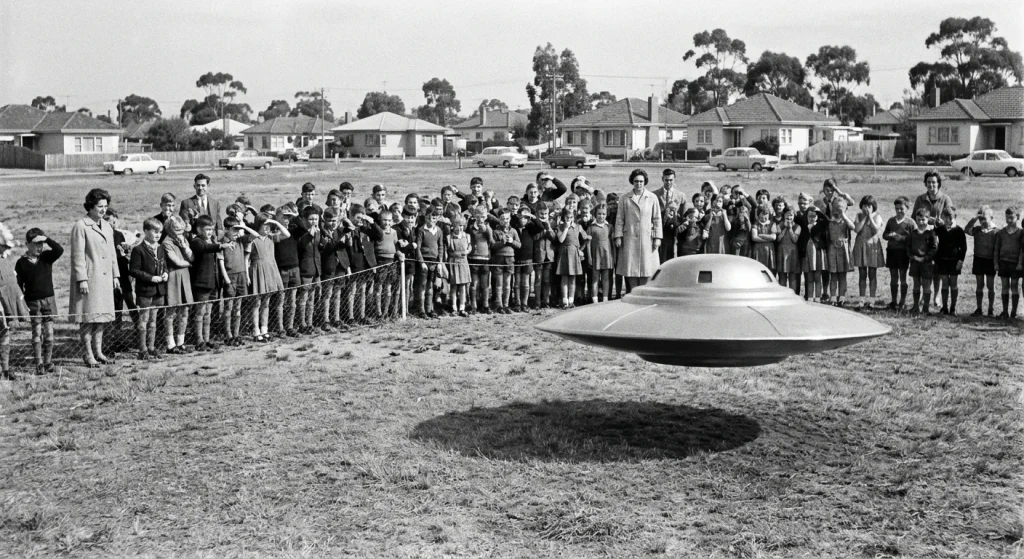
Westall keeps resurfacing because it sits in an uncomfortable sweet spot: a daylight, high-witness-count schoolyard case that still produces no consensus. You see it recycled in headlines and clips as if it is a settled classic, then you try to chase the sourcing and discover the foundation is thinner than the certainty of the retellings.
At the center is a claim that is both specific and stubborn: Westall is widely described as occurring on 6 April 1966 at or near the Westall schools in Melbourne’s southeast, with roughly 200 students and teachers commonly reported as witnesses (an approximate figure repeated across later accounts). The 6 April 1966 date and the “about 200” headcount are documented in contemporary and early sources: contemporary newspaper coverage includes items such as a 7 April 1966 local press item available via Trove, and early UFO-group publications reprinted a local Clayton Calendar notice in mid-1960s UFO journals; the State Library Victoria summary of the event catalogues these early references. These contemporary press items and early group publications are the earliest traceable published sources for the date and the headcount; earlier documentation has not been located. See the State Library Victoria summary and a Trove digitised newspaper item for examples of those early sources.
The friction is that witness volume does not equal evidentiary quality. Memory is demonstrably fallible over time, and post-event information and group reinforcement contaminate recall, especially when a story becomes culturally “known.” A case can be sincerely remembered by many people and still be hard to verify at the level serious analysis requires.
This piece uses a strict operating standard: separate what is well-sourced and close to 1966 documentation from what is disputed, secondhand, or amplified by decades of repetition. Primary records and early reporting matter because they anchor claims before they are polished by retelling, and multiple independent sources are the only reliable antidote to bias and error.
Language adds another layer of confusion: witnesses and the public still call legacy cases a UFO vs UAP-what the terms mean today, while modern official reporting in U.S. government contexts (including DoD and AARO) often adopts the newer umbrella term you can see formalized when the FAA retitled Aeronautical Information Manual section 7-7-4 to “Unidentified Anomalous Phenomena (UAP) Reports.” See the FAA AIM publications page for the AIM editions that incorporate the 7-7-4 changes.
You leave with a fact-forward framework for evaluating Westall by source proximity, plus a clear map of what is known, what is disputed, and what is worth re-checking.
Students, teachers, and the record trail
Westall’s staying power is structural: a school creates a dense witness environment that is both a strength and a vulnerability. It concentrates dozens to hundreds of semi-independent observers across different roles, sightlines, and attention states, students on the yard, teachers supervising or teaching, and locals who happen to be nearby. That diversity raises the ceiling on corroboration because you can compare accounts from people who were not standing together and not performing the same task. The same setting also accelerates shared discussion, and memory conformity and social contagion are well-established when people trade impressions and treat certain voices as more credible.
The second vulnerability is collection dynamics. Once adults, journalists, or enthusiasts start asking leading questions, they can unintentionally reinforce tentative answers and distort recall. For Westall, that means the witness pool itself is not the problem, the handling is: you want accounts captured separately, with neutral prompts, and with minimal “Did you see X?” steering that pushes everyone toward a standardized story.
Those witness dynamics are why the record trail matters as much as the headcount. Treat the Westall file as layered evidence, not one uniform archive. Contemporaneous sources, records created at or very near the time of the event, deserve first-pass weight because they place the fewest opportunities between observation and documentation. In practice, that category includes any original notes, school or official documentation if it exists, and primary media artifacts created close-in. Later oral history adds volume and detail but must be screened for replayed phrasing and post hoc certainty that can accumulate across decades.
Within both categories, access matters as much as proximity. Give more weight to materials where the original audio, video, or verbatim transcripts are accessible and can be checked for exact wording, interviewer prompts, and edits. Discount items that survive only as summaries, paraphrases, or third-party retellings, because you cannot audit what was asked, what was cut, or what was inferred.
Also account for the mechanics of formalized statements: producing a polished witness statement takes time and involvement from both the witness and whoever is drafting or editing. That process is not automatically unreliable, but it increases the risk that clarity is purchased with unintended restructuring of what was originally uncertain or approximate.
Once sources are ranked by proximity and auditability, the remaining task is to separate what stays stable from what accretes over time. Cross-decade analysis works only if you separate persistent core elements from later-emerging embellishments. The core elements that recur across many independent retellings are straightforward: a disc-like description, a low-altitude object, a hovering or landing claim, and in some accounts the presence of aircraft in the vicinity. Those points persist because they are simple, visual, and easy to restate without importing extra narrative.
What grows over time is the story’s specificity and dramatization. Look for details that become sharper, more cinematic, or more uniform across witnesses after publicity cycles, group discussion, or leading interviews, and treat them as later-emerging embellishments unless they are anchored to close-in documentation. The disciplined way to read Westall is to rank each source by (1) proximity to the event, (2) whether you can access the original recording or transcript, and (3) whether the claim stays stable across accounts that were collected independently.
Competing explanations and sticking points
Westall stays contested for a simple reason: every leading explanation fits part of the record, then collides with a specific constraint that the others handle better. The disciplined way to discuss it is to treat each explanation as a testable hypothesis, then ask what contemporaneous data would falsify it, rather than selecting the story that feels most satisfying.
Aircraft explanations do real work because they naturally cover daylight visibility, loudness, and the possibility of multiple objects if you include a lead aircraft plus a second aircraft, a target tow, or other activity. They also connect to a concrete verification path: flight activity context. If an airfield, training area, or scheduled transit corridor plausibly intersects the time window, you can test the match against known aircraft performance and likely tracks.
The friction is geometry and behavior. Reports that imply a low-altitude maneuver or rapid transitions demand an aircraft type and flight profile that match the location and constraints, not a generic “plane in the sky” label. This is where speculation creeps in: the more the argument leans on decades-later recollections about close approach or unusual motion, the more it depends on memory rather than time-proximate documentation.
Balloons are attractive because they can look odd at range and can drift in ways that confuse size and distance. The balloon hypothesis is only as strong as its wind model. That means checking contemporaneous station observations for wind direction and speed, then asking whether a balloon released from a plausible origin would drift into the viewing sector at the right time. For historical weather and wind data, consult the Australian Bureau of Meteorology station data and climate archives.
Two practical constraints matter. First, official observations tell you what the air was doing at a standard height and time, but they do not reconstruct a precise 3D trajectory on their own. Second, historical balloon wind work that relied on optical theodolite tracking was operationally limited to fair weather or conditions below cloud base, because the method needs sustained visual contact. That limitation cuts both ways: it can explain why tracking data are sparse, but it also prevents using “balloon data” as a catch-all when cloud and visibility conditions would have broken the visual chain.
Atmospheric and optical explanations only become persuasive when they are pinned to the day’s actual observations, not assumed conditions. Visibility, cloud base, and precipitation determine what could be seen, how long it could be held in view, and whether glare, haze layers, or cloud edges could produce misinterpretations. Those are not vibes; they are logged variables.
Official weather observations typically include wind direction and speed, temperature, pressure, and precipitation. Those data can strongly constrain what was plausible to see and how objects would drift, but they cannot, by themselves, identify what the object “was.” They narrow the solution space; they do not provide the solution.
Large-group events create a known interpretive problem: people rapidly cross-check each other, and shared narratives can converge even when individual perceptions started out different. Memory conformity and post-event contamination are well-established in experimental and applied research, and they intensify when the source of a detail is perceived as credible, such as a teacher, an older student, or an interviewer.
This does not “debunk” anything; it sets a burden of care. The highest-weight details are the ones recorded closest in time with minimal prompting. The most fragile details are the ones that emerge after long delays, repeated retellings, or leading interview dynamics, because longer retention intervals weaken confidence-accuracy links and questioning can inadvertently reinforce tentative answers.
The extraordinary interpretation persists because it aims to explain the residue: multiple witnesses, perceived proximity, and recurring claims of a landing or physical trace. That argument is strongest when it relies on time-proximate documentation and independent corroboration across sources that did not influence each other.
Its main weakness is evidentiary: the more it depends on the most dramatic elements primarily preserved in later recollections, the more it leans on the least stable part of the record. Historians treat no single source as decisive and privilege primary documentation when adjudicating competing narratives.
The case remains open because a few constraints pull against each other: reported duration in daylight conditions, a large cohort of student witnesses plus some staff, recurring claims of a landing or trace, and recurring claims of aircraft presence in the same window. Any explanation that cannot meet those constraints without hand-waving fails the stress test.
- Falsify with weather: pull contemporaneous station logs for visibility, cloud base, wind direction and speed, pressure, temperature, and precipitation; use them to constrain balloon drift and optical effects. For Australian historical station data consult the Bureau of Meteorology station data and climate archives.
- Constrain with flight context: identify plausible aircraft operations and test whether specific aircraft types and profiles fit the time window and geometry without relying on late embellishment. Useful sources include Airservices Australia flight and NOTAM data and the Airservices FOI contact page for records requests.
- Weight by proximity: treat the most dramatic details as provisional unless they are supported by time-proximate records or independent sources that were not mutually contaminating. Use digitised local newspapers (Trove), state archive catalogues (Public Record Office Victoria), and the National Archives RecordSearch to locate contemporary press, police, education, or base duty logs.
Cover-up claims and institutional silence
Institutional silence happens for ordinary reasons, but extraordinary claims still need documentary anchors. In the Westall context, “suppression” usually means alleged discouragement from speaking, intimidation allegations (warnings from officials, visits to homes or the school), a thin or missing official paper trail, and institutional minimization (treating it as a non-incident). Those points can coexist with a real event, yet they do not automatically add up to a “government UFO cover-up” allegation, “alien disclosure” allegation, “non-human intelligence” allegation, or “UFO whistleblower” allegation. Like the sighting itself, suppression claims only become persuasive when they separate documented actions from hearsay and show who did what, when, under what authority.
That standard immediately turns the debate toward the kinds of records that should exist if an official response occurred. If authorities responded in a routine administrative way, the most relevant records would typically be mundane: police call and dispatch logs (who called, when units were sent, what was recorded), education department correspondence about an incident at a government school (notes, directives, or follow-up communications), and military or base operational logs if service personnel were tasked or vehicles moved. The core point is simple: the absence of these records is not proof of a cover-up. It only establishes that a particular archive, search scope, or retention pathway did not produce them. If you plan to use FOI processes, consult the Australian Information Commissioner guidance on Freedom of Information and the National Archives of Australia guidance on FOI and access to records to understand typical FOI outcomes and practical next steps.
FOI and FOIA-style processes exist to request government records. Common outcomes fall into three buckets: “no records found” (the agency cannot locate responsive material), partial release (some pages located and released with redactions), or withheld material (responsive records acknowledged but withheld under an exemption or because they are not releasable). Each outcome has a different evidentiary meaning, and none is, by itself, confirmation of concealment.
Paper trails disappear for boring reasons: routine disposal under retention schedules, misfiling under an unexpected subject heading, jurisdictional mismatch (the wrong agency gets searched), and uneven archival practices from the 1960s. A school-level incident can also generate informal handling that never becomes a centrally registered file, leaving later researchers to mistake administrative thinness for intent.
Suppression claims strengthen when they become testable. The gold-standard upgrades are specific record finds (a dated dispatch entry, an education directive, a base duty log), verifiable contemporaneous documentation (letters, diary entries, meeting minutes) that can be authenticated, and consistent independent corroboration that does not rely on later group retellings. Intimidation allegations, in particular, need corroboration anchored close in time, because later questioning and reinforcement can reshape what witnesses feel confident about recalling.
The clean way to frame it is a three-part question: what specific record should exist, where would it be held, and what would count as confirmation versus mere absence.
Westall in the UAP disclosure era
Modern disclosure-era attention tends to resurface older mass-sighting reports because public interest, official reporting channels, and media cycles create a demand for historical precedents. That resurfacing increases the number of people re-reading and re-sharing old accounts, but attention cycles are not corroboration. They do not change what contemporaneous records exist; they change who is looking and how loudly they report what they find.
Formal offices and recurring oversight or media interest can create reporting channels and incentives for agencies to summarise what they hold, which sometimes produces new, centralised summaries of received reports. Such activity explains why legacy cases reappear in public discussion, without implying that the new attention by itself upgrades old evidence. Treat modern publicity as a prompt to re-check primary sources, not as independent verification of them. For example, public testimony or reporting by contemporary figures can drive renewed searches of archives and FOI requests, but the outcome of those searches is what matters, not the publicity that generated them.
How to assess Westall claims today
Most misinformation around Westall and “UFO sightings 2025” style feeds thrives on sloppy sourcing, not sophisticated hoaxes. If you adopt four habits, you can assess claims responsibly without turning yourself into an investigator: rank sources, separate what was seen from what it means, watch for contamination, and demand evidence integrity.
Weight evidence by how close it sits to the event and how hard it is to edit after the fact. First reports and official documentation outrank recollections assembled decades later, because the earlier record has fewer opportunities for polishing, omission, or narrative drift.
Westall example: Prefer contemporaneous notes, dated letters, early press items, and any school or public records over highlight reels that splice interviews into a single “canonical” story. Modern-UAP example: When summarizing an “official statement,” label its status as verified (original video/transcript), edited (clip, excerpt, dubbed), or anonymous (unsourced claim), because official statements and news clips can be staged or manipulated.
Treat eyewitness testimony as data, not a conclusion. Memory is fallible, and long delays weaken the link between confidence and accuracy, so you can take witnesses seriously while staying strict about what their words actually establish.
Westall example: “A bright object moved away” is testimony; “it was a craft landing” is interpretation. Watch for memory conformity, witnesses aligning details after talking or consuming the same retellings. Modern-UAP example: A pilot report about lights is testimony; a creator’s overlay claiming “non-human tech confirmed” is interpretation.
Post-event information contaminates recall, so your job is to map what the witness saw before they read, watched, or were questioned into a specific storyline. Once contamination is plausible, precision claims become fragile.
Westall example: Ask whether an interviewee’s details predate documentaries, reunions, or repeated interviewing. Modern-UAP example: Treat “new 2026 sighting” threads cautiously when the clip is packaged with leading captions, stitched reactions, or confident identifications that viewers then repeat verbatim.
Make “chain of custody” your standard: a documented, continuous record of where a file came from, who handled it, and what changed. Without it, integrity questions become unsolvable, especially in repost ecosystems that erase origin and edits.
Westall example: If a “new photo” surfaces, require the earliest known upload, the original scan, and a clear repost trail before treating it as evidence. Modern-UAP example: If a clip is billed as “fresh,” but no first publication, raw file, or provenance is provided, treat it as recycled content until chain of custody exists.
Use this as your standing rule: label source status, find originals, track edits and repost chains, and refuse to treat unattributed clips as fresh evidence.
What Westall still leaves unanswered
Westall remains a touchstone because its credibility rests on scale and persistence while its uncertainty is driven by gaps in the paper trail.
What holds up is the high-confidence core: the event occurred in daylight, it was seen by many witnesses, and the description keeps snapping back to a consistent set of central elements across retellings. That combination matters because convergence across independent memories is harder to dismiss than a single account. It still stops short of proving anything extraordinary, because mass testimony is meaningful but not self-authenticating, and the surviving documentation is incomplete and uneven.
That brings the article back to the problem stated up front: Westall is repeatedly treated as settled, but the record is not strong enough to carry the certainty of many retellings. What remains unanswered is exactly where the first, checkable records are, and whether any institutional files ever captured the same core details in real time. Missing records are suggestive, not dispositive. The needle moves with primary material: overlooked local media items, private diaries or photos, school and community archives, and declassified military or police records. Prioritize first reports and official documentation where they exist, cross-check sources, and treat later interviews as vulnerable to memory distortion when questioning reinforces details.
Readers who want to push Westall forward should search local newspaper and TV collections, ask alumni and families for contemporaneous materials, and query school, council, and community historical archives. For government holdings, work through national archives collections, state archives, and library research guides, and file focused FOI requests that name the agency, date range, location, and record type (logs, dispatch sheets, correspondence) so archivists can actually find what survives.
Frequently Asked Questions
-
What happened in the Westall School UFO incident in Australia in 1966?
Westall is widely described as a daylight event on 6 April 1966 near the Westall schools in Melbourne’s southeast, involving reports of a disc-like object seen low to the ground. Later accounts commonly cite roughly 200 student and teacher witnesses and include claims of hovering or landing.
-
How many people witnessed the Westall School UFO in 1966?
The figure most commonly repeated in later retellings is roughly 200 students and teachers. The article notes that high witness count does not automatically equal high evidentiary quality without close-in documentation.
-
What are the most consistent details across Westall witness accounts?
Across many retellings, the recurring core elements are a disc-like description, a low-altitude object, and a hovering or landing claim. Some accounts also repeatedly mention aircraft in the vicinity during the same time window.
-
Why does the Westall UFO case remain disputed despite so many witnesses?
The article emphasizes that memory is fallible and can be contaminated by group discussion and leading questions, especially over decades. It also points to an uneven or missing contemporaneous paper trail, which prevents the story from being verified at the level serious analysis requires.
-
What explanations are most often tested for the Westall 1966 sighting (aircraft, balloons, weather)?
The article outlines aircraft, balloon drift, and atmospheric/optical effects as the main testable hypotheses. Each must be checked against constraints like daylight visibility, reported behavior/geometry, and contemporaneous weather and flight-context data.
-
What records should exist if there was an official response or suppression after Westall?
The article says the most relevant “mundane” records would be police call and dispatch logs, education department correspondence about an incident at a government school, and military/base operational logs if personnel or vehicles were tasked. It also notes FOI-style requests often return “no records found,” partial releases with redactions, or withheld material under exemptions.
-
How should you evaluate new Westall UFO claims or “new evidence” today?
Rank sources by proximity to 1966 and auditability, and prefer original notes, early press items, and accessible recordings/transcripts over paraphrased retellings. Treat dramatic details as provisional unless they’re supported by time-proximate records, and require a clear chain of custody for any “new photo” or clip.
