You keep seeing UFO news in 2025 and 2026 packaged as “disclosure,” but the evidence trail rarely changes: the same headline names get recycled, the same clips get reinterpreted, and trust keeps getting thinner. The frustration is predictable: 1947 gets treated like it begins and ends with a few famous stories, while an airline crew report of nine objects over Idaho gets treated like trivia.
You also know the trap. Trained witnesses matter, especially when the witnesses are working professionals in a cockpit, but “credible witness” is not the same thing as “credible dataset.” Curiosity is rational; sliding into a prewritten “government UFO cover-up” conclusion is not.
This is where the United Airlines Idaho report earns attention. It’s an early aviation-era data point that tests evidence discipline better than most viral 1947 anecdotes because it sits in a documentation gap, before case handling became centralized and standardized. In modern language, it’s a UAP, Unidentified Anomalous Phenomena, the umbrella label that pushes us to describe the anomaly without smuggling in an answer. It’s also a classic UFO, Unidentified Flying Object, the older label that names the observational problem without resolving what the object was.
Place it in the only timeline that matters for evaluation, not mythology. Kenneth Arnold’s widely cited sighting occurred on June 24, 1947, when he reported nine shiny, unusual objects near Mount Rainier. The Roswell episode followed in late June through early July 1947, a nearby moment in the news cycle but not evidence of linkage. Centralized Air Force case handling arrived later, which is why many 1947 reports remain scattered across fragmented, pre-Blue Book records.
You’ll walk away with a disciplined, evidence-first way to understand the United Airlines Idaho report and its relevance to modern UAP disclosure debates by separating (1) what’s asserted, (2) what’s corroborated, and (3) which missing records would actually decide the hardest questions.
Sources consulted / Where this case appears in the literature
- Primary contemporary press item (example newspaper brief): “Speedy flying saucers” wire copy reproduced in a regional paper (newspaper archive entry) – https://www.newspapers.com/article/the-times-news-speedy-flying-saucers/173909274/ (primary newspaper coverage)
- Case summary – Flight 105: Flight 105 (United Airlines) UFO sighting entry – https://en.wikipedia.org/wiki/Flight_105_UFO_sighting (secondary summary)
- Context – Kenneth Arnold: Kenneth Arnold UFO sighting overview and its role in June 1947 reporting – https://en.wikipedia.org/wiki/Kenneth_Arnold_UFO_sighting (secondary summary)
- Catalog / case index: CUFOS classic cases overview (catalog-style resource) – https://cufos.org/resources/classic-ufo-cases/ (secondary/catalog)
- Catalog / historical NICAP listing: NICAP 1947 chronologies and case listings – http://www.nicap.org/1947.htm (secondary/catalog)
Case File and Timeline
The United Airlines crew sighting over Idaho in 1947 becomes analyzable only after you separate two categories that later retellings often blend together: case assertions (what a summary says happened) versus verifiable operational records (what an airline, regulators, and weather observers normally generated at the time). Treat this as file hygiene. If a detail cannot be anchored to a record type that should exist for a revenue flight, it stays testimony-level, not measurement-level.
- Known identifiers:
- Date / month: July 4, 1947 is reported for the United Airlines Flight 105 sighting (see Flight 105 summary) – https://en.wikipedia.org/wiki/Flight_105_UFO_sighting
- Route endpoints: reported departure from Boise, Idaho, bound for Pendleton, Oregon for Flight 105 (secondary summary) – https://en.wikipedia.org/wiki/Flight_105_UFO_sighting
- Approximate area: described in summaries as “over Idaho” along the flight corridor; no precise Idaho fix is preserved in accessible summaries (Not found in accessible summaries)
- Reported duration: not found in the accessible summaries consulted (Not found in accessible summaries)
- Sources for the above: secondary summaries and press briefs listed in the Sources consulted block; contemporaneous airline paperwork or ATC logs that would anchor time/position were not available in the consulted summaries
Confirmed core: The stable nucleus of the case is small and repeatable across accessible summaries: the event occurred in 1947; the witnesses are an airline flight crew (United Airlines); the observation was made over Idaho along the flight’s route corridor; and the crew reported nine objects. Those elements define the case without smuggling in precision that is not preserved in the summaries most readers can actually inspect.
Unconfirmed in accessible summaries: The numbers people want for analysis are often exactly what later write-ups over-specify without showing a source. Unless a primary document is produced, treat the following as unconfirmed: the exact clock time (and time zone reference), precise position fixes along the airway, aircraft altitude or flight level at the moment of observation, headings and course changes, distance or size estimates, duration beyond a rough interval, and any structured description of cloud layers or visibility. These are not “nice-to-haves.” They are the difference between an anecdote and an event you can reconstruct against navigation, traffic, and meteorological context.
An airline event is normally resolvable because the flight is not a mystery object; it is a scheduled operation. Dispatch paperwork and flight paperwork are where the case either tightens or collapses: flight identification (number and aircraft), departure and arrival stations, planned routing across Idaho, fuel and performance planning, and any irregularity notes. Manifests and station ops logs help pin down the actual movement of the aircraft through the system, even when narrative descriptions drift. Survivability is the friction point: 1947-era airline paperwork was not created for long-term public access, and retention varies by carrier policy and archive status. Without that paper trail, later summaries that read like a cockpit logbook should be treated as reconstruction, not record.
If the crew reported the objects to controllers, the corroboration path runs through Civil Aeronautics Administration channels: position reports, radio logs, and any incident reporting that moved up a supervisory chain. The catch is procedural and archival: not every sighting would have been reported, not every facility would have logged it in a way that survives, and not every log is accessible today. Still, this is the pathway that would confirm whether the crew called anything in, whether other aircraft were in the same corridor, and whether any traffic advisories or unusual radar notes were generated.
Do not accept claims about “clear skies,” “high overcast,” or “perfect visibility” unless they are tied to contemporaneous meteorological observations. NOAA and NWS repositories exist specifically to reconstruct historical weather context using archived station observations and related products. That is the correct way to check plausibility for cloud layers, haze, sun angle constraints, and visibility along an Idaho route corridor on the date in question, instead of asserting conditions from memory-based narrative.
Finally, keep the program timeline straight when you see “official investigation” claims attached to 1947 cases. Earlier efforts were Project Sign (Dec 1947 to Feb 1949) followed by Project Grudge (1949 onward), and later the better-known Project Blue Book ran 1952 to 1969. Precision that appears only in later retellings should be treated as unverified until it is backed by the record types above. A practical rule: if a retelling adds exact times, altitudes, distances, or weather specifics without pointing to flight paperwork, CAA/ATC documentation, or contemporaneous meteorological observations, read it as narrative, not data. Modern tools like FlightAware illustrate what verification looks like today, but this 1947 file only earns that level of specificity when primary records are produced.
Those constraints define the ceiling for what you can honestly claim from the surviving file. Inside that boundary, the remaining question is what the crew actually reported seeing.
Nine Objects in Formation
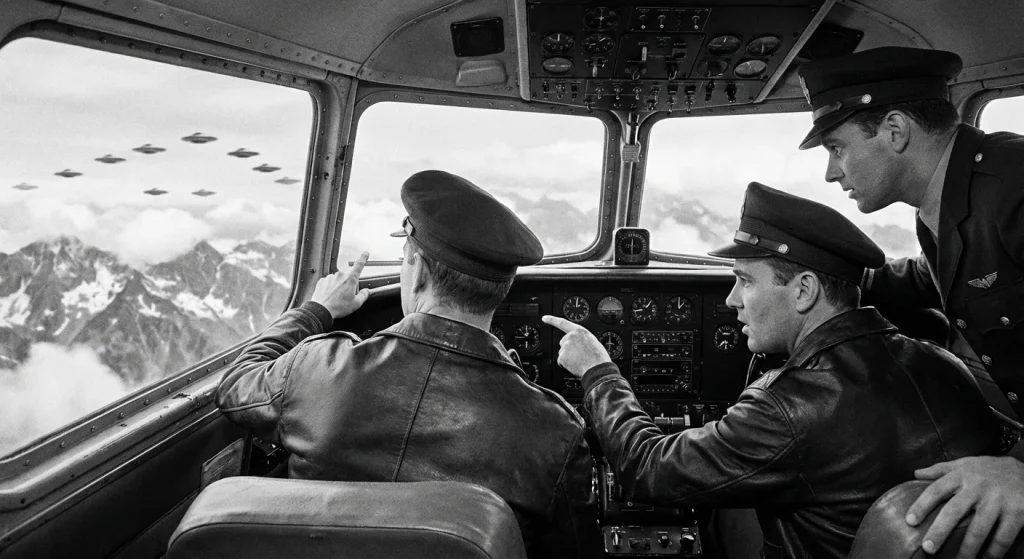
Multi-witness cockpit observations are among the highest-value civilian reports because they come from professionals trained to describe what they see against stable references. They still leave critical ambiguities when the record does not preserve geometry and timing, because “nine objects in formation” can describe either nine distinct objects or nine apparent lights whose spacing and motion are being inferred at long range.
Across the preserved summaries available for this draft, the core observational content that survives is narrow: a United Airlines cockpit crew reported seeing nine objects and described them as being in formation. That “formation” phrasing matters because it implies an ordered relationship between the nine, not a random scatter, but the summaries do not retain the details that would let a reader reconstruct what “formation” meant in practice.
No formation geometry is preserved in the available summaries. There is no retained description of whether the nine were in a straight line, a shallow arc, a wedge, or a staggered pattern; no spacing estimate; and no statement of whether the spacing appeared constant, opened up, or tightened over time. Likewise, brightness and optical character are not preserved in the summaries available here: there is no retained language about color, pulsing, glinting, “star-like” points, sharply bounded shapes, or whether the objects were visible as bodies versus lights. Relative motion is also not preserved beyond the implication that the crew perceived a coherent grouping: the summaries do not retain whether the formation crossed the windscreen, held station relative to the aircraft, climbed or descended relative to the horizon, or showed any internal rearrangement among the nine.
Altitude relationship is not preserved either. The available summaries do not retain whether the crew placed the objects above the horizon, at the horizon, or against a cloud deck, and they do not record any explicit comparison to the airliner’s own altitude. Without those anchors, later retellings tend to accumulate cinematic detail that the source record cannot support.
A cockpit gives witnesses tools that most ground observers do not have. Flight crew routinely judge relative motion by reading an object’s behavior against the horizon and against fixed structure in the windscreen, and they are habituated to cross-checking perception with instruments as part of normal scan discipline. They also carry an internal catalog of conventional traffic cues: anti-collision light patterns, steady nav lights, closing-angle changes, and the way known aircraft appear to slide, grow, or fade at different aspect angles. That combination makes a pilot report especially valuable as an observation record, not as an automatic identification.
Formation language also has a specific weight in aviation culture. Crews are used to seeing single targets, paired traffic, and structured groups, and they tend to reserve “in formation” for something that maintains an ordered spacing rather than a random coincidence. If that phrase was used in the original account, it is a meaningful choice of words, even when the underlying geometry is not preserved.
Even expert observers cannot escape the distance, speed, and size coupling that dominates aerial sightings. If you do not know range, you cannot reliably infer true size from apparent size, and you cannot reliably infer true speed from apparent motion. At cruise altitude, small angular errors create huge differences in estimated distance, which then cascade into wildly different interpretations of what “nine objects” physically were.
Corroboration is the other gap a cockpit report cannot fill on its own. Unless the preserved record includes instrumented correlation, such as radar confirmation or independent observers with synchronized timing, the account remains primarily visual. Visual perception can be stable and repeatable and still be wrong about scale, and that misperception can persist even for experts because the brain will lock onto a coherent interpretation when the cues are incomplete.
Most UFO reports eventually collapse into mundane causes once enough data is available, and that baseline should bound confidence in any single narrative. The disciplined move is to treat “mundane resolution is common” as a warning against certainty, not as a reflexive dismissal. For this case, the actionable standard is simple: demand source-anchored descriptors, especially geometry and timing, and treat added precision about spacing, altitude, or maneuvers as a red flag unless it is explicitly preserved in the original record.
How those limited observations reached the public is the next pressure point, because the survival of records often dictates what later researchers think the event “was.”
Reports, Media, and Official Interest
For airline-era UAP reports in 1947, the biggest determinant of what we “know” today is rarely what happened in the sky. It’s what survived the paperwork chain: who wrote something down, where it was filed, who duplicated it, and whether anyone later had a reason to index it. That pipeline produces cases that feel both well-attested and strangely hard to audit, because the best-known version is often the one that simply circulated the farthest, not the one backed by the most surviving originals.
In a late-1940s airline context, the first record was usually operational, not paranormal: a crew report to company channels, a dispatch note, a maintenance log entry, or a safety-related memo. That internal record had incentives to be brief and utilitarian. If it didn’t affect routing, aircraft condition, or crew fitness, it could be treated as an oddity and left in a local file that was never centrally preserved.
The second pathway was publicity, and it operated under different incentives. A local newspaper write-up might preserve names, date, and a compressed narrative because editors needed a readable story and a single filing deadline. Wire services could amplify that into multiple regional papers, which creates the illusion of “multiple sources” while actually replicating one short item. Any step can be missing: an internal report with no press coverage, press coverage with no internal record that survives, or both existing but disconnected because they were stored under unrelated categories like “public relations,” “complaints,” or “miscellaneous incidents.”
The third pathway was early military interest, which was not a single intake pipe. A base intelligence officer might hear about a story, ask for a statement, or clip a newspaper and forward it. Those actions generated paperwork, but not necessarily a case file you can reliably retrieve decades later. In 1947, recordkeeping practices were still oriented around immediate operational value, not future historical reconstruction.
Late-1947 timing matters because the Air Force’s first formal UFO investigative effort – Project Sign (Dec 1947 to Feb 1949) – began to create a more consistent intake and review process for reported sightings. I did not find an authoritative contemporary source in the consulted materials confirming the specific figure “243 sightings” for Project Sign; comprehensive Air Force-era totals are more reliably reported for the later, broader Blue Book-era compilations. Across the Air Force investigations from 1948 to 1969, Project Blue Book compiled 12,618 reported sightings in total; of those, 701 remained classified as “unknown” in Blue Book case evaluations (see Air Force archival summaries) – https://www.archives.gov/research/military/air-force/ufos and https://www.secretsdeclassified.af.mil/Fact-Sheets/Display/Article/459832/project-blue-book/.
Even then, continuity was not guaranteed. Project Grudge succeeded Project Sign beginning in 1949 and continued inquiries with a more dismissive posture in many summaries. Institutional posture shapes interpretation because analysts decide what to extract, what to omit, and what to call “explained” versus “insufficient data,” and those choices become the version later researchers see.
Project Blue Book became the best-known centralized archive for many cases, but it also helps explain why 1947 indexing is uneven. Material from the earlier period was only as complete as whatever had been retained, transferred, or refiled during multiple program transitions.
Later catalogs help, but they are not the record. Researchers compiling catalogs have produced different tallies for Blue Book “unknown” cases. For example, Brad Sparks produced catalogs of Project Blue Book unknowns in different versions, variously titled and reported with counts in the 1,600 to 2,200 range depending on edition or scope; these compiled catalogs are useful guides but do not replace the original Blue Book documents – http://www.cisu.org/wp-content/uploads/2017/01/Sparks-CATALOG-BB-Unknowns-1.27-Dec-20-2016.pdf and https://archive.org/download/BernardSieglerTechnicsAndTime1TheFaultOfEpimetheus/Brad%20Sparks%20-%20Comprehensive%20Catalog%20of%201%2C600%20Project%20Blue%20Book%20UFO%20Unknowns.pdf. Use these compilations as lead-generation tools and then seek the primary Air Force or contemporaneous records they reference.
The practical risk is circular sourcing: an article cites a catalog; the catalog entry traces back to a newspaper brief; later writers treat the repeated citation as independent confirmation. The rule that prevents that spiral is simple: treat primary documents as the evidence (airline memos, original statements, contemporaneous newspapers, and program files) and treat secondary compilations as maps. If a citation chain never reaches a primary, you are looking at a lead, not documentation.
Once you treat the paperwork chain as part of the evidence, the identification question looks less like a debate and more like a set of testable hypotheses.
What Else Could It Have Been
Most identification debates fail for one reason: people argue conclusions first, then retrofit the facts. A cleaner approach treats the report as a data pattern and asks a harder question for each conventional explanation: what would it have to match, and what records would decisively confirm or kill it?
- Count constraint: nine distinct objects, not “a few” or an indeterminate cluster.
- Apparent organization: a formation-like presentation rather than random scatter.
- Relative motion: whether the objects held station, overtook, fell behind, or drifted relative to the airliner’s track.
- Brightness and definition: descriptions of brightness or “sharply focused” definition are not reliably preserved for this case in the accessible summaries; do not treat brightness/definition as an established constraint unless a primary contemporaneous source is produced that explicitly uses that language.
- Duration and evolution: how long the configuration persisted and whether any turning, divergence, or rearrangement was documented.
The largest analytical handicap is missing geometry: the available descriptive record does not preserve formation shape, spacing estimates, or size and distance measurements. That missing structure is exactly what separates “nine separate things” from “one thing producing nine apparent points.”
The aircraft hypothesis only works if nine independent aircraft can plausibly present as a single organized set from the crew’s viewpoint. That is a geometry problem first, not a credibility argument: you need consistent relative motion, plausible spacing at altitude, and lights that read as discrete points at range.
The friction is that formation behavior is highly constrained by speed envelopes and separation norms. If the objects “held station” relative to the airliner for any meaningful interval, then either (1) they were on a similar course and speed, (2) they were far enough away that parallax made motion hard to judge, or (3) the observation was dominated by lights without clear range cues. Each branch implies a different test.
The actionable discriminator is records plus geometry. Corridor activity and schedules (civil and military), paired with the airliner’s exact heading, altitude, and timestamps, let you compute whether nine aircraft could occupy the observed bearings without violating speed consistency or requiring improbable coordination. The deciding details are formation spacing, apparent climb or descent, and whether any object diverged or turned independently; those are the fingerprints of multiple aircraft rather than a single optical source.
The balloon hypothesis earns serious consideration because 1947 had real high-altitude balloon activity, including classified and scientific programs. One historically relevant program is Project Mogul, a classified high-altitude balloon effort that used balloon trains carrying sensors; Project Mogul was later identified in official Air Force histories as a program that used high-altitude balloons for acoustic and atmospheric monitoring and is the program the Air Force linked to some 1947 debris recoveries in later investigations – see the Air Force historical report on Mogul and related operations for context – https://www.dafhistory.af.mil/Portals/16/documents/AFD-101201-038.pdf. That establishes plausibility for balloon activity in the period without proving a specific launch match to this sighting.
The complication is wind. Balloons do not “fly in formation” in the aircraft sense; they drift with the wind field at their altitude, and wind shear can stretch a cluster into lines, arcs, or scattered groupings. A nine-object set stays formation-like only if the balloons are at similar altitudes in a relatively uniform flow, or if the observer’s viewing geometry compresses depth into an apparent pattern.
The resolution is straightforward: this hypothesis lives or dies on launch documentation and atmospheric data. To confirm it, you need launch logs (times, locations, payload counts), plus upper-air winds and stability profiles along the airliner’s track for the relevant altitudes. To rule it out, show that winds at plausible balloon altitudes would rapidly disperse nine objects beyond any stable apparent spacing, or that no launches occurred upwind within the drift window.
A meteor explanation must be tested against duration and multiplicity, not “brightness” alone. A fireball or bolide is an exceptionally bright meteor event visible over large distances, sometimes bright enough to rival or exceed Venus; that definition is precisely why you would check a date-aligned fireball and bolide dataset for exceptionally bright events that could have been widely seen from the flight corridor. Fireballs can outshine Venus, so “bright” by itself is not disqualifying.
The friction is that meteor phenomenology fights the “nine objects in formation” constraint. Most fireballs are brief, and while fragmentation can create multiple luminous pieces, those fragments separate along a track, evolve rapidly, and do not hold a stable, formation-like spacing relative to an aircraft for extended periods.
The deciding test is temporal alignment: if the report’s time window can be pinned down to minutes, you can compare it against the publicly maintained dataset of fireball and bolide reports documenting exceptionally bright meteors. A strong match would look like a widely reported event with a consistent direction of travel and short-lived multi-fragment behavior. A strong mismatch is a long-duration, slow-evolving nine-point configuration.
Atmospheric optics and reflections are the most efficient way to manufacture “multiple objects” without multiple platforms. Ice-crystal phenomena (halo fragments, bright mock suns) can create several bright points with crisp edges, and layered refraction can lift or duplicate apparent sources into mirage-like points. Inside the cockpit, reflections can duplicate bright external lights into multiple apparent points if the geometry is right.
The catch is that these mechanisms demand specific conditions that should leave traces: thin ice-crystal layers, strong inversions, particular sun angles, or highly reflective window geometry. Without those conditions, the hypothesis becomes hand-waving.
The practical resolution is to demand the environmental record. Weather observations along the route, cloud type reports, visibility, and evidence of inversion layers can support or reject optics-based duplication. A key discriminator is whether the points maintained fixed angular relationships as the aircraft changed heading; reflections and some halo effects move with the observer in ways real external objects do not.
Experimental platforms are plausible in principle because 1940s aerospace testing did not come with public transparency. The limitation is epistemic: without program records, “secret tests” cannot be falsified, which makes it a poor default explanation.
The right way to handle this hypothesis is to constrain it to what would be observable: platform count, expected altitudes, expected lighting, and whether nine vehicles could be deployed simultaneously. If no documentation can produce even basic operational constraints, the hypothesis remains untestable rather than “proven.”
- Lock the geometry: exact timestamps, the airliner’s position, heading, altitude, and the objects’ bearings and elevation angles (even rough). This single package separates “lights at range,” “drift,” and “transient track” interpretations.
- Reconstruct traffic: civil and military corridor activity and schedules, plus any ATC communications or flight-plan traces, to test speed consistency and whether nine aircraft could plausibly hold the observed relationships.
- Pull balloon records and winds: launch logs upwind and upper-air wind fields at stratospheric altitudes to test whether nine balloons could remain formation-like rather than dispersing.
- Check bright-meteor alignment: compare the report’s time window against the fireball and bolide report dataset for an exceptionally bright, widely visible event with fragmentation consistent with “multiple points.”
- Verify optical conditions: weather layers, cloud and ice-crystal indicators, and any evidence of inversion-driven refraction, plus cockpit window geometry cues if available.
Takeaways From the Idaho Encounter
The Idaho report demonstrates a hard truth about aviation-era UFO cases: credible witnesses plus incomplete records produce durable ambiguity. The discipline that holds up is the case-file split you established earlier, separating the confirmed core (who, where, when, what was reported) from unconfirmed metrics (distance, speed, size) that the surviving paperwork cannot lock down.
The strongest element is the human layer: multiple trained cockpit witnesses describing nine objects in formation, observed from an airliner in controlled conditions. That combination raises the floor on basic credibility while still leaving the encounter constrained to what eyes in a moving cockpit can reliably report.
The biggest unknowns are not philosophical; they are missing operational and environmental discriminators. Explanations separate cleanly only when you can anchor timing, altitude, course changes, traffic advisories, and weather along the route. Program handoffs and documentation pipelines, including transitions across Sign-, Grudge-, and Blue Book-era handling, are exactly where crew statements and supporting logs tend to fragment or disappear.
- Pursue carrier records: Ask United Airlines corporate archives (if accessible) for crew written statements, dispatch/operations logs, and any internal safety or incident correspondence tied to the flight.
- Work the federal archive trail: Search NARA holdings for Project Sign, Project Grudge, and Project Blue Book-era records; if a file appears missing, use NARA’s Archival Recovery Program (ARP), which actively searches for missing holdings and explains how gaps later resurface.
- Use FOIA for agency copies: File FOIA (Freedom of Information Act) requests, a federal law that gives the public the right to request access to records from federal agencies, while expecting exemptions and redactions; request CAA/ATC communications, any radar records (if they existed), and route-specific weather observations.
- Verify contemporaneous reporting: Pull local newspaper archives to capture dates, names, and wording that can be matched against official routing and operations records.
That standard is also the practical bridge between a 1947 cockpit report and the 2025-2026 “disclosure” cycle that keeps recycling familiar material. Produce the records, show the gaps, and let the evidence, not the aura, carry the case.
Frequently Asked Questions
-
What happened in the United Airlines UFO sighting over Idaho in 1947?
In 1947, a United Airlines flight crew reported seeing nine objects over Idaho along their route corridor. The core claim preserved across accessible summaries is simply the who/where/when and the count of nine objects.
-
What does UAP mean, and how is it different from UFO in this 1947 Idaho case?
UAP means Unidentified Anomalous Phenomena, a modern umbrella term that emphasizes describing the anomaly without assuming an explanation. UFO means Unidentified Flying Object, an older label that similarly flags an observation as unidentified without resolving what it was.
-
Which details are confirmed versus unconfirmed in the 1947 United Airlines Idaho report?
Confirmed core details are: the year (1947), the witnesses (a United Airlines airline crew), the location (over Idaho), and the report of nine objects. Unconfirmed in accessible summaries are exact time, precise position, altitude, headings, distance/size estimates, duration specifics, and structured weather/visibility descriptions.
-
Why does the article treat a “credible flight crew” report as different from a “credible dataset”?
The article says trained cockpit witnesses increase credibility of the observation, but without primary operational records it stays testimony-level rather than measurement-level. It highlights that missing timestamps, position fixes, altitude, and weather data prevent reconstruction of geometry and motion.
-
What does “nine objects in formation” actually tell us about the Idaho sighting?
The preserved summaries retain that the crew described nine objects “in formation,” implying an ordered relationship rather than random scatter. The summaries do not preserve the formation geometry (line, wedge, arc), spacing, brightness/color details, or relative-motion specifics needed for reconstruction.
-
What conventional explanations does the article say should be tested for nine bright objects in formation?
It proposes testing aircraft, balloons, meteors/fireballs with fragmentation, and atmospheric optics/reflections as hypotheses. The article notes a key constraint that the objects were characterized as “bright, sharply focused particles,” pushing tests toward point-source lights, reflections, or high-contrast atmospheric effects.
-
What records should you look for to verify or debunk the 1947 United Airlines Idaho UAP report?
The article recommends pursuing United Airlines dispatch/operations paperwork and crew statements, plus Civil Aeronautics Administration (CAA) position reports and radio logs if the crew contacted controllers. It also points to NOAA/NWS historical weather observations, NARA program files (Sign/Grudge/Blue Book), and FOIA requests for any surviving ATC/radar and route-specific weather records.
