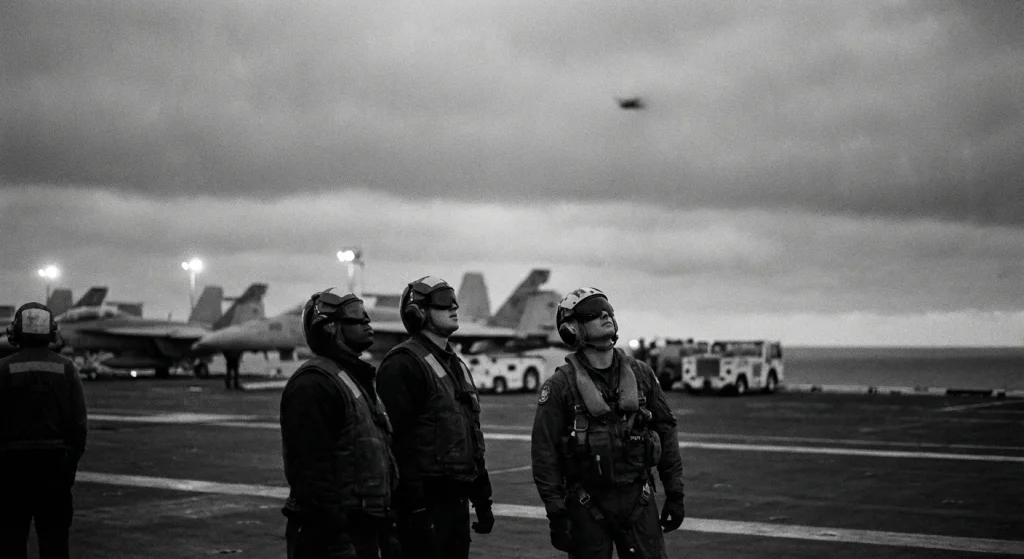
You keep seeing “government UFO cover-up” headlines, but the real tell is when the Navy changes paperwork. In 2019, after years of official quiet, the U.S. Navy moved to formalize how pilots and other personnel report strange aerial encounters, and that bureaucratic shift is one of the most consequential UAP disclosure developments because it changes what can be logged, compared, and acted on.
If you’ve tried to follow UFO news, you know the problem: viral clips and secondhand rumor travel faster than anything you can verify. You’re stuck deciding what’s signal and what’s noise, without getting dragged into either cynicism or fantasy.
Here’s the tension: aviation safety and credibility run on repeatable documentation, while the public hunger is for definitive answers. Bureaucracy sounds boring, but it’s how institutions decide what’s real enough to track, brief, and respond to.
April 2019 reporting indicated the U.S. military wanted pilots to report strange sightings while reducing stigma around making those reports. History.com reported the U.S. Navy confirmed it was updating guidelines for reporting “unexplained aerial phenomena” (History.com, “Reporting UFO Sightings to the US Navy Just Got Easier”, April 2019). Then, on Sept. 18, 2019, CNN reported Navy spokesperson Joe Gradisher confirmed the objects in three declassified military video clips were “unidentified aerial phenomena” (CNN, Sept. 18, 2019).
That’s not alien disclosure or proof of non-human intelligence. It’s infrastructure for handling uncertainty, and it helped set the stage for later Pentagon structures and congressional scrutiny.
Want a high-signal indicator going forward? Treat process changes like updated guidance, formal channels, and official confirmations as more meaningful than any single clip or claim.
To see why that kind of process shift matters, it helps to start with what reporting looked like before the Navy put anything formal on the books.
Years of Silence and Stigma
Silence wasn’t always “nobody knew”, it was often “nobody wanted to be the one to file the weird report.” Before 2019, a pilot could have a genuinely anomalous observation and still decide the safest move professionally was to say nothing, or to mention it informally and move on. The shift in language helped later: Unidentified Aerial Phenomena (UAP) became a more neutral label for aerial observations that remain unidentified after initial review, while Unidentified Flying Object (UFO) carried decades of pop culture baggage that made “UFO sightings” sound like a claim about aliens, not a routine aviation problem.
In aviation, credibility is currency. If you get tagged as the person who “sees things,” you risk being treated as unreliable in a community where trust and judgment are everything. That dynamic mirrors a well-documented pattern in aviation and the military around sensitive reporting: people hold back on disclosing issues when they expect stigma or negative consequences, and leaders have publicly acknowledged that stigma is real and needs active countermeasures. The analogy matters because it shows the mechanism: fear suppresses reporting even when the underlying issue is important to safety and readiness.
The Navy already has mature safety infrastructure, including the Navy and Marine Corps Mishap and Safety Investigation, Reporting, and Record Keeping Manual (OPNAV M-5102.1 | MCO 5100.29C). On paper, that makes you think “problem solved.” In practice, UAP-style events sit in an awkward seam: is it a flight safety hazard, an airspace deconfliction issue, an intelligence matter, or all three?
If you cannot answer basic routing questions like “does this belong in the safety system or an intelligence channel?” and “what do I do with sensor data that might be sensitive or classified?”, reporting becomes a judgment call made at the squadron level. Judgment calls are where consistency goes to die.
Ad hoc handling doesn’t look neutral from the outside. One unit logs an event as a hazard, another treats it as an intel curiosity, a third decides the paperwork headache is not worth it. Over time, those gaps create the exact conditions where “government UFO cover-up” narratives thrive: not because secrecy is proven, but because the system produces uneven traces and long quiet stretches. Stigma-driven underreporting is a documented phenomenon in other aviation-adjacent contexts for the same reason: people avoid processes that feel punitive or career-limiting.
The practical takeaway is simple: reporting only becomes routine when three things exist at the same time: a clearly owned channel, explicit leadership permission that protects the reporter, and a shared vocabulary (UAP alongside UFO in public and government usage) that lets crews describe what they saw without accidentally making a claim they can’t substantiate.
That cultural friction explains the “why was it so quiet?” part of the story. The Navy’s next problem was the “what changed?” part-because the encounters themselves weren’t going away.
What Forced the Navy’s Hand
Policy changes usually happen when private friction becomes public risk. The Navy did not move toward standardizing how aviators talk about unknown objects because of vibes. It moved because repeated, hard-to-ignore incidents started to look like a flight safety problem, and then the outside world gave leadership fewer places to hide.
By 2014 and 2015, U.S. Navy pilots were reporting multiple sightings while training over the East Coast, a pattern later confirmed in mainstream coverage based on interviews. When the same kind of “what was that?” report keeps popping up on a training range, it stops being a curiosity and starts being an operational variable you have to manage.
The complication is that “unknown” is the worst category for risk. A fast-moving object with no clear identity, no reliable altitude read, and no predictable behavior forces pilots and controllers to make conservative choices in real time. That can mean breaking off a training run, changing blocks of airspace, or adjusting deconfliction, all of which costs time and creates new chances for misunderstanding.
Mainstream reporting described a late-2014 near-collision involving a Super Hornet that was reported to have generated an official mishap report; that account is described in reporting such as The New York Times (May 26, 2019) (New York Times, May 26, 2019). Once something enters the mishap ecosystem, it is no longer just hangar talk, it is paperwork, hazard tracking, and command attention.
Public incentives shifted sharply on Dec. 16, 2017, when The New York Times reported on a Pentagon program that investigated UAP and UFO reports. The story did not just reach the public, it reached every chain of command that might get asked about it by reporters, lawmakers, or their own people.
That is where public-facing figures mattered, without being puppet-masters. People like Lue Elizondo and Christopher Mellon became part of the broader discourse ecosystem around what the government had looked at, and journalists like George Knapp helped keep attention on the topic. The effect was straightforward: pilots saw the subject treated as legitimate enough to discuss in daylight, and leaders saw that silence now looked like avoidance instead of prudence.
Pressure rose again in April and May 2020, when the FLIR1 / GIMBAL / GOFAST videos, three widely publicized U.S. military encounter videos that were leaked earlier and later officially acknowledged and authenticated by DoD in 2020 reporting, became common reference points. Once those clips were tied to official confirmation in widely reported coverage, “we do not discuss this” stopped working as a default response in UAP news cycles.
No single cause explains the shift. Repeated range encounters created the internal safety logic, and mainstream exposure changed the external cost of doing nothing. Together, they made standardization hard to avoid.
- Track whether incidents generate formal safety artifacts (mishap reports, hazard tracking, official acknowledgments) instead of informal anecdotes.
- Watch for standardized language replacing slang, because institutions name problems precisely when they plan to manage them.
- Look for formal guidance that tells operators what to do, because that is the moment taboo turns into process.
Once you accept that the driver was risk and accountability-not a sudden change of heart-the 2019 update reads less like a revelation and more like a systems upgrade.
What the 2019 Protocols Changed
A reporting system doesn’t solve the mystery. It makes the mystery measurable.
The practical change in 2019 wasn’t that the Navy “decided what UAP are.” It was that the Navy treated UAP reports like operational inputs that deserve the same disciplined handling as any other safety or security anomaly. A reporting protocol, a standardized process that specifies how an observation is documented, routed, and reviewed inside an organization, matters because it turns “I saw something weird” into something leaders can compare across aircraft, crews, and units.
A useful UAP report starts with boring details, because boring details are what let analysts separate signal from noise. Instead of a free-form story that varies by narrator, the 2019-style guidance pushes observations into consistent buckets: when it happened, where it happened, what the operational context was (training, transit, working area), and who witnessed it. Then it adds the parts that make aviation reports actionable: what sensors were involved (if any), whether anyone captured radar, EO/IR, or other system data, and what the object did relative to the aircraft or mission.
The key is that the narrative sits on top of structured context. “Bright light off the nose” is not very usable by itself. “Visual contact at 1432 local, two aircrew, 18,000 feet, training airspace, object held position relative to aircraft for 20 seconds, no comms impact, one sensor track recorded” is the kind of statement that can be cross-checked, de-duplicated, and prioritized. Just as important, the report calls out risk and safety impact in plain language: did it create a near-midair risk, drive an evasive maneuver, disrupt training, or suggest a pattern that should change how the unit operates tomorrow?
Once reporting is designed to move up the chain of command, the formal hierarchy through which information and decisions move within a military organization, the report stops being hangar talk and starts being operational data. In practice, that means you’re not relying on the most senior person in the room to remember details correctly a week later. The report gets captured while memories are fresh, then routed for awareness and review through leadership channels that already exist for flight safety and operational readiness.
There’s also a quiet but important handling distinction baked into most military “weird thing happened” workflows: safety gets what it needs to prevent accidents, and intelligence or security elements get what they need if the observation has threat implications. The point is not to turn every sighting into an intel case file. It’s to avoid the opposite failure mode, where a legitimate hazard gets stuck in the wrong inbox, or never leaves the squadron because no one is sure who “owns” it.
Standardized templates are risk-management tools. They improve consistency and comparability, which is exactly what you need if you want triage that makes sense, de-duplication across multiple witnesses, and analysis that can spot patterns without being tricked by mismatched terminology or missing context. If two crews describe the same event with different time references, vague locations, and different labels for the same sensor, you don’t get “more data.” You get administrative fog that wastes time and undermines credibility.
Standardization also lowers the social cost of speaking up. When the organization signals “this is a normal reportable category,” people stop feeling like they’re volunteering for ridicule. Stigma is a known suppressor of reporting behavior in military contexts, and research in related fields suggests fear of stigma can influence whether service members disclose concerns; DoD messaging has, in other contexts, emphasized reducing stigma to improve help-seeking. The same human friction applies to anomaly reporting: normalize the process, and you get more complete data.
Here’s the “behind the curtain” effect in one mini-scenario. Two pilots see an unusual object during a working area transit. Before a protocol, one tells a buddy, another mentions it casually in debrief, and a week later a supervisor hears a third-hand version that’s missing time, altitude, and whether anyone checked sensors. After a protocol, both aircrew submit a structured report the same day: same time standard, same location reference, same question prompts about sensor corroboration and safety impact. Now, if another crew reports a similar event in the same block of airspace, it’s obvious the reports match and worth elevating. The encounter didn’t become less strange. It became comparable.
Protocols are about documentation and risk management, not confirming exotic explanations or non-human intelligence. A standardized form can tell you “multiple trained observers saw something correlated with sensor data in a specific area.” It cannot, by itself, tell you what that something ultimately was.
A civil aviation analogy is helpful: civil aviation reporting channels generally treat unexpected aerial observations as operationally relevant and route them through established safety reporting systems rather than treating them as a sideshow. The Navy’s terminology discipline fits the same logic. The Navy already runs on standardized language, including NTRP 1-02, the Navy supplement to the DoD dictionary, because consistent terms prevent misunderstandings and make data portable across units. UAP reporting slots into that culture: same need for shared definitions, consistent fields, and predictable routing.
Later, broader DoD structures centralized assessment so reports could be evaluated more consistently across the department, but the core value still starts at the point of collection.
If you’re trying to judge the seriousness of future UAP reporting conversations, especially anything framed as UAP disclosure, ignore the hype and watch the plumbing:
- Check the fields: Are time, location, context, witnesses, and safety impact captured in a consistent way?
- Demand corroboration hooks: Does the process ask about sensor data and how it’s retained or referenced?
- Follow the routing: Is there clear movement through leadership channels, with sensible coordination between safety and security handling?
- Look for leadership backing: Do commanders actively encourage reporting and protect reporters from being treated like a punchline?
That “plumbing” piece is also what made it possible for the Pentagon to treat UAP as something it could aggregate and brief in a more standardized way.
From Navy Memos to Pentagon Offices
Once reporting exists at the squadron level, the next fight is where the data lives and who’s accountable for answering for it.
The Navy’s 2019 shift made it easier for operators to push sightings into an official pipeline. The Pentagon’s follow-on problem was bigger: if the same kind of incident is reported by aviators, radar operators, ship crews, and multiple services, who pulls it together, checks it against other data, and then answers to Congress with something more rigorous than anecdotes?
DoD’s response has been a clear institutional progression: the UAP Task Force (UAPTF), then the Airborne Object Identification and Management Synchronization Group (AOIMSG), and finally the All-domain Anomaly Resolution Office (AARO), the Department of Defense office designated as the focal point for collecting, analyzing, and coordinating UAP and UAP-related matters and reporting outward to oversight bodies. That “focal point” language matters because it turns a scatter of service-level reports into a single place that can do cross-service pattern analysis, deconfliction with other programs, and consistent briefings.
AARO was formally established via a DoD memorandum dated July 20, 2022, and designated as the DoD focal point for UAP and UAP-related activities. Functionally, that’s the split you should keep in mind: Navy protocols are the frontline intake, while the DoD office is the centralized back-end that aggregates cases, runs analysis, coordinates across agencies, and produces reporting for oversight.
AARO’s public products are real deliverables, not vibes. It has published a 2023 UAP Annual Report and the AARO Historical Record Report (Volume 1) in 2024. Those reports are where “UAP news” tends to get its recurring fuel, because they’re one of the few repeatable, institutional update channels that can show whether the government is learning anything over time.
The catch is built in: public reporting is constrained by classification and, more importantly, by data quality. AARO’s public messaging has been consistent that many cases remain unresolved, and that better data can resolve more of them. AARO leadership testimony also undercut some of the viral talking points, stating that sensational claims such as “transmedium” behavior in reviewed cases were not supported in the examined examples.
Here’s the expectations reset: “unresolved” doesn’t equal extraterrestrial. It usually equals insufficient data, like no correlated sensor tracks, incomplete time stamps, missing range context, or an event that can’t be recreated from the surviving records.
Read AARO outputs in a process-first way by treating them as process documents:
- Look for methods: what data sources were used, what was excluded, and what standards were applied.
- Track data-quality notes: when AARO says better collection would resolve more, that’s a roadmap for what’s missing.
- Focus on category breakdowns and disposition changes over time, not headline-friendly ambiguity around a handful of hard cases.
Once you have an office producing regular outputs, the next logical pressure point is oversight-because Congress can demand receipts in a way social media can’t.
Congress, Whistleblowers, and Disclosure Bills
“Once Congress gets involved, the story stops being ‘what did pilots see?’ and becomes ‘what is the government required to track and tell oversight?'” Standardized reporting pipelines and centralized offices change the center of gravity: lawmakers can demand recurring briefings, hold public hearings, propose amendments, and keep re-asking the same accountability question, “What did you log, who did you tell, and what can you prove?”
Start with what’s on the record. On May 17, 2022, the House held a public hearing on UAP that was widely described as the first open congressional hearing on UFOs in over 50 years. Scott Bray, then identified as the deputy director of Naval Intelligence, participated. The practical value here is boring in a good way: an official transcript is available on Congress.gov, which means you can quote exact questions, exact answers, and exactly what witnesses were willing to say in public.
Public hearings also create a repeatable oversight rhythm. Once the questions are asked in a formal setting, members can follow up in closed briefings, request additional data, and write new reporting requirements when they feel the answers are incomplete.
Whistleblower stories are where attention spikes and where precision matters most. In July 2023, David Grusch gave public testimony. He has been described in reporting as a former intelligence officer with Pentagon-related experience, and he made extraordinary allegations about hidden UAP programs and “non-human” material. Those claims remain allegations and are not established by publicly released evidence in the hearing record.
A useful way to read moments like this is to separate two lanes: (1) verified events, like who testified and what they said under oath, and (2) verified proof, like documents, audits, budget lines, inspector general findings, or corroboration that can be evaluated outside a single narrative. Lawmakers including Tim Burchett have kept public pressure up, but the oversight system still runs on documentation, not viral clips or personality-driven drama.
Reader rule: treat testimony as a data point, then look for the paper trail it triggers. The reliable “disclosure” story is usually incremental: mandated reports, follow-up questions, and eventually declassifications when they’re permitted, not instant UFO disclosure dumps.
The lever Congress pulls most consistently is the National Defense Authorization Act (NDAA), and it’s frequently used to mandate UAP reporting and oversight requirements because it gives lawmakers a recurring chance to demand updates. The FY2024 NDAA, Public Law 118-31, directs expanded congressional briefings by AARO, including a mandate that explicitly references UAP intercepts.
Even when the statute points to specific categories of data and acknowledges classified portions, the public-facing text often won’t spell out every data element. That’s not a loophole; it’s how Congress forces a process while still living inside classification rules.
If you want to follow UAP disclosure without getting whiplash, stick to primary sources: read the transcripts, track what laws actually require agencies to brief or report, and keep “alleged” and “evidenced” in separate columns.
All of that feeds into a more practical question for everyone watching from the outside: what will UAP “updates” actually look like as this machinery keeps running?
What This Means for Future Sightings
The biggest change you’ll notice in 2025-2026 isn’t a single jaw-dropping video-it’s whether sightings come with usable context. Standardized reporting is the unglamorous upgrade: consistent definitions and consistent data fields tighten data hygiene, so the same event is less likely to get logged three different ways, and “unknown” stops being a catch-all bucket. The payoff is comparability over time: once reports are formatted the same way, pattern claims become testable instead of vibes.
The harder part is verification, because higher reporting volume can also create more noise. The direction baked into NDAA-era language pushes UAP data into required reporting formats and processes, including handling for classified portions, which is exactly what you need if you want cross-checking to scale.
That cross-checking is where accuracy jumps: a witness narrative plus sensor data plus basic metadata (time, location, platform) lets analysts discard misidentifications faster and prioritize the truly anomalous cases for deeper review. You also get fewer rumor loops, because clearer categories and better documentation make it harder for a secondhand story to mutate into a “confirmed” incident.
Public expectations are going to lag behind that reality. Editorial attention and search-driven hopes for a single “big reveal” will persist, but the more realistic outcome is a cadence of mandated briefings and periodic updates through AARO, not a one-time disclosure moment.
- Check context: time, location, altitude, and platform are stated plainly.
- Look for corroboration: more than one source type (witness plus sensors plus metadata).
- Verify handling: tied to an official process or briefing, not recycled social posts.
- Spot hype signals: anonymous claims, missing provenance, and “no details but trust us.”
Better infrastructure is necessary for transparency, but it isn’t proof of non-human intelligence. It’s proof the government is finally treating UAP as a data problem instead of a punchline.
Conclusion
The cleanest signal in this whole topic is process: when the Navy and Congress build a repeatable path for reporting, documenting, and auditing UAP claims, the conversation stops being vibes and starts being governance.
In 2019, the Navy confirmed updated UAP reporting guidance, putting a formal route on the books for aviators and commands (History.com, April 2019). On Sept. 18, 2019, CNN attributed a key clarification to Navy spokesperson Joe Gradisher, describing the released videos as “unidentified aerial phenomena” (CNN, Sept. 18, 2019). On May 17, 2022, the public House hearing transcript became available on Congress.gov, which matters because it locks testimony into a citable record. On July 20, 2022, the AARO establishment memo put a permanent oversight structure on paper, shifting UAP disclosure from ad hoc briefings to an office with assigned responsibilities.
Official structures move slowly, and that’s exactly why they’re higher-trust than hype. High-signal items have provenance: dated memos, hearing transcripts, and mandated reports you can point to and re-check; low-signal items are viral clips with no chain of custody, no metadata, and no primary documentation.
If you want to track the next wave without getting misled, anchor yourself to primary sources, follow periodic reporting, and use FOIA to request records; FOIA requests may involve fees, but you can request a fee waiver or ask agencies for cost estimates, and many requesters keep costs low by narrowing the scope.
Frequently Asked Questions
-
What does UAP mean, and how is it different from UFO?
UAP stands for Unidentified Aerial Phenomena and is described as a neutral label for aerial observations that remain unidentified after initial review. The article contrasts it with “UFO,” which carries pop-culture baggage that can make reports sound like alien claims rather than an aviation or safety issue.
-
When did the U.S. Navy create formal UAP reporting guidance?
The article says the U.S. Navy updated and confirmed guidance for reporting “unexplained aerial phenomena” in 2019 after years of official quiet. It frames this as a key bureaucratic shift because it formalized how sightings are documented and routed.
-
What did the Navy officially say about the three declassified UAP videos in 2019?
On Sept. 18, 2019, CNN reported Navy spokesperson Joe Gradisher confirmed the objects in three declassified military video clips were “unidentified aerial phenomena.” The article emphasizes this was not proof of aliens, but an official classification of the videos’ objects as unidentified.
-
Why was UAP reporting discouraged before 2019 in the Navy aviation community?
The article explains that stigma and career risk suppressed reporting, because pilots feared being labeled as unreliable if they filed “weird” reports. It also notes UAP events fell into an awkward seam between flight safety, airspace deconfliction, and intelligence channels, leading to inconsistent handling.
-
What details does a useful Navy-style UAP report include according to the article?
The article says structured reports capture when and where it happened, the operational context (training/transit/working area), and who witnessed it. It also calls out sensor involvement (radar, EO/IR, other data) and explicit safety impact such as near-midair risk or mission disruption.
-
What Pentagon office is now the central hub for analyzing UAP reports, and when was it established?
The article identifies the All-domain Anomaly Resolution Office (AARO) as the DoD focal point for collecting, analyzing, and coordinating UAP matters. It states AARO was formally established by a DoD memorandum dated July 20, 2022.
-
How can you tell if a new UAP claim is high-signal instead of hype?
The article says to prioritize process-backed items like updated guidance, formal reporting channels, official confirmations, hearing transcripts, and mandated reports over viral clips. It also recommends checking for context fields (time/location/altitude/platform), corroboration hooks (sensor data), clear routing through leadership channels, and leadership encouragement that protects reporters.
