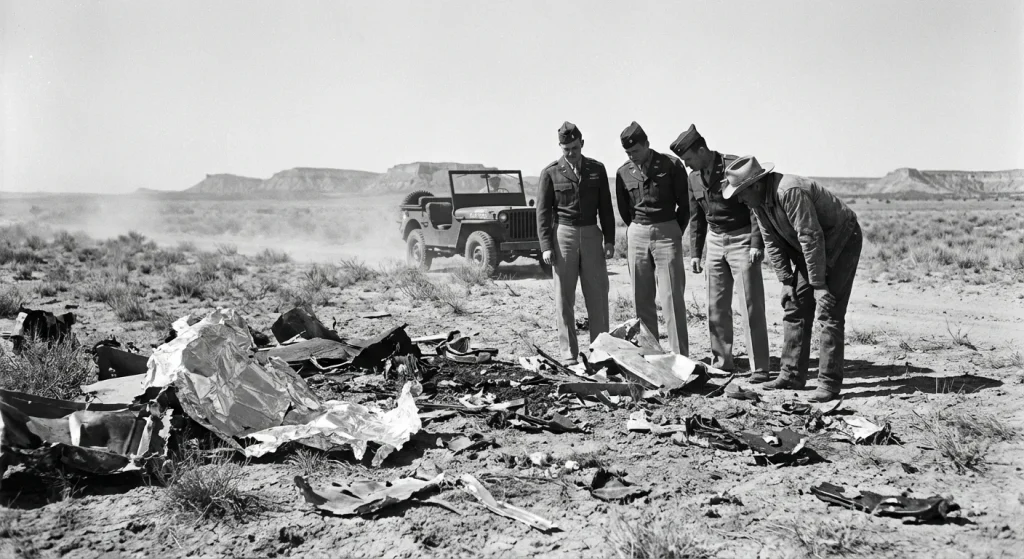
You have seen this cycle: an official statement lights up UFO news, the headline hardens into certainty, and then the same authorities walk it back fast enough to leave everyone arguing about motive instead of evidence. Roswell became the enduring template for modern disclosure fights because it condensed that entire dynamic into a single day and a single credibility fracture.
What people want, and rarely get, is clean separation between what was actually said in 1947 and what later generations layered on top of it.
Here is the documented ignition point: on July 8, 1947, Roswell Army Air Field (RAAF) issued a press release-a formal statement intended for public and media distribution-stating it had recovered a “flying disc,” an object that could not immediately be identified and therefore instantly met the public expectation of a “UFO.” That one official press release did what press releases are designed to do: it defined the story in a single, quotable phrase. In secondary accounts, Walter Haut is widely identified as the RAAF public information officer (PIO) connected to issuing that initial release. See a reproduction of the July 8, 1947 Roswell Daily Record press item here: Wikisource.
The same day, the reversal landed. A retraction statement was issued and carried by wire services the night of July 8, 1947, explicitly reversing the “disc” framing. That rapid swing from certainty to denial is the part that matters most for today’s UAP disclosure debates, where “UAP” functions as the modern umbrella label used in U.S. government reporting. Once the public watches officials confidently label an unknown and then retreat within hours, every later update gets read through the same lens: controlled information, partial disclosure, and the suspicion of a government UFO cover-up. Contemporary reprintings and related correspondence can be found in archival collections such as the FBI Roswell FOIA vault: Vault Fbi.
The anchor here is primary source material: contemporaneous records such as July 1947 newspaper and wire-service reporting, official statements, and photographs. These are weighed more heavily than later summaries and interpretations. Later narratives will be treated as later narratives, labeled as such, and kept separate from what the 1947 paper trail can actually support.
This same evidence hierarchy also helps you read modern spikes in attention. Applied consistently, it lets you sort contemporary coverage by prioritizing contemporaneous documentation such as declassified reports, radar logs, and FAA data, with interpretations and mythology considered only after the documentary base is established.
That method starts with the only part Roswell reliably gives you at scale: the July timeline, the command handoff, and the public language that changed on the record.
What Happened in July 1947
The 1947 record reduces to a short, date-anchored chain: a rancher finds debris, a sheriff gets told, the Roswell Army Air Field (RAAF) gets involved, material moves up the command chain to Fort Worth, and public messaging shifts in real time. The confusion comes from one narrow gap: the discovery and first report dates vary across accounts, so you have to separate what was said in 1947 coverage from what appears only in later recollections.
Accounts place rancher Mac (W.W.) “Mac” Brazel’s debris discovery in late June to early July 1947. One specific date cited in some sources is July 2, 1947, but that date is not consistent across all tellings, which is exactly why it needs to be treated as a reported claim rather than a single settled timestamp.
The next anchor point is Brazel’s first report to local law enforcement. At least one account states he reported the find to the sheriff on July 5, 1947. Other accounts place the report later, including a July 7 date that appears in some summaries of the initial news cycle. The usable takeaway is straightforward: discovery and reporting were close together, but the exact day-of-month for each step depends on which source you are reading, and you should label it accordingly rather than blending them into one “official” day.
Attribution discipline: the late June to early July window, the specifically cited July 2 date, and the July 5 report date are all elements that show up as reconstructed chronology across later summaries. Treat them as claimed timing unless you are looking at contemporaneous July 1947 newspaper coverage that pins them down.
Once the report reached authorities, RAAF personnel became involved in the recovery and handling of material from the ranch area. This is the point where the story becomes trackable through named actors and orders, even if you do not take a position on what the debris was.
Maj. Jesse Marcel is identified as the intelligence officer who investigated and collected debris in 1947. Col. William Blanchard ordered Maj. Marcel to fly material to Fort Worth and hand it to Gen. Roger Ramey. Gen. Ramey is identified as the commanding general involved in the 1947 handling. Those roles and that chain of custody matter because they are the connective tissue between a local report and a command-level response: who collected it, who ordered movement, where it went, and who received it.
Attribution discipline: Marcel’s identification as the intelligence officer, Blanchard’s order sending him to Fort Worth, and Ramey’s role as the commanding general are elements that appear as a structured account of the 1947 handling. Keep them tied to what they actually establish: responsibility and movement, not composition or conclusions.
In 1947, RAAF issued a press release claiming recovery of a “flying disc” from a Roswell-area ranch. That contemporaneous public statement is the visible peak of the first phase: it tells you what officials chose to say in the moment, not what later writers argue it “really meant.”
Contemporaneous reporting and later summaries of that reporting also preserve the basic sequence: debris is recovered and routed through RAAF channels, material is flown to Fort Worth under command authority, and the public framing shifts once Gen. Ramey becomes the press-facing focal point. For timeline work, the critical point is not the label itself but the speed at which the label changed.
The mid-July press aftermath is where the story gets noisy: later recollections often expand the cast, sharpen dates, or add motive. For a disciplined 1947-only reconstruction, the pivot you can reliably track is that the initial public messaging did not remain static once the material reached Fort Worth command authority.
- Finder and window: Who found the debris, and what discovery window is supported versus merely asserted (for Roswell: Brazel, late June to early July, with July 2 cited by some sources).
- First report: Who was told first, and on what date (for Roswell: sheriff report dated July 5 in at least one account, with other accounts placing it later).
- Custody and orders: Which unit took custody, who physically moved material, and under whose orders (for Roswell: RAAF involvement; Blanchard ordered Marcel to fly material to Gen. Ramey in Fort Worth).
- Public statements: What was actually said publicly at the time, and when it changed (for Roswell: the 1947 RAAF press release and the subsequent Fort Worth-centered handling and messaging shift).
That is the part of Roswell you can outline without speculating about exotic origins: people, dates (often approximate), movement, and public language. The next question is narrower and harder-what the surviving descriptions and photographs can actually establish about the material itself.
Debris, Photos, and Conflicting Accounts
The Roswell debate persists for a simple reason: the physical evidence is thinly documented in 1947, and later claims grow far beyond what the verifiable record can carry. Once you set aside the headline language and the basic July movements already covered, what remains is an evidentiary problem: a small set of early, generic debris descriptions, a short photographic moment that captures appearance but not identity, and decades-later recollections that arrive without preserved artifacts or a documented handling trail.
The earliest debris descriptions, as summarized in later reporting about 1947 accounts, are materially plain. They include “tough metal foil,” and an early contemporaneous description reported in secondary sources described the debris as “foil, rubber, and wooden sticks.” Those phrases matter because they anchor the record to categories of common materials: thin metallic-looking sheeting, elastomer-like pieces, and stick-like structural elements.
The friction is that these categories are not diagnostic. “Tough metal foil” does not, by itself, distinguish between an unusual alloy, a laminated composite, metallized film, or ordinary foil seen under stress. “Foil, rubber, and wooden sticks” is even broader: it describes a mixed debris field without specifying dimensions, manufacturing marks, fasteners, adhesives, serial numbers, or any preserved sample that could be examined today.
The actionable way to read the 1947-style descriptions is narrow: treat them as inventory nouns, not conclusions. They establish that people described recoverable material in ordinary terms, but they do not establish origin, purpose, or performance characteristics because the descriptions lack measurements, documented testing, and survivable specimens (primary source material, not retellings).
The Fort Worth photo moment functions as an evidentiary event, not a final identification. A photograph can reliably establish that certain objects were present at a specific time and place and that specific people handled or displayed them. It can also preserve relative scale, arrangement, and visible texture in a way that later memory cannot.
The complication is that images do not establish provenance on their own. A photo does not tell you where the material was collected, whether all recovered items are represented, whether anything was swapped before the shutter clicked, or whether the photographed pieces are representative of the most unusual items described later. Without a documented link between the photographed objects and the collection site, a photo is evidence of display, not evidence of recovery.
The disciplined conclusion is strict: treat photographs as artifacts of a moment. They can corroborate that a presentation occurred and what was visible in that presentation. They cannot, by themselves, prove what the debris “really was,” because identification requires preserved material, documented handling, and analysis records tied to specific samples.
Later witness accounts and investigators add descriptions such as “memory” materials and symbol-like markings, typically emerging decades after 1947. These claims are not just more dramatic; they are also harder to test because they arrive late, often without the underlying item being available for inspection and without contemporaneous documentation that pins the claim to a specific, trackable piece of debris.
The verification problem is structural, not personal. Memory drift, incentives created by media attention, and repeated retellings can all change what gets emphasized, even when a witness is sincere. A single high-profile retelling can also standardize a vocabulary across accounts, where later narrators adopt the same descriptive hooks because they have become the expected language of the story (UFO/UAP talk, not lab work).
The central friction point is chain of custody: an unbroken chronological record of who possessed an item of evidence from collection to analysis or display, typically documented as a recorded list of handlers with sign-offs each time custody changes. Without those sign-offs, you are forced to reconstruct possession from later testimony, and the evidentiary confidence drops because you cannot show that the item being described is the same item that was recovered.
In forensic and investigative contexts, chain-of-custody documentation functions as a legal integrity record. The point is not paperwork for its own sake; it is the mechanism that allows an outsider to verify that an artifact was not substituted, contaminated, or selectively curated before analysis or public display.
If you want a minimum standard for any “recovered material” story, use a documentation test, not a plausibility debate:
- Demand a chain-of-custody record with named handlers, dated transfers, and documented sign-offs from collection through storage and analysis.
- Require contemporaneous photographs with provenance: who took them, when, where, and how the photographed items map to specific collected pieces.
- Insist on independent analysis records tied to a specific sample ID, including methods used and where the examined material is stored for re-testing.
Without those three elements, “memory metal,” symbols, or any other performance claim is not evidence. It is a narrative about evidence.
Those evidentiary limits also explain why the official explanation became as consequential as the debris itself: the less the record can carry, the more weight gets put on what authorities said, and how quickly they changed what they said.
From Weather Balloon to Project Mogul
The official story did not “settle” Roswell because the government’s messaging changed faster than the public record could support. A one-day shift from “flying disc” language to balloon-related language left a paper trail that looked like a reversal, and later retroactive explanations had to compete with that early whiplash plus the absence of preserved, testable artifacts.
The public-facing explanation moved quickly from the initial “flying disc” framing to a conventional account: Army Air Forces officials soon identified the recovered material as a standard radar target and emphasized a balloon-style explanation rather than anything exotic. That contrast, widely repeated in later coverage, became the first structural problem for official messaging: the same episode was publicly described in two incompatible ways, close together in time.
In that immediate phase, Gen. Roger Ramey and 8th Air Force handling are commonly associated with the press-facing presentation that the debris was balloon-related. The point is not the personalities; it is the communications posture. Once the official narrative is anchored to “balloon,” every ambiguity in the photographs, the debris descriptions, and the chain of custody gets interpreted through a single constraint. The Air Force later argued that classification of programs like Project Mogul constrained what officials could say publicly at the time, producing shorthand public explanations such as “weather balloon” while the program itself remained secret. See the Air Force archival review for details: Ia601607 Us Archive.
That dynamic explains why “weather balloon” hardened into a durable shorthand. It functioned as a simple, repeatable public explanation that could be kept consistent even when the government could not openly provide program context, component details, or a clean documentary package that showed exactly what was recovered and from where.
Decades later, the U.S. Air Force revisited Roswell with formal reports in 1994 and 1997. Those reports concluded, as a matter of record, that Air Force research found no indication that the 1947 events involved an extraterrestrial spacecraft. The approach was archival and comparative: review what could be recovered from records, then compare described materials and timelines to known US programs and test articles.
The pivot that made the balloon explanation legible was Project Mogul explained. The Air Force framed Mogul as the missing context that 1947 officials could not responsibly disclose: a classified 1947 U.S. Army Air Forces program that flew high-altitude balloon trains carrying acoustic sensors to detect potential Soviet nuclear tests. Secrecy was not decorative; Mogul’s Soviet test-monitoring purpose is why it was classified, and that classification is what the Air Force later argued produced thin public explanations in 1947. See the Air Force archival report for discussion of Project Mogul and classification context: Department of Defense.
The 1997 follow-up also addressed later body-recovery narratives at a high level, concluding those accounts fit misidentifications tied to anthropomorphic dummies and other military activities, not non-human victims. In the Air Force’s telling, Roswell is best explained as a pileup of misunderstood materials, incomplete public context, and later interpretive drift, not a recovered craft.
Doubt persisted for bounded, structural reasons that do not require re-arguing every memory. First, classification encourages thin public explanations, and thin explanations invite suspicion. Second, the mismatch between early “disc” messaging and the rapid balloon framing created an enduring inconsistency that critics treat as probative, even if the later reports supply a program narrative that could reconcile it. Third, documentation gaps and missing artifacts matter: without a preserved, verifiable debris set and unbroken provenance, the dispute becomes a contest between stories and paperwork, not testable materials.
The actionable way to read official reports is to separate what they can conclusively answer from what they cannot. They can credibly establish bottom-line institutional findings, show how those findings map to known programs, and document why secrecy shaped what officials said at the time. They cannot substitute for physical evidence. Without recoverable artifacts that can be independently examined, consistency of contemporaneous documentation and consistency of public messaging are the only durable yardsticks, and both remain the pressure points in the Roswell record.
That unresolved tension-between an official narrative and a record that feels incomplete-is also the bridge from Roswell as an event to Roswell as a cultural engine.
How Roswell Shaped UFO Culture
Roswell’s power comes less from what’s provable and more from what it trained people to expect: a repeating “disclosure” cycle where an official statement appears, gets walked back, and then resurfaces decades later as proof of a deeper cover-up. Once that template exists, every new UFO or UAP (unidentified anomalous phenomena) claim gets judged against Roswell’s rhythm, not just its documents.
After the brief 1947 press burst, Roswell largely faded from public view. The modern Roswell narrative was built later, when the story re-emerged in late-1970s and 1980s UFO literature and media, including publications explicitly titled The Roswell Incident, a framing that packaged a messy, disputed episode into a single branded event people could cite, collect, and retell.
That naming move matters because it solves a practical problem for mythology: ambiguity does not travel well. A press episode with contradictions is hard to transmit across decades; a titled “incident” is easy to reference, catalog, and escalate. The result is a cultural feedback loop where each retelling feels like corroboration even when it is mostly repetition of previous retellings.
The story’s staying power becomes measurable once it is institutionalized. Roswell’s International UFO Museum and Research Center opened in 1992, turning an argument about documents into a physical destination with exhibits, archives, and a permanent public-facing identity.
The museum reportedly draws over 220,000 visitors each year. That figure is evidence of cultural impact, not evidence of non-human intelligence: a large, recurring audience means Roswell functions as a durable public narrative that people spend time and money to engage with, year after year.
The complication is that institutions can blur categories in the public mind. “There is a museum” often gets misread as “there is a settled record.” In reality, a museum can preserve artifacts of belief, media, and memory just as effectively as it preserves primary documentation.
Once Roswell is established as the flagship case, it becomes the default analogy for later sightings and alleged retrieval-program stories. New claims get interpreted through Roswell’s script: initial report, fast denial, whispered insiders, and the promise that the real story is still being hidden. Even retrospective coverage, such as a 2009 History.com article, reinforces Roswell’s role as the yardstick that later narratives measure themselves against.
The practical takeaway is simple: discount cultural repetition when you assess evidentiary strength. Treat Roswell references as signals of influence, not validation. “Everyone compares this to Roswell” tells you a story has entered the shared mythology; it does not tell you the underlying documentation got stronger.
That cultural reflex feeds directly into policy arguments, because once Roswell becomes shorthand for “reversal and concealment,” it gets imported into debates that revolve around modern agencies and modern rules.
Roswell in Today’s UAP Politics
Modern disclosure politics runs on the same dynamic Roswell exposed: official statements land first, only a sliver of evidence reaches the public, and inference rushes in to explain the gap. Roswell remains politically useful because it is the archetype for “retrieval plus reversal” narratives, even when today’s cases involve different agencies, different reporting channels, and different levels of documentation.
The clearest institutional shift since 1947 is that UAP oversight now has formal venues. In May 2022, the House held the first public congressional hearing on UFOs in over 50 years, and the witness list included Scott Bray, then identified as the deputy director of naval intelligence. A public hearing does one concrete thing well: it forces agencies to answer questions on the record. The friction is that a hearing is not a discovery process; it surfaces what officials are willing and legally able to say in an open setting, which can still leave the evidentiary core out of view.
Legislation is the other modern signal. The UAP Disclosure Act associated with Sen. Chuck Schumer and Sen. Mike Rounds was reported as proposing the release of government UAP records no more than 25 years after their creation. That kind of rule aims at a specific failure mode: perpetual secrecy by default. The catch is structural: a release timeline can expand access to documents, but it does not guarantee that the most contested claims ever existed in an official record, or that any released material will be decisive on origin or intent.
Recent UAP debate mixes three categories that should never be treated as interchangeable. First is sworn testimony. David Grusch is described as a former intelligence officer, and in a congressional hearing in late July he repeated claims under oath, including allegations about “non-human reverse engineering programs.” Under oath means subject to perjury consequences; it does not mean independently verified.
Second are proposed legal requirements, like the UAP Disclosure Act’s reported 25-year disclosure concept. A proposal signals legislative intent, not current compliance obligations.
Third is agency reporting. Today’s process is formalized through AARO, the All-domain Anomaly Resolution Office, a U.S. Department of Defense office that collects and analyzes UAP reports and issues public reporting within its scope. AARO can narrow ambiguity in contemporary cases, but it does not retroactively adjudicate Roswell, and it does not have unilateral authority over decades of compartmented records.
Roswell is rhetorical gravity. When modern witnesses allege hidden programs or record-withholding, Roswell becomes shorthand for “the government already did this once,” even though the public record on 1947 is still contested and uneven. Invoking Roswell frames today’s disputes as cover-up problems before the underlying documentation is established.
The disciplined way to read modern UAP news is to track what actually changed on the public record. Separate (1) testimony, (2) documents released under a defined legal process, and (3) physical evidence. Treat each new claim as a claim until it is matched to auditable records, and do not import Roswell’s conclusions into unrelated incidents simply because the storyline feels familiar.
Those same categories-statements, documents, and testable materials-also define what Roswell can, and cannot, responsibly be used to prove.
What Roswell Proves and Doesn’t
Roswell proves a communications-and-documentation failure more reliably than it proves any single explanation. The July 8, 1947 press-release reversal set the template: one confident claim, a rapid institutional walk-back, and decades of certainty outrunning what the record can actually bear. That pattern still drives how UFO news and UAP news gets consumed, especially when modern disclosure politics amplifies attention faster than documentation can catch up.
The firm ground is the contemporaneous public record: newspapers, official statements, and photos produced at the time. Those primary sources carry more evidentiary weight than later retellings because they give direct access to what was said and shown in 1947, while secondary accounts are summaries and interpretations built after the fact.
The article’s timeline checkpoints and the Roswell-to-Fort Worth handoff matter here for one reason: they are documented inflection points where the story changed in public, in writing, and on camera.
The core unresolved questions persist as documentation and verification gaps: incomplete records, disputed debris identification, and a lack of confirmatory artifacts that can be independently tested. The evidence problem remains the same one surfaced earlier: without preserved material and verifiable provenance, the most dramatic claims arrive as narratives about evidence rather than evidence itself.
The 1994 and 1997 Air Force reports exist and land on a bottom-line framing that routes the incident through Project Mogul, but those reports do not convert cultural certainty into public, independently verifiable proof.
Use this checklist for new claims and apply it to contemporary cases: prioritize contemporaneous documentation such as declassified reports, radar logs, and FAA data, and treat other material as secondary until verified.
- Prioritize contemporaneous documents over memoir-style narratives and viral summaries.
- Trace chain of custody: who possessed what, when, and where is it now.
- Demand testable material or records that independent experts can examine, not just assertions.
- Separate process from proof: hearings, the UAP Disclosure Act concept, and AARO reporting create pathways for claims, not automatic validation. AARO has reviewed reports going back to 1945 and reported resolving 118 of 485 cases in a May 1, 2023 to June 1, 2024 window.
If you want updates as new records, hearings, and AARO releases shift the evidentiary picture, follow our continuing coverage.
Frequently Asked Questions
-
What did the Roswell Army Air Field press release say on July 8, 1947?
On July 8, 1947, Roswell Army Air Field issued a formal press release stating it had recovered a “flying disc.” The article notes Walter Haut is widely identified in secondary accounts as the public information officer associated with issuing that release.
-
When did the military retract the Roswell “flying disc” claim?
A retraction was issued the same day, carried by wire services the night of July 8, 1947. It explicitly reversed the earlier “disc” framing and shifted the public story away from that label.
-
Who were the key military figures in the Roswell-to-Fort Worth handoff?
Maj. Jesse Marcel is identified as the intelligence officer who collected debris, and Col. William Blanchard ordered Marcel to fly the material to Fort Worth. Gen. Roger Ramey is identified as the commanding general who received the material and became central to the press-facing messaging.
-
What dates are commonly cited for Mac Brazel’s debris discovery and report to the sheriff?
The article places Brazel’s discovery in late June to early July 1947, with July 2, 1947 cited by some sources. It also states at least one account says Brazel reported the find to the sheriff on July 5, 1947, while other accounts place the report later (including July 7).
-
What was the debris described as in early Roswell accounts?
Early descriptions summarized in later reporting about 1947 accounts include “tough metal foil,” and another description reported in secondary sources described “foil, rubber, and wooden sticks.” The article emphasizes these are broad material categories and do not identify origin without preserved samples and documented testing.
-
What did the Air Force conclude in its 1994 and 1997 Roswell reports, and what was Project Mogul?
The article says the Air Force reports (1994 and 1997) concluded there was no indication the 1947 events involved an extraterrestrial spacecraft. It describes Project Mogul as a classified 1947 U.S. Army Air Forces program using high-altitude balloon trains with acoustic sensors to detect potential Soviet nuclear tests.
-
What evidence should you look for to evaluate “recovered material” UAP claims like Roswell?
The article’s minimum standard is: (1) a chain-of-custody record with named handlers, dated transfers, and sign-offs, (2) contemporaneous photos with provenance (who/when/where and how items map to collected pieces), and (3) independent analysis records tied to a specific sample ID and storage location for re-testing. Without those three elements, the article says claims like “memory metal” or symbols are narratives, not evidence.
