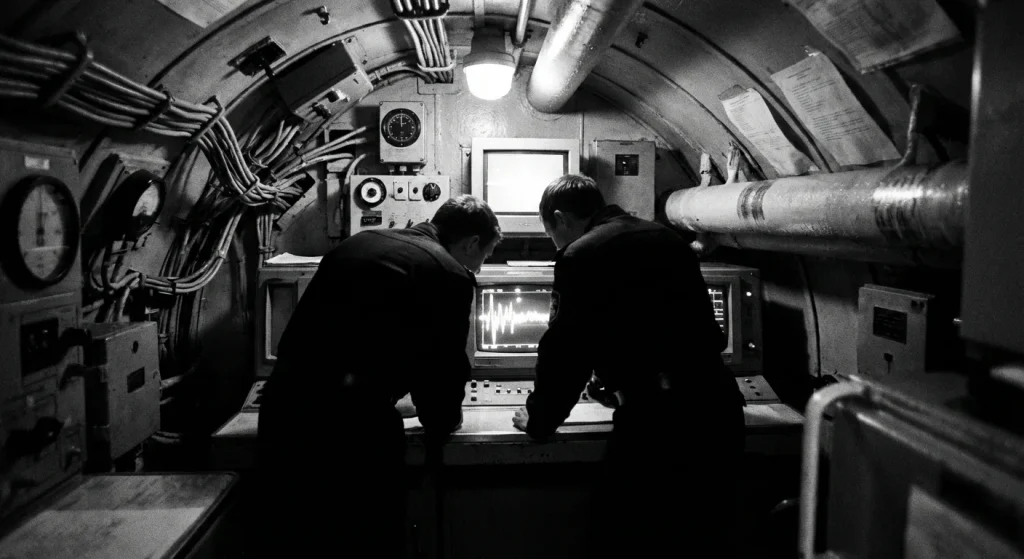
“UFO disclosure” and “UAP disclosure” headlines keep circulating, often paired with the same resurfaced “Russian Navy 2009” claim, which drives a straightforward question: is this signal, or recycled noise? The hook is consistent: secondary reporting says alleged Russian Navy records from 2009 describe unidentified underwater or aerial objects tracked near nuclear submarines at reported speeds around “230 knots.”
The tension is not the number; it is the evidence trail. Old military anecdotes are getting re-litigated because “disclosure-era” attention rewards anything that sounds like a document, a memo, or a leak. But in practice, much of what circulates is tertiary: retellings of retellings that borrow the authority of the words “Navy” and “records” without letting readers inspect the record itself.
Governments prefer the umbrella term UAP (Unidentified Anomalous Phenomena) because it keeps the label non-committal: it acknowledges an observation without conceding origin, intent, or even category. UFO is the legacy term that dominates public discourse, and that matters here because the story’s framing tends to outrun its sourcing. This article treats the “Russian Navy 2009” claim as a sourcing exercise: first, identify what is consistently claimed across retellings; second, separate that from what can be verified by tracking each assertion to a sourcing tier, with special scrutiny on the “230 knots” line and the quality of the citations attached to it.
Start with what can be said cleanly: across the supplied secondary sources, the speed shows up as the numeric English phrase “230 knots” (sometimes “up to 230 knots” or “200-230 knots”), not as a Russian original quote. No Russian-language original wording for the “230 knots” line appears in the materials identified in the Sources and documents reviewed section below, which makes translation drift a live risk and turns exact phrasing into a verification problem, not a physics debate. In this context, a primary source means a contemporaneous log, report, photo, or other artifact created at the time; an electronic copy can still qualify as primary if its provenance is clear, and archives typically hold unique, unpublished materials that function as primary records.
The rest of the analysis follows that same discipline: isolate what is being alleged, then specify what would have to be produced to move the claim from repetition to documentation.
This article concludes with three practical outputs: what is actually alleged, where the evidence gaps are, and what specific primary-source artifacts would upgrade this from a headline to a verified record.
What the 2009 records actually claim
The loudest part of this story is also the simplest: people keep repeating a clean talking point, “230 knots,” while the underlying documentation is not shown in a way that lets readers verify what the record actually says. Retellings frame the episode as a Russian Navy detection problem occurring near or around nuclear submarines, with the objects treated as a potential operational concern in waters where strategic platforms operate. Some secondary accounts further describe the setting as a training event, patrol, or exercise context, but those descriptors are reported details, not established by any verbatim primary-document excerpt in the materials identified in the Sources and documents reviewed section below. The materials identified there also do not establish a specific fleet, unit, or hull identification tied to the alleged tracking; later-added specificity should be treated as unverified unless document scans and provenance are produced.
At the narrative level, the objects are consistently presented as “unknowns” associated with submarine operations, which pushes readers toward an underwater interpretation. The complication is that retellings sometimes blur domains, describing detections that sound submerged in one sentence and airborne in another, or implying a transition between water and air without supplying the original wording. Based on the materials cited below, that domain question stays unresolved: the story is told as underwater-adjacent, but the documentation needed to pin the object to underwater, airborne, or explicitly transmedium behavior is not quoted.
Secondary tellings commonly name sonar as the central sensor, sometimes alongside radar and occasionally periscope or electro-optical observation. The modality label matters because “passive sonar” is listening-only and does not emit signals, while “active sonar” emits pulses and listens for echoes. Those are fundamentally different evidentiary situations: passive tracks can be real but are easier to misattribute without corroboration, and active returns can be more track-like but introduce their own interpretive and operational constraints. The friction is that the materials cited below present the sensor labels at the retelling level, yet they do not provide the concrete track numerics an analyst would need to evaluate how the contact was held, correlated, or rejected across sensors.
The “230 knots” figure is the recurring headline, but the excerpts and summaries reviewed here do not include concrete track numerics quoted from a primary document: no stated speed, no duration, no range, and no depth. That absence is the central gap to keep in view. When “230 knots” is referenced in English-language summaries, it should be treated as a retelling-level claim attributed to later summaries, not as a number directly quoted from a primary record excerpt unless provenance and scans are produced.
Sensors, speeds, and the 230-knot question
If the story cannot yet be treated as document-backed, the next step is to be precise about what a number like “230 knots” could even represent in submarine operations. “230 knots” is not a simple headline number. In submarine tracking, speed is an output of inference, context, and geometry, not a direct readout from a single sensor. The same contact can look slow, then fast, then slow again as the ship maneuvers, the acoustic picture changes, and the fire-control team refines the track.
A submarine typically holds a listening watch, builds bearings on contacts, and tries to turn those bearings into a usable track. Passive sonar (listening) gives direction well before it gives distance; active sonar (pinging) can help with range, but it brings its own operational costs and complications. Either way, the key point is that a displayed speed is usually derived from a track solution, not directly measured.
That derivation is where Target Motion Analysis (TMA) matters. TMA is the set of methods that uses bearing changes over time, plus own-ship motion, to estimate a target’s course, range, and speed. The friction is built in: TMA is laggy. It can reveal that a target has turned, but the change is not detected instantaneously because the solution needs time and geometry to separate “target turned” from “we just changed our own aspect.” When geometry improves, the solution can snap into a different, better fit, and apparent target speed can jump with it.
In practice, teams manage this by maneuvering for advantage. A steady bearing with a weak bearing rate can make multiple solutions look plausible, and then an own-ship turn, a change in target aspect, or a shift in propagation can collapse that ambiguity fast. The important consequence for a number like “230” is straightforward: without the underlying time history and geometry, what appears is not a measurement, but the current best estimate.
| Interpretation error | What “230” would be referring to | Why it produces misleading confidence |
|---|---|---|
| Domain ambiguity | Underwater speed vs surface speed vs aerial speed | The same unit implies radically different feasibility and detection cues. 230 knots is a fast aircraft, a fast surface craft, and an extraordinary underwater figure, so the domain drives the whole plausibility discussion. |
| Translation and conversion artifacts | A number that has moved through languages and unit systems | Once a story circulates in English, “230 knots” often gets paired with a metric figure that looks precise. That precision can be cosmetic if the metric value was rounded, then later converted again. |
| Track association and geometry problems | A speed spike in the fire-control solution | Speeds can jump when contacts are swapped, when multipath or propagation changes alter the apparent bearing behavior, or when own-ship maneuvers change observability. The plot looks like acceleration; the root cause is continuity and geometry. |
The minimum grounding math is simple: 230 knots is about 426 km/h, which is about 118 m/s. That alone should trigger a second question: “230” of what, in what medium, for how long, at what range, and with what continuity?
The conversions also show how numbers drift in retelling. One writeup will carry a full conversion, another will round aggressively (“around 230 knots” becomes “400 km per hour”), and then the rounded metric value gets converted back into knots later. Run that loop and you naturally create nearby variants: 432 km/h corresponds to about 233 knots, and now “233” looks like a new data point when it is just conversion and rounding compounding.
There is an engineering analog that helps bound plausibility: the VA-111 Shkval is reported in defense and naval summaries to reach about 200 knots, achieved by operating inside a self-generated gas cavity so the vehicle rides on a supercavitation bubble (see sources below for defense and naval reporting on the Shkval’s performance). National Interest and USNI Proceedings discuss the commonly cited 200-knot figure and the historical context for the system.
Some secondary reports include unconfirmed or contested claims of faster Shkval variants “up to 300 knots”; those variants are not established in primary, manufacturer, or formal naval technical publications and should be treated as unverified or contested in secondary reporting. See secondary summaries and analysis in the Sources section for how the claim is discussed and qualified in open reporting.
That benchmark cuts both ways. It proves that triple-digit underwater knots is a solved problem in a very specific design space. It also shows why “230 knots underwater” is not a casual inference to lift from a track number without the supporting plots, ranges, and duration. A supercavitating weapon is not a conventional submarine, and even for a purpose-built vehicle, performance claims do not authenticate any particular 2009 track solution.
One operational nuance makes the story less intuitive than it sounds: modern sonar improvements, including ARCI-era capability, detect targets at longer ranges. Longer-range detection changes encounter dynamics. It increases the chance that tracking occurs at geometries where TMA uncertainty is larger, where small bearing errors create big range uncertainty, and where track continuity can be harder to maintain through maneuvers, multipath, and changing propagation.
The actionable takeaway is strict: treat “230 knots” as a hypothesis that only becomes meaningful when it is tied to domain (underwater, surface, air), time and range context (how long, how far, under what geometry), and track continuity (same contact, same solution lineage). Without those, the number is not an evidentiary anchor; it is a prompt to ask for the underlying plots and logs that produced it.
Evidence, sourcing, and credibility checks
Once the operational meaning of the number is framed correctly, the credibility question returns to its core: provenance. The fastest way to cut through UFO news and UAP news churn is to grade evidence by provenance, not by how dramatic the performance claim sounds. A headline speed figure can be repeated perfectly and still be unverified; authenticity only moves when the underlying record can be traced back to an origin, preserved intact, and evaluated in context.
Start with the standard that matters most: primary sources are contemporaneous records that provide a direct view of events, which is why scans of the original Russian language material matter more than any later retelling.
- Original document scans, in the original language: Strong evidence begins with images of the source pages themselves, not typed excerpts or a blogger’s translation. The scans need visible identifiers such as stamps, signatures, letterheads, registration marks, or archive style references so readers can evaluate whether the document looks like a real administrative product rather than reconstructed text.
- Identifiers and continuity: The pages should carry date and time references and unit or platform identifiers, and the set should show continuity across pages. Page numbers, consistent formatting, and internal references that match across the packet are what make “a document set” more than a single page someone can cherry-pick.
- Sensor context, not just a number: If a record asserts an extreme speed, the supporting material must include enough track or log context to interpret what the number actually refers to. A speed value without the associated plot, timeline, coordinate frame, and the surrounding operational notes is not an analyzable claim.
- Corroborating testimony with traceable identities: Statements become evidence when you can attach them to real roles and real access. Named witnesses with job functions and duty positions, ideally multiple independent witnesses, are categorically stronger than unattributed “sources” or secondhand paraphrases.
- Independent expert review: Translation fidelity is a specialist task, and so is interpreting naval records and sensor documentation. A credible package withstands review by linguists for translation accuracy and by naval and sensor analysts for what the record format implies and what it does not.
Most “documented” UFO claims collapse at the same point: nobody can show how the record moved from an originating unit or archive into public circulation. Chain of custody is the handling history of the material, which depends on preserving related documents together and recording when and where they were handled; random screenshots, paraphrases, and decontextualized images cannot establish provenance because they sever the packet from its surrounding pages, metadata, and documented custody trail.
For the alleged 2009 Russian Navy case, the credibility question is not “Does this screenshot look official?” It is “Can a reviewer trace this set of pages, as a set, from a plausible origin through a documented path to the current publisher without unexplained gaps?” If that lineage is missing, the claim stays unproven even if the images look convincing.
Formal authentication can help with documents, but it is not a truth machine. An Apostille is one example of an international pathway: documents authenticated by an Apostille from a participant country are exempted from further validation of signatures in other participant countries. That shortcut confirms the signature or seal is recognized for cross-border use; it does not certify that the underlying narrative, interpretation, or conclusions inside the document are accurate.
Three failure modes repeatedly inflate confidence in incidents like this.
Translation drift turns a technical or ambiguous Russian phrasing into a clean English sound bite. The fact that “230 knots” often appears as an English phrase in circulating summaries is exactly the kind of cue that the audience may be looking at a translation layer, not the underlying record.
Recycled lore creates false consensus. Once one site publishes a paraphrase, others copy it, then later articles cite the copies as “multiple sources,” even though they all stem from the same unattributed text.
Anonymous sourcing and missing document lineage block verification. If nobody will name where the pages came from, who handled them, and whether the full packet exists, readers cannot distinguish an authentic extract from a fabricated or edited composite.
One boundary matters here: the materials cited below do not include authoritative technical references for specific sonar or radar failure modes that yield extreme-speed artifacts. Without that documentation, technical debates about how “230 knots” could appear stay speculative, so the only responsible move is to keep assertions limited to evidence standards and sourcing.
Actionable takeaway: before sharing the 2009 claim as established, demand a tight bundle of artifacts, original-language scans with visible identifiers, continuity across pages, sensor plot or log context that defines what the speed refers to, traceable witness identities and roles, and independent review for translation and operational interpretation. If any of those are missing, treat the story as unverified reporting, not a settled record.
Why this matters in 2025 and 2026
The sourcing standards above are not academic; they map directly onto how disclosure-era attention works in 2025 and 2026. The 2025 to 2026 UAP disclosure environment rewards old military stories that can be framed as “suppressed records,” even when the underlying evidence is thin. The attention cycle is predictable: a foreign archive rumor gets repackaged as UFO news, then the existence of U.S. paperwork gets treated as implied corroboration. That inference is wrong. U.S. process signals mostly indicate that agencies are tightening how they collect, label, and publish material, not validating Russian allegations or any specific “alien disclosure” narrative.
The most concrete shift is boring on purpose: records taxonomy. The U.S. National Archives issued “Guidance on Unidentified Anomalous Phenomena Records” (AC-26-2024, May 09, 2024), directed to federal records management contacts. That matters for UAP disclosure because it formalizes UAP as an identifiable category in federal records handling, which changes how items are tagged, retained, and retrievable when oversight or litigation pressures arrive.
The friction is that “better categorized” is not the same as “more evidentiary.” A memo can improve archival consistency without producing a single new primary record about the Russian Navy 2009 story. The practical takeaway is narrower and more useful: if UAP records exist, formal categories reduce the odds they stay orphaned in miscellaneous files.
AARO’s 2025-facing materials show the same institutionalization on the intake side. AARO published a mission brief (AARO Mission Brief, 2025) and provides public guidance on reporting via its Submit-A-Report page; those materials encourage civilian pilots and other observers to report UAP and note that AARO receives UAP-related Pilot Reports from federal sources. AARO’s public UAP records page and workshop materials include references to a “2025 UAP Workshop: Narrative Data, Infrastructures, and Analysis” effort; participants such as the National UFO Reporting Center have documented their involvement in an August 11, 2025 post (NUFORC participation in AARO workshop, Aug 11, 2025).
The nuance is the part social media skips: a mature pipeline increases report volume and standardization, not truth-status. AARO exploring procurement or tooling to improve intake and case management is a scalability move, the administrative equivalent of adding a ticketing system; public AARO program documentation and user guides speak to program reporting formats and user workflows rather than to any specific foreign incident. See the AARO UAP Program Report User Guide for public-facing details on reporting formats and program reporting expectations (AARO UAP Program Report User Guide, 2023-12-11).
Oversight is where clips routinely outrun documents. Congress.gov is the reliable repository for House hearing transcripts once released by the Government Publishing Office (GPO). If a viral segment claims a witness “confirmed” something about UAP disclosure, the transcript is the adjudicating artifact, because it captures the exact question, the exact answer, and what was entered into the record.
The Russian Navy 2009 story is a clean case study in why process beats rhetoric. Standardized release practices, predictable archival access, and whistleblower-safe channels create a path for evidence-based findings that survive cross-examination. Read 2025 to 2026 disclosure activity as tightening process that increases the odds of better evidence if it is released, not as retroactive confirmation of any specific foreign incident or a spike in UFO sightings 2025 and UFO sightings 2026 claims.
What to watch and how to think
The 2009 Russian Navy “230 knots” story remains an evidence problem, not a settled performance fact.
The retellings lean on a compelling frame: multiple objects allegedly tracked near nuclear submarines. But the materials collected above do not do the job a record has to do: they do not quote concrete track numerics, and they do not lock the event to specific fleet or unit details or hull identifiers that would let outsiders verify what platform, what sensor, and what exact contact history is being described. The technical contention is real, and the earlier discussion of track derivation, domain ambiguity, and conversion drift explains why the same “230” can sound definitive while still being analytically thin. Engineering analogs such as supercavitation systems like Shkval set plausibility boundaries for propulsion, not authenticity standards for a particular 2009 track. Authenticity starts only when the documentary threshold is met: original-language scans, date and time, unit and platform identifiers, sensor plot or log context, and credible provenance and chain of custody. Until then, “230 knots” remains a high-uncertainty headline point.
- Release of original-language document scans that include clear identifiers (dates, units, platforms).
- Reputable translation published alongside source images, line-for-line verifiable.
- Sensor-context materials (plots or log excerpts) with enough metadata for expert review.
- Official oversight records in primary repositories such as Congress.gov and GPO transcripts, not social clips, as UAP records management becomes more formal (National Archives AC-26-2024, May 09, 2024; AARO process artifacts and records pages).
Demand transparency, but enforce evidence standards before treating this as confirmed non-human intelligence; prioritize primary-document releases and repository-posted oversight records over recycled summaries.
Sources and documents reviewed
- National Archives, “Guidance on Unidentified Anomalous Phenomena Records” (AC-26-2024), May 09, 2024
- AARO, “AARO Mission Brief” (UNCLASSIFIED), 2025
- AARO, “Submit-A-Report” (pilot reporting guidance) — AARO Submit-A-Report page
- AARO, “UAP Program Report User Guide”, 2023-12-11 (PDF)
- AARO, “UAP Records” page (institutional UAP records and workshop references)
- NUFORC, “NUFORC participation in AARO workshop”, Aug 11, 2025
- USNI Proceedings, “Red Subs Rising”, October 2019 (discussion of Shkval and related submarine developments)
- The National Interest, “Russia’s 200-Knot Shkval Supercavitating Torpedo Nightmare for the US Navy” (analysis of Shkval performance figures)
- Naval Post, “A Gamechanger Weapon: Supercavitating Torpedo” (secondary summary and discussion of claimed performance)
- Wikipedia, “VA-111 Shkval” (technical overview and references)
Frequently Asked Questions
-
What does the “Russian Navy 2009” UFO/UAP claim say happened near nuclear submarines?
Retellings claim Russian Navy detections occurred near or around nuclear submarines, with unidentified objects treated as an operational concern. The most repeated headline detail is a reported speed “around 230 knots,” but the article notes the circulated excerpts do not provide verifiable primary-document parameters.
-
Where does the “230 knots” number come from in the Russian Navy 2009 story?
Across the secondary sources discussed, the speed appears as the English phrase “230 knots” (sometimes “up to 230 knots” or “200-230 knots”), not as a quoted Russian original. The article says no Russian-language original wording for the “230 knots” line is shown in the provided source set.
-
Is there a verified primary-source scan of the Russian Navy 2009 “230 knots” record?
No-the article’s key point is that the underlying documentation is not shown in a way that allows verification of what the record actually says. It specifically notes the supplied excerpts do not include verbatim primary-document text with track numerics like speed, duration, range, or depth.
-
Were the objects in the Russian Navy 2009 claim underwater, airborne, or transmedium?
The article says retellings blur domains, sometimes describing submerged detections and other times implying airborne behavior or a transition between water and air. Because the original wording and track context are not quoted, the domain (underwater vs air vs transmedium) remains unresolved.
-
What sensors are mentioned in retellings of the Russian Navy 2009 “230 knots” incident?
Secondary tellings commonly name sonar as the central sensor, sometimes alongside radar, and occasionally periscope or electro-optical observation. The article emphasizes that these sensor labels appear at the retelling level and are not supported by concrete quoted track numerics in the supplied excerpts.
-
What is 230 knots in km/h and m/s, and why does that matter for this claim?
The article converts 230 knots to about 426 km/h and about 118 m/s. It argues the key question is “230 of what, in what medium, for how long, at what range,” because speed in submarine tracking is typically derived from a track solution rather than directly measured.
-
What evidence should you look for to verify the Russian Navy 2009 “230 knots” story before sharing it?
The article says verification requires original-language document scans with visible identifiers (stamps, signatures, letterheads, registration marks), continuity across pages, and sensor-context materials like plots or logs that define what the speed refers to. It also calls for traceable witness identities and independent review by linguists and naval/sensor analysts, plus a documented chain of custody.
