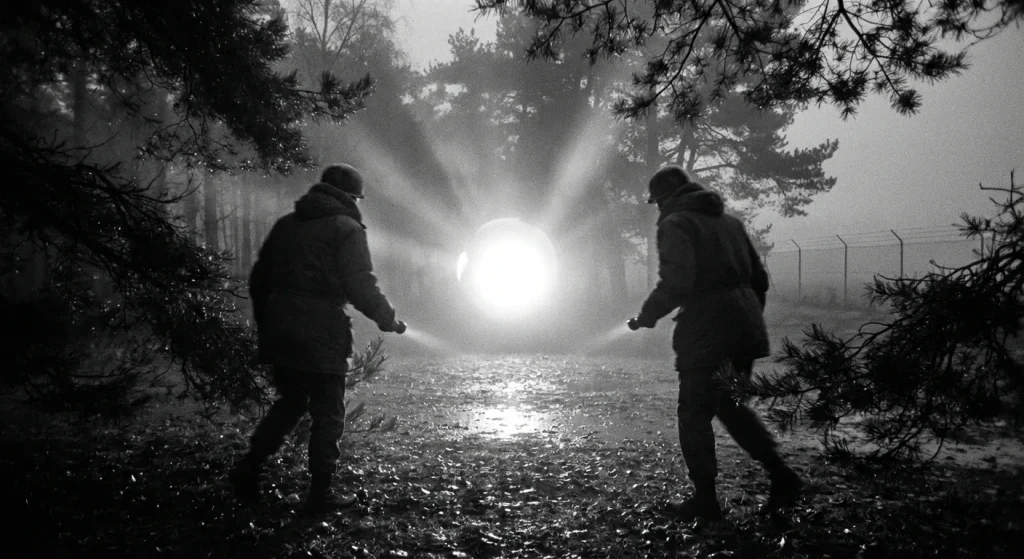
You are trying to do something most “disclosure” coverage does not make easy: separate high-status military lore from what can actually be pinned to records. As UFO news and UAP news cycles spike, Rendlesham keeps resurfacing because it gives commentators something they can point to that sounds official, sounds witnessed, and sounds repeatable.
The Rendlesham Forest Incident is the rare military-linked UFO story that people use as a litmus test: either it is held up as “the best military UFO case,” or it is treated as a cautionary example of how dramatic claims accrete around a small core of paperwork. If you are deciding which bucket it belongs in, you are already asking the right question.
The reason this case will not fade is structural. It sits at the intersection of three things that make a story durable: repeated reporting across multiple nights, multiple U.S. Air Force witnesses, and an official memo trail. Contemporary reporting describes several dozen military witnesses in the broader episode, which is a different signal than a single anonymous account repeated for decades.
The public-facing description is also sticky: the incident is commonly described as a series of reported sightings of unexplained lights and alleged craft landings near Rendlesham Forest. That phrasing travels well, but it also hides the main problem this article resolves: official-sounding documentation and confident testimony exist, yet not every specific claim you will hear in retellings sits on the same evidentiary footing.
Start with what is straightforward to name. Col. Charles Halt wrote an official memo titled “Unexplained Lights” to the UK Ministry of Defence reporting the Rendlesham Forest events. The Halt memo is dated 13 January 1981, is authored by Lieutenant Colonel Charles Halt, and was addressed to the Ministry of Defence (including Defence Secretariat 8). A public scan of the memo and an online transcript are available for inspection (see the Halt memorandum scan and transcript links below). The Halt memo is exactly why the case gets invoked in arguments about transparency and alleged government cover-up narratives: it is a concrete document people can circulate, quote, and treat as institutional acknowledgment even when the underlying claims vary in strength.
After reading, you will be able to evaluate Rendlesham with a disciplined, record-first lens that separates what is asserted from what is documented.
Cold War setting and key witnesses
The Rendlesham story reads differently once you treat it as an on-duty security and command problem on a restricted Cold War installation, not as a free-standing “lights in the woods” anecdote. Reports that start at a perimeter fence line are designed to be actionable for supervisors, not cinematic for outsiders, and that design choice shapes what gets written down and what gets left out.
In December 1980, RAF Bentwaters and RAF Woodbridge were USAF-operated fields run under the 81st Fighter Wing, and Americans commonly referred to them as the “Twin Bases.” The wing structure matters because it defines who owns security, who owns operations, and where incident reporting ultimately lands. In 1980, these bases operated in a UK air-defence environment organised under RAF Strike Command following postwar reorganisation – No. 11 Group was by then part of the Strike Command-era structure rather than the historic pre-1968 “Fighter Command” formation. For contemporary context on RAF organisation and No. 11 Group, see the RAF history and No. 11 Group entries linked below.
When unusual lights are reported near a restricted perimeter, security forces behavior follows a predictable pattern: verify the report from a controlled vantage point, establish what can be observed without compromising safety, control access points and vehicle movement, and keep communications clear for escalation. The friction is that early reports prioritize time, location, and accountability over interpretation. That is why first-pass language can read sparse or procedural.
That procedural feel is a feature of the chain of command, the formal line of authority through which information is passed upward so decisions can be made at the right level. A sentry or patrol documents what they can directly support, then a supervisor consolidates and forwards only what commanders need to know immediately.
At the command level, Lt. Col. Charles Halt was the Deputy Base Commander in December 1980. He sits in a different part of the reporting pipeline than a patrol on the fence line, and his involvement begins as information arrives through normal channels. On December 28, 1980, Halt received word of sightings related to the incident, which is the operational trigger for command-level awareness and oversight.
For the first night, the core named firsthand participants most often cited are John Burroughs and Jim Penniston, both USAF security personnel. Their relevance in the record is role-based: security forces are the first responders for perimeter anomalies, and their observations are the starting point for what supervisors and command staff later see.
In incidents like this, the records that typically exist are practical: duty logs, dispatch notes, brief memos, and written statements from involved personnel. In this case, original written statements from five first-night participants were made available, which is consistent with how a military organization captures initial accounts for internal use.
Read every later claim through three filters: who held the role, how close they were to the initial report, and where their account entered the reporting system. That approach keeps you anchored to observation and authority, not hindsight storytelling.
Night one and the first response
That chain-of-command framing is not background color; it is the reason the first night matters. The earliest response is where the initial observations were made, written up, and passed upward before later interpretations had time to settle.
The first night is the foundation every later retelling builds on: a perimeter alert, a short security movement into or toward Rendlesham Forest, reported close-range observations, and an immediate report up the chain. The friction is that the public-facing material does not provide timestamped certainty here. Exact times, exact positions, and exact sequences are presented as recollections rather than as a single, primary-source timeline you can time-stamp minute by minute.
Commonly cited accounts place the first-night reports with USAF security personnel, notably John Burroughs and Jim Penniston, tied to Dec 26, 1980. Those names anchor “Night One” in the literature, but the detailed choreography of who saw what first and precisely when remains dependent on which account you are reading.
Night One typically starts with an alert of unusual lights seen near the base perimeter in the direction of the forest. In the version most readers encounter, the sighting is not framed as a stargazing curiosity. It is treated as a potential on-the-ground incident close enough to warrant a check, and that is what triggers a security response rather than a passive observation from a distance.
The practical reality of a night response matters to how the story later fractures: darkness compresses depth perception, bright points of light dominate attention, and urgency favors movement over careful measurement. That is the environment in which the “origin event” is reported to unfold, and it is also why later retellings disagree on the small stuff.
As the story is commonly told, security personnel moved toward the treeline and into or near Rendlesham Forest to locate the source of the lights. Once on scene, the most repeated elements are lights seen in or above the forest, combined with a growing impression that the lights were associated with a physical object rather than a distant source. In some accounts, the narrative escalates from “lights” to an “object presence” and then to a “landing” framing, described as something on or very near the ground.
Those close-in sequences are supported primarily by participant narratives rather than by a primary-source, timestamped reconstruction that fixes movement and observation minute by minute. The result is a record with multiple firsthand voices but without a single instrumented timeline that settles disputed timing, positions, and distances.
In closer-range retellings, observers describe localized illumination, directional movement, and the sense of something structured. Those are reported impressions, not measurements. The disciplined way to hold them is to treat “what was perceived at close range” as a set of claimed observations that vary by witness and retelling, especially on granular points like distance, whether the light source appeared suspended or grounded, and how long each phase lasted.
One of the least controversial pieces of the Night One narrative is that the incident was said to have been reported upward promptly through the reporting hierarchy. The details of exactly who was called first, or the precise wording used, are where accounts diverge. The consistent backbone is simpler: an unusual light triggers a response; the responders report what they believe they encountered; the report is escalated rather than dismissed at the lowest level.
Skeptics frequently raise a competing explanation centered on Orford Ness (Orfordness) Lighthouse on Orford Ness in Suffolk, arguing that a powerful navigational light can be misidentified at night, especially when observers are moving through dark terrain. If you encounter this hypothesis, the key identifiers are straightforward: Orfordness Lighthouse was 30 metres (98 ft) tall and completed in 1792. This section does not adjudicate that explanation, and it does not attempt bearings, flash patterns, or timing comparisons.
Use a strict rule: separate the minimum shared narrative from the embellishment-prone details. The shared narrative is alert, response, reported observation, and report upward. Treat exact times, distances, and tight sequencing as claims that require direct sourcing, because this project’s inputs do not provide a primary-source, timestamped reconstruction that settles them.
- Minimal timeline (least-disputed)
- 26 December 1980 – Initial perimeter reports by security personnel (based on contemporaneous witness statements commonly cited in the record).
- 27 December 1980 – Night associated with Lt. Col. Halt’s on-scene audio recording in accounts of the case (based on the Halt tape references).
- 28 December 1980 – Senior command awareness and on-base reporting activities cited in multiple accounts (based on participant statements and later summaries).
- 13 January 1981 – “Unexplained Lights” memorandum authored by Lt. Col. Charles Halt and addressed to the UK Ministry of Defence (the Halt memo is dated 13 January 1981).
Nights two and three escalation
Once the first response was taken seriously enough to move up the reporting ladder, the question became whether the anomaly would recur. In the Rendlesham narrative, it did, and that repeatability is what pulled senior leadership into active documentation rather than informal awareness.
The Rendlesham story persists because it did what most famous UFO cases never do: it escalated into command-level documentation and an on-scene audio record. Those two durable artifacts, the Halt memo and the Halt tape, fix parts of the timeline and preserve what personnel said and did in the moment. They do not, by themselves, identify what the lights were.
That distinction matters because paperwork and recordings carry institutional weight. They show that senior staff treated the reports as operationally relevant enough to log and pursue. They do not automatically convert an observation into a confirmed craft, threat, or intelligence finding.
Night One established that something was worth checking; subsequent nights established that it would not go away. Lt. Col. Charles Halt, the Deputy Base Commander, received word of sightings on Dec 28, 1980. At that point, the issue had crossed the line from a localized report to a problem senior duty leadership had to manage: evaluate what was being seen, control rumor, and create a record of what actions were taken.
That escalation trigger also explains a tonal shift in how the incident is remembered. Instead of only recollections after the fact, the record begins to include materials produced for an official audience. The value is procedural: who was notified, what was tasked, and what observations were considered worth writing down or recording while events were still unfolding.
A memo or report titled “Unexplained Lights” exists in the record. It was sent to Defence Secretariat 8 (DS8) at Whitehall and directed that RAF Woodbridge personnel investigate unexplained lights over Rendlesham Forest. That is what the “Halt memo” is for in practice: an operational report meant to capture what was reported and what the unit did about it, not a final verdict on what caused the reports. The Halt memo is dated 13 January 1981 and is available as a public scan and transcript (links below).
The complication is built into the format. A memo like this prioritizes chain of command, basic timings, and tasking language because those elements are actionable. It is designed to show due diligence and provide a defensible administrative trail. That makes it a strong anchor for the fact of escalation and the fact of investigation, while still being limited as a tool for identification.
The other anchor is the “Halt tape,” an audio recording associated with Charles Halt. Audio matters because it captures contemporaneous impressions: what participants thought they were seeing, what they chose to comment on, and how they described it while attention was fixed on the sky and treeline. That same strength is also the limitation: a live narration can preserve urgency and detail without providing the measurements, imagery, or corroboration needed to identify a source beyond dispute.
Its public-life history is part of why it is repeatedly cited. According to accounts collected by researchers, a copy of the Halt tape was circulated to researchers in 1984; see researcher accounts linked below. Some secondary sources also state that copies or versions of the circulated recording include Suffolk Constabulary audio elements. Where the article cannot independently verify the provenance and chain of custody of individual circulated copies, those claims are presented as reported or claimed by researchers rather than as independently authenticated fact.
None of that is the same as authentication. Circulation establishes that an audio artifact existed and was shared. Reported police audio suggests overlap with real-world response channels. Neither fact alone identifies the phenomenon being discussed on the recording.
Across the subsequent nights, reported activity centered on renewed sightings of lights in the sky and over or near the forest, with personnel attempting to observe and document rather than simply respond and depart. Descriptions in the public record commonly include light sources that appeared to move, change intensity, or present as narrow, beam-like effects. Those beam-like descriptions are part of the reported narrative, but the documentation itself does not inherently explain whether the appearance came from a structured object, a directional light source, atmospheric effects, or a misperception under stress and low visibility.
The operational behavior is the point to watch. The presence of a memo directing investigation, and an on-scene recording associated with the Deputy Base Commander, indicates that personnel were not only watching but also trying to capture a record that could be relayed and evaluated. Attempts to document, whether through notes, photographs, or audio narration, reflect a shift from immediate reaction to structured observation.
Use the Halt memo and Halt tape as constraints, not conclusions. They are your best anchors for what was formally reported, who was involved, and how the event was described in real time or near real time. Keep the identification question separate: the existence and handling of these items demonstrates escalation into official attention and documentation, but it does not, by itself, prove a craft, a technology, or an intruder.
Evidence, records, and competing explanations
The memo-and-tape anchors clarify what was logged and how seriously it was treated, but they do not flatten the rest of the record into a single reliability level. Rendlesham isn’t hard to understand because the story is complicated. It’s hard because the public record is layered, and each layer carries a different reliability profile. If you treat every claim as equal, the case looks like an argument about belief. If you sort claims by evidentiary tier first, it becomes an evidence-management problem with predictable failure modes: later certainty built on earlier ambiguity.
Tier 1 is the paper-and-tape footprint created while the incident was still “live”: a contemporaneous document, meaning a record written or recorded at the time (or immediately after) the events it describes, before decades of retelling can harden guesses into “facts.” For Rendlesham, what belongs here are the early written statements that were produced close to the December 1980 sightings, plus any logs, notes, and recordings that capture observations without the benefit of hindsight. Widely cited summaries frame the core event as unexplained lights near Rendlesham Forest in December 1980.
Tier 1 is also where you would expect the most valuable constraints: timestamps from duty logs, unedited audio, maps used that night, and any original sketches or measurement notes. Those items don’t have to “prove a UFO” to be decisive; they just have to nail down what was said, when it was said, and what was actually checked.
Tier 2 is everything that arrives later: interviews, memoir fragments, conference talks, and retrospective reconstructions. For this case, later testimony includes recollections about what was seen, how it moved, and what observers believed it was. The value is real: later testimony can add context, clarify who did what, and surface details that were never written down. The friction is just as real: memory is not a recording, and later narratives tend to import structure, precision, and motive into moments that were originally uncertain. Public accounts also emphasize that a senior officer was informed during the incident window, which matters for understanding how quickly the event was taken seriously on-base.
Tier 3 is where Rendlesham becomes “Rendlesham”: books, TV segments, documentaries, podcasts, and internet summaries that compress messy records into a clean storyline. These retellings often mix Tier 1 and Tier 2 material without labeling which is which, then add interpretive glue that reads like fact. The result is a case that feels more documented than it is, because repetition creates the illusion of corroboration even when every version ultimately traces back to the same small set of inputs.
One reliability principle does most of the work here: physical evidence is typically treated as more reliable than purely testimonial evidence. Applied to Rendlesham, the public-facing record is robust in narrative artifacts (statements, recordings, later interviews) and thin in independently verifiable measurements. The project’s provided research does not supply verified quantitative details for a lighthouse flash pattern or bearing, meteor timing, or instrument models and readings. Any argument that leans on those specifics is making a claim that requires sourcing, not an established fact in this project’s inputs.
Skeptical interpretations cluster around misidentification under imperfect conditions: distant navigational lights, stars, and meteors, amplified by stress and expectation. This cluster explains why multiple people could converge on “unusual lights” without a single, consistent object description, and why perceived motion can emerge from perspective shifts and intermittent light. It also gains traction because a prominent lighthouse exists in the relevant geography and is documented at an approximate distance on the order of tens of kilometers in planning and mapping materials. Where the skeptical cluster struggles, in strictly evidentiary terms, is when it asserts precise geometry, flash cadence, or exact timing matches without presenting verified bearings, measured line-of-sight constraints, or validated meteor-event timestamps in the record being used.
Pro-UFO interpretations cluster around a structured craft, non-human intelligence, and, in the strongest version, deliberate suppression by authorities. This cluster explains why some witnesses frame the experience as close, coherent, and physical rather than merely “lights,” and why the incident retains cultural force: it treats the case as an encounter, not an optical puzzle. The cost is that it must assume more than the tiered record itself establishes, especially when later testimony is asked to supply measurements, traces, or instrument behavior that are not preserved as verified contemporaneous data. The cover-up framing, in particular, requires documentary proof of suppression actions, not just the absence of public documentation.
- Tag each claim as Tier 1 (contemporaneous documents), Tier 2 (later testimony), or Tier 3 (media retellings).
- Isolate which parts are physical or instrumented evidence versus human description, and weight them accordingly.
- Demand sourcing for quantitative assertions (bearings, flash patterns, meteor timing, instrument models and readings) instead of treating them as settled.
- Track whether a detail appears only after years or decades, and treat it as a memory-dependent claim until shown in Tier 1 material.
- Compare explanations by their weakest required assumption, not their most exciting implication.
Rendlesham in today’s disclosure politics
That tiered approach is also what keeps Rendlesham in circulation long after the event window ended. In the current disclosure era, Rendlesham functions less like a solved incident and more like a benchmark people use to argue for or against transparency: if a case has military witnesses and an official paper trail, the logic goes, the government should be able to account for it clearly. That rhetorical role is why Rendlesham keeps resurfacing in “UFO news” cycles even when no new documentation has appeared. It is a convenient shorthand for credibility cues, not proof of an outcome.
Today’s reporting environment is built for intake at scale, not retroactive confirmation of famous legacy cases. AARO reported receiving a total of 801 UAP reports as of April 30, 2023 (see the AARO FY2023 Consolidated Annual Report on UAP). AARO (All-domain Anomaly Resolution Office) exists to collect, analyze, and report across domains, and its FY2023 Consolidated Annual Report on UAP covers reports from 31 August 2022 to 30 April 2023 (see the AARO FY2023 Consolidated Annual Report on UAP). The Department of Defense also stated that AARO reviewed historical records alongside contemporary intake; AARO and DoD have not validated Rendlesham, and no AARO product is presented as endorsing that incident.
The UAP Disclosure Act of 2023 was proposed to accelerate disclosure of U.S. government UAP records, and reporting on July 25, 2023 said a Senate panel sought a mandatory timeline and process for declassification. That pressure keeps the public revisiting older cases as test questions for openness. Treat “Rendlesham cited” as agenda-setting unless it comes with new primary material: declassified contemporaneous logs, command-level correspondence, authenticated sensor data, or chain-of-custody documentation that materially changes what is knowable.
What we know and what’s next
Against that backdrop, Rendlesham is best handled the same way it was introduced at the start of this article: by privileging records over lore. Rendlesham remains credible as a documented military report of unexplained lights, and unresolved as proof of non-human intelligence. The record supports a real sequence of reports and follow-up inside a military chain of command; it does not close the loop on what, exactly, was observed or identified.
The most defensible anchors are the official memo and the associated audio recording: they pin the story to specific claims made close to the event, with enough internal detail to be tested against timelines and other records. Those anchors matter because they reduce the case’s dependence on later recollection, which is where the narrative tends to inflate.
The escalation also fits the simple fact pattern this article has emphasized: reporting spans more than one night. Published accounts identify initial reports on December 26 and subsequent awareness by Lt Col Charles Halt by December 28, alongside contemporary reporting that describes dozens of military witnesses and Halt as the most senior cited. Multiple nights are the mechanism that explains both why the incident climbed the ladder and why it kept circulating.
The clean way to hold the evidence is the three-tier hierarchy: (1) contemporaneous records and near-contemporaneous material (memo and audio, plus any original statements), (2) later testimony, and (3) retellings of testimony. Open questions stay open under that hierarchy: identification of the lights, which specifics are recorded versus reconstructed later, and how much of the familiar narrative rests on memory assembled after the fact.
- Search the catalogue using The National Archives (UK) Discovery catalogue and the MoD/UFO file series (DEFE 24) as starting points – example queries include “Rendlesham”, “Bentwaters”, “Woodbridge”, and “Unexplained Lights” (see the TNA Discovery and MoD UFO files guides linked below).
- Request copies through The National Archives’ digital or paper copying service – requests begin with a Page Check as described on the National Archives record-copying pages (see the TNA record-copying fees and guidance linked below).
- Use the reference library on-site as a force multiplier: The National Archives reference library holds over 65,000 printed and online sources for triangulating citations and file trails (see the TNA reference library guidance linked below).
For 2025 to 2026, watch only for signals that materially tighten the chain of evidence: newly released primary documents, clearer official indexing that makes files easier to locate and cross-reference, and officially attributable updates that improve reporting transparency. Subscribe for updates when new primary-source releases and verifiable official indexing changes drop.
Rendlesham rewards the same discipline it demands: treat documents as the floor, memory as a variable, and mythology as noise.
Frequently Asked Questions
-
What was the Rendlesham Forest Incident in December 1980?
It was a series of reported sightings of unexplained lights near Rendlesham Forest involving U.S. Air Force personnel at the USAF-operated RAF Bentwaters/RAF Woodbridge “Twin Bases.” Reports span multiple nights in late December 1980, commonly anchored to initial reports on Dec 26 and command-level awareness by Dec 28.
-
Who were the key USAF witnesses named in the Rendlesham Forest case?
The most-cited first-night security personnel are John Burroughs and Jim Penniston. Lt. Col. Charles Halt, the Deputy Base Commander, is the senior figure tied to the official documentation and an on-scene audio recording.
-
What is the Halt memo and what does it actually prove?
Col. Charles Halt wrote an official memo titled “Unexplained Lights,” dated 1981, routed to the UK Ministry of Defence (including DS8 at Whitehall) and directing investigation of lights over Rendlesham Forest. It proves the event escalated into official reporting and tasking, not what the lights were.
-
What is the “Halt tape” and when did it circulate publicly?
The Halt tape is an audio recording associated with Charles Halt that preserves contemporaneous narration of what personnel thought they were seeing during the incident. A copy circulated to researchers in 1984, and sources report Suffolk Constabulary audio is present on the tape.
-
What is the Orford Ness lighthouse explanation for Rendlesham, and what specs does the article give?
A common skeptical hypothesis is that the Orford Ness (Orfordness) Lighthouse was misidentified as unusual lights during night movement in dark terrain. The article states the lighthouse was 30 metres (98 ft) tall and completed in 1792.
-
How can you evaluate Rendlesham evidence without mixing records with later retellings?
Use a three-tier method: Tier 1 is contemporaneous records (memo, tape, early statements/logs), Tier 2 is later testimony, and Tier 3 is media retellings. The article also says to demand sourcing for quantitative claims like bearings, flash patterns, meteor timing, and instrument models/readings.
-
Does AARO or the U.S. Department of Defense validate the Rendlesham Forest Incident as non-human intelligence?
No-AARO and DoD have not validated Rendlesham, and no AARO product is presented as endorsing the incident. The article notes AARO had received 801 UAP reports as of April 30, 2023 and emphasizes UAP is an umbrella term that does not imply a cause.
