A steady drumbeat of UFO news and UAP news can feel like institutional whiplash: one day it’s “non-human intelligence,” the next day an official voice insists there’s nothing to see. That tension isn’t new, and it isn’t accidental.
The harder problem is deciding what any fresh claim actually means when the messaging ecosystem has a long memory. Once an institution learns how to calm a public conversation, it tends to reuse the same playbook, even when the underlying question is technical: What was observed, by whom, with what instruments, under what conditions, and with what chain of custody for the data?
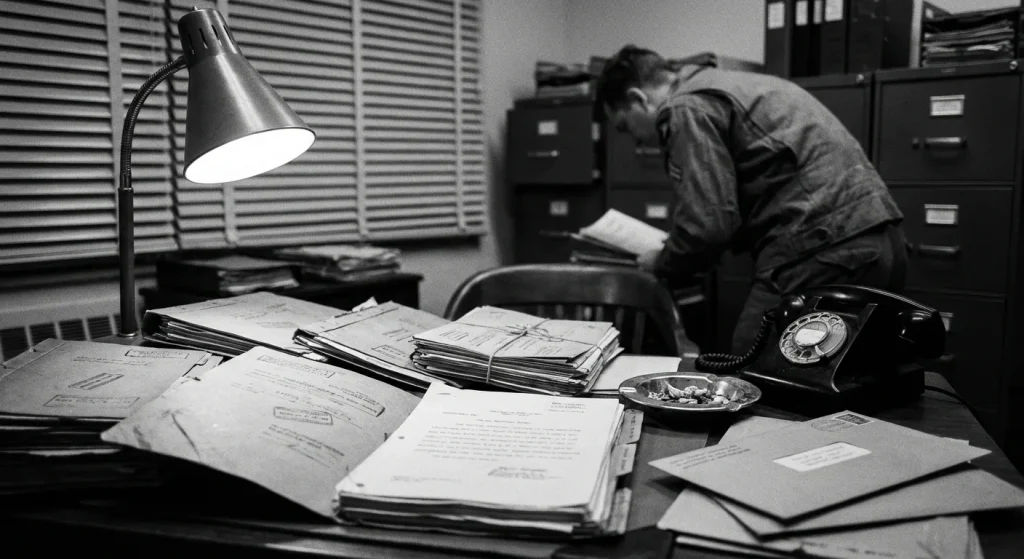
Project Grudge is the template that still shapes how UFO disclosure and UAP disclosure arguments get framed. On February 11, 1949, the effort was renamed Project Grudge, and by the end of 1949 a formal Project Grudge report had been written. That timing matters because it captures a settled posture, not an improvisation: the project wasn’t only collecting reports, it was managing the social consequences of reporting.
Grudge documentation didn’t treat public attention as a neutral backdrop. It included reporting procedures and planned responses to press and public inquiry, which means the system was designed to classify incoming accounts and to control the outward narrative at the same time. That design choice creates the non-obvious friction that still drives today’s disclosure fights: the same posture that prevents panic and keeps the problem manageable also pre-shapes what counts as a serious report, what gets routed into technical channels, and what gets treated as social noise.
The central tradeoff is simple and permanent: public reassurance and manageability versus trust, data quality, and long-term credibility. This article offers a practical lens for judging disclosure-era headlines and sighting waves by tracking how institutions frame reports as noise versus data before deciding what any new claim “proves.”
Why Grudge existed at all
Project Grudge existed because the U.S. Air Force had to impose order on a surge of ambiguous reports under early Cold War pressure. In the years immediately after World War II, aviation and detection capabilities were advancing quickly, and the national-security environment rewarded caution: unexplained objects in controlled airspace were not just a curiosity, they were an uncertainty the Air Force had to triage.
The reporting wave that forced the issue into the open has a clear catalyst. On June 24, 1947, private pilot Kenneth Arnold reported seeing nine unidentified flying objects near Mount Rainier. That kind of claim, arriving in a climate already primed for air-defense anxiety, helped drive a sharp rise in public and military reporting that demanded an institutional response.
The Air Force’s answer was to formalize analysis, channel reports, and decide what required action. The internal sequence matters because it shows a bureaucracy attempting to stabilize a fast-moving public issue while protecting operational priorities. Project Sign came first, and Project Grudge succeeded Project Sign in February 1949. Grudge then ran as an official effort; the Air Force announced in late December 1949 that Project Grudge had been “closed out” and issued a final report and press notice, but official Air Force UFO investigative activity continued into the early 1950s and was later incorporated into Project Blue Book in the early 1950s. [Air Force historical record] [National Archives on Project Blue Book]
The Air Force announced Project Grudge had been closed out on December 27, 1949, and contemporaneous material indicates the decision was influenced by concern that visible investigation of UFOs helped fuel public interest and thereby increased reporting pressure on the service. That rationale captures the bind the Air Force faced: investigating reports was necessary for security triage, but visible investigation also validated the topic in the public mind and increased demand for answers. [Air Force announcement and context] [related service documentation]
Language has always been part of that management problem. In the late 1940s, the era’s framing leaned on “UFO,” meaning “unidentified flying object,” a label that kept the focus on discrete objects and invited the public to treat sightings as things to be named, explained, and debated.
Modern official messaging increasingly prefers “UAP,” meaning “unidentified aerial phenomena,” which functions as a more procedural category: it groups uncertain observations for assessment without conceding what they are. The same logic shows up in contemporary debates over UAP sightings and UFO disclosure, even as today’s programs and reporting channels look different from 1949.
The takeaway is practical. When official language changes, and when programs are stood up or shut down, treat those moves as signals of institutional priorities: reduce uncertainty, control public reaction, and protect sensitive capabilities. Those incentives explain why Project Grudge existed, why it became politically delicate, and why ambiguity management remains the through-line in today’s disclosure disputes.
Mass hysteria as an explanation
That emphasis on managing ambiguity didn’t just shape how reports were processed; it shaped how they were explained. The end-of-1949 Grudge report framed many sightings less as an aerospace mystery and more as a human-systems problem: reports spread, intensify, and mutate when people copy each other’s language and expectations. It leaned on the idea of mass hysteria as a top-level explanation for why clusters of reports could surge even when the underlying stimuli were ordinary. The friction in that framing is obvious: the report still had to account for the fact that observations came from both civilian and military sources, not just excitable bystanders. Its resolution was to treat “who reported it” as secondary to “how the report was interpreted, repeated, and amplified” once an attention cycle took over.
Grudge’s administrative posture supported that interpretation. The program did not just collect narratives; it included planned responses to press and public inquiry, treating public messaging as part of the operational problem, not an afterthought. That approach only makes sense if the report’s authors believed publicity changed the volume and character of incoming reports. The actionable implication is the report’s core premise: if you want fewer “unknowns,” you manage the social feedback loops that turn ambiguous stimuli into confident headlines.
The report’s case logic depended on a straightforward claim: most sightings were re-labeling of familiar inputs. It did not need exotic craft to generate “flying saucer” descriptions; it needed misread distance, speed, and size under stress, excitement, or poor viewing geometry. That is where mass hysteria mattered in practice: the report treated “unknown” as a reporting outcome, not a property of the object itself.
| Ordinary stimulus the report pointed to | What witnesses commonly reported | Why the report said the mismatch happens |
|---|---|---|
| Astronomical objects (bright stars, planets, meteors) | Stationary “objects” that seemed to pace an aircraft or “follow” a car | Motion illusion from the observer moving, plus poor depth cues at night |
| Balloons | Disc-like shapes and “hovering” behavior | Slow drift and changing sun angles alter perceived shape and motion |
| Aircraft | Sudden acceleration, sharp turns, or “no sound” | Angle-to-observer changes, cloud layers, and distance erase reliable speed and audio cues |
| Radar anomalies | Instrument-confirmed “targets” without visual contact | Non-target returns and interpretation errors turn artifacts into tracks |
The complication for the report was that not every file neatly collapsed into a single mundane bucket. Its solution was procedural rather than sensational: where data were thin, the report treated “unexplained” as “insufficiently described,” then pushed the explanatory weight back onto perception, context, and rumor dynamics.
This skepticism also shaped how the report approached publicity. Grudge documents included planned responses to inquiries because the report assumed that dramatic framing acted like gasoline: the more intense the coverage, the more ambiguous lights and blips would be reinterpreted through the flying-saucer template. The tradeoff is credibility. Tight message discipline can stabilize public attention, but it can also read as stonewalling when people want case-by-case detail. The report’s practical answer was to avoid feeding the cycle.
That orientation also fit Grudge’s scale. The program persisted as a scaled-down continuation and is recorded as collecting 244 additional sighting reports, meaning the Air Force expected the flow of claims to continue even under a skeptical explanatory model. [Air Force historical record]
Evidence standards and blind spots
Grudge’s 1949 posture also implies a set of evidence standards, even when they are expressed through what gets discounted. If the key questions are “what was observed” and “under what conditions,” then thin descriptions and missing context make it easier for institutions to treat “unknown” as a reporting outcome rather than a durable category.
That creates a predictable blind spot: a system built to dampen feedback loops and reduce public agitation can also discourage the kind of data-rich reporting that would narrow ambiguity over time. When the outward posture prioritizes manageability, the internal record can end up thinner than later investigators-and the public-expect it to be.
Those blind spots don’t disappear in later eras; they change form. As modern programs emphasize controlled intake, institutional constraints like classification, reporting stigma, and uneven routing of sensor-backed cases versus narrative-only cases can still determine what survives as a usable evidentiary trail and what is treated as noise.
The legacy in Pentagon messaging
Official messaging systems tend to preserve themselves, and they shape what gets reported. Once evidence standards and blind spots harden into routine, the institution’s default move is often communications-first: contain uncertainty, reduce noise, and keep the topic from consuming bandwidth. That approach outlives any one program name because it rewards the same behaviors over time: narrow what counts as credible, minimize what becomes public, and discourage messier reports that leaders cannot quickly explain.
The cleanest waypoint for that shift is the CIA-convened Robertson Panel. It met in January 1953 at the direction of the Director of Central Intelligence, and its report is publicly accessible through the CIA Reading Room as DOC_0005516124. [Robertson Panel report, CIA Reading Room] In institutional terms, the panel represents a post-Grudge inflection point: the government treating the reporting environment itself as something to manage, not just the objects in the sky. The durable lesson was procedural, not paranormal: if public attention creates operational drag, the organization will prioritize controlling the narrative and the intake pipeline over satisfying outside curiosity.
That same impulse reappears in the modern, Pentagon-era lineage. The U.S. government formed the Unidentified Aerial Phenomena Task Force (UAPTF) in August 2020, followed by AOIMSG in 2021 and AARO in 2022, a straight line of increasing formalization. Structure matters because structure governs inputs and outputs: who can submit reports, how they are routed, and what fraction can be summarized publicly without damaging equities. Classification limits who can access information and how it can be shared, which is why even maximum public pressure does not force release when sensor capabilities, platforms, sources, or methods are implicated.
Public demands for “maximum transparency” keep rising in UAP disclosure debates, and they collide with the realities of security bureaucracy.
That collision becomes corrosive when official messaging implies the public is being managed rather than informed, fueling the “government UFO cover-up” narrative even when the binding constraint is the clearance system. The other friction is social: stigma operates inside the workforce, and personnel may underreport, delay reporting, or sanitize details to avoid being tagged as unreliable, distracted, or unserious. The predictable result is a data-quality trap: fewer clean reports enter the system, fewer can be confidently briefed back out, and trust degrades again.
Congressional attention and public testimony keep the credibility problem alive, because once multiple witnesses describe experiences in a formal setting, the audience expects visible institutional learning, not just rebranding.
The measurable test is simple: track whether new structures change inputs and outputs, not whether they change names. Watch for expanded data intake pathways, clear reporting channels that protect reporters, and a stable public reporting cadence. Then verify the paper trail in primary documents, including the Robertson Panel report (DOC_0005516124), and in statutory plumbing such as sections 1841-1843 of the FY2024 National Defense Authorization Act, which establish an Unidentified Anomalous Phenomena Records Collection at the National Archives. [NARA guidance on UAP records] [Public Law 118-31 (FY2024 NDAA)]
Disclosure politics meets old narratives
That institutional emphasis on intake, routing, and public posture is exactly where modern disclosure politics now concentrates its pressure. Disclosure today is being operationalized through oversight and records mandates, shifting the center of gravity: UAP are being treated as a governance and records problem that generates deadlines, custodianship questions, and protected reporting pathways, not a one-off PR flare-up driven by the latest clip.
A scheduled hearing is a concrete signal of oversight priority and public salience, even before a single witness speaks. The House Committee on Oversight and Government Reform listed a hearing titled “Unidentified Anomalous Phenomena: Exposing the Truth” for November 13, 2024; the committee’s notice and materials are publicly posted. [Hearing listing and materials]
The complication is that hearings also replay a familiar political pattern: a public-facing debunking narrative runs in parallel with unresolved categories that institutions cannot neatly close. A hearing can generate clarity about process and responsibility while still leaving the underlying “what is it?” question open. Treating a hearing as proof of “alien disclosure” misreads what oversight is built to do, which is evaluate governance, compliance, and conduct.
The actionable read is simple: a hearing’s existence elevates UAP news into a sustained oversight topic, but it does not authenticate any extraordinary claim on its own.
Viral videos dominate attention; archival language changes behavior. Senate Amendment SA2610, the Schumer and Rounds text, proposed an “Unidentified Anomalous Phenomena Records Collection” at the National Archives, formalizing the idea that UAP disclosure lives or dies on record location, retention, and transfer, not on press conferences.
The enacted requirement is operational in statutory form: the FY2024 NDAA (Public Law 118-31) directs the establishment of a UAP Records Collection and requires heads of federal agencies to review, identify, and organize UAP records in their custody within 300 days of enactment. See the FY2024 NDAA text and NARA guidance for the statutory language and implementation details. [Public Law 118-31, sections 1841-1843] [NARA guidance on UAP records]
The friction is obvious: an agency can meet a records-organization deadline without satisfying public curiosity, because compliance is about completeness and control, not narrative resolution.
For readers trying to gauge UFO disclosure momentum, this is the hard pivot: the existence of a records collection framework is a stronger indicator than any single sensational release. It creates a measurable trail of compliance artifacts, including organized record sets, transfer actions, and deadline-driven responses.
High-profile whistleblower allegations shift the burden of response even when they remain disputed. David Grusch publicly alleged that the U.S. government is concealing recovered craft, referenced “nonhuman biologics,” and stated he faced retaliation connected to whistleblower activity. Those statements are allegations, not established findings, but they change the expectation environment: Congress, inspectors general, and agency counsel have to treat the claims as governance risks that require documented handling, not as rumors to be brushed aside.
The complication is that allegation-driven pressure can polarize the debate into two unhelpful extremes: total debunking versus total acceptance. Institutions typically respond by tightening process, limiting public commitments, and forcing contested claims into formal channels that produce audit trails. That is not a verdict on what UAP are; it is an adaptation to oversight pressure.
Takeaway: track UAP disclosure by measurable governance steps, not headline certainty. Look for compliance artifacts tied to deadlines (record organization, releases, formal responses) and for reporting channels that protect witnesses from retaliation, because those are the mechanisms that outlast a news cycle, regardless of what the final “alien disclosure” story turns out to be.
What the 1949 report still teaches
Grudge’s dismissal posture solved a short-term problem but created long-term costs: narrative management can dampen public alarm while simultaneously degrading the quality of the record. The 1949 communications posture treated public reaction as something to be planned for, not merely observed, and the report’s emphasis on social amplification and ordinary explanations pushed attention toward managing belief and away from building a durable evidentiary baseline. That trade creates a predictable residue: once officials lean on reassurance and simplification, later investigators inherit thinner files, fewer preserved data points, and a public that assumes the story was curated rather than measured.
The modern disclosure push is trying to correct that credibility gap without pretending security constraints disappear, which is why records process matters as much as any headline. Enacted requirements include the statutory direction that agencies review, identify, and organize UAP records in their custody within 300 days of enactment (see Public Law 118-31, sections 1841-1843), and bipartisan UAP-related transparency proposals signal ongoing, trackable policy pressure rather than a settled factual conclusion. Treat the next wave of UFO news like an audit: read primary documents first (the Robertson Panel report is accessible in the CIA Reading Room as DOC_0005516124), track statutory deadlines and compliance signals, and keep two bins in mind at all times: mundane misidentifications that deserve fast closure, and the smaller remainder of genuine unknowns that only shrink with data-rich reporting, not with claims about non-human intelligence. [Robertson Panel report] [Public Law 118-31]
Frequently Asked Questions
-
What was Project Grudge and when did it run?
Project Grudge was a U.S. Air Force program that succeeded Project Sign after it was renamed on February 11, 1949. It formally ended in December 1949.
-
Why did the U.S. Air Force create Project Grudge in the first place?
It was created to impose order on a surge of ambiguous UFO reports under early Cold War security pressure. The reporting wave was catalyzed by Kenneth Arnold’s June 24, 1947 sighting of nine objects near Mount Rainier, which helped drive a sharp rise in reports.
-
What did the 1949 Project Grudge report say caused many UFO sighting waves?
The report leaned on mass hysteria as a top-level explanation, arguing that reports spread and intensify when people copy shared language and expectations. It treated “unknown” as a reporting outcome shaped by interpretation and amplification, not necessarily by an exotic object.
-
What ordinary things did the Grudge report say people commonly misidentified as UFOs?
It pointed to astronomical objects (bright stars, planets, meteors), balloons, aircraft, and radar anomalies. The report attributed misidentifications to motion illusions, poor depth cues, changing viewing angles, and non-target radar returns or interpretation errors.
-
How many additional sighting reports did Project Grudge collect?
The article states Grudge collected 244 additional sighting reports as a scaled-down continuation. This indicates the Air Force expected reports to continue even under a skeptical explanatory model.
-
What is the Robertson Panel report reference mentioned, and where can you find it?
The CIA-convened Robertson Panel met in January 1953 and its report is available via the CIA Reading Room. The article gives the document identifier as DOC_0005516124.
-
How can you judge modern UFO/UAP disclosure claims using the article’s framework?
Track measurable governance and records signals rather than headline certainty, such as whether new structures change inputs and outputs and whether there is a stable public reporting cadence. The article highlights a concrete compliance marker: agencies were required to review, identify, and organize all UAP records in their custody by October 20, 2024.
