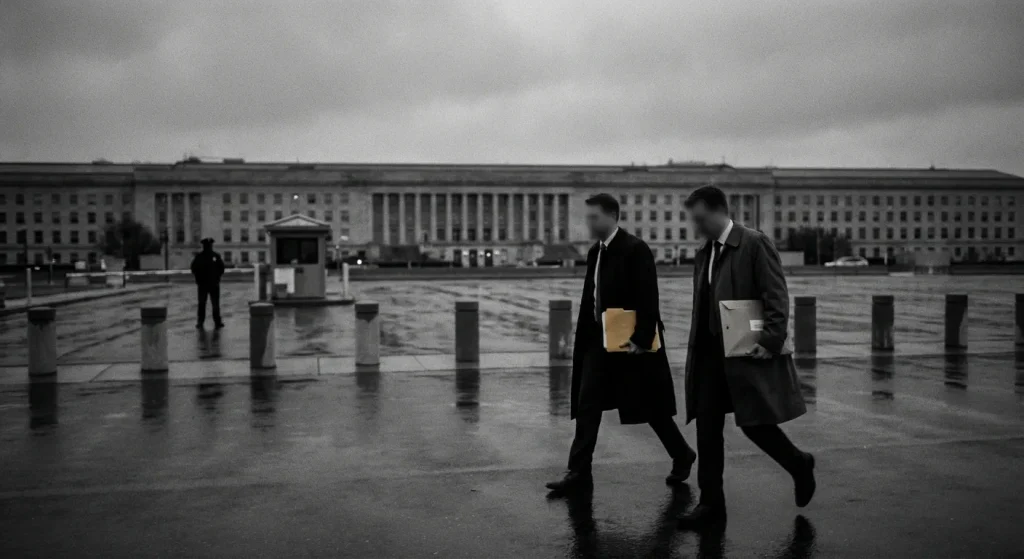
The Pentagon’s 2021 move on UFOs wasn’t a dramatic “disclosure” moment. It was a paperwork move with real consequences. The Department of Defense announced it was creating the Airborne Object Identification and Management Synchronization Group (AOIMSG), a new office aimed at bringing order to how the military handles Unidentified Aerial Phenomena (UAP), the DoD’s preferred umbrella term for what most people still call UFOs.
DoD said the point of AOIMSG was to “synchronize” efforts across the Department, and it explicitly framed the group as a replacement for the Navy’s Unidentified Aerial Phenomena Task Force. In other words, this wasn’t just expanding a Navy initiative. It was DoD pulling the mission upward and formalizing it as a department-level coordination function. DoD also stated the AOIMSG director would synchronize activities among elements of the Office of the Secretary of Defense (OSD), which tells you where the center of gravity was meant to sit: inside the Secretary’s office ecosystem, not out on the edge of a single service.
The mission language mattered because it signaled a shift in posture, not just a new acronym. AOIMSG was tasked to proactively identify objects in Special Use Airspace and to shift emphasis away from only reacting to observed items. That’s a coordination problem first: consistent reporting, consistent triage, consistent handoffs. But it also creates an immediate tension that never goes away in UAP policy: coordination can tighten internal processes while doing very little to increase public transparency.
This piece walks through how the Pentagon got to AOIMSG, what the mission and scope actually implied, why the office drew skepticism, how it evolved into AARO, and how Congress kept pushing the whole system toward more formal oversight.
Here’s the practical way to read the next “new office” Pentagon announcement: (1) circle the mission verbs like “synchronize” because they reveal the real job, (2) note what it replaces because that shows who’s losing and gaining control, and (3) track where it sits in the org chart because placement is policy.
How We Got to AOIMSG
AOIMSG didn’t pop out of nowhere in 2021. By that point, a formal coordination mechanism for UAP (official umbrella term) was basically the institutional endpoint of a pressure build: public artifacts hit wide circulation, intelligence agencies got tasked to summarize what they had, and Congress started treating “process and funding” as the real issue.
The operational inflection point was 2020, when the Pentagon publicly released three U.S. Navy videos of unidentified aerial phenomena. Whatever someone thinks the objects were, the release itself changed the environment inside government because it put “unknowns in military airspace” into the mainstream news cycle with official provenance, not rumor.
That matters in practical terms because pilots and range operators don’t get to wait for perfect answers. If something shows up near training areas or operating airspace and you can’t immediately identify it, you have two immediate problems: safety risk (near-misses, distraction, collision hazards) and security risk (unknown collection platforms, probing behavior). The moment the videos were made official, pressure rose to make reporting less ad hoc and more consistent across the places that actually see these events.
The friction is that media attention and public interest can spike in days, while bureaucracies take months or years to standardize reporting pipelines. That mismatch creates two bad outcomes at once: real safety concerns can sit in a queue waiting for a “proper” process, and the public narrative fills with speculation because the system can’t produce clean, comparable answers on demand.
In 2021, the Office of the Director of National Intelligence (ODNI) issued a Preliminary Assessment on UAP. The key detail for understanding why coordination became inevitable is what it said about inputs: the majority of the data reviewed came from U.S. Navy reporting.
That “Navy-heavy” sourcing tells you something important about collection, even before you argue about explanations. If one service accounts for most of the reporting, you’re not looking at an evenly instrumented problem set. You’re looking at uneven coverage, uneven incentives to report, and uneven sensor and operational contexts. Oversight bodies hate that, because it makes trend analysis messy and it makes resource decisions feel like guesswork.
This is also where rumor-vacuum dynamics get loud. When the public sees an official assessment but the data behind it is concentrated in one corner of the force, people naturally try to backfill the gaps with lore. Staying disciplined here is simple: treat the assessment as a snapshot of what was collected and shared, not as a universal census of everything that ever happened.
Once UAP was in official releases and in an ODNI product, Congress had an obvious next move: demand a durable process with funding. The public press framing made that explicit. A Gillibrand press release title points to a Gillibrand-Rubio bipartisan push for full funding of a UAP office, framed “amid heightened focus on airborne national security risks.” The same referenced press material identifies Sen. Mark Warner as Senate Intelligence Committee Vice Chairman and Sen. Chris Coons as Ranking Member on the Senate Appropriations Subcommittee on Defense, which is the combination that turns “we want answers” into oversight requirements and budget leverage.
That’s the non-obvious part of the story: once funding and appropriations become live, the issue stops being a niche debate about sightings and becomes a governance problem. Who collects? Who adjudicates? Who reports upward? Who pays? Those questions force institutional design, and institutional design is exactly where a formal coordination office comes from.
One information-hygiene reminder, because it comes up a lot in online threads: the supplied GAO, DHS, and State Department excerpts floating around do not mention AATIP, so they shouldn’t be used to “prove” side narratives in either direction.
- Check for official artifacts like declassified videos, statements, or formal releases, not screenshots and retellings.
- Look for an IC assessment that describes data sources, because collection bias (like Navy-dominant reporting) drives everything that follows.
- Track oversight and funding moves in press releases and appropriations language, because that’s where ad hoc attention hardens into an actual process.
AOIMSG Mission and Scope
All of that pressure, plus the Navy-heavy reporting baseline, is the setup for why DoD chose a coordination office instead of a flashy investigative unit. AOIMSG’s real story isn’t “a disclosure office showed up.” It’s that the DoD tried to take messy, inconsistent sighting reports and turn them into a managed workflow: less public-facing revelation, more internal coordination hub that keeps everyone rowing in the same direction.
“Synchronization” sounds abstract until you translate it into the daily mechanics of how a report moves. AOIMSG was described as shifting emphasis away from only reacting to observed items and instead proactively identifying objects, including in Special Use Airspace. That framing points to a shop built to manage process: get reports moving to the right desks fast, and keep the handling consistent across the department.
In practical terms, synchronization means four unglamorous but decisive actions: aligning reporting pathways (so a pilot, range control, base security, and an intel shop aren’t all inventing their own inbox); standardizing intake (same minimum data, same triage tags, same “what counts as actionable” thresholds); coordinating assessments (so safety, intel, and operational risk reviews aren’t duplicated or contradictory); and keeping efforts consistent across OSD elements (so one office isn’t quietly running a different playbook than another). The payoff is basic: fewer reports lost to bureaucracy, fewer parallel investigations, and a clearer picture of patterns that only show up when you aggregate data.
The friction is that a coordination hub doesn’t own every sensor, unit, or mission set. It has to persuade, route, and enforce standards without always having direct command authority. If you expected AOIMSG to be a single “UFO unit” that personally investigates every case, synchronization feels underwhelming. If you’ve ever watched cross-office reporting break down, it’s exactly the point.
Public-facing characterization of AOIMSG repeatedly framed its lane around Unidentified Aerial Phenomena (UAP) and “airborne” phenomena. That one word, airborne, became the flashpoint because real-world observations are not neatly sorted by altitude.
Related definition sets in UAP literature commonly carve the problem into three buckets: (A) airborne objects not immediately identifiable, (B) transmedium objects or devices, and (C) submerged objects or devices not immediately identifiable. “Transmedium” matters because it describes cases that appear to move between air and water, which is exactly the kind of boundary-crossing behavior an airborne-only lens can struggle to capture cleanly.
Once you put those categories next to the “airborne” label, the criticism writes itself: a scope word that sounds tight can unintentionally signal “we only care about A,” even though observers and sensors live across domains where B and C can show up. You don’t need to litigate anyone’s motives to see why people reacted; the observable world does not respect org charts.
Here’s the hard boundary with the provided source set: it does not verify named leadership roles for AOIMSG or identify specific participating DoD components in a way you can cite and stand behind. Some items in the set are personal or community posts, and others simply don’t contain organizational assignments. So if you’ve seen confident claims about “who ran it” or “which offices were officially in the loop,” treat those as unverified within this evidence base.
That gap matters because an office’s real power comes from who it can task, who it can compel to report, and which organizations are formally obligated to play by its standards. Without verifiable component participation, it’s easy to overestimate what “synchronization” can enforce in practice.
Bottom line: AOIMSG was designed to coordinate reporting and assessment, not to fulfill what many people hoped for, namely definitive “alien disclosure.” When you evaluate any UAP office, read it like an operator: pay attention to the scope words, the reporting boundaries, and what’s actually verifiable versus what’s assumed.
Why AOIMSG Drew Skepticism
Once you frame AOIMSG as an internal workflow fix, the public reaction makes more sense too: people were primed to look for visible results, not cleaner routing slips. The skepticism around AOIMSG was predictable. It didn’t land in a vacuum. Critics had been saying for years that the Department of Defense lacked a coordinated approach to track and report UAP, which leaves the public guessing who owns the problem, what gets counted, and what gets briefed upward. When an office is built primarily to coordinate inside the building, real work can happen and still look like nothing is happening from the outside.
That mismatch is the heart of the “too little, too internal” critique. People weren’t just asking for activity; they were asking for trust signals: clear authority, independence from the chain of command that might be implicated, regular public reporting, and a way to tell whether coordination produced tangible outputs. When those signals are weak or absent, silence gets interpreted as avoidance, even if the internal machinery is moving.
There’s also a practical friction here: the most sensitive details are often the least publishable. Classification can be legitimate, but without a public-facing rhythm for what can be released and why some things can’t, the default assumption becomes “they’re hiding it.” That isn’t proof of a cover-up. It’s what systems do when transparency is thin and expectations are high.
A second bucket of concern was scope. AOIMSG’s framing around identifying objects in Special Use Airspace and pushing the system to be proactive read, to some observers, like an “airborne objects” problem statement.
Some critics argued that emphasis risked excluding other evidence categories: things reported in maritime contexts, sensor anomalies that don’t resolve cleanly into “objects,” or incidents that involve potential effects across domains (air, sea, space, cyber, and intelligence). You don’t have to re-litigate definitions to see the fear in plain English: if your intake funnel is shaped like “airborne intrusion,” then anything that looks different can get treated as somebody else’s problem.
The nuance is that scoping language is often written to align with immediate defense priorities, not to satisfy public curiosity. But when the topic is already trust-starved, narrow-sounding scope language reads like a built-in escape hatch. The fix people wanted was simple: explicit “we will capture cross-domain reporting” statements backed by visible reporting metrics.
Oversight is the anchor that turns “trust me” into “check me.” The DoD Office of Inspector General conducted an evaluation of DoD actions regarding unidentified anomalous phenomena and produced a report. That matters because it’s concrete proof that oversight mechanisms exist, even if reasonable people disagree on what any one report implies.
And if you’re evaluating big UAP-related claims, whistleblower pathways are the other half of the credibility equation. A “protected disclosure” is a report made through legally recognized channels that trigger anti-retaliation protections, changing the incentives for insiders who are weighing whether to come forward. For service members, Title 10 U.S.C. § 1034 (the Military Whistleblower Act) covers protected communications. For most federal civilian employees, the Whistleblower Protection Act of 1989 applies. For Intelligence Community contractors, the FISA Amendments Act of 2017 expanded protections, which is a key detail when allegations touch classified programs.
None of this guarantees the public will see the evidence. IG processes can be slow, results can be redacted, and jurisdiction can be complicated. But it does give you a practical filter.
If you’re weighing a claim (or making one), look for whether it’s routed through protected disclosure pathways, whether an oversight body like an Inspector General can access the underlying details, and whether the allegation actually matches the office’s stated scope.
AOIMSG to AARO Evolution
That mix of skepticism, scope concerns, and oversight attention is the backdrop for why AOIMSG didn’t stay the final form. The shift from AOIMSG to the All-domain Anomaly Resolution Office (AARO) reads best as institutionalization: broaden the mandate, centralize the intake and resolution pipeline, and put deliverables on a schedule. It’s not automatic proof the government reached some hidden conclusion about what UAP “really are.” AARO’s practical role is to be the focal point that pulls in UAP reports across domains, drives resolution efforts, and feeds required briefings and reports up the chain and out to oversight.
That emphasis on “required” is where Congress shows up. The National Defense Authorization Act (NDAA) is the annual authorization law that sets defense policy and, in practice, tells DoD what structures and outputs it has to stand up. If you want a clean way to interpret the AOIMSG to AARO evolution, follow the NDAA language and the oversight hooks it creates, because that’s how these offices get shaped and reshaped.
On paper, “evolution” means Congress kept tightening the scope and boundaries of the work, not loosening it into speculation. FY2024 NDAA Section 924 directed the Secretary of Defense to study the feasibility and advisability of transferring the space components of an existing office (AOIMSG). That kind of instruction is a tell: Congress is thinking in org charts and authorities, including who owns the “space” slice of the problem set and whether that slice should sit somewhere else for better access, resourcing, or oversight.
Another signal comes from how UAP work gets positioned next to airspace security. Media-reported legislative language proposed requiring AARO to liaise with a newly proposed Counter-UAS (C-UAS) Task Force. That’s not about entertainment value. It’s about workflow: deconfliction, shared reporting channels, and making sure “anomalous” doesn’t become a junk drawer that bypasses the systems already built to track drones and other airspace threats.
You can see the same framing in public messaging around UAP funding pushes, which have been described as responding to heightened focus on airborne national security risks. That context matters because it pulls the conversation back toward detection, identification, and protection of sensitive airspace, even when the public conversation wants to sprint to conclusions.
Even the forward-looking language points to ongoing reorganization. The FY2026 NDAA executive summary includes language indicating older organizational provisions are being replaced with a new provision, which is exactly how Congress signals “we’re updating the machinery,” not “we’re revealing the answer.”
Expect more visibility on process, not necessarily more visibility on sources. What changed is the expectation of outputs: defined reporting cadence, categories, and briefings that can be audited by oversight. What didn’t change is classification. The most sensitive collection methods and some case details will stay locked, even if the office is more public-facing.
So judge updates like an analyst would: look for clear methodology, stable categories over time, data sourcing described at a high level, and transparent accounting of what’s unresolved versus resolved. A report that can’t explain how cases enter, how they get triaged, and what “resolved” means is noise.
- Check the mandate in the latest NDAA language: what domains, what authorities, what definitions are being enforced.
- Track deliverables: required briefings, report cadence, and whether metrics stay consistent across releases.
- Look for oversight hooks: studies, transfer feasibility reviews, and any explicit direction on org placement or responsibilities.
- Map adjacent mission ties like C-UAS liaison requirements, because that’s where “UAP” meets day-to-day airspace security.
Congress Turns Up the Pressure
If AOIMSG was the Pentagon formalizing coordination, Congress was the part of the system trying to formalize accountability. AOIMSG and its successors could coordinate and study, but they couldn’t settle the trust question on their own. So Congress started pushing on the levers it actually controls: putting testimony into formal hearing records, floating disclosure language that would force agencies to sort records, and tightening whistleblower-related protections so information can move to oversight channels without career-ending retaliation.
The late-July 2023 burst of oversight was designed to create something internal briefings rarely produce: a durable, citable public record.
One touchpoint was a House Judiciary Committee hearing held Wednesday, July 26, 2023, at 10:00 a.m. ET, with a title beginning “Oversight of the U.S.” The next day, a House Oversight and Government Reform Subcommittee hearing was recorded on July 27, 2023, at 10:00 a.m. Those dates matter because hearings don’t just generate headlines, they generate artifacts: written statements, Q&A, and transcripts that can be referenced later by staff, inspectors general, and other committees.
For readers trying to separate “said on cable news” from “said under a committee gavel,” Congress.gov is the cleanest starting point. It provides access to House committee hearing transcripts and lets you browse hearings by Congress, which is how you track what was actually entered into the record versus what was merely discussed around it.
The catch is that hearings create oversight pressure, not automatic disclosure. In a classified system, Congress can demand answers in closed settings and still keep most details out of public view. That can be real accountability while still looking like “nothing happened” to the public.
Proposed language is where Congress tries to move from “tell us more” to “build a process that forces sorting and release decisions.” The UAP Disclosure Act amendment in the 118th Congress stated its purpose plainly: “to provide for the expeditious disclosure of unidentified anomalous phenomena records.”
Its big swing was procedural, not rhetorical: the amendment declared a presumption of immediate disclosure for federal UAP records. That flips the default posture. Instead of disclosure requiring an affirmative push from an agency, the framework pressures the government to justify withholding.
But “presumption” still lives inside classification rules. A presumption of disclosure can increase the volume of reviewed records, formalize timelines, and narrow excuses. It does not guarantee that sensitive sources, methods, or defense capabilities become public, because those exemptions still exist. The point was to force structured triage, not to pretend classification disappears.
Oversight also depends on whether people inside the system can safely route information to Congress. The Intelligence Authorization Act for Fiscal Year 2026, as reported July 17, 2025, includes Section 802: protections for whistleblower disclosures to offices of legislative or congressional affairs. That targets a common chokepoint, the moment information moves toward Congressional engagement.
Another friction point is coercive fitness screening after someone reports. Senate Report 119-51 includes Section 805, “Whistleblower protections relating to psychiatric testing or examination,” amending the National Security Act of 1947. The practical effect is straightforward: it narrows the space to use psychiatric testing or examination as a pressure tactic after a protected disclosure (legally protected report).
When a “UAP disclosure” headline hits, sort it fast:
- Identify whether it’s a hearing (look for a committee, a date/time, and a transcript you can pull on Congress.gov).
- Check whether it’s proposed language (an amendment can be ambitious and still never become binding).
- Confirm what’s enacted (sections that become requirements change what agencies must do, even if the results stay partly classified).
What AOIMSG Means Going Forward
AOIMSG mattered less as an acronym and more as the hinge point where UAP stopped being a sporadic headline and became a durable national-security process. It started as a paperwork move built around coordination verbs like “synchronize,” and it replaced a Navy task force while positioning the work inside the OSD ecosystem, which is exactly the kind of bureaucratic detail that quietly changes who holds the pen.
The pre-2021 catalyst chain you already saw in this piece, the public videos, then the ODNI assessment built heavily on Navy reporting, made coordination inevitable because the same pattern kept repeating across units with no single intake or triage path. AOIMSG’s real tell was operational: proactively identifying objects in Special Use Airspace and shifting emphasis away from only reacting to what someone happened to observe. That scope met an immediate tension the body sections called out: the “airborne” framing that drove urgency, versus the broader “all-domain” reality people expected the government to capture. Better process also did not equal public “disclosure.” Classification, uneven data quality, and internal trust gaps kept the debate hot, and the skepticism drivers you read about, oversight demands, a persistent reporting-protection problem, and confidence in who controls the narrative, are exactly why Congress kept turning the pressure up.
When the next “UFO sightings 2025/2026” wave hits, sanity-check it with four filters:
- Provenance: Does the claim tie back to primary documents, official releases, or a named reporting channel, not screenshots and retellings?
- Data quality: Is there clear sensor context (platform, time, location, classification constraints) or just conclusions?
- Process fit: Does it describe how it entered the system, was it reported, triaged, and deconflicted, or just “leaked”?
- Oversight trace: Do the claims map to the oversight and reporting-protection debates, not just rhetoric about “non-human intelligence”?
AARO is the U.S. government office leading efforts to address Unidentified Anomalous Phenomena (UAP), so watch what changes inside its reporting plumbing, not what trends on social. AARO’s new secure reporting form, launched as the second phase of its reporting mechanism, is the kind of signal that actually moves case intake and standardization. Pair that with the Joint Staff guidance issued to the services on reporting, and you get the real story: whether people can report consistently, and whether the government can compare cases across commands without reinventing the wheel. Keep an eye on primary documents and official releases, and treat everything else as commentary until it connects back to the process.
Frequently Asked Questions
-
What is AOIMSG and why did the Pentagon create it in 2021?
AOIMSG stands for the Airborne Object Identification and Management Synchronization Group, created by the Department of Defense in 2021 to coordinate how the military handles Unidentified Aerial Phenomena (UAP). DoD said its purpose was to “synchronize” efforts across the Department rather than operate as a single-service initiative.
-
Did AOIMSG replace the Navy’s UAP Task Force?
Yes. DoD explicitly framed AOIMSG as the replacement for the Navy’s Unidentified Aerial Phenomena Task Force, pulling the mission up to a department-level coordination function.
-
What was AOIMSG’s mission and what does “synchronize” mean in practice?
AOIMSG was tasked to proactively identify objects in Special Use Airspace and to shift emphasis away from only reacting to observed items. In practice, the article describes synchronization as aligning reporting pathways, standardizing intake and triage, coordinating assessments, and keeping activities consistent across Office of the Secretary of Defense (OSD) elements.
-
What events led to AOIMSG being created (2020 videos and 2021 ODNI report)?
The Pentagon’s public release of three U.S. Navy UAP videos in 2020 increased pressure to standardize reporting for unknowns in military airspace. In 2021, ODNI’s Preliminary Assessment noted most of the data it reviewed came from U.S. Navy reporting, highlighting collection and reporting imbalance across services.
-
Why did AOIMSG draw skepticism about transparency and scope?
The article says AOIMSG looked “too internal” because coordination work can improve processes without producing visible public outputs, especially under classification. It also drew scope concerns because its “airborne” framing risked signaling a narrower focus than cross-domain cases people expected.
-
How did AOIMSG evolve into AARO and what changed?
The transition from AOIMSG to the All-domain Anomaly Resolution Office (AARO) is described as institutionalization: broadening the mandate beyond “airborne,” centralizing intake and resolution, and putting deliverables on a schedule. The article ties that evolution to Congress shaping requirements through NDAA language and oversight hooks.
-
What should I look for in the next Pentagon UAP office announcement to judge what it really does?
The article recommends circling mission verbs like “synchronize,” noting what the new office replaces, and tracking where it sits in the org chart because placement signals control. It also advises evaluating updates by methodology and workflow: how cases enter, how they’re triaged, and what “resolved” means, rather than expecting “alien disclosure.”
