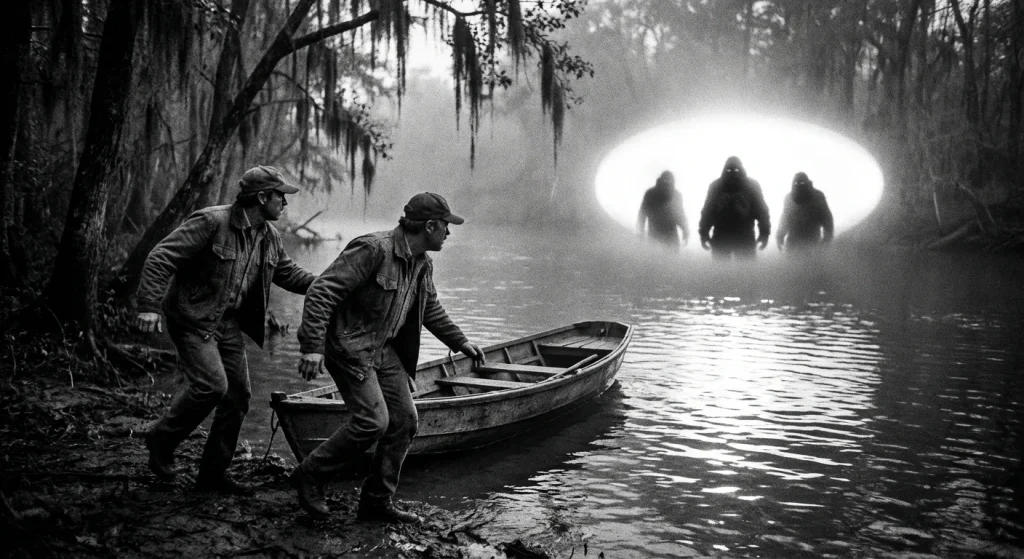
Pascagoula keeps resurfacing in UFO news because it does not behave like a pure campfire tale. It is anchored to paperwork and an artifact that lock the story to a specific night, even while the extraordinary claim at the center stays disputed. That combination makes the case hard to evaluate: the record is real, but what the record proves is narrower than what later retellings often imply.
The setting matters because it is ordinary. Think thick Gulf humidity, a late hour, and the flat quiet of a working waterfront where the air feels heavy and every sound carries. In a place like that, an alleged UFO (unidentified flying object) encounter lands with extra force, because “UFO” describes an object the witness cannot identify in the moment, not a confirmed origin or intent. The mood is grounded; the claim is not.
Three anchors keep the 1973 report from dissolving into folklore. Early accounts consistently date the incident to the night of October 11, 1973. Charles Hickson and Calvin Parker reported the event to the Jackson County Sheriff’s Department that same night. And a recorded in-room conversation at the sheriff’s office became a central artifact, repeatedly referenced in later discussions of what the men said when they thought no one was listening.
Those anchors do not settle what happened at the waterfront. They settle something more limited and more useful: what was reported, to whom, and when, plus the existence of a contemporaneous recording tied to the initial law-enforcement contact. The contest is over interpretation, and interpretation is exactly where decades of narrative gravity accumulate.
You will leave able to separate dated, checkable records from later amplification.
That separation starts by pinning down the mundane baseline-who they were, where they said they stood, and what the night looked like-before turning to the claimed sequence, and then to the records produced when the story hit law enforcement and the media.
Pascagoula, The River, The Two Men
The credibility debate around Pascagoula starts with ordinary geography and ordinary people: an industrial Gulf Coast river town, late-night bank fishing, and a plain, workaday reason for being there. That baseline matters because it narrows the range of plausible explanations later. The more mundane the setup, the sharper the interpretive conflict becomes when an extraordinary allegation collides with routine local behavior.
Pascagoula in 1973 read like a place organized around shifts, water, and heavy industry. The river and bay were practical infrastructure as much as scenery, with bridges and rail lines cutting hard paths through low, flat terrain. Night fishing fit that rhythm: a low-cost way to decompress after work in a town where being outdoors by the water was normal, not performative, and where a dark riverbank was an accessible, familiar margin of space.
In contemporaneous framing, Charles Hickson and Calvin Parker were described repeatedly as local shipyard workers who went fishing that evening. Their relationship is presented in early accounts in the most practical terms: two local men connected by the same working world, spending time together in a way that made sense in a shift-driven town. Before anything unusual was reported, the point is simple and constraining: they were doing something common, at a time and place where it was common, with a companion who had a straightforward reason to be there with them.
According to early accounts, they were reportedly fishing together on the west bank of the East Pascagoula River between the railroad and the Highway 90 bridge. That description anchors the story to a real corridor of infrastructure and shoreline rather than an abstract “out by the water” claim, and it gives investigators and reporters a concrete scene to verify, revisit, and dispute without relying on later retellings.
- Fix the who: treat them first as local shipyard workers described as going fishing, not as characters built from later legend.
- Fix the where: keep the reported site consistent, the west bank of the East Pascagoula River between the railroad and the Highway 90 bridge.
- Fix the when and why: start from a late, ordinary leisure routine after work, not an outing constructed to invite attention.
- Track the reporting path: they contacted the Jackson County Sheriff’s Office in connection with their October 11, 1973 account, a choice that shaped how authorities and media encountered the story.
Once those basics are held steady, the remaining question is strictly sequential: what, exactly, did they say happened next, and which parts of that sequence are actions we can place in the world versus claims about what occurred at the riverbank?
The Reported Encounter Minute by Minute
The only responsible way to recount the Pascagoula story is as a timeline of stated allegations, separated from whatever readers later conclude it means. Hickson and Parker’s account contains high-strangeness elements that people instinctively treat as evidence. This section does not. It pins down the reported sequence, step by step, and labels each component for what it is: either a documented action (such as going to law enforcement) or a claim they said occurred.
The reported event is placed on the evening of October 11, 1973, beginning with the two men fishing by the river. In their retellings, the encounter starts as an interruption to a routine stretch of fishing, followed by an unexpected observation they interpreted as a craft or object near them. The stable element across versions is that the shift from ordinary activity to alarm is triggered by something they said they saw and perceived as anomalous, not by an argument or a decision to stage a report.
Later accounts sometimes tighten the description of the object’s appearance and behavior into more vivid, confident language than early summaries, but the core claim remains the same: they reported noticing something they took to be a nearby craft and becoming immediately focused on it.
From that initial observation, their story moves into direct contact. Hickson’s accounts consistently frame the next beat as a sudden loss of control, described as being seized and unable to resist. Across repeated retellings, the motifs are capture, levitation, and paralysis: they reported being taken against their will, lifted or moved without normal bodily control, and rendered unable to fight or flee.
Parker’s later descriptions are frequently characterized by distress and disorientation; in many retellings he is portrayed as more overwhelmed during the alleged contact phase. Regardless of how later narratives emphasize each man’s reactions, the stable reported claim is that both were forcibly controlled at close range and physically transported by means they did not understand.
A consistent piece of the story is the presence of three entities. In their descriptions, the figures are often characterized as claw-handed and “robotic-seeming,” with an affect and movement that reads to them as mechanical or non-human. Hickson’s retellings typically supply the most structured description of their appearance and handling of the men. Parker’s retellings are more likely to foreground his fear response and the sense of being unable to intervene.
Across early and later accounts alike, the key stabilizers are the number (three) and the functional role: they reported these three figures physically controlled them and brought them into an enclosed space.
After the alleged seizure, both men’s story proceeds to a transition into an interior environment they interpreted as the inside of a craft. In their accounts, the practical point is not sightseeing or conversation; it is custody. They reported being moved into a contained room or chamber where they were placed in a position that limited their movement and kept them under control.
Details about the interior vary more across retellings than the exterior sequence does. The drift is usually in the form of added specificity: later accounts sometimes provide firmer statements about layout, surfaces, or the placement of the men relative to the entities. The stable claim is simpler: an interior space, controlled positioning, and a sense of being processed rather than engaged.
Retellings consistently include a “medical examination” element, and it must be treated as an allegation unless independently supported by documentation. In the reported sequence, this phase functions like an intake: the men described being subjected to procedures that they interpreted as clinical or diagnostic, carried out without consent and without a clear explanation. Hickson’s narrative is often the one that presents this as an organized, step-by-step examination. Parker’s narrative is often described as fragmented by panic, but it still sits within the same reported framework: restrained or immobilized, observed, and examined.
What remains consistent across versions is the claimed character of the interaction: they reported being treated as bodies to be assessed, not as people to be questioned, and they reported limited ability to resist during the process.
After the alleged examination, their story moves to release. They reported being returned from the interior space to the outside environment near where they had been fishing. This “back where we started” beat is one of the most stable structural points in the narrative because it sets up the immediate, checkable decision that follows: what they did next.
Their account culminates in an immediate aftermath defined by agitation, fear, and an urgent need to tell someone in authority what they believed had happened. The documented action, repeated in all responsible summaries, is that they later went to law enforcement claiming they had been abducted. Whatever a reader makes of the underlying claims, the sequence is clear at this point: they moved from the alleged release into a rapid decision to report an abduction rather than keep the event private.
The disciplined takeaway is the stable reported sequence later sections can test against records: fishing by the river on the evening of October 11, 1973; an anomalous object noticed; reported immobilization and forced transport; three claw-handed, robotic-seeming entities; a claimed medical-style examination; reported return; and a real-world choice to go to law enforcement and allege abduction. That is the timeline, separated cleanly into claims versus actions.
That final step-walking into a sheriff’s office-marks the point where Pascagoula stops being only a narrated experience and becomes a case with an institutional paper trail and a widely discussed recording.
Police Interviews and the Hidden Tape
The Pascagoula story becomes a documentable case at the moment Charles Hickson and Calvin Parker walk into the Jackson County Sheriff’s Department and make a report connected to the October 11, 1973 incident. That institutional step matters because it produces two things the public can later interrogate: an early law-enforcement record of what the men said and did, and the most-cited audio artifact tied to the night.
What is known in institutional terms is straightforward: they reported the incident to the sheriff’s office, they were interviewed at the station, and officers treated the account as a matter to be documented and assessed. A station interview creates a fixed point in time: who reported, when they reported, and what they said in response to questions. The friction is that an interview is also an environment with built-in pressures. People perform differently in front of authority, under fluorescent lights, after a shock, or while trying to be believed. The reliable takeaway is narrow but useful: the sheriff’s-office response generates the earliest structured record available from the principals, captured close to the claimed timeline.
During that law-enforcement sequence, an in-room recording was made while the men were left alone, and that recording became a central referenced piece of evidence in the case’s public life. People focus on it for a simple reason: it feels unfiltered. A moment without direct questioning reads like a stress test, and listeners treat it as a window into spontaneity rather than storytelling. The catch is that “spontaneous” is still a context, not a truth machine. An audio segment can document voices, timing, and demeanor in that room, without establishing what happened outside it.
What is known and what is not is important to state plainly. What is known: contemporaneous reporting and later archival guides confirm that Hickson and Parker reported the event the night of October 11, 1973, and that a hidden or in-room recording exists and has circulated in public forms (see the case summary and reporting linked below, including a collection guide and local news reporting that recounts the tape). What is not publicly confirmed: the exact archival location or catalog number of an original master tape held by law enforcement, and a formally documented chain of custody for any purported “original” master. Several recent accounts note disputes over provenance and whether circulating audio represents an original master or later copies (see local reporting and archival guides for discussion and context) (Clarion Ledger, 2020), (Hinds Community College libguide), (Wikipedia summary).
Chain of custody is the evaluative hinge here because it tells you whether the audio you hear is the same artifact created in the room, handled in a documented way from recording to storage to release. If the earliest generation recording is unavailable, if copying steps are unclear, or if there is no documentation of who possessed it and when, confidence drops. That does not make the tape worthless; it limits what it can establish. With a solid chain of custody, the recording can strongly support claims about what was said at the station and in what apparent condition. Even with perfect custody, it cannot prove the external event described; it only proves the captured moment occurred as recorded.
- Ask for the earliest-generation recording available, not a later copy or compilation.
- Demand documented handling: who recorded it, who stored it, who copied it, and when each transfer occurred (the chain of custody).
- Verify recording conditions: where the device was placed, what the room setup was, and what happened immediately before and after the segment.
Once an official report exists, the next force shaping what the public thinks it knows is not the sheriff’s file but the media pipeline that selects, compresses, and repeats the most durable parts of the story.
Media Storm and Early Investigations
The Pascagoula case didn’t become durable because of a single artifact or a single interview. It became durable because the media pipeline turned a local report into a repeatable national story, and repetition is what converts a claim into a reference point.
Early coverage starts with proximity: local reporters can name places, quote officials, and capture uncertainty while it is still uncertainty. Once a story moves outward through syndication and wire services, then into broadcast interviews, the incentives change. Editors need a clean headline. Producers need a short segment with a memorable hook. Every handoff compresses context, favors the most repeatable details, and quietly drops qualifiers that were present in the earliest write-ups.
After a few cycles, the same details get quoted back to new audiences, then cited as if they were independently confirmed. That is how narrative hardening happens: not through fraud, but through the physics of distribution.
Public follow-ups added fuel. Reports that one of the men “passed” a lie detector test were publicized, but the meaning of such reports is limited. Polygraph results have restricted admissibility and use in many U.S. legal contexts, and their scientific reliability is contested. For an overview of legal practice and limits on polygraph evidence, see the Department of Justice Criminal Resource Manual on polygraphs and summaries of scientific assessments of polygraph reliability (DOJ Criminal Resource Manual), (American Psychological Association summary).
A primary source is any dated material produced at the time, for example contemporaneous newspaper stories, wire copy, and broadcast transcripts, and it is your best tool for pinning down what was actually claimed before it was streamlined. Later reinvestigations and modern UFO journalism often revisit legacy cases, but they frequently pull from prior summaries, which means you are reading layers of interpretation, not the original record.
- Start with contemporaneous local reporting to capture names, dates, and hedged language as originally published.
- Compare wire and syndicated versions to see what got shortened, standardized, or promoted into the headline.
- Check broadcast interviews for phrasing that later write-ups quote as definitive.
- Demote investigator summaries and documentaries to secondary sources unless they quote documents you can inspect.
- Track every modern claim back to the earliest printed or recorded version before accepting it as “established.”
That sourcing discipline is also the quickest way to understand why Pascagoula remains contested: the best materials fix what was said and how it spread, while the event itself still depends on interpretation under imperfect conditions.
Primary Sources & Key Early Coverage
Below are named starting points to locate contemporaneous newspaper coverage, law-enforcement records, and the in-room recording. For each item I list where the material is reported to be held or where to begin a search. Exact catalog numbers are often not publicly disclosed for local law-enforcement files; when a specific identifier is not available I note that explicitly.
- Jackson County Times (local paper). Contemporary coverage of the October 11, 1973 report was carried in local Jackson County outlets. Microfilm holdings for Jackson County titles, including local papers such as the Jackson County Times, are reported as available at the Jackson County Chancery Court Archives in Pascagoula. See the Oceans Springs Archives newspaper research page for local microfilm direction: Oceanspringsarchives.
- Mississippi State University Special Collections. The Special Collections department maintains microfilm listings for Mississippi newspapers (requestable alphabetically by town), a starting point for hunting October 1973 local coverage: Library Msstate.
- University of Mississippi Archives & Special Collections. For primary-source research methods and regional holdings that include Mississippi newspaper and archival material, consult the university guide: Guides Lib Olemiss.
- Jackson County Sheriff’s Department report (Oct. 11, 1973). Multiple summaries note Hickson and Parker reported the event to the Jackson County Sheriff’s Office the night of October 11, 1973, but an official incident report number (if one exists in a public archive) is not publicly confirmed. See the case synopsis and archival discussions: Wikipedia, Aquila Usm.
- In-room recording and transcript access. An audio recording from the sheriff’s office interview (the 1973 recording) is documented in local reporting and college-level archival guides and has been made available in circulated copies. A useful repository page collecting references and links to the known 1973 recording is Hinds Community College’s paranormal research libguide: Libguides Hindscc. Local reporting on a recording that surfaced in 2020 provides additional provenance discussion: Clarion Ledger, July 13, 2020.
- Academic treatments and transcript citations. Scholarship and student work collect and cite transcripts and primary materials; an example is an honors thesis from the University of Southern Mississippi that compiles case citations and references to primary material: Aquila Usm.
- Magazine and regional publications. Magazine and regional pieces that reprint or summarize early accounts can provide published transcripts or excerpts; one example of periodical coverage that has republished material is Country Roads magazine (see a recent online issue for contextual reporting): Issuu.
- Aggregated starting point. A consolidated summary and bibliography is available on the Wikipedia page for the incident, which lists many primary and secondary references to consult: Wikipedia. Use Wikipedia only as a guide to primary citations, then track those citations to original microfilm, broadcast, or archival records.
Practical note: start with October 11, 1973 local issues and the days immediately following (October 12-15, 1973) when searching microfilm and digitized collections for earliest coverage. Where a precise law-enforcement file number or an original tape accession number is not publicly posted, explicitly label that identifier “not publicly confirmed” before assuming it can be independently checked.
Skeptics, Hoax Theories, and Open Questions
The case stays unresolved for a simple reason: the strongest documentation captures reporting behavior, not the external event itself. A report being made, an interview being recorded, and two people repeating an account are documented facts. What the experience “was” is an interpretive leap that has to compete with multiple ordinary mechanisms that can produce sincere, detailed testimony.
Low light, distance, and stress compress perception into fast, high-confidence impressions. Once you add glare off water, obstructed sightlines, and the brain’s tendency to complete partial patterns, “I saw something” can harden into “I saw a structured craft” without anyone deciding to embellish. The skeptical point is not that witnesses lied; it’s that error bars widen sharply when observation quality drops, and extraordinary interpretations demand exceptionally tight observation.
After the first retelling, memory becomes reconstructive: people recall the last version they told, not the original perception. Confabulation fills gaps with plausible detail, and contamination occurs when later conversations, questions, or media framing supply imagery that feels like personal recall. Publicity adds a second force: social reinforcement. Once an account becomes a local and then national story, attention rewards specificity, and supporters and critics both pressure the narrative into cleaner, more dramatic shapes.
That’s why “inconsistencies” have to be handled like a record problem, not a vibe check. When accounts evolve across retellings, the disciplined move is comparing dated primary sources (contemporaneous interviews, early notes) against later secondary narratives that paraphrase, summarize, or dramatize.
Hoax hypotheses cluster around motive and opportunity: notoriety, financial upside from interviews, or the simple thrill of successfully pulling off a story. A clean skeptical map also includes hybrid scenarios, where an initial misperception becomes a consciously curated narrative after the spotlight arrives. This doesn’t require cartoonish villainy; it requires only that incentives exist and that repeated retellings reward commitment.
The same three touchpoints that keep Pascagoula from floating free of calendar time-an immediate report to authorities, the existence of an in-room recording, and the persistence of core motifs even as peripheral details shift-also define the ceiling on what the case can establish. They are strong for reconstructing reporting and demeanor, and weak for proving what occurred outside the station.
The open issues are concrete: what details can be pinned to the earliest dated sources, what elements first appear only after sustained publicity, what independent witnesses or physical traces can be time-locked to the same window, and what parts of the account are falsifiable rather than interpretive.
- Separate what is documented (reports, recordings, dated statements) from what is inferred (craft type, entities, intent).
- Compare early primary sources against later retellings, logging exactly when new details enter the record.
- Identify alternative mechanisms that fit the same facts: perception limits, memory contamination, social reinforcement, or fabrication incentives.
- Define what would change your view: a time-locked independent witness, a contemporaneous physical trace, or a contradiction in the earliest record that cannot be reconciled.
Those open questions are why Pascagoula keeps getting pulled into modern disclosure debates: it is an older civilian story with unusually sticky documentation, arriving in an era that increasingly demands standardized reporting and evidence handling.
Why Pascagoula Matters in UAP Disclosure
Pascagoula still lands the same way at the human level: two men, a terrifying claim, and local law-enforcement artifacts that keep the story anchored to a specific night. What changes in 2025 and 2026 is what people treat the case as evidence of. The disclosure era adds official vocabulary, formal reporting channels, and legislation-style record hunts that push older stories into arguments they were never built to settle.
“UAP (unidentified anomalous phenomena)” is a policy-driven umbrella term that deliberately stretches past “lights in the sky” and into anything anomalous that might matter to safety, intelligence, or defense decision-making. That linguistic shift pulls legacy UFO narratives into a wider frame: instead of debating a single extraordinary claim on its own terms, the public asks whether it belongs to a larger, government-trackable category with standards for data, chain of custody, and analytic triage.
AARO, the All-domain Anomaly Resolution Office, exists to collect and evaluate UAP reports, maintain an array of historical UAP reports, and promote transparency through public releases and reporting guidance. See AARO’s mission statement and overview on its official site and the AARO historical record report. In particular, consult AARO’s Mission-Vision page and the office’s Report on the Historical Record of U.S. Government Involvement with Unidentified Anomalous Phenomena, Volume 1 (2024) for the office’s stated purposes and historical scope (AARO Mission-Vision), Report on the Historical Record of U.S. Government Involvement with Unidentified Anomalous Phenomena, Volume 1 (2024). Consolidated annual reports and interagency products (for example, a DOD/ODNI consolidated annual UAP report dated November 2024) further describe how historical and recent reports are being catalogued and reviewed (DOD-AARO Consolidated Annual Report on UAP, Nov. 2024).
Public summaries of official UAP work have emphasized, as assessed in those reports, that many historical public reports do not establish evidence of extraterrestrial technology or confirmed non-human intelligence when evaluated against multi-sensor, provenance-verified standards. For readers, the practical distinction is clear: citing AARO materials and the 2024 historical volume makes it explicit that modern offices prioritize sensor corroboration, documented chain of custody, and standardized reporting practices; they do not retroactively “adjudicate” every older civilian abduction claim as part of a single institutional finding.
Today’s UAP frameworks privilege sensor-derived incidents and national-security reporting pipelines: radar, infrared, pilot logs, intelligence channels, and standardized case management. Pascagoula is a civilian abduction claim whose core evidentiary weight sits in testimony and local documentation, not a multi-sensor track. That mismatch is why the case gets rhetorically reused: it is vivid enough to fuel disclosure arguments, but structurally unlike the incidents modern processes are designed to resolve.
Proposed disclosure legislation has added record-seeking mechanisms and explicit “non-human intelligence” terminology, which predictably triggers renewed digging into older cases for paper trails, missing files, and institutional touchpoints. Read Pascagoula accordingly: as a case study in documentation, narrative drift, and how institutions respond to extraordinary civilian reports, not as a substitute for official confirmation in the modern UAP system.
Put plainly, the modern frame increases demand for provenance, custody, and time-locked records-the same criteria that determine which parts of Pascagoula can be discussed as fixed and which must remain attributed allegations.
What We Can Say With Confidence
Pascagoula endures for a simple reason: its paper trail and the much-cited in-room audio are real touchpoints, while the central event itself remains unverified. The setting never needed mythmaking, either. Two men fishing in a working river town is ordinary enough that the case’s staying power comes from documentation, not atmosphere.
Documented anchors: the reported date is October 11, 1973; a report was made to the Jackson County Sheriff’s Department; and an in-room recording made during the sheriff’s-office interviews exists and is frequently cited in later retellings.
Claimed elements (allegations requiring attribution): the mechanics of the abduction including non-human entities, paralysis and levitation, and a medical-style examination are claims, not independently verified facts.
The debate does not end because the parts people most want to “prove” depend on evidence handling: without a clearly documented chain of custody and provenance for any physical items, there is no responsible way to move from story to specimen, even if evidence was gathered and stored under standard protected procedures.
Media pipelines add another layer: once a case spreads through journalism, books, and film, details drift toward the most repeatable version. Polygraph reports were publicized in the case’s early coverage, but polygraph evidence is often inadmissible or limited in U.S. courts and its scientific reliability remains contested. For legal context and scientific discussion see the Department of Justice manual and the American Psychological Association materials cited above (DOJ Criminal Resource Manual), (APA polygraph overview).
The responsible script is straightforward: cite the anchors (date, sheriff’s report, recording), label the encounter mechanics as alleged, and demand archival transparency. Libraries, museums, and archives exist to preserve and provide access, but access depends on documented procedures and materials that survive long-term deterioration, especially for audio and film.
Frequently Asked Questions
-
What is the Pascagoula abduction case from 1973?
It is a reported UFO abduction claim involving two Mississippi fishermen, Charles Hickson and Calvin Parker, dated to the night of October 11, 1973. The case is notable because it includes a same-night report to the Jackson County Sheriff’s Department and a recorded in-room conversation from the sheriff’s office.
-
Who were Charles Hickson and Calvin Parker and what were they doing that night?
Early accounts describe them as local shipyard workers who went night fishing. They said they were fishing together on the west bank of the East Pascagoula River on October 11, 1973.
-
Where did Hickson and Parker say the Pascagoula encounter happened?
They reportedly placed the site on the west bank of the East Pascagoula River. The article anchors it more specifically as between the railroad and the Highway 90 bridge.
-
What did Hickson and Parker claim happened during the encounter minute by minute?
They reported noticing an anomalous object, then being immobilized and forcibly transported. Their account includes three “claw-handed” robotic-seeming entities, an interior space they interpreted as a craft, a claimed medical-style examination, and then being returned near where they started.
-
What is the “hidden tape” from the Pascagoula sheriff’s office and why does chain of custody matter?
It is an in-room recording made while Hickson and Parker were left alone during the Jackson County Sheriff’s Department interviews, and it’s frequently cited because it captures what they said when they thought no one was listening. Chain of custody matters because it documents who recorded, stored, and copied the audio and when, which determines whether the recording can be trusted as the original artifact of that night.
-
What should you check in primary sources to separate early records from later retellings of Pascagoula?
Use contemporaneous materials-local newspaper coverage, wire copy, and broadcast transcripts-to pin down what was claimed before it was streamlined by repetition. Then compare those dated sources against later summaries and documentaries to log exactly when new details first enter the record.
-
How does the Pascagoula case compare to modern UAP disclosure standards like AARO’s approach?
The article describes Pascagoula as a civilian abduction claim whose evidentiary weight is mainly testimony plus local documentation (a sheriff’s report and an audio recording), not a multi-sensor incident. Modern UAP frameworks prioritize provenance, chain of custody, and sensor-derived data, so Pascagoula functions better as a case study in documentation and narrative drift than as an official finding.
