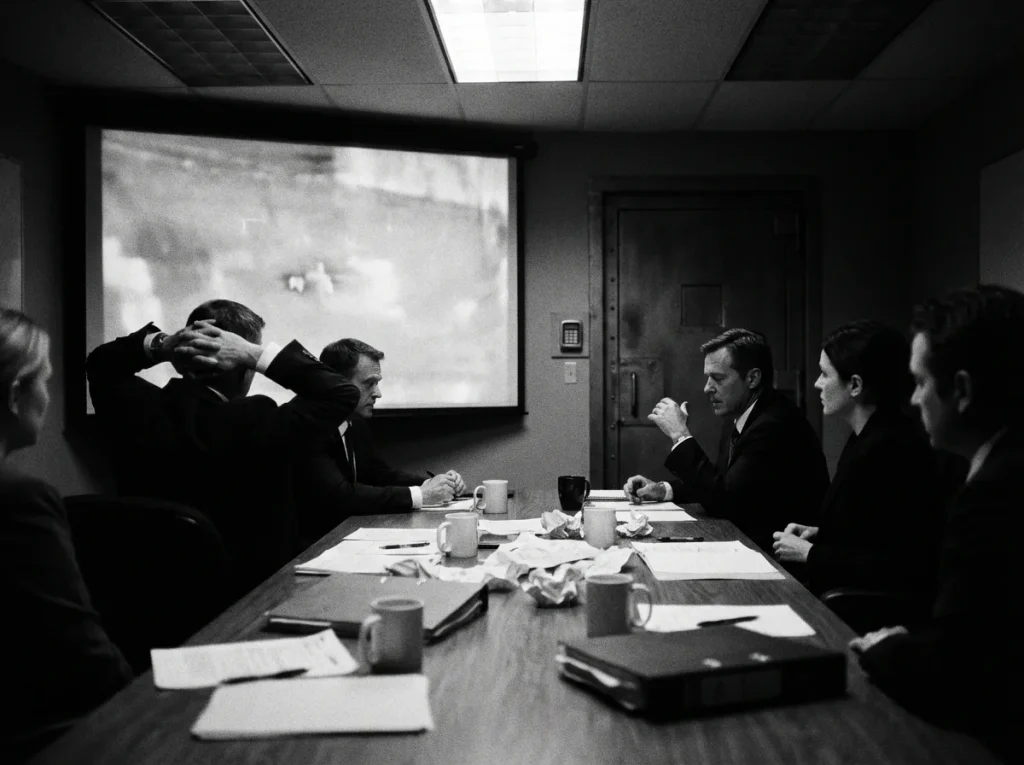
December 2017 is when this stopped being a cultural argument and became a Pentagon problem. If you keep seeing “UFO disclosure” headlines and you can’t tell what actually changed inside government versus what’s just recycled pop culture, you’re reacting to a real shift in posture, not a new wave of internet hype. The New York Times, Dec. 16, 2017
The pressure is practical: you have to decide which claims deserve attention, which ones are just content, and which details are grounded in official statements instead of lore.
The stakes sit in a hard tradeoff. National-security organizations run on secrecy and classification, but democratic oversight runs on traceable facts, and public trust collapses when the government looks like it is managing optics instead of accountability.
For decades, the official baseline was closed-book. Project Blue Book was publicly ended after investigators found no evidence UFOs were extraterrestrial or a national-security threat, and that conclusion anchored the government’s public posture: the case was investigated, wrapped up, and put away.
That is why the December 2017 New York Times report hit differently. The story didn’t just revive “UFOs” as a topic; it asserted a Pentagon-linked program existed inside the Department of Defense, and the Times reported the Pentagon had never before acknowledged that program’s existence at the time of the story. NYT, Dec. 16, 2017
Once a major outlet put “unacknowledged, Pentagon-linked, taxpayer-funded” into the same sentence, incentives changed immediately. Congress had a clearer reason to demand briefings and paper trails, the Department of Defense had a reason to draw a defensible boundary around what was true, and future insiders had a reason to come forward with documentation instead of anecdotes.
That boundary showed up fast: the Department of Defense later said it shut down the program in 2012. NBC News reporting on the Pentagon statement
You leave this article knowing what the New York Times actually reported, what the government did next in response, and how to verify new claims without getting pulled into speculation.
What the NYT Actually Revealed
The 2017 reporting landed because it packaged four things tabloids rarely deliver in the same breath: a previously unacknowledged, Pentagon-linked effort to track and study UAP (Unidentified Anomalous Phenomena, the government’s catch-all label for aerial observations that remain unresolved), a specific date window, named people and organizations, and three concrete artifacts in the form of cockpit videos. A single insinuation is easy to wave away. A named program, a budget line, and footage the public can watch creates an argument the Department of Defense has to address on the record.
The piece framed that effort around AATIP (Advanced Aerospace Threat Identification Program), described as a Defense Department initiative active in the 2007 to 2012 timeframe. Just as importantly, the report treated the work as real administration, not folklore: a program title, a period of activity, and a trail of participants tied to contracting and briefings. That structure is what made the story structurally different from prior “UFO news,” even for readers who assumed the government had stopped taking the subject seriously. NYT, Dec. 16, 2017
The complication arrived immediately: the acronym map. Alongside AATIP, public discussion kept circling AAWSAP (Advanced Aerospace Weapon System Applications Program), a separate program name that shows up in reporting and commentary about the same 2007 to 2012 window. The dispute was not whether some Pentagon-linked activity existed, the dispute was how to label it and how to attach the funding narrative to the correct label.
The widely cited funding figure was about $22 million, and the sourcing around that number has never been universally presented as “AATIP’s budget.” Some sourcing attributes the $22 million to AAWSAP rather than AATIP, even while other descriptions compress the story into a single program for readability. In practical terms, the money fight muddied public understanding while failing to erase the core revelation: a documented, Defense-connected effort existed in that 2007 to 2012 period, and it was treated as official work with enough structure to generate contracts, reports, and briefings.
That distinction matters because it changes what, exactly, is being claimed. “AATIP got $22 million” is a different statement than “AAWSAP received the $22 million and AATIP is an adjacent or successor label used in related contexts.” Readers who want clean facts separate the existence claim (a programmatic effort happened) from the bookkeeping claim (which named program owned which dollars).
The other reason the story resisted dismissal was the inclusion of a frequently cited contracting and research-management pathway tied to Robert Bigelow-related entities. Public reporting and subsequent discussion commonly link work connected to these programs to Bigelow Aerospace and to BAASS (Bigelow Aerospace Advanced Space Studies) as the kind of intermediary organizations that would manage studies, collect reports, and coordinate deliverables under a government contract.
That framing also intersected with Luis Elizondo’s name in the reporting context, where he was presented as associated with AATIP in a leadership or administrative capacity. Whether readers accepted every inference or not, the presence of identifiable individuals and corporate entities shifted the conversation from “someone says the Pentagon cares” to “these are the people and organizations described as connected to a specific set of activities.”
Then came the artifacts, the piece of the package that non-specialists could evaluate without decoding contracting language. The three videos were identified as FLIR1 (often linked to the 2004 Nimitz incident), GIMBAL, and GOFAST. Whatever anyone concluded about what the objects were, the existence of the clips created a fixed reference point: the discussion was no longer purely secondhand.
A clean way to track what the reporting set in motion is a short timeline that ends where the public record became explicit.
- Describe a Pentagon-linked effort in the 2007 to 2012 window, tied in reporting to AATIP and debated publicly alongside AAWSAP, with a widely cited roughly $22 million funding figure whose attribution is contested between the two program names.
- Circulate three Navy cockpit videos under the names FLIR1, GIMBAL, and GOFAST, giving the public tangible artifacts to interrogate rather than rumor.
- Confirm in April 2020 when the Department of Defense “approved for release” and “officially released” three unclassified videos of Navy encounters, an action described in contemporary reporting as the Pentagon’s formal release and public confirmation of the footage. CNN, Apr. 27, 2020 The three clips had circulated publicly in prior years before the DoD’s April 2020 action. Popular Mechanics on earlier circulation
The credibility shift came from the reporting package itself: named programs (AATIP and AAWSAP), a defined 2007 to 2012 activity window, identifiable individuals and a contractor pathway discussed in relation to Bigelow Aerospace and BAASS, and videos that the DoD later authenticated and released officially in April 2020. The actionable takeaway is to keep two buckets separate: what is documented or officially confirmed (the videos’ authenticity and the reality of a Pentagon-linked effort) versus what remained contested in framing (the $22 million attribution and how AAWSAP and AATIP relate as labels). That separation prevents readers from treating genuine confirmation as proof of every surrounding narrative, while also preventing paperwork disputes from erasing what was, in fact, acknowledged.
Once programs, personnel, and artifacts were tied to a defined window, the remaining argument could not stay at the level of pop-culture belief. The question narrowed into how the national-security system would treat unknowns that appear in operational environments.
The National Security Reframe Takes Hold
After the 2017 reporting pushed UAP back into serious circulation, the dominant question stopped being “what is it?” and became operational: what is operating inside controlled airspace and inside military training ranges. That framing matters because a fast-moving unknown in a range is not a cultural mystery; it is a safety and readiness problem that collides with live flight operations, real-world rules of engagement, and instrumented sensor suites designed to classify aircraft.
The friction is obvious in practice: pilots have to fly the jet, deconflict traffic, and keep the training objective on track, all while an unidentified track can blow up the plan. The only workable resolution is to treat UAP reports like any other hazard report: capture the track, preserve the sensor context, and route it through a defined chain so the event can be assessed rather than argued about.
DoD and ODNI (Office of the Director of National Intelligence) keep the issue in a national-security lane for four public, operational reasons. First is airspace safety and direct risk to flight operations: near-miss potential, distraction, and unknown intent in shared airspace. Second is proximity to sensitive sites and national-security activities, where an unidentified object is automatically a security problem regardless of origin. Third is sensor and ISR (intelligence, surveillance, reconnaissance) integrity in operational environments: if unknown objects are generating tracks, spoofing signatures, or stressing collection systems, the reliability of the entire kill chain and intelligence picture is in question.
The fourth is counterintelligence and strategic surprise: an unidentified presence near forces, ranges, or critical sites is the exact scenario adversaries exploit to collect, probe, and map responses. DoD and ODNI also explicitly keep the foreign-adversary platform question on the table as a threat to be assessed, while AARO has publicly stated it has no indication or confirmation that observed UAP are attributable to foreign adversaries. The actionable takeaway is simple: treat UAP as an identification and attribution problem, not an internet debate.
The USS Nimitz cluster is the cleanest anchor because it is a dated, localized operational event: November 2004, near the Baja Peninsula, during training with the USS Nimitz Carrier Strike Group. Cmdr. Dave Fravor and Lt. Cmdr. Alex Dietrich are directly tied to the encounter, which is why it persists as a reference point in military discussions.
The second anchor is less cinematic and more consequential: increased U.S. Navy sightings in later years that pushed leadership toward a repeatable reporting posture. The nuance is that single events invite mythology; clusters drive process. Enough reports in the same operational ecosystem force the institution to decide whether it is collecting data or collecting stories.
The concrete shift was behavioral. Pilot stigma dropped, reporting volume increased, and the Navy moved toward standardized capture instead of ad hoc anecdotes. On April 24, 2019, the U.S. Navy issued guidance to standardize reporting of “unexplained aerial phenomena” (UAP), explicitly instructing personnel how to report incidents and enabling associated radar or other sensor data to be gathered and stored long term. Navy FOIA reading room (UAP documents) CNN, Apr. 24, 2019
That standardization is the practical dividing line between noise and analysis. Evaluate any new UAP claim the same way an operations shop would: what data exists, which sensors collected it, and what reporting pathway handled the event from cockpit to archive.
From AATIP to AARO
After 2017, the Pentagon’s durable response wasn’t a single revelation. It was process-building: standardized reporting, centralized triage, and controlled public messaging designed to turn scattered sightings into a managed workflow. The tradeoff is immediate: the more the system treats these incidents like regulated intelligence and safety inputs, the less room there is for open-ended public validation. The practical result is that “new UAP news” increasingly reflects administrative decisions, not sudden breakthroughs.
The Navy’s move toward standardized reporting created the template for broader institutional handling: normalize the pipeline, reduce stigma, and make reports comparable enough to analyze. The cultural friction remains the same one operators have described for years: reporting anything unusual can invite stigma or create paperwork risk, so guidance and routing matter as much as curiosity about the underlying events.
The next step was to stop treating these cases as a series of one-off unit problems. The Department of Defense formally established the All-domain Anomaly Resolution Office (AARO) in an official document posted July 20, 2022, designating it as the authoritative office for UAP-related activities within DoD. DoD memo, July 20, 2022 DoD announcement That mandate signals formal coordination across domains and organizations: one office to intake, deconflict, prioritize, and push cases through consistent analytic standards. Critics fixate on transparency because authority cuts both ways. A single gatekeeper can improve consistency, but it also controls access, decides what evidence can be shared beyond secure channels, and determines what gets counted as “resolved.”
Public-facing reports are built to standardize case categories, reduce reporting stigma, separate explainable incidents from unknowns, and protect sources and methods. FOIA’s nine exemption categories, plus DoD FOIA rules and guidance, formalize why sensor performance, collection methods, and operational context often stay classified even when an incident is acknowledged publicly.
That design creates a predictable credibility gap: the same classification rules that protect sensitive capabilities also limit what outsiders can independently validate. In late 2024, AARO publicly reported on hundreds of cases, including some it did not explain, while also describing caseload growth since prior updates. Reporting on AARO caseloads DefenseScoop later reported the caseload appeared to have grown by at least 400 cases since that late-2024 update. DefenseScoop, Feb. 25, 2026 Public materials have continued to reference report-based work, including a 2025 report tied to a workshop held at Associated Universities, Inc. headquarters in August 2025. AUI report on 2025 workshop AARO UAP records page
The actionable lens is simple: when a headline claims momentum, ask which lever moved. Was it a reporting pipeline change, a case-triage change, or a disclosure decision? Each implies a different evidence standard, and only one of them necessarily changes the underlying facts.
That managed workflow also creates a clear target for oversight. Once an office is designated as authoritative and a pipeline exists, Congress can interrogate who controls intake, what gets briefed, and what remains behind classification walls.
Congress, Hearings, and Whistleblower Pressure
Congress turned UAP from an internal defense issue into an oversight contest, forcing sworn testimony, document demands, and public accountability. That shift matters more than any single claim: once members treat UAP as a governance problem, the pressure moves to process questions the executive branch cannot ignore indefinitely, like who briefed whom, what programs exist on paper, and what records are produced to support or refute allegations raised under oath.
The July 26, 2023 House Oversight hearing, titled “Unidentified Anomalous Phenomena: Implications on National Security, Public Safety and Government Transparency,” was the pivotal signal that UAP had entered routine oversight machinery. The witness table itself made the point: it included David Grusch alongside former military pilots, putting operational encounters and institutional allegations in the same public record. House Oversight hearing page (July 26, 2023) Congress.gov event record Sworn testimony raises the cost of casual dismissal, and the hearing’s transparency framing made “show the documentation” a mainstream demand rather than a niche refrain. Even if much of the underlying material remains classified, the hearing created a durable reference point for follow-on requests, closed briefings, and more specific questions that can be tested against records.
Whistleblowers became central because they can allege programmatic concealment from inside the system, which is the exact trigger Congress needs to justify more aggressive oversight. The friction is structural: classification rules and nondisclosure agreements constrain what can be said publicly, and hearings are designed to build a record, not to adjudicate the truth of classified assertions in real time. The result is a predictable gap between what an audience hears and what investigators can verify inside secure channels.
David Grusch illustrates both the power and the limits of this pathway. He is publicly identified as a whistleblower alleging U.S. retrieval of non-human craft and related concealment. He previously served at the National Geospatial-Intelligence Agency (NGA), is described as a decorated former combat officer, and his case has been framed as a test of newer whistleblower protections. Those are credentials and a legal posture; they are not, by themselves, corroboration of the underlying claims. Publicly, the allegations remain assertions unless and until Congress obtains corroborating documents, on-the-record confirmations from additional cleared witnesses, or testimony in a classified setting that can be matched to verifiable program records. C-SPAN’s publication of the hearing footage reinforced this distinction by making the sworn statements easy to cite while leaving the evidentiary burden where oversight law puts it: on documentation and corroboration.
As of [article publish date], a House Oversight committee hearing for September 9, 2025 titled “Restoring Public Trust Through UAP Transparency and Whistleblower Protection” has been listed on congressional committee calendars; treat that entry as an announced scheduling item rather than proof of outcomes. Congressional committee schedule (daily calendar)
Once hearings and whistleblower allegations became recurring inputs, the pressure predictably migrated from questions to mechanisms. In Congress, the mechanism that reliably survives news cycles is statutory text.
Disclosure Acts and NDAA Power Plays
The disclosure fight moved from headlines to statutory design: Congress tried to force record collection, review, and controlled declassification through the NDAA and proposed disclosure frameworks. The NDAA (National Defense Authorization Act) is where Congress actually moves machinery, it can create offices, impose reporting requirements, and hardwire oversight and disclosure mechanisms into the defense bureaucracy. After the public pressure campaign phase, lawmakers reached for the only scalable lever that survives personnel changes: mandatory process written into law.
The bet was simple: if you can compel agencies to find what they have, document it in a standard way, and route decisions through a formal release process, you stop relying on ad hoc briefings and selective transparency. The catch is equally simple: in national security law, “process” only matters when it makes it into final enacted text, not when it trends on social media.
The Schumer and Rounds UAP Disclosure Act amendment stated its purpose plainly, “to provide for the expeditious disclosure of unidentified anomalous phenomena records,” and, in introduced form, it paired that goal with a records-collection mandate and a review-board concept. Operationally, that design is about compulsion: ordering agencies to identify, collect, and inventory UAP-related records instead of letting every component decide what “counts” and what stays buried in program silos.
The second lever was adjudication. A review-board model is built to create a repeatable declassification and release pathway, where requests, exemptions, and postponements get logged and justified. That structure matters because classification is not just a secrecy preference, it is a set of procedural permissions that can be invoked indefinitely unless Congress forces periodic review.
The third lever was schedule pressure: timelines, reporting requirements, and compliance expectations that convert “we’re looking into it” into measurable obligations. Deadlines do not guarantee disclosure, but they do force an institutional stance, either produce records, justify postponement, or admit noncompliance.
The non-obvious complication is that introduced language, even Senate-passed language, can be narrowed or deleted in conference, when House and Senate negotiators reconcile competing bills. Reporting, including The Debrief, indicated that Senate-passed UAP-related language, including a proposed UAP Records Review Board, was eliminated from the final FY2024 NDAA during conference. The FY2024 NDAA conference report and the enacted public law reflect the negotiated outcome. FY2024 NDAA conference report Public Law 118-31 (enacted)
That outcome is the power play in plain sight: the “real battlefield” is not who can draft the strongest text, it is what survives the closed-door negotiations where objections from committees, agencies, and leadership get priced in. When a review board and mandatory records pipeline get cut, the signal is institutional resistance to an externalized release mechanism, not a lack of public interest.
Whistleblower protection is not a sensational add-on, it is a compliance tool. If personnel believe reporting triggers retaliation, the record-collection system never fills. H.R.10111 (118th Congress) is described as providing whistleblower protections tied to disclosing taxpayer-funded UAP-related activity, aiming to clarify what can be reported and reduce fear of career or clearance consequences.
The practical takeaway is procedural: track (1) introduced text, (2) Senate and House passed versions, and (3) the final conference language. Only the last one creates enforceable obligations that agencies must follow.
Those legislative constraints help explain why the post-2017 landscape is dominated by process signals: inventories, reporting requirements, office mandates, and recurring oversight events. The story that began with one article becomes legible mainly by following what institutions actually formalize.
What 2017 Set in Motion
2017 did not “prove aliens.” It hardwired UAP into governance: formal case intake, routine adjudication, escalating oversight pressure, and an expectation of public accountability. The lasting shift is procedural. UAP moved from a cultural argument to an operational queue where incidents get logged, scoped, and either explained or left pending based on the available data.
That process shows up in the volume. AARO reports it reviewed more than 1,600 cases as of June 1, 2024. In its 2024 annual report window (May 2023 through June 2024), AARO investigated 485 cases and resolved 118. DoD/AARO annual report release “Resolved” is usually boring on purpose: prosaic objects such as balloons and birds, identified through the same kind of cross-checking any safety or intelligence workflow relies on. The friction is that unresolved does not mean exotic. Some cases stay unresolved because the data is thin: a short clip, a single sensor, missing range, missing altitude, or insufficient context to discriminate between ordinary clutter and something genuinely anomalous. In a system constrained by classification and fragmentary collection, the default outcome is not a punchline, it is a file that cannot be closed yet.
The oversight strand is still institutionally live. The House Committee on Oversight has a scheduled September 9, 2025 hearing titled “Restoring Public Trust Through UAP Transparency and Whistleblower Protection.” Treat that calendar entry as the tell: Congress is still applying pressure where the public narrative and the classified record diverge. For “UFO sightings 2025” and “UFO sightings 2026” coverage, expect more standardized reporting and more official updates, because the machinery now exists to receive and triage claims. Expect continued political conflict over secrecy versus transparency, because oversight rewards disclosure while operational agencies protect sources, methods, and sensitive collection. And expect a persistent gap between high-confidence public claims and what can actually be demonstrated with declassified evidence. The mainstream question is governance: regardless of conclusions about non-human intelligence, how well do institutions handle unknowns in operational space, and how transparently do they justify what they can and cannot say?
Conclusion
Verification is the only way to keep the UAP story from collapsing into belief versus disbelief. The Dec. 2017 New York Times report forced an institutional response instead of quiet compartmentalization, the national-security framing drove more standardized reporting up the chain, and Congress plus subsequent legislation turned “disclosure” into a fight over what the final statutory language actually compels. That brings the article’s opening tradeoff into focus: secrecy and classification may be operationally necessary, but oversight and public trust depend on traceable, testable records. At this stage, the only durable way to separate signal from noise is to anchor every claim to primary sources and treat everything else as commentary until proven.
Verify it yourself: FOIA (Freedom of Information Act) is the tool the public uses to request federal records, subject to statutory exemptions that allow agencies to withhold or redact protected information. FOIA requests should be submitted through the agency FOIA offices, FOIA.gov, or the relevant DoD/component FOIA portals; FOIA.gov provides guidance on when FOIA is the right tool and how to submit a request. FOIA.gov how-to If your concern is suspected misconduct, process failures, or allegations of wrongdoing, file a complaint or tip with the DoD Office of Inspector General Hotline rather than using FOIA; the OIG hotline handles allegations, complaints, and whistleblower intake separate from FOIA processes. DoD OIG Hotline and submissions Expect friction: triangulate across primary-source anchors, including the Dec. 2017 NYT AATIP article “Glowing Auras and ‘Black Money’: The Pentagon’s Mysterious U.F.O. Program,” the DoD’s April 2020 official release/confirmation of the three videos, ODNI UAP assessments, AARO reports, and official hearing records. NYT, Dec. 16, 2017 CNN, Apr. 27, 2020 ODNI Preliminary Assessment, June 25, 2021 DoD memo establishing AARO, July 20, 2022
Prioritize documents, sworn testimony, and official reporting over viral clips.
Frequently Asked Questions
-
What did the New York Times report in December 2017 about AATIP?
The article reported a previously unacknowledged, Pentagon-linked effort to track and study UAP, framed around the Advanced Aerospace Threat Identification Program (AATIP). It described activity in the 2007-2012 timeframe and tied the story to named participants and three Navy cockpit videos.
-
What does UAP mean in U.S. government reporting?
UAP stands for Unidentified Anomalous Phenomena, the government’s catch-all label for aerial observations that remain unresolved. It is used as an operational identification category rather than a claim about extraterrestrial origin.
-
Did the Department of Defense say AATIP ended, and when?
Yes-after the 2017 reporting, the Department of Defense later said it shut down the program in 2012. That shifted the debate from “are UFOs real” to what the Pentagon did, what was classified, and who was accountable.
-
What are the three Navy UAP videos mentioned, and when did DoD officially release them?
The videos are commonly identified as FLIR1, GIMBAL, and GOFAST. The Department of Defense authorized their official release in April 2020 and confirmed they were real Navy footage released as unclassified.
-
What’s the difference between AATIP and AAWSAP, and where does the $22 million figure fit?
The article explains that AAWSAP is a separate program name that appears alongside AATIP for the same 2007-2012 window, and public debate centers on labeling and funding attribution. The widely cited roughly $22 million figure is often attributed to AAWSAP rather than universally presented as AATIP’s budget.
-
Why did UAP become a national security issue instead of a pop-culture UFO debate after 2017?
The framing moved to operational risk: unknown objects in controlled airspace and military ranges affect flight safety, readiness, and rules of engagement. DoD and ODNI also cite proximity to sensitive sites, sensor/ISR integrity, and counterintelligence/strategic surprise as the core security concerns.
-
How can you verify new UAP “disclosure” claims using official sources and process signals?
Separate what is officially confirmed (like DoD’s April 2020 authentication and release of the videos) from contested narratives (like the $22 million attribution). Track concrete levers-reporting pipeline changes (e.g., the Navy’s April 24, 2019 UAP reporting guidance), office mandates (AARO established July 20, 2022), official reports, and sworn hearing records-and use FOIA via FOIA.gov when records are the claim.
