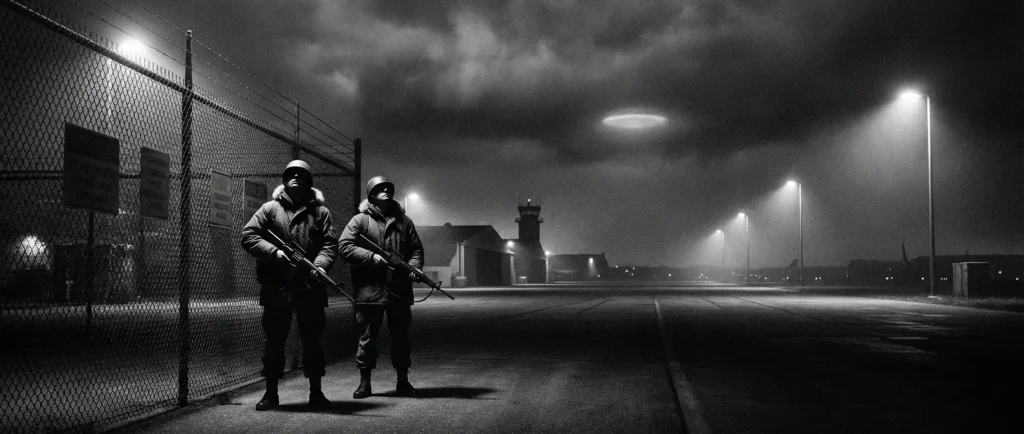
The phrase “nuclear base incursions” is often waved around as slam-dunk proof in modern UFO disclosure narratives, but the sourcing is a mess. The hard part is separating what is actually documented from what has calcified into internet lore, especially once nuclear sites enter the story.
Start with the stakes: the 1975 reports describe unknown objects repeatedly entering SAC-related restricted airspace around nuclear-mission installations and triggering serious security responses. In 1975, SAC bomber aircraft on ground alert were armed with nuclear weapons, so an incursion was a command problem, not a curiosity sighting. By 1975, SAC’s manned bomber force included several hundred B-52D and B-52G bombers, and those bomber wings were supported by KC-135 tankers during alert operations, which is exactly why “something in the pattern” had deterrence-scale implications. [1]
The friction is that high-consequence events often leave an uneven public trail: some UAP reports remain unresolved because the available data is insufficient, even when the underlying incident was taken seriously at the time.
At the same time, the modern disclosure cycle keeps pulling legacy cases back into the spotlight because unresolved intercept and airspace-security questions are still treated as national-security concerns in official discussions.
That combination, real stakes plus incomplete public records, is how confident claims spread faster than verifiable timelines. The origin of the 1975 objects remains unidentified in the public record, and pretending otherwise is marketing, not analysis.
This piece draws a hard line between documented facts, credible testimony, and unresolved unknowns, so any new “1975 proves disclosure” claim can be judged by what it actually adds to the record, not by how loudly it repeats the story. To do that, it helps to start with what SAC-controlled airspace was designed to do: detect deviations, force decisions, and leave a trail.
Why SAC Airspace Was Untouchable
Strategic Air Command (SAC), a Cold War-era U.S. Air Force major command responsible for long-range strike and nuclear deterrence forces including bomber alert operations, ran environments engineered for control: fixed alert postures, routine checklists, and defined response timelines. In that design, an unidentified track inside controlled airspace is not a campfire story. It is a deviation from an operating baseline that was built to be measurable, briefed, and accountable.
SAC served as the bombardment arm of the U.S. Air Force and a major part of the U.S. nuclear deterrent; its primary peacetime mission was deterrence.
That deterrence posture was not abstract. SAC maintained nuclear-capable bomber forces on ground alert, including B-52D/G aircraft as part of its mid-1970s force structure. [1]
Because deterrence is a day-to-day mission, not a wartime surge, predictability mattered operationally: aircraft, weapons, crews, and security forces were expected to behave inside known parameters. An airspace penetration near nuclear-mission activity therefore triggered process, not improvisation, and that process generated artifacts.
Restricted airspace, a designated airspace area where flight is limited and requires authorization and coordination, is controlled through formal activation and communications. FAA restricted airspace is activated through a Notice to Airmen (NOTAM), an official aviation notice that communicates time-sensitive restrictions and hazards, including the activation status of restricted areas. Civilian aircraft transiting restricted airspace are required to contact local range control towers, which turns “who is in the box” into a logged coordination problem, not a mystery. FAA orders and the Chart Supplement define how SUA vertical limits and activation are published. [2]
Some restricted areas also extend far higher than casual readers assume. For example, Fort Bliss restricted areas are published with vertical limits that allow effectively unlimited upper altitudes during activation in some segments; consult FAA-special-use-airspace publications and local range EIS material for the controlling descriptions. [2]
Layering is what converts an airspace rule into enforceable control. Long-range radars provide early detection and time to coordinate a response; terminal radars confirm what is approaching the installation itself. The term “Standard Hercules” in U.S. air defense usage refers to the Nike Hercules surface-to-air missile system (designation MIM-14), which included associated radar and fire-control components under Army air-defense units. “HIP AR” or “HIPAR” stands for High Power Acquisition Radar, an L-band acquisition radar used with the Improved Nike-Hercules system to extend initial detection ranges. Published technical and historical accounts place the Nike-Hercules missile engagement ranges on the order of tens of miles to roughly 80-100 miles depending on variant and mission profile, and HIPAR acquisition ranges are documented at up to about 350,000 yards (about 175 nautical miles), which is why HIPAR-equipped sites extended early acquisition reach for the system. [3]
At the airfield, Airport Surveillance Radar (ASR), an approach and terminal-area radar that displays aircraft position and range near an airfield, supports identification, sequencing, and confirmation of tracks that get close enough to matter.
The friction is that layered systems create layered reporting. A single violation can touch range control, approach control, a base command post, security forces, and higher headquarters. That complexity is not a bug. It is how a nuclear-mission installation keeps a common operational picture when minutes matter.
Legacy cases still matter because the 1970s stack produced paper and voice-era equivalents of today’s digital footprints. A credible claim of a restricted-airspace incursion near nuclear missions should map to specific traces: a NOTAM status and controlling-agency logs for the restricted area; range-control or tower contact attempts for any transiting aircraft; radar tracks with time stamps (long-range acquisition and terminal-area ASR correlation); command post and security forces blotter entries; and message traffic summarizing the event for higher command. If those artifacts are absent, the story is missing the operational residue that SAC’s controlled environment was designed to generate.
That expectation-control systems that generate auditable traces-is the baseline against which the 1975 retellings rise or fall. The next question is not whether the story is compelling, but whether the publicly described dates and locations can be tied to that residue.
1975 Incursions in Brief Timeline
The 1975 “incursion cluster” persists for one reason: it is told as a repeated problem near nuclear-mission installations, not as a single clean, cinematic sighting. The narrative power comes from recurrence, alleged penetration of controlled areas, and the claim that bases treated the activity as an operational issue. The public-facing timeline, though, is a patchwork assembled from retellings and compilations, not a single, fully documented incident set.
The line that matters for this section is verification. Publicly accessible primary documentation for alleged 1975 SAC restricted-airspace incursions is limited. Many popular summaries and compilations do not supply document identifiers, message routing numbers, unit blotter references, or declassified radar-plot artifacts, and therefore cannot be used alone to demonstrate a fully documented cluster. Researchers should treat compilations as leads to follow rather than as primary proof. If a claimed incident cannot be tied to primary records with stable identifiers, it remains an attributed report rather than a documented event.
Status: Attributed / Reported (pending document verification)
Loring AFB is commonly reported as the center of unusual aerial activity on Oct 27 and Oct 28, 1975, described as a multi-night incident focused on the base in northern Maine. The core repeatable elements in these retellings are consistent in shape even when specifics vary: observers report unusual lights or an object near the installation (visual observations), radar involvement is frequently asserted in summaries (radar observations), and on-base personnel activity is often described as part of the event record (security or ground reports). None of that is verified here by primary paperwork with stable identifiers available in the public record, so it stays in the “reported” category until such documentation is produced.
One claim appears in the Loring story often enough to flag explicitly: reports say the aerial activity involved incursions reportedly originating from Canadian airspace. That is a distinct, concrete allegation because it implies a cross-border track and a defined direction of approach. It is also precisely the kind of detail that should be traceable in logs, radar summaries, command post entries, and message routing records if the underlying documents are produced. In this section, it remains a reported element awaiting documentation.
Status: Unverified retelling
Beyond Loring, the commonly repeated “cluster” framing asserts that late October 1975 involved more than one nuclear-mission site and more than one night. The retelling typically emphasizes repeated penetrations (objects inside or near restricted areas), loitering or hovering claims (objects lingering rather than transiting), and a multi-night recurrence that turns a one-off into a pattern. Those are operationally meaningful allegations because they imply extended security posture, repeated reporting, and escalating coordination costs. The public record accessible to general researchers does not supply primary records, named witnesses with auditable trace links, or a stable list of which additional installations belong in the 1975 set, so all “other bases in the cluster” claims remain unverified here.
Status: Attributed (as a claim about a compilation), but not usable as documentation here
A frequently referenced artifact in discussions of 1975 is that NICAP produced a 30-page chronology of UFO incidents and events for that year, described as a compilation of reported incidents. That kind of document can be valuable for reconstruction because it can preserve dates, locations, and the language later authors borrow. However, without a primary-document identifier or an archival record, a compilation is an attributed source rather than a primary record for proving operational traces.
Loring is the best mini-case to anchor because the story is both time-bounded (two consecutive nights are repeatedly cited) and operationally framed (the activity is described as an incursion problem, not a distant light). Here is the incident as it is commonly reported, with the key claims kept concrete and explicitly labeled as reported pending verification.
Night 1 (Oct 27, 1975, reported): unusual aerial activity is described near the base, with visual sightings commonly included. Many summaries also assert radar involvement, either as corroboration or as part of the alert process. Security or ground elements are often mentioned as participating in observation and reporting. Without base logs, tower records, security desk entries, or released message traffic with stable identifiers in the public record, those elements remain reported, not documented.
Night 2 (Oct 28, 1975, reported): the story is told as recurring, with the second night functioning as the “pattern confirmation” point. Retellings often repeat the same observation categories, especially the combination of visual reports and an asserted radar picture, plus the claim that on-base response continued. The recurrence is the friction point: even if the first night is ambiguous, a second night forces structured reporting and sustained attention.
Message traffic and escalation (reported/claimed): some retellings claim that priority messages were sent to the National Military Command Center in Washington, D.C., and to senior Air Force leadership, sometimes summarized as the “Air Force Chief.” In this section, those statements must be read as reported/claimed pending documentation, because public-accessible records with message identifiers and routing metadata have not been produced for independent verification.
Viral posts about “1975 SAC incursions” typically front-load escalation language and back-load sourcing. Treat that as a warning sign. Before accepting any summary as more than a retelling, require four specifics: (1) exact dates and local times, (2) the named installation and unit elements involved (command post, tower, security police), (3) the record type (desk blotter, logs, radar summaries, teletype), and (4) message identifiers if someone claims NMCC-level priority traffic. If a timeline cannot produce those anchors, it is not a documented cluster. It is a story about a cluster, and the difference matters.
That difference is also why “timeline” work has to be paired with “records” work: once the dates are asserted, the decisive question becomes what traceable artifacts those dates should have generated.
Radar, Witnesses, and Paper Trails
The decisive question in any restricted-airspace intrusion near a nuclear-mission installation is not “what did it mean,” but “what records exist, and do they cross-check.” A credible case has a paper trail that ties a time, a place, and a reporting chain to specific sensor outputs and specific human actions. Once those anchors cannot be identified, the evaluation shifts from an incident to a narrative.
The most reliable materials are the ones created closest to the event, by people who had to act on them. Start with raw or near-raw sensor artifacts: radar records or prints, scope photos, track logs, and any contemporaneous annotations. Those are followed by tower logs, because they timestamp what controllers believed they saw and what instructions were issued. Security Police blotter reports come next, since they capture perimeter calls, patrol dispatches, and on-the-ground observations that can confirm or contradict the air picture.
After that come command post logs and command summaries. They are valuable, but they are already a compression step, written to brief leadership rather than preserve every detail. Finally, you have message traffic (teletype, situation reports, inter-command notifications) and pilot statements. Pilot accounts can be excellent, but they are often separated from the original sensor context; a statement without the matching time hack, vector, altitude, and control instructions is hard to audit.
Eyewitness books can add color and procedural texture, but they are not substitutes for operational records. Lloyd R. “Dick” Leavitt’s account is explicitly presented as an eyewitness narrative, which makes it useful for understanding what a participant remembers and emphasizes, not for replacing logs, prints, and message routing as the backbone of proof.
FOIA (a U.S. law that lets the public request certain federal records, subject to exemptions and redactions) is a retrieval tool, not a guarantee of completeness. A real government PDF can still be irrelevant to the incident being researched, including routine administrative items like logs about parking or speeding tickets. Treat “it’s a government document” as a starting filter, not a credibility stamp.
Classification is the bigger distortion engine. Mid-1970s classification practices were governed by formal policies and periodic review processes that could later reduce classification or declassify material. Classified information also becomes less sensitive over time and can be released, but what arrives in public is often fragmented, redacted, and missing attachments that carried the operational detail. Declassified documents sometimes still display classification markings (e.g., (U)) to show what was unclassified in that version, which is helpful, but it also highlights what was removed or never released alongside it.
Use convergence as the north star. Multi-sensor corroboration matters because it reduces single-sensor failure modes, including atmospheric propagation effects that can bend or extend returns, clutter that creates false targets, and other artifacts that look “real” on one channel. Independent witness convergence matters because it separates shared observation from shared rumor: tower logs, Security Police notes, and command post entries written independently but aligning on time and behavior are stronger than a single compelling description repeated across retellings.
Contemporaneous notes beat recollection. Human memory distorts with retelling, social reinforcement, and hindsight framing. The more an account is reconstructed after the fact, the more matching timestamps, routing indicators, and unchanged originals matter.
It also helps to normalize ambiguity. Modern government UAP reporting explicitly acknowledges that some cases remain unresolved when the available data is insufficient for an explanation, while still treating unknown objects as potential security concerns. “Unresolved” is often a data-quality verdict, not a conclusion about what the object was.
- Identify the exact date/time window and the installation airspace boundary involved.
- Locate the primary record: radar print/track log, tower log entry, or Security Police blotter line with a timestamp.
- Verify chain-of-custody: document number, office of record, routing, and whether attachments are referenced but missing.
- Cross-check for independent convergence: tower plus Security Police, or radar plus command post, not one channel echoed repeatedly.
- Inspect classification markings (e.g., (U)) and redactions to see what was considered sensitive, and what context is absent.
- Demand a single, stable narrative keyed to the records, not to later summaries or memory-only accounts.
What Fits and What Fails
The hard part is not imagining a cause. It is finding one cause that survives restricted airspace, recurrence across multiple nights, and an operational response that treated the returns as actionable. Most single-point explanations can match one slice of the record, then fail when they have to also explain why the pattern repeats, why it clusters around controlled areas, or why sensors and people kept getting pulled into the same story.
Bright stars and planets belong on the list only as a misidentification category. A low, bright object near the horizon, seen through haze or thin cloud, can look “stationary,” “unusual,” or “too bright,” especially when observers are primed to scan the sky. The friction is immediate: astronomy does not explain coordinated reactions to tracks that were treated as airspace problems, nor does it naturally create repeated, time-bounded “incursions” tied to specific locations.
Conventional aircraft, including misrouted or unauthorized flights, can explain lights, engine noise, and normal radar returns. It struggles with any report set that implies loitering inside controlled areas without an identified flight plan, or behavior that would be reckless for a civilian pilot repeatedly over consecutive nights. The actionable takeaway is simple: if the object behaves like an aircraft, the decisive artifact is paperwork and voice. Tower logs, flight-plan correlation, and audio from controllers and intercept coordination either closes this bucket or keeps it open.
Balloons can explain slow drift, altitude changes with temperature, and odd lighting if illuminated. Balloons struggle with repeated, location-specific reappearances on consecutive nights unless launches are consistent and wind fields cooperate. They also do not naturally map to fast closures or sudden course changes in reports. Correlating surface winds and upper-air soundings with track direction is what makes this bucket win or lose.
Anomalous propagation and related refraction effects can produce false or displaced radar targets when temperature and humidity gradients bend radar energy. This bucket can fit “radar only” anomalies. It strains when you have multiple independent sensors or trained observers describing objects in the same time window. The decisive data here is boring but final: local meteorological profiles, radar mode settings, and whether multiple radars saw the same geometry at the same time.
A combined electronic warfare picture is conceptually stronger than a one-off misidentification because doctrine uses effects in layers. RAND documents jamming, deception, standoff weapons, and layered intercept concepts, which is why layered EW and deception are often raised when analysts ask how defenses could be confused. [7]
Deception also has a timing problem that matters for SAC-style response cycles. A military study states that time, distance, and speed factors determine whether the target of a deception can react fast enough to counter true intent. If the timeline shows compressed decision windows, spoofing and managed ambiguity become a tighter conceptual fit than a slow-moving “thing” that everyone simply watched.
Modern 2025 and 2026 UFO discourse often defaults to “drones,” meaning cheap, small, ubiquitous quadcopters. Mapping that directly onto 1975 is anachronistic. The caveat is that unmanned systems did exist, and some were extreme: the D-21B was flight tested in the mid-1960s and had published performance figures in the Mach 3-plus range and operational altitudes in the 80,000-95,000 foot band; tests and operational launches from B-52 carrier aircraft occurred in the late 1960s and into 1971. [5]
The NRO also ran early drone programs in the 1960s and fielded several UAV and target/recce systems in that era under high secrecy, which is why “no drones existed then” is incorrect while “1975 did not have hobby drones” is also correct. [6]
“Unknown” is a disciplined category: insufficient data to select among hypotheses. It is not a conclusion about origin. What collapses uncertainty is correlation, not louder stories: time-stamped primary radar plots and scope photos, intercept tapes, controller logs, transponder and flight-plan matches, and weather plus propagation diagnostics tied to the exact minutes of the events.
That record-first discipline is also what turns a legacy case into a disclosure test: a claim can remain “unknown” while still being audited, but it cannot be audited without files that can be checked.
How 1975 Shapes Disclosure Today
The 1975 nuclear base incursion story matters now for one reason: it is a stress test for whether UFO disclosure is actually about releasing evidence, or about reinforcing a familiar narrative without producing files that can be checked. A restricted airspace event tied to strategic deterrence creates the highest possible incentive to document, route, and retain reports. If modern UAP disclosure cannot credibly surface what was recorded then, the trust debate stays stuck on retellings instead of records.
That trust question is not abstract. The Cold War command structure changed names, but the institutional lineage did not: modern US Strategic Command is the successor to Strategic Air Command. Continuity at that level implies continuity in reporting pipelines, classification handling, and the probability that archived records exist somewhere inside defense information systems.
Today’s institutional benchmark is formal, repeatable reporting. The Department of Defense now routes UAP incidents through the All-domain Anomaly Resolution Office (AARO), a DoD office tasked with collecting, analyzing, and reporting on UAP incidents across domains, which forces the conversation toward standardized fields, adjudicated explanations, and documented gaps. AARO produced a consolidated annual report covering UAP reports from May 1, 2023 to June 1, 2024. [8]
The catch is operational, not philosophical. Modern summaries do not automatically unlock older records. They can coexist with legacy classification, compartmented handling, and missing provenance unless the underlying documents are actively identified, reviewed, and released.
This is why the public demand has shifted to “records, not rumors,” and why the terminology shifted with it. UAP is widely used as a rebranded name for UFOs in contemporary coverage, and the new label tracks the governance reality: reporting, archiving, and classification controls drive what can be shown.
One concrete legislative example that is relevant to current UAP-records debates is Senate Amendment 797 from the 118th Congress, which includes language to create an “Unidentified Anomalous Phenomena Records Collection” at the National Archives and is part of a package of measures aimed at improving public access to UAP-related records. See the amendment text for the official language. [10]
Disclosure also lives or dies on classification mechanics. Legislation and directives require AARO to account for all security classification guides that govern UAP-related reporting and investigations, which is the difference between “we cannot talk about it” and “here is the rule that controls this paragraph, image, or sensor modality.”
- Track document releases: primary-source dumps with clear provenance (origin office, date, classification history) move the needle; recycled anecdotes do not.
- Demand archiving standards: look for stable case identifiers, retention language, and records schedules that make legacy cases retrievable rather than folkloric.
- Insist on reproducible case files: sensor type, time bounds, location handling, and chain-of-custody notes determine whether independent review is possible.
- Watch classification-guide accounting: disclosure advances when agencies can point to the controlling guide, the declassification decision, and what was actually released.
Those standards are not abstract bureaucratic preferences; they are the only way a 1975-style incursion claim becomes something more than a resilient anecdote.
The Unfinished Ledger of Incursions
The unresolved issue in the 1975 SAC incursions is not mythology. It is the ledger: which agencies generated which logs, tracks, transcripts, and after-action products, and why so little of that record is publicly anchored to primary documents.
The stakes remain non-negotiable. Incursions anywhere near a nuclear alert posture demand accountability, regardless of what the objects ultimately were. Restricted airspace control plus layered detection and response implies a paper trail should exist; the friction is that the public timeline is widely repeated while the supporting primary documentation is thin, and even the commonly reported Loring dates of Oct 27 to 28 remain “reported” pending records.
That gap is why “unknown” has to be treated as a data status, not a conclusion about non-human intelligence. Official reporting leaves cases unresolved when available data is insufficient, even when the event is still treated as a security concern.
- Search AFHRA at Maxwell for unit histories and supporting files; the Air Force Historical Research Agency’s collections at Maxwell Air Force Base are used to prepare Air Force organizational lineage and honors and remain a key hub for historical Air Force records. [1]
- Work NARA by Record Group; the National Archives organizes federal records into Record Groups, including Air Force related groups, which is the most practical pathway for locating holdings tied to base defense incidents.
- Request specific record types instead of narratives: command post logs, security police desk blotters, radar/ATC coordination records, message traffic, and after-action summaries, expecting classification, redaction, and fragmented releases.
- Track standards, not headlines; the FAA implemented changes to FAA Order JO 7210.3 that revised the Unidentified Flying Object paragraph and related notices in 2026, which is part of the contemporaneous administrative evolution affecting reporting and watch-stander guidance. [9]
The principle going forward is simple: follow documents and reporting standards, and treat viral certainty as noise until the record set is complete. That is the same hard line set in the opening: separate what is documented from what is merely repeated, especially when the claim involves SAC-era nuclear alert environments that were built to leave measurable traces.
Sources
- [1] SAC bomber alert posture and B-52 inventory and related SAC alert operations: “SAC Alert Operations” (AFGSC). https://www.afgsc.af.mil/Portals/51/Docs/SAC%20Alert%20Operations%20Lo-Res.pdf?ver=2016-09-27-114343-960 and supporting historical summaries including RAND analysis and DTIC material. https://www.rand.org/pubs/research_memoranda/RM2373.html and https://apps.dtic.mil/sti/tr/pdf/ADC078179.pdf
- [2] Fort Bliss and FAA special-use-airspace vertical-limit and publication guidance: FAA Order 7400.10F and FAA AIM guidance on special use airspace, and local range EIS material. https://www.faa.gov/documentLibrary/media/Order/Order_7400.10F_2024_-_final_-signed.pdf and https://www.faa.gov/air_traffic/publications/atpubs/aim_html/chap3_section_4.html and Holloman AF EIS discussion of SUA. https://www.holloman.af.mil/Portals/101/2021-03-29_EIS%20for%20SUA%20Optimization%20at%20Holloman%20AFB.pdf
- [3] Nike-Hercules (MIM-14) and HIPAR radar definitions and ranges: historical and technical documentation for the Nike Hercules family and the HIPAR acquisition radar, including the Nike technical manual and historical summaries. https://ed-thelen.org/NIKE-English-version.pdf and https://en.wikipedia.org/wiki/Nike_Hercules and https://www.radartutorial.eu/19.kartei/11.ancient5/karte005.en.html
- [4] Technical HIPAR data and descriptions: HIPAR peak power and operating-range summaries as referenced in technical histories. https://nikemissile.org/technicaldata.shtml and https://ed-thelen.org/NIKE-English-version.pdf
- [5] D-21B drone performance and testing timeline, including B-52H launch history and museum technical summary. https://www.nationalmuseum.af.mil/Visit/Museum-Exhibits/Fact-Sheets/Display/Article/195778/lockheed-d-21b/ and https://en.wikipedia.org/wiki/Lockheed_D-21 and historical launch summaries. http://www.habu.org/m21-d21/1021.html
- [6] NRO early UAV programs and Tagboard/Firebee relationships in the 1960s. https://apps.dtic.mil/sti/tr/pdf/ADA526045.pdf and NRO historical photo/history materials. https://www.nro.gov/Portals/135/Documents/history/csnr/NRO_History_in_Photos_7May2024_web.pdf?ver=Qtx2ES0HJFSkxmH4ziElIA%3D%3D
- [7] RAND electronic-warfare and layered-defense analysis on interception and layered deployment. https://www.rand.org/topics/electronic-warfare.html and the RAND Monograph MR-390. https://www.rand.org/content/dam/rand/pubs/monograph_reports/2005/RAND_MR390.pdf
- [8] AARO Consolidated Annual Report reporting window and report PDF. https://www.dni.gov/files/ODNI/documents/assessments/DOD-AARO-Consolidated-Annual-Report-on-UAP-Nov2024.pdf and AARO congressional press products. https://www.aaro.mil/Congressional-Press-Products/
- [9] FAA Order JO 7210.3 change documents and notice implementing the Unidentified Flying Object/UAP paragraph revision and related notices. https://www.faa.gov/regulations_policies/orders_notices/index.cfm/go/document.information/documentID/1044304 and https://www.faa.gov/documentLibrary/media/Order/7210.3EE_Bsc_w_Chg_1_and_2_dtd_1-22-26_Final.pdf and the current order entry. https://www.faa.gov/regulations_policies/orders_notices/index.cfm/go/document.current/documentNumber/7210.3
- [10] Legislative reference relevant to UAP records and public-access proposals: Senate Amendment 797, 118th Congress (text creating an Unidentified Anomalous Phenomena Records Collection at the National Archives). https://www.congress.gov/amendment/118th-congress/senate-amendment/797/text and related H.R.1187 text on public release of UAP documents. https://www.congress.gov/bill/119th-congress/house-bill/1187/text
Frequently Asked Questions
-
What does “nuclear base incursion” mean in the 1975 SAC UFO context?
In the 1975 reports, it refers to unknown objects repeatedly entering SAC-related restricted airspace around nuclear-mission installations and triggering serious security responses. Because SAC bombers on ground alert were armed with nuclear weapons, an incursion was treated as a command-and-control problem rather than a curiosity sighting.
-
What is restricted airspace and how was it controlled around SAC installations?
Restricted airspace is a designated area where flight is limited and requires authorization and coordination, and it is activated via a Notice to Airman (NOTAM). Civilian aircraft must contact local range control towers to transit it, turning unauthorized presence into a logged coordination issue.
-
How high can restricted airspace go near U.S. military ranges?
Some restricted areas extend much higher than people assume; the article notes Fort Bliss restricted airspace reaches a maximum altitude of unlimited. That means violations can occur at any altitude and still fall under defined discovery and escalation procedures.
-
What radar coverage specs does the article cite for detecting airspace intrusions?
It cites Standard Hercules radars with a nominal range of about 125 miles and HIP AR extending acquisition to about 175 nautical miles with more than 400 seconds of additional lead time. It also notes Airport Surveillance Radar (ASR) is used near the airfield to confirm and sequence tracks close to the installation.
-
What dates are commonly reported for the 1975 Loring AFB UFO incidents?
Loring AFB is commonly reported as the center of unusual aerial activity on Oct 27 and Oct 28, 1975, described as a multi-night incident in northern Maine. The article classifies these dates as attributed/reported pending primary document verification in the provided sources.
-
What records should exist if there were real 1975 SAC restricted-airspace incursions?
The article says a credible claim should map to artifacts like NOTAM status and controlling-agency logs, tower/range-control contact attempts, radar tracks with timestamps (long-range and terminal ASR), Security Police blotter entries, command post logs, and message traffic to higher command. If those traces are absent, the story lacks the operational residue SAC environments were designed to generate.
-
What should you look for to evaluate modern claims about the 1975 SAC incursion “cluster”?
Require four specifics: exact dates and local times, the named installation and unit elements involved (tower, command post, Security Police), the record type (logs, radar summaries, teletype), and message identifiers if NMCC-level priority traffic is claimed. The article’s decision rule is “records, not rumors,” with “unknown” treated as a data-status until time-stamped files can be cross-checked.
