You can scroll UFO news and UAP news for ten minutes and get a dozen “disclosure” claims, none of them anchored to anything you can actually inspect. The counterweight is real and unusually large for a small country: in 2010, the New Zealand Defence Force (NZDF) published a release described as roughly 2,000 pages of material, and it exists in a form you can check rather than take on faith.
The frustration is simple: you want signal, not sensationalism. You do not need another viral thread about what someone “heard”; you want to know what the New Zealand material actually contains, what it supports, and what it cannot support.
This is the tension the archive forces into the open. “Unidentified” is a category of reporting, not a confirmed conclusion, and the distance between those two is where most disclosure hype lives. Archives create clarity because you can trace claims back to documents, but they also expose limits because paperwork often records uncertainty as faithfully as it records facts.
Language feeds expectations, which is why terminology matters only insofar as it changes how people hear the same evidence. “UFO” is commonly used as shorthand for something reported but not identified at the time. “UAP” is the modern official framing that emphasizes “phenomena” without smuggling in assumptions about objects or origins. What matters here is the paper trail: available excerpts do not verify whether the 2010 package used the term “UFO” versus “UAP,” so this piece will not claim a label used inside the files.
Two identifiers keep this grounded: the 2010 release was published by the NZDF, and a National Library record lists an alternate title, “NZDF U.F.O. file,” with a 15-volume format noted as “<15> v.”
You will walk away with a document-first way to understand what the 2010 release shows, what it does not show, and how to read it responsibly.
What the 2010 files contain
The archive’s structure determines what you can responsibly claim from it. The 2010 public release is not “a report” or “a single case.” It is a multi-volume set, catalogued in the National Library record as an alternate-titled “NZDF U.F.O. file,” comprising 15 volumes. Your first job is to treat it like an archive: identify what each volume is, how the pages are organized, and what kind of records you’re reading before you try to interpret what any one page “means.”

That sounds basic, but it’s where most over-claims start. If a page is an incoming letter, it tells you what a member of the public reported. If it’s an internal minute, it tells you how an office routed that report. If it’s a copy forwarded to another agency, it tells you distribution, not endorsement. You don’t get to jump straight from “it’s in the file” to “it’s a confirmed event.” The container matters as much as the content.
Once material is declassified, its security status has been formally changed so it can be released under a public-access decision, sometimes with conditions attached. In practice, that status change tells you something narrow and specific: the material is no longer being withheld on classification grounds at the time of release. It does not tell you the content is accurate, complete, or validated, and it does not tell you that earlier handling was improper.
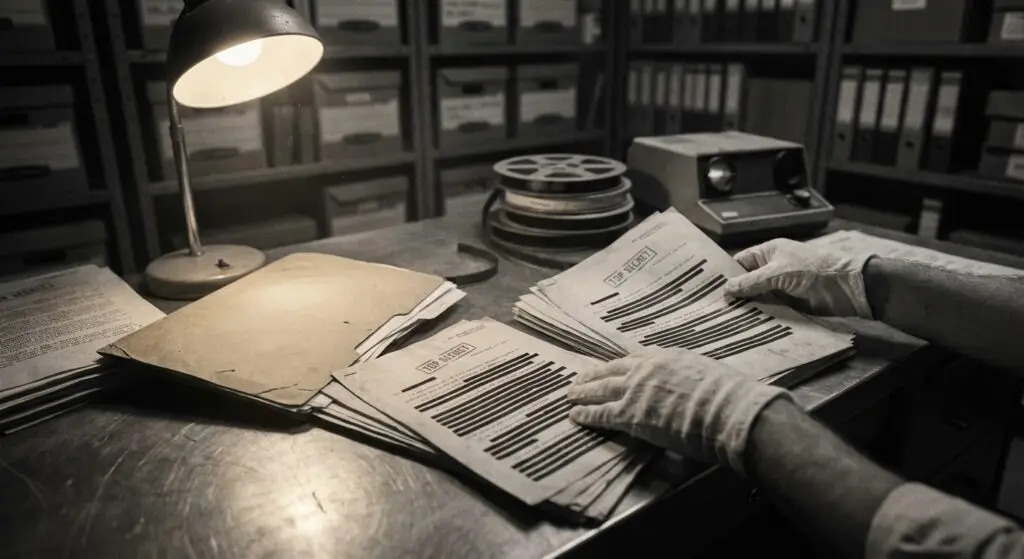
New Zealand uses formal security markings, including RESTRICTED, CONFIDENTIAL, SECRET, and TOP SECRET. When you see those markings in any set of government records, read them as handling instructions that applied at the time the document was created or circulated. Don’t treat them as a proxy for truth, threat level, or “importance.” A mundane administrative detail can be marked; a dramatic claim can be unmarked. Classification controls distribution, not reality.
Public releases routinely include redaction, meaning specific text, names, or details are deliberately obscured before publication. Redactions usually signal one of three things: privacy protection for individuals, protection of sources and contact details, or removal of operational or security-sensitive specifics that still shouldn’t be broadcast. That is normal pre-release handling, not an admission of wrongdoing.
Just as importantly, redactions do not automatically prove a “cover-up,” a debunking effort, or a confirmed military assessment. A blacked-out line can be a home address. It can also be a routing code. You only learn what a redaction implies by triangulating the surrounding metadata, the document type, and any referenced attachments, not by the presence of black bars alone.
- Date and time: creation date, incident date, and any later forwarding dates (they’re often different).
- Originator: who wrote it (unit, office, or individual role), not who it’s filed under.
- Recipients and distribution: addressees, carbon copies, and routing notes that show how widely it moved.
- Classification marking: RESTRICTED, CONFIDENTIAL, SECRET, TOP SECRET, or unclassified, exactly as printed.
- Location fields: place names, grid references, or airspace references, if present.
- Witness type: civilian, military, aviation-related, or anonymous, as stated on the document.
- Referenced attachments: sketches, photos, logs, or enclosures mentioned but not necessarily included.
Finally, treat big-scope claims as “verify inside the PDFs/scans.” The provided excerpts do not lock down the archive’s date range, file series identifiers, or hosting format, so you don’t assert those from memory or secondary summaries. You confirm them by reading the released volumes themselves and extracting the metadata they actually contain.
That discipline also sets expectations for the question readers ask next. Once you treat the release as an archive of record types and metadata-not a single narrative-you can evaluate individual incidents without turning the mere fact of filing into implied confirmation.
Standout sightings and recurring themes
These NZDF volumes read less like a single “answer” and more like a record of who observed what, when they observed it, what they thought it was, and what supporting material (if any) was attached. The archive’s value sits in the recorded detail, not the label at the end.
A constraint for this section is straightforward and non-negotiable: the materials provided here do not include any incident entries from the 2010 New Zealand file set, so I cannot verify a volume identifier plus page number (or a printed document ID) for 4 to 6 cases. Without the released PDFs (or the specific pages) available here to cite line-by-line, I will not fabricate “standout sightings,” summaries, or patterns.
To write this section as intended, I need the actual NZDF 2010 volumes (PDFs) or, at minimum, the exact pages that contain the 4 to 6 incidents you want summarized, including the visible volume identifier and page number (or printed document ID) on the same page as the case text.
- Upload the NZDF 2010 PDF volume(s) that contain the incident narratives (or provide the exact page range extracts).
- Include the volume identifier and page numbers as shown in the released documents (or the printed document ID if that is what the file uses).
- Confirm which 4 to 6 incidents you want (by date/location if you already have targets) or allow me to select them once I can read the volumes.
- Provide any annex pages tied to those incidents (sketches, photos, radar/ATC notes, or forwarding memos), because handling and resolution status are often recorded outside the witness narrative.
For each incident that includes a time and location, I will pull the relevant historical weather context using MetService’s official historical weather reports (where accessible under MetService’s published access terms) so visibility, cloud, and wind conditions are grounded in station data rather than assumptions.
For aviation-linked reports, I will cross-check what an operator could have been briefed on using MetJet, a web-based aviation weather briefing system used for airlines in New Zealand and internationally, because those briefings often align with the operational context described in official handling notes.
For aircraft-activity plausibility checks, I will use flight information sources where available, noting that most flight information can be obtained for free while some historical detail may require paid access, and I will only treat flight candidates as “verified” when the timestamp and track plausibly match the reported direction, duration, and position.
Even without case-by-case summaries on the page, the file’s larger value still shows up in how official systems handle uncertain reports. That makes government posture-and the claims people attach to it-the next thing worth reading with equal care.
Government posture and cover-up claims
Most archives like the 2010 New Zealand release read as process, not secret investigation: receipt, triage, referral, and closure language dominate. You see the government doing what bureaucracies reliably do with unsolicited reports: confirm it arrived, decide which office (if any) owns it, forward it if there is a plausible owner, and close the file with “no further action” style wording once the mandate runs out.
Those phrases matter because they are the normal form of public-sector record keeping. They signal administrative disposition rather than factual resolution. A file can be thin because the agency never had a reason, authority, or resources to do more, not because it discovered something extraordinary and hid it.
Thin documentation is not evidence of suppressed truth. It is evidence of limited scope until you can prove otherwise. A cover-up claim requires documentation that shows intentional secrecy designed to hide extraordinary facts, not just the absence of follow-up.
The evidentiary bar is specific and document-driven. Substantiating a cover-up requires at least one of the following: explicit directives to conceal or mislead; internal memos that contradict the public posture; logs that show reports received but missing from the released file series; references to attachments or annexes that are systematically absent without a lawful withholding basis; unexplained destruction or off-registry storage instructions; or redaction patterns that do not match privacy, security, or standard release practice. Without those indicators, “the file is quiet” stays in the bureaucracy lane.
The modern reality check is straightforward: NZDF explicitly states it neither investigates nor maintains records relating to UAS/UFO sightings. Set expectations there. If the defence force says it does not run an investigative program and does not keep a sightings database, then the correspondence-heavy texture of the 2010 material is exactly what you should predict, not a paradox that demands a conspiracy to explain it.
It also helps to place the 2010 release in context: there are declassified and publicly released New Zealand files of correspondence on UFOs covering 1952 to 2009. That time span reads like a long-running paper trail of inbound reports and inter-agency routing, not a single sealed “truth file.” Even in the better-known episodes already summarized, the posture that shows through is administrative handling and occasional referral, not a sustained, resourced investigative apparatus.
If you want to evaluate posture versus suppression, ask for the paperwork that governs handling, not more stories. Readers can use Official Information Act-style requests to ask for protocols, procedures, or guidelines on how reports are handled and referred. Practical targets include: the agency’s triage criteria, referral pathways to aviation or police channels, record-retention schedules for unsolicited sightings reports, and any templates used for “no further action” closure language.
Treat disclosure as a records question. NZDF’s own communications practice includes publishing proactive releases and official documents, which is consistent with an institution that relies on standard information-management channels rather than an off-book secrecy system.
The responsible way to talk about “cover-up” is to name the specific documentary indicators and show them. If you cannot point to directives, contradictions, missing referenced attachments, or inconsistent logs, the NZ record supports a conclusion of routine bureaucratic handling, not intentional concealment of extraordinary facts.
How it fits today’s disclosure push
Modern “UAP disclosure” language changed the yardstick people use to judge government releases. A New Zealand archive drop that once read like a finite historical dump now gets reread like an incomplete case file, because audiences have been trained to look for chain-of-custody, internal tasking, and explicit conclusions, not just scanned reports. That expectation shift is the real reason older archives keep getting reopened: people are no longer asking “what was reported?” but “what did the state do with it, and what else exists?”
New Zealand’s disclosure culture runs through process, not theatre. The Official Information Act (OIA) is the country’s core transparency framework: it enables people to request official information and generally expect release unless there is good reason to withhold. In practice, that means the “disclosure moment” is usually an accountable paper trail, not a single press conference or a one-time declassification event.
Crucially, an OIA response should be legible enough to audit. It should detail what was released, what was withheld (if anything), and the OIA grounds for withholding. That structure matters because it lets readers distinguish between “the agency searched and found nothing else,” “the agency found more but withheld it,” and “the agency released in part with redactions.” Those are three different realities, and the OIA forces agencies to state which one applies.
Even when a story is New Zealand-based, global media frames are dominated by U.S. terminology and institutions. The Pentagon’s UAP office mandate remains an active contemporary touchpoint for UAP matters, and its ongoing work keeps “UAP” in headlines that spill into international reading habits. The result is predictable: readers bring a current, investigation-first mental model to older archives, expecting modern-style categorisation, centralized record collection, and clear lines of responsibility.
That’s also why search traffic clusters around legislative keywords. Terms like “UAP Disclosure Act”, “UAPDA,” and “Schumer UAPDA” circulate heavily, but the excerpts commonly shared are not sufficient to assert enacted statutory requirements and should be treated as proposals and search terms unless verified elsewhere.
One widely circulated excerpt explicitly says an omnibus amendment omitted the text of the Rounds-Schumer UAP Disclosure Act, identified as UAPDA (SA 2610).
Other discussion frames a “Rounds/Schumer UAP Disclosure Act 2.0” as something being talked about rather than a settled mandate.
Modern “disclosure” framing creates a specific failure mode: readers overread an older release as proof of a bigger, hidden system, or dismiss it as meaningless because it lacks today’s investigative scaffolding. The disciplined approach is narrower and more productive: treat the 2010 release as evidence of what was compiled and made public, then use process-based transparency to test what else exists and why it is, or is not, accessible.
- Define the record class you actually want (for example: internal protocols, search logs, or correspondence about handling reports), not a vague “everything on UAP.”
- Request it under the OIA with clear date ranges and custodians so the agency’s search is falsifiable.
- Audit the response by checking three items: what was released, what was withheld, and the specific withholding grounds cited.
How to analyze the files yourself
Most cases in the NZ volumes get clearer when you test them against independent records, not when you argue about what they “must” mean. Treat every file as a recorded claim that needs external anchors. “Unidentified at the time of the report” describes the witness and the moment; it is not the same as “unexplainable in principle.”
Before you reach for explanations, extract the fields that make cross-checking possible: incident date and local time (including any stated time zone or daylight saving status), location (town, coordinates, bearing references), direction of travel or bearing, elevation above the horizon if given, duration, and witness type (pilot, police, civilian, multiple parties). Note any sketches, photos, radar mentions, or attachments the text says exist, even if they are missing from the scan.
Then write down what the document does not say. A missing timestamp, vague direction (“over the hills”), or no duration turns a dramatic narrative into a low-resolution datapoint. Your job is to keep the uncertainty visible, not to fill it in with confident storytelling.
A report upgrades beyond a single observation only when corroboration, meaning independent support from other witnesses, contemporaneous logs, or instrument records, points to the same time and place. Two people repeating the same story after talking is not independence; a second witness who did not coordinate, an airport log entry, or an objective sensor record is. Professional archival and records literature formally examines the concepts of “archive” and “record,” which is why disciplined readers separate “this was written down” from “this was verified as an event.”
Weather: historical weather events and reports can provide official information on historical weather events and reports from an extensive network of weather stations. Use weather to answer concrete questions: was there low cloud, fog, haze, lightning, or a temperature inversion that could create glare, looming, or distorted horizons?
Aviation context: Public airport movements, notices, and incident summaries (where available) help you test whether a “stationary” light aligns with an aircraft on approach. Landing lights can look fixed when an aircraft is coming straight toward the observer, then “suddenly” move when it turns. MetJet is a web-based aviation weather briefing system intended primarily for use by airlines in New Zealand and overseas; it matters here only as context for the kinds of aviation weather products pilots rely on, not as something to access or misuse.
Astronomy and satellites: Public sky apps and published pass predictions answer “what was above that horizon at that minute?” Venus reaches about magnitude -4.7 and is routinely reported as an unusually bright, steady “light.” Published satellite passes explain slow, steady motion and timed brightening; closely spaced satellites can look like a structured formation.
- Approach or departure aircraft lights (stationary appearance, then rapid lateral movement after a turn).
- Meteor or fireball (seconds-long duration, fragmentation, abrupt termination).
- Satellite pass (steady track, no sound, predictable timing; occasional flare-like brightening).
- Bright planets (steady light, low on the horizon, “following” the observer due to motion parallax).
- Atmospheric refraction or mirage under inversions (elevated, displaced, or shimmering lights).
- Cloud-edge illumination (moonlight or urban light reflecting off layered cloud).
- Human perception errors (poor range estimation, size-distance confusion, misread bearings).
The repeatable mindset is simple: extract the minimum fields, keep missing data explicit, and demand independent support before you upgrade a story into a stronger claim. Do that consistently and the NZ files stop being a debate about conclusions and become a disciplined comparison between reports and records.
What the 2,000 pages really prove
The 2010 NZDF release-widely described as roughly 2,000 pages and cataloged in the National Library record as a 15-volume “NZDF U.F.O. file” package-proves a documented history of reporting and record-keeping. It does not prove a confirmed extraordinary origin. Nothing in the provided excerpts supports the claim that the archive “confirms aliens.” “Unidentified” is a statement about identification status, not proof of “non-human.”
The value of the set is exactly where the hype usually fails: it shows what gets written down, how it gets labeled “declassified,” and what redaction leaves visible versus permanently ambiguous. It also makes the limits visible: without document-level corroboration and complete context, a filing remains a recorded report, not an established event, and the NZDF posture described above points to administrative handling rather than a resourced investigative program.
Use the archive like a record, not a rumor: cite documents precisely, separate what a page reports from what you infer, and demand corroboration before you amplify conclusions. When you want more than anecdotes, ask for process records-intake criteria, routing, retention, and any withholding decisions-under the OIA expectations that information may be released with stated withholding grounds. That is the signal the introduction promised: inspectable paperwork, clear limits, and conclusions that stay tethered to what the documents can actually carry.
Sources
Frequently Asked Questions
What are the New Zealand UFO files released in 2010?
They are a New Zealand Defence Force (NZDF) public release described as roughly 2,000 pages of previously classified UFO-related material. A National Library record lists an alternate title, “NZDF U.F.O. file,” and notes the set as 15 volumes (“<15> v”).
How many pages and volumes are in the NZDF UFO file release?
The release is described as roughly 2,000 pages of material. The National Library record notes the package as 15 volumes (“<15> v”).
Does the 2010 NZDF UFO release prove aliens or non-human intelligence?
No-nothing in the provided excerpts supports the claim that the archive “confirms aliens.” The article states that “unidentified” means not identified at the time of reporting, not proof of an extraordinary origin.
What does it mean when a document in the NZDF files is marked RESTRICTED, CONFIDENTIAL, SECRET, or TOP SECRET?
Those markings are security handling instructions that applied when the document was created or circulated. The article says classification controls distribution, not truth, threat level, or the “importance” of a claim.
Do redactions in the New Zealand UFO files automatically indicate a government cover-up?
No-redactions are described as normal pre-release handling often used to protect privacy, sources/contact details, or operational/security-sensitive specifics. The article adds that blacked-out lines can be mundane items like home addresses or routing codes.
What information should I extract from a NZDF UFO document before trying to interpret it?
The article lists key fields to capture: dates/times (including forwarding dates), originator, recipients/distribution, classification marking, location fields, witness type, and referenced attachments. It also stresses that document type matters (incoming letter vs internal minute vs forwarded copy) because filing does not equal confirmation.
How can I evaluate whether the NZDF files show administrative handling or a real cover-up?
The article says a cover-up claim needs documentary indicators like explicit concealment directives, internal contradictions, missing referenced annexes without a lawful basis, or unexplained destruction/off-registry storage instructions. Without those, the NZ record supports routine receipt/triage/referral/closure rather than intentional concealment.