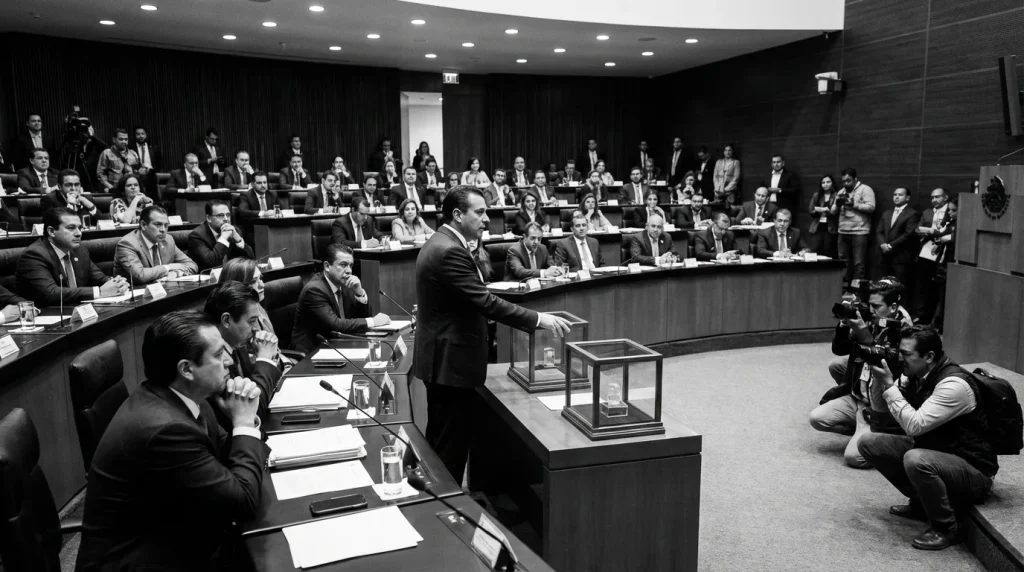
If you watched the clip, you probably had the same whiplash everyone else did: it looks like government alien disclosure. The room is formal, the microphones are hot, cameras are rolling, and then two small caskets or boxes get carried in and opened on camera. Your brain fills in the rest. “If it’s in Congress, it must be official.” The problem is that the setting can make something feel validated even when it’s simply being presented.
Here is the specific moment that kicked off the global frenzy. In mid-September 2023, Jaime Maussan appeared inside Mexico’s congressional chambers and presented two caskets or boxes said to contain alleged non-human bodies. Major outlets reported and illustrated the session, including Reuters (search results for Jaime Maussan and the congressional presentation: https://www.reuters.com/site-search/?query=Jaime%20Maussan), the BBC (search results: https://www.bbc.co.uk/search?q=Jaime+Maussan), and The Guardian (search results: https://www.theguardian.com/search?q=Jaime+Maussan). Video of the presentation has circulated widely online; an accessible place to find clips and recordings is common video platforms (for example, YouTube search results: https://www.youtube.com/results?search_query=Jaime+Maussan+Congreso+Mexico). Those reports and the circulating footage show the items being brought into the congressional chamber and uncovered during Maussan’s appearance, creating the kind of made-for-virality visual that screenshots and short clips thrive on.
The non-obvious nuance is how quickly “presented to lawmakers” turns into “confirmed by lawmakers” once the internet gets involved. A congressional chamber reads as authority, even if the people seated there haven’t endorsed what’s on the table. The cameras capture the props and the gasps, but they don’t automatically capture institutional backing. And once the footage is chopped into ten-second segments, the context that matters most tends to be the first thing that disappears.
That’s also why this landed so hard in the broader disclosure era conversation. Public expectations have been shaped by years of nonstop UFO disclosure and alien disclosure talk, so a dramatic visual in a government-looking room doesn’t register as “a claim being aired.” It registers as “the moment the curtain finally moved.”
As you read on, keep one mindset: separate what was physically shown, what was claimed about it, and what was officially endorsed. That one habit cuts through the noise without asking you to pick a side and it sets you up for the practical part later, where the question becomes: what would count as real documentation, and where would it show up if it existed?
What Mexico’s Congress Actually Heard
What happened was a presentation in a congressional setting, more “claims delivered to lawmakers” than “government-confirmed evidence.” The same reporting that fueled the frenzy framed the session as a “UFO hearing,” and the core visuals people remember came straight from the chamber: journalist and UFO personality Jaime Maussan presenting materials that included two small boxes or caskets brought into the room. See contemporaneous reporting and footage collections such as Reuters (https://www.reuters.com/site-search/?query=Jaime%20Maussan), the BBC (https://www.bbc.co.uk/search?q=Jaime+Maussan), and The Guardian (https://www.theguardian.com/search?q=Jaime+Maussan) for coverage and links to publicly shared video clips.
That distinction matters because a room can look official long before anything in it becomes officially validated. In fast-moving coverage, “Mexico’s Congress held a UFO hearing” easily turns into “Mexico’s government verified aliens,” even though those are completely different claims.
People usually mean, “This happened inside a legislative venue and lawmakers were present.” That’s true in broad strokes, and it’s why the moment carried so much weight online. But “congressional hearing” can be a slippery phrase: being invited to present in a congressional setting doesn’t automatically mean the state has authenticated what was shown, adopted the claims as policy, or opened a formal investigation with official findings.
If you’re trying to describe it accurately, treat the venue as context, not as verification. Officials often default to UAP (unidentified anomalous phenomena) as a catch-all for things that aren’t immediately identified, even though most of us still say UFO (unidentified flying object) when we’re talking about what a witness thought they saw; that language gap is part of why the same event can sound like either “a briefing” or “a breakthrough,” depending on who’s telling it.
Just as important: as of June 2024, publicly available materials reviewed for this article do not include a verified official agenda, an official event title, or an official Mexico Congress page reference for the session. Those details require primary records (official video, official minutes, or an official listing) before they should be treated as confirmed.
On camera, the headline element was straightforward: Maussan used the legislative setting to present his materials and claims, and the two boxed displays were physically shown inside the chamber. That visual is doing a lot of work in how the story has been shared, because it looks like “evidence being entered into a government record,” even if the session itself didn’t function that way.
What was talked about, in broad strokes, followed the same pattern as many public UFO or UAP discussions: assertions were made to lawmakers, and the presentation framed those assertions as significant. The key point for readers is not the technical content (which depends on documentation outside this section), but the mismatch between what a presentation can do and what a government has actually endorsed. Without primary records showing formal actions by lawmakers, you should not assume there was a vote, an official acceptance of the claims, or an institutional conclusion reached in that room.
- Separate venue from validation. A congressional room signals access and attention, not automatic authentication.
- Look for official records. Minutes, an agenda, a committee statement, or a formal resolution tell you what lawmakers actually did, not just what was displayed.
- Insist on independent documentation. If supporting material isn’t accessible for outside review, treat the claims as unverified, even if they were delivered at a lectern.
That’s the clean way to talk about this event: a high-profile presentation to legislators, captured on camera and widely framed as a “UFO hearing,” but not, by that fact alone, a government verification of what was claimed.
The Alleged Non-Human Bodies Claims
The strongest thing you can say from the public footage and reporting is what was physically displayed: two small caskets or boxes presented in the chamber. Everything else lives or dies on documentation most people have not been able to inspect.
Viewers could directly observe a simple, concrete setup: two casket-like boxes shown in the room, positioned as the centerpiece of the presentation. The visuals communicated “these are the bodies” through staging, labeling, and the act of physically bringing containers into a legislative space. That matters because it’s the part of the story you don’t have to outsource to a narration, a screenshot, or a secondhand summary.
The friction is obvious: a physical display feels like proof, especially in a formal setting. But what the audience can verify from video alone stops at the existence of the boxes and the fact that something was represented as being inside them. Without authenticated documentation tied to those specific items, the display functions as a claim amplifier, not a verification step.
A big chunk of the claim landscape is provenance: the alleged origin story attached to the bodies. The most common association repeated around the event is “Nazca, Peru,” often framed as an archaeological or cave-discovery context. Treat that as asserted context, not established fact. As of June 2024, publicly available materials reviewed for this article do not supply a verified chain-of-custody timeline or verified permits that would substantiate extraction, possession, transfer, export, or legal custody.
Here’s the real-world catch: “Nazca/Peru” is not just geography, it’s an implied credibility shortcut. If something is presented as an ancient find from a famous region, people mentally file it under “artifact” before they’ve seen a single document. If you want to talk about these claims responsibly, separate “where someone says they came from” from “what can be documented about how they moved from that place to this room.” Without a clear chain of custody (a documented record of who handled the evidence and when), even impressive-sounding origin stories are impossible to weigh.
The presentation also leaned hard on the idea that testing exists: references to scans, DNA work, dating, and expert opinions. That’s a powerful rhetorical move because it implies the conclusion is already downstream of lab work, and the audience is just hearing the headline.
The complication is that “tests were mentioned” is not the same thing as “test records were available.” As of June 2024, publicly available materials reviewed for this article do not include what would let an independent reader tie results to these specific displayed items: no verified CT or X-ray provider names, no verified carbon-dating lab names, and no sample IDs tied to the event. Any such specifics require primary documentation before they belong in a factual retelling.
So keep the categories clean. Publicly shown: the boxes in the chamber and whatever on-screen images or summaries were displayed. Publicly referenced but not independently accessible as of June 2024: underlying full scan datasets, lab reports, accession paperwork, sample logs, analyst notes, contamination controls, or anything that proves the samples came from the same items shown in-chamber.
Viral stories thrive on compressing technical work into a single sentence: “they scanned them,” “they sequenced them,” “they dated them.” The paperwork is where those claims either become testable or collapse. Documentation is the difference between an argument you can audit and a narrative you can only repeat.
In this case, what is missing from publicly accessible records as of June 2024 is exactly what would let the public evaluate extraordinary evidence in ordinary ways: a verified chain-of-custody timeline, verified permits, verified lab or provider names, and sample identifiers that connect the alleged bodies to specific reports. Without those anchors, people end up arguing about vibes, not verification.
If you want to keep the conversation fair to believers and skeptics, talk in requests, not conclusions. Ask for identifiers that let anyone check the work:
- Name the imaging providers and labs (facility, department, and responsible personnel), then publish the report numbers.
- Release sample IDs and collection notes that explicitly link each sample to a specific body and a specific date of collection.
- Provide full scan data (DICOM or equivalent), not just selected frames or summaries.
- Publish the chain-of-custody documentation and any permits that explain legal handling, transport, and storage.
That’s the line between “interesting presentation” and “evidence the public can actually evaluate.”
Skepticism, Prior Cases, and Verification
Once you start asking for chain of custody, lab identifiers, and primary data, you quickly run into the reason this kind of story draws pushback. The objections weren’t just “people being closed-minded”; it’s that similar claims have a track record, and this kind of evidence needs unusually strong documentation. If you’ve watched alleged-artifact stories blow up online before, you’ve seen the same pattern: striking visuals first, paperwork later. And for biological remains especially, “trust us” collapses fast once provenance and handling get questioned.
The context matters. “Nazca mummies” refers to a collection of uncharacteristic humanoid remains associated with the Nazca region of Peru, first publicized in 2017. That earlier publicity wave trained a lot of qualified observers to look for the usual failure points: unclear chain-of-custody, unclear excavation context, and a reliance on presentation over verification. The skepticism isn’t personal. It’s pattern recognition.
On top of that, some commentators have asserted that a significant subset of the Nazca remains are constructed dolls. That claim is disputed among experts and commentators and has been covered as a contested interpretation in mainstream outlets (see, for example, coverage collections at The Guardian: https://www.theguardian.com/search?q=Jaime+Maussan and the BBC: https://www.bbc.co.uk/search?q=Nazca+mummies). Given the dispute, it is best to treat “constructed dolls” as an allegation in need of evidence, not as a baseline credibility premise.
Provenance disputes are also a recurring issue in alleged-artifact cases because the incentives push in the wrong direction. If an object’s origin intersects with protected sites, illegal extraction, or gray-market movement, you often get gaps: no verified find location, no contemporaneous field notes, no controlled recovery, no independent custody trail. Public reporting around the Nazca lines area has included concerns about illegal activity in protected zones, and there are also ongoing efforts that track illicit trafficking of cultural goods. That broader backdrop is exactly why “we have bodies” headlines trigger immediate questions about documentation and custody.
Even outside any one case, heritage claims frequently turn on paperwork, timelines, and chain-of-ownership disputes, and courts have rejected or limited claims on procedural grounds in past international-return fights. The takeaway isn’t legal minutiae; it’s that contested provenance is common, and it reliably muddies scientific evaluation because you can’t separate biology from handling, storage, and incentives.
Persuasion here isn’t about a better presentation. It’s about independent replication (separate labs getting consistent findings). If the results can’t survive independent replication, it stays a controversy, not a conclusion.
Peer review matters for the same reason. Without peer review (expert scrutiny of methods before publication), even flashy claims can be more marketing than science. Qualified outsiders don’t need to be “convinced”; they need enough transparency to try to break the claim and fail.
One constraint up front: as of June 2024, publicly available materials reviewed for this article do not contain explicit forensic anthropology or ancient DNA verification requirements for this specific event. So the standards below are general best practices, not event-specific findings.
- Show a clean chain of custody: who handled the specimens, when, under what conditions, and how samples were secured and tracked.
- Release primary data: imaging datasets, lab outputs, and documentation that lets other teams evaluate the same underlying evidence instead of screenshots or summaries.
- Name the labs and methods: which facilities ran which tests, what protocols they used, and what contamination controls were in place.
- Enable truly independent sampling: separate teams collect and test material under agreed controls, not just re-analyzing the same provided extracts.
- Repeat the results across teams: convergence is what turns a viral claim into something durable.
And yes, when people already suspect a “government UFO cover-up,” they’re primed to treat institutional skepticism as suppression. But scientific trust is built the boring way: open methods, open data, and reproducible outcomes.
If you don’t want to run the full best-practices checklist every time, here’s the quick version of what to look for in the wild:
- Check for publicly accessible datasets (not just slides).
- Look for named labs with clearly stated methods and controls.
- Wait for consistent findings across independent teams, not a single pipeline.
How This Fits the Disclosure Era
The disclosure era is less about one jaw-dropping moment and more about whether institutions create repeatable pathways for claims to be tested and recorded. That’s why the Mexico clip feels huge on first watch, but the bigger question is what-if anything-happens after the cameras stop.
Viral UFO news usually has three ingredients: strong visuals, a high-status venue, and an audience primed for a reveal. Mexico’s moment hit all three. The format looked like “disclosure” because it happened in a lawmaker-facing setting, it was filmed cleanly, and it presented something you could point to in a screenshot.
The friction is that virality rewards immediacy, not process. A single striking presentation can dominate the conversation even if the underlying claims still need chain-of-custody documentation, independent replication, and routine forensic boringness. That’s not a knock on public interest. It’s a reminder that the internet tends to treat a high-visibility moment like an endpoint, while institutions treat it like an input.
The useful way to read these moments is as cultural pressure events: they show what people want their governments to take seriously. They don’t automatically create a durable record that other investigators can interrogate later.
The U.S. “disclosure era” looks less like a single viral clip and more like a stack of mechanisms: sworn testimony, formal reporting lanes, and Congressional language that tries to pin slippery claims to specific categories.
One milestone that captures this difference is the July 26, 2023 proceeding before a House Oversight and Accountability subcommittee focused on UAP or UFO issues. The public witnesses included David Grusch, Ryan Graves, and David Fravor. Culturally, that hearing mattered because it moved the conversation from “people saw something” to “people are willing to say specific things under oath, in public, on the record.”
The catch is that hearings don’t magically settle disputed evidence. Testimony can be serious and still leave open questions about what can be corroborated, what is classified, what is secondhand, and what can be documented without burning sources or methods. The payoff is institutional, not cinematic: testimony creates traceable claims that can be referenced, challenged, and compared over time instead of disappearing into rumor.
That’s also where AARO (All-domain Anomaly Resolution Office) changes the texture of the conversation. AARO exists as an institutional pipeline: it has an official reporting role and publishes congressional-facing materials. That matters because a pipeline is how you turn “we heard a thing” into “the government received a report, categorized it, and had to answer for it,” even if the ultimate conclusion is mundane.
If you want a fast way to tell “disclosure-era” dynamics from standard UFO buzz, look at the words lawmakers choose when they draft. The Schumer-Rounds UAP Disclosure Act is a perfect example, not because it proves any sensational claim, but because it represents a proposed framework that tries to define what the government is even talking about, including terms like “non-human intelligence.”
The amendment text uses specific phrases such as “unidentified anomalous phenomena,” “technologies of unknown origin,” and “non-human intelligence.” That specificity is a political signal. It tells agencies and contractors, “Congress is naming the categories we care about,” which changes incentives inside bureaucracy. Vague curiosity is easy to ignore. Defined buckets invite paperwork, oversight questions, and formal denials that can be revisited later.
The nuance is that legislative language can be both meaningful and non-probative at the same time. Meaningful, because it shows lawmakers are willing to put loaded concepts into official text and wrestle them into definitions. Non-probative, because words on paper are still just a framework until they force the release of records, compel cooperation, or create consequences for noncompliance. Think of it as scaffolding: it shapes what can be built, but it isn’t the building.
Put differently, viral moments are optimized for attention. The U.S. disclosure conversation, at its most serious, is optimized for repeatability: consistent intake of claims, consistent categorization, and consistent pressure to reconcile what’s said publicly with what’s known privately.
The clean takeaway for future UAP news is simple: separate cultural momentum from evidentiary momentum. Cultural momentum is public fascination, social media velocity, and “Congress is talking about it” energy. Evidentiary momentum is whether a claim enters a system where it can be checked, compared, and revisited.
- Identify what kind of event you’re looking at: a presentation built for the public, or a process built for the record.
- Ask whether the claim has a repeatable pathway: sworn testimony, an official reporting lane (like AARO), or language in legislation that forces categorization.
- Track what becomes more specific over time: names of programs, dates, locations, record types, and who is accountable for answering.
If a headline spikes cultural momentum but doesn’t increase specificity or improve the pathway for verification, it’s likely to fade without changing what can be proven. If it tightens the record, even without a smoking gun, it’s part of the disclosure era’s real engine.
What to Watch in 2025 and 2026
The process-vs-virality split is useful because the next wave of UAP chatter won’t politely wait for context. If you want to follow UAP news without getting played by virality, you need a repeatable way to score new claims. The 2025 and 2026 sighting chatter will be loud, fast, and algorithm-shaped, so your filter has to be simple enough to run in your head.
- Source: Who’s making the claim, and are they identifiable, accountable, and consistent over time?
- Documentation: Do you have primary material (raw video, sensor data, unedited audio, reports), not just reposts and screenshots?
- Custody: Can you trace where the material came from and who handled it, so it hasn’t been swapped, edited, or “enhanced” along the way?
- Independent replication: Can a separate party using a separate method confirm the same event (another radar, another camera, another dataset)?
- Institutional confirmation: Has an official body acknowledged it in a trackable way, with documents you can actually pull?
A lot of “UFO sightings 2025” hype dies the moment you ask where it was filed. In the U.S., official reporting tends to surface in three places:
- AARO: AARO maintains a “Congressional Press Products” page on its official website where congressional-facing materials and reports are posted.
- GPO and govinfo: Many congressionally mandated reports and agency materials may become publicly accessible via the Government Publishing Office or the govinfo.gov service, but publication practices are inconsistent. Some reports are submitted through GPO/govinfo, some are delivered directly to committees, and some materials are classified or withheld. For guidance on searching GPO/govinfo resources see the govinfo search help (https://www.govinfo.gov/help/search) and for examples you can search govinfo for UAP-related documents (https://www.govinfo.gov/search?q=unidentified+anomalous+phenomena).
- Federal Register: The Federal Register is the official online edition for federal publications and notices.
When a story breaks, spend 10 minutes checking whether any primary documents or official postings exist yet: look for the raw files, then scan AARO’s congressional materials, search govinfo for relevant mandated reports, and check the Federal Register for related notices. If none of that exists, you’re not “missing the truth”, you’re skipping the whiplash.
Conclusion
Mexico’s hearing proved the power of a stage, not the truth of the specimens.
What’s solidly on the record is narrow: Jaime Maussan presented two caskets or boxes with alleged non-human bodies in a Mexican congressional setting, and the moment was covered globally as “UFO hearing” news. Everything that tries to turn that display into a settled story – where the bodies came from, what tests supposedly showed, and what the biology “means” – stays in the claims bucket until primary data and independent verification are actually in view.
That’s the same whiplash problem from the beginning of this story: a government-looking room can make a presentation feel like validation. The split that matters is the one you kept seeing throughout the article – what was physically shown versus what was only referenced, and what documentation (if any) actually exists behind the clip. The “disclosure era” is process, not vibes.
If you want real updates, track AARO’s published congressional materials and U.S. reporting artifacts routed through govinfo/gpo and the Federal Register. Keep a simple notes doc of links and dates, and subscribe for alerts when primary documents drop.
Frequently Asked Questions
-
Did Mexico’s Congress officially confirm alien bodies in 2023?
No. The article says the event was a presentation in a congressional setting where Jaime Maussan showed two small caskets/boxes, but it was not, by that fact alone, a government verification or official endorsement of the claims.
-
What exactly was shown in Mexico’s Congress during Jaime Maussan’s 2023 appearance?
The article states that two small caskets or boxes were carried into the chamber and opened on camera as alleged non-human bodies. That physical display is the most concrete, directly observable element from the public footage described.
-
Why did people call the Mexico event a “UFO hearing” if it wasn’t official confirmation?
Multiple reports described the session as a “UFO hearing” because it occurred inside Mexico’s congressional chambers with lawmakers present and was filmed in a formal setting. The article emphasizes that a legislative venue can look authoritative even when it’s only a claim being presented, not validated.
-
Where were the alleged bodies said to come from (Nazca, Peru)?
The article says the most common association repeated around the event was “Nazca, Peru.” It also states the provided research does not include a verified chain-of-custody timeline or verified permits substantiating extraction, possession, transfer, export, or legal custody.
-
What documentation was missing that would let the public verify the alleged bodies claims?
The article says there were no verified CT/X-ray provider names, no verified carbon-dating lab names, and no sample IDs tying test results to the specific items shown in the chamber. It also notes the absence of a verified chain of custody and permits linking the alleged origin to the displayed specimens.
-
What should you look for to evaluate claims like these (chain of custody, labs, and raw data)?
The article recommends asking for named imaging providers and labs with report numbers, published sample IDs and collection notes tied to each body and date, and full scan data such as DICOM files. It also calls for a published chain-of-custody timeline and permits, plus independent replication across separate teams.
-
Where can you check for official UAP documentation instead of relying on viral clips?
The article says U.S. official reporting often surfaces via AARO’s “Congressional Press Products” page, mandated reports submitted to the Government Publishing Office (GPO), and related notices in the Federal Register. It recommends spending about 10 minutes checking these sources for primary documents when a story breaks.
