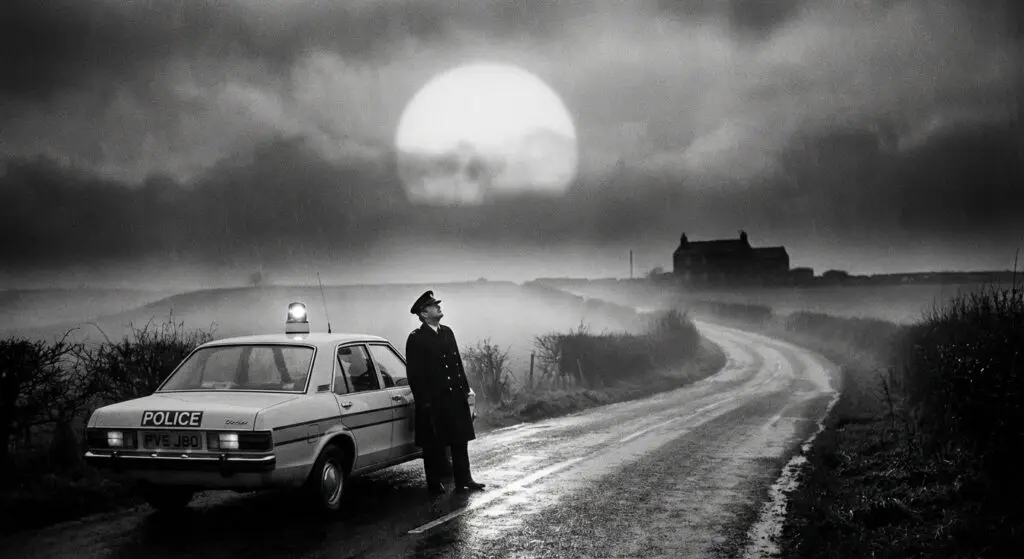
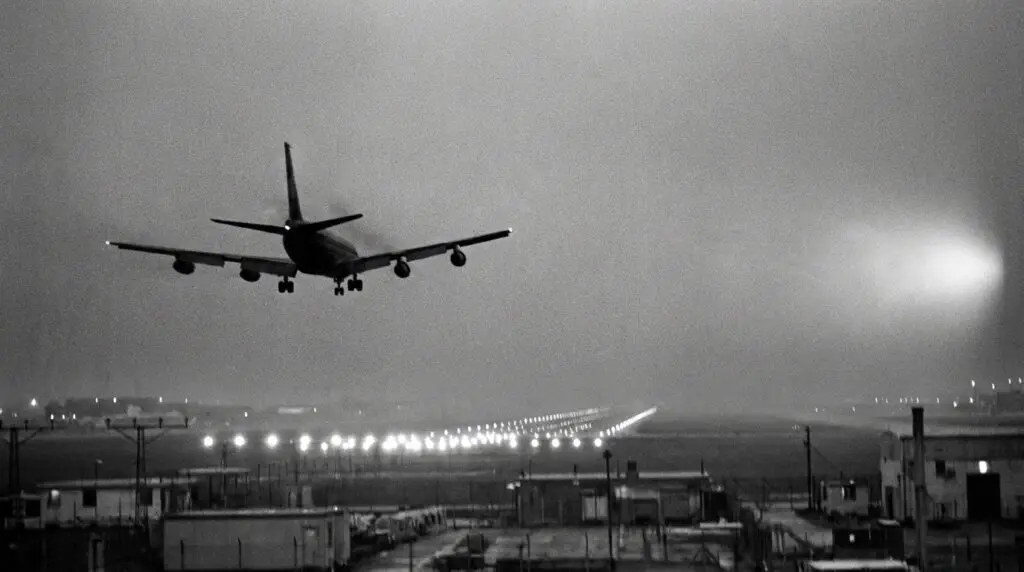
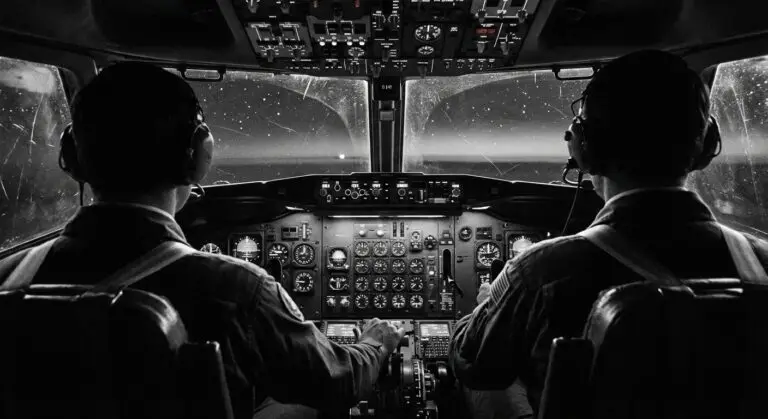
A commercial cockpit doesn’t get to treat an unknown light as a curiosity. When something bright and persistent sits where it shouldn’t, the crew has to decide in real time what matters more: staying on the planned route, or taking the safest path to the nearest runway with emergency services standing by. The Manises 1979 incident endures because it forced exactly that kind of high-pressure aviation judgment under uncertainty, with consequences serious enough to trigger documentation rather than just anecdotes.
If you’ve been reading modern “UFO” or “UAP disclosure” headlines, you’ve probably noticed the same problem: one dramatic historical case gets retold so many times it turns into a legend. Details inflate, quotes harden into “official statements,” and the parts that can actually be checked, flight actions, communications, diversions, get buried under the parts that can’t. You’re not looking for a vibe; you’re looking for a case that stays dramatic even when it’s pinned to records.
The reason Manises keeps resurfacing is the tradeoff at its core. On one side, you have dramatic witness reporting and real-world emergency actions; the story is usually summarized as unusual lights reported by an airliner, a diversion and emergency landing at Manises (Valencia), and a military response that included a Mirage launch. On the other side, calling anything a “craft” demands an evidentiary standard that most sighting stories never even approach. This case sits in the narrow overlap where the narrative is loud, but the paper trail is louder, and the only honest way to handle it is to separate what was reported from what was documented.
The goal is straightforward: identify what is solidly documented, isolate what is disputed, and be explicit about what additional records would actually settle the case.
Timeline, Aircraft, and Main Witnesses
Incident brief (concise, sourced):
- Date: 11 November 1979. Sources commonly give this date for the Manises event (Wikipedia).
- Operator: Commercial flight operated by Transportes Aereos Espanoles (TAE) as reported in multiple summaries of the case (Wikipedia).
- Flight identification: The flight is commonly identified in retellings as TAE flight JK-297; that identifier appears in several secondary accounts (Wikipedia).
- Aircraft type and registration: Contemporary and widely cited retellings describe the airliner as a Caravelle or Super Caravelle; however, no contemporaneous public record with a definitive tail number has been identified in the sources reviewed here, and registration details remain unreliably reported in public retellings (Wikipedia).
- Passengers: The commercial flight carried about 109 passengers in commonly cited accounts (Wikipedia).
- Diversion and landing: The airliner made an unscheduled emergency landing at Manises Airport, Valencia, after crew reports of bright lights; this diversion and landing are described in contemporary summaries and later investigations (Wikipedia) (Medium).
- Military response: Spanish Air Force fighters were scrambled in response; most accounts identify a Dassault Mirage F1 as the fighter involved and report an attempted intercept. Secondary sources state the pilot achieved high speed during the intercept attempt (Wikipedia) (Grokipedia).
What is documented versus disputed: contemporary press, later investigative summaries, and released Spanish files have preserved at least enough of the sequence to show an airliner diversion and a military scramble were reported and investigated. For example, secondary accounts and case dossiers summarize the emergency landing and the scramble as part of the official record of inquiry (Wikipedia) (Medium). Declassified Spanish files and archive notes have been cited by researchers as sent to Air Force archives for review (partial declassification compilation). That said, precise operational artifacts that would resolve every disputed detail – tower audio, original ATC strips, preserved radar replays, or an official published mission debrief with a tail number – are not publicly available in a single, complete packet in the sources reviewed here.
Competing claims made explicit:
- Date variation: Most authoritative summaries list 11 November 1979, but some retellings and later media pieces occasionally give alternate dates such as 14 November in error or as a result of secondary sourcing (Wikipedia) (Reddit discussion of date variants).
- Flight identifier and aircraft model: The common retelling names the operator as Transportes Aereos Espanoles and the flight identifier as JK-297 with a Caravelle-type aircraft, but because contemporary operational documents with clear movement lists or a published tail registration are not present in the reviewed public record, some accounts hedge the aircraft model or omit a registration (Wikipedia) (Medium).
- Mirage details and pilot identity: Multiple references record that a Mirage was scrambled; several secondary sources identify the type as a Mirage F1 and place the scramble from Los Llanos base in press summaries, while media retellings give varying pilot names or degrees of identification. These variations are present across public retellings and should be treated as competing claims until tied to a specific mission log or signed debrief (Wikipedia) (Grokipedia) (Medium).
Methodology note for the timeline: this article uses an artifact-first approach. Concrete claims are promoted only when tied to an identifiable source in the public record. Where multiple sources conflict, those competing claims are shown side-by-side and traced to the cited secondary or archival material so readers can see which parts remain unresolved.
Cockpit Reports and Radar Controversy
The credibility bottleneck in aviation-UFO cases is almost always the same: radar and instruments. This is where dramatic narratives most often outrun the record, because the most consequential assertions, close proximity, “something on radar,” and cockpit anomalies, sit on the fault line between human perception under workload, ATC procedure under time pressure, and the hard limits of radar physics.
Secondary retellings of the Manises incident consistently describe the crew reporting one or more bright lights outside the cockpit, a sense of relative motion that did not match normal traffic patterns, and an impression that the object was uncomfortably close at times, even when exact distance was unclear. That mix, a vivid visual cue paired with uncertain geometry, is common in fast-moving, low-context scenarios where pilots must build a mental model quickly.
On the instrument side, some accounts add a cockpit concern tied to fuel indication or fuel consumption. A circulated report specifically claims the crew noticed either a fuel gauge malfunction or unexpectedly high fuel consumption after several runs. Taken strictly as “reported,” this is an important detail because it shifts the story from a pure visual sighting to an event where the crew believed aircraft systems were also behaving abnormally, without establishing, by itself, what the root cause was.
What matters for evaluating these claims is the pattern, not the drama: pilots describing lights often report apparent pacing, stops, or closure because angular movement can look like straight-line pursuit, and perceived proximity can spike when there are no reliable depth cues at night. Those human-factors limitations are exactly why the radar and ATC layer becomes decisive.
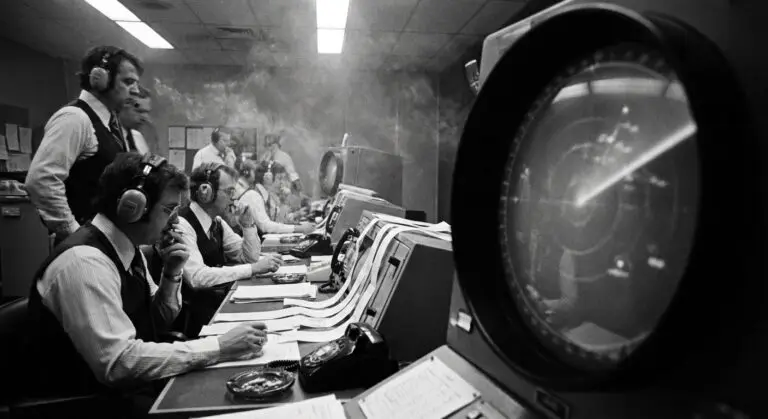
Controllers do not “validate” unusual traffic by believing or disbelieving a pilot; they work the problem. If a crew reports unknown traffic, ATC typically checks what is available on the controller display, queries the aircraft for position, altitude, and intentions, and issues traffic advisories or vectors as needed. When the situation is operationally significant, it is normally reflected in some combination of controller notes, flight progress strips, event logs, and recorded communications, while radar data may be stored separately depending on the facility and era.
“Radar” is not a single sensor with a single truth value. Primary radar is the classic skin-paint system, it transmits energy and displays returns from reflected energy, which is why it can show an object even when it carries no cooperative equipment, but it also struggles with clutter and ambiguous blobs. Secondary radar is a cooperative surveillance system, it relies on interrogating a transponder aboard the aircraft, which is why ATC can see an identity code and a pressure altitude readout when the transponder replies, and why a non-responding target can disappear from that layer entirely.
Mirage Scramble and Intercept Claims
The Mirage launch is the highest-stakes moment in the Manises narrative because it marks a shift from civil-aviation anomaly to air-defense action. That escalation raises urgency and expands what could be checked in real time, but it does not automatically convert a confusing set of lights into a confirmed, structured craft. A night intercept is an evidence-gathering tool, not a verdict.
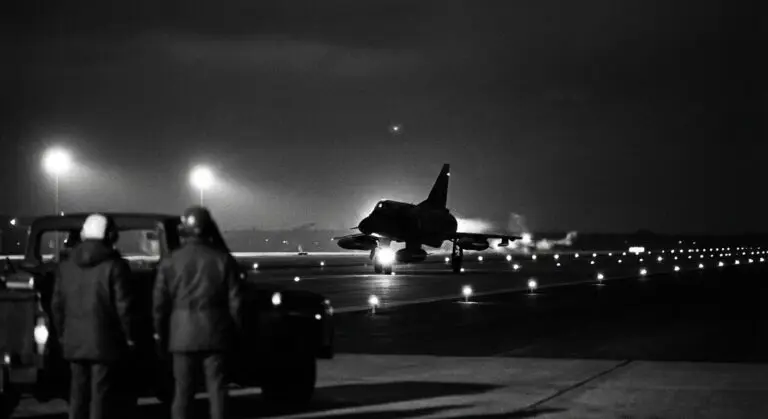
In operational terms, a scramble is a rapid-response launch from alert posture, sending fighters immediately airborne to intercept so the air force can identify what is in the airspace, assess intent, and secure the operating area. You launch quickly because the unknown is moving while decision-makers are still deciding: the intercept compresses uncertainty into a controlled encounter, or it ends it by disproving a threat through direct contact.
Multiple public accounts describe a Mirage F1 – the Spanish Air Force type in service at the time – being tasked to intercept after the diversion and landing. Secondary sources report that the pilot attempted an intercept and reached high speed during the attempt, but the specific mission logs or a publicly released signed debrief tying times, speeds, and pilot statements to a verified mission log are not present in the set of publicly available primary artifacts reviewed here (Wikipedia) (Grokipedia) (Medium).
Conventional Explanations and Open Questions
Conventional explanations are not cop-outs. They are testable mechanisms that often fit real portions of messy reports. The productive question in Manises is not “debunk or believe,” but “which mechanism matches which reported elements, and which elements stay stubbornly unmatched.”
Mechanism: a bright planet or star, or a bright Moon effect, misread as a structured light. What it explains well: a persistent light at a stable bearing that seems “to pace” an aircraft for long stretches. Celestial positions are not guesswork; at any moment they are defined by azimuth and altitude, and astronomy predicts their future positions and motions. Apparent drift also has a known signature because the rate of change of a star’s azimuth depends on time and altitude, and Moon brightness can suppress or alter what else people notice in the sky. What it struggles with: reports that emphasize large bearing changes, rapid apparent closures, or a light that clearly maneuvers relative to the horizon or other reference points. If multiple observers at different locations reported sharply different bearings at the same time, a single celestial source will not reconcile those geometries without additional effects like haze layers or cockpit motion cues.
Mechanism: other aircraft, including formation traffic, presenting landing lights, anti-collision strobes, or a constant navigation light that looks “stationary” when the geometry is right. What it explains well: intermittent intensity changes (lights “blooming” when pointed toward the observer), reports of multiple lights that separate or rejoin, and timing that tracks along airways or near terminal areas. What it struggles with: long-duration pacing at unusual bearings without any corroborating ATC picture, and behavior that implies instantaneous accelerations rather than geometry changes from relative motion.
Mechanism: military activity, including flare testing, which some accounts cite as an official conclusion. What it explains well: bright, attention-grabbing lights that appear to hover, descend, or drift, sometimes in clusters, sometimes with slow “falls” that read as purposeful motion at night. Flares also create the exact kind of human confusion that turns one light into “a craft” when distance is unknown. What it struggles with: the need to match the reported timing and bearings to a plausible range area and to the burn time profile. If witnesses separated by many miles saw the same light at the same time but described incompatible directions, “one flare” stops working unless multiple drops occurred.
- Meteorological records: surface and upper-air profiles to confirm or reject inversion-driven refraction and ducting conditions.
- Flare and range logs: launch times, drop zones, burn durations, and NOTAMs tied to the relevant sectors.
- Precise azimuth and elevation estimates: even rough values let you back-solve celestial candidates using standard tables or software.
- ATC and military records: traffic tracks, radio logs, and any correlated radar annotations that anchor timing and geometry.
The responsible way to discuss Manises is to keep the mechanism-to-evidence mapping explicit. Say what a hypothesis explains cleanly, name the specific feature it cannot explain without extra assumptions, and be equally clear about what data would falsify it. In practice, the same missing inputs that keep those hypotheses from being cleanly confirmed or rejected are also what make legacy cases useful in today’s disclosure debate.
What Manises Means for UAP Disclosure
Manises still matters because modern disclosure debates hinge on record retention and accessibility. The practical question is how governments store, classify, and declassify aviation and defense records that would resolve operational incidents. The core documentary types that matter for a case like Manises are ATC audio and strips, radar replays, airport movement logs, and military mission logs and debriefs. When those records are preserved and released, they convert story fragments into an auditable case.
There is an explicit institutional response to the challenge of handling UAP reports. The U.S. All-domain Anomaly Resolution Office publishes consolidated annual reporting that quantifies incoming reports and sets standards for data handling. For example, an AARO FY 2023 consolidated report documents the office’s handling of UAP reports and gives a cumulative total of reports received through the covered period (AARO FY 2023 consolidated annual report). That administrative transparency model is instructive: a central inventory, clear retention policies, and publicly stated data standards make legacy investigations easier to revisit and audit.
Use Manises as a filter. The strongest disclosure claims point to an accessible document, a clear standard, and an auditable chain from report to conclusion. That is also the standard that keeps a dramatic legacy incident from turning into an untouchable legend.
Aviation Mystery, Enduring Disclosure Test
The Manises case still lands where it began: a high-stakes operational decision in the cockpit, an unscheduled emergency landing at Manises, and a reported military response that included a Mirage launch-followed by decades of retellings that are strongest when they stay tied to auditable records.
What holds up across tellings is narrow but solid: the airliner diverted and made an emergency landing; multiple observers across different vantage points reported unusual lights; and a military response, including a Mirage launch, is part of the documented narrative in public summaries and case dossiers (Wikipedia) (Medium). The friction is also consistent: what exactly was seen from each platform, what (if anything) appeared on radar or other instruments, and whether the popular “flare testing” conclusion fully accounts for the reports. Conventional explanations map cleanly onto some elements but not all, and the difference is never rhetoric; it’s documentation.
To move Manises forward, the wish list is straightforward: the Spanish declassified dossier or case file; ATC logs and any surviving tapes; military operations logs for the scramble and intercept reporting; and primary radar plots or strips tied to the relevant sectors. Publicly cited summaries point to declassification activity and archive transfers in Spain but do not yet provide a single, complete packet of all operational artifacts in a publicly accessible location (declassification compilation)(Wikipedia).
Read and share aviation UAP cases with one standard: primary records first, witness dignity always, and persistent pressure for transparent archival access.
Frequently Asked Questions
What was the Manises UFO incident in 1979?
It was a 1979 aviation incident where an airliner reported persistent bright lights, diverted, and made an unscheduled emergency landing at Manises Airport (Valencia). The narrative also includes a military response that involved a Mirage launch.
Where did the Manises incident happen and why is Manises mentioned so often?
Manises refers to Manises Airport in Valencia, Spain, where the airliner made an emergency landing after reporting unusual lights. The case is frequently cited because it combines dramatic witness reports with operational actions that should leave a paper trail (ATC, airport, and military records).
Why do Spanish sources call the Manises case an ‘OVNI’ incident?
Spanish-language coverage often uses “OVNI” as shorthand for “unidentified flying object” as a reporting label rather than an official certification. The article notes this matters because it influences how sources frame the event versus what is actually documented.
What records should exist for the Manises emergency landing and Mirage scramble?
The article says to look for ATC logs/strips/transcripts or audio, airport movement logs and operations notes, and military notification records, scramble orders, mission logs, and after-action summaries. It also recommends same-week press reports that quote named participants and separate observation from inference.
What’s the difference between primary radar and secondary radar in UAP cases like Manises?
Primary radar shows “skin-paint” returns from reflected energy and can show non-cooperative targets, but it’s vulnerable to clutter and ambiguous returns. Secondary radar relies on a transponder reply, which is why ATC can see identity/altitude when a transponder responds and why a non-responding target may not appear on that layer.
What unusual cockpit or instrument issues are reported in some Manises retellings?
Some accounts add a cockpit concern involving fuel indication or unexpectedly high fuel consumption after several runs. The article treats this as a reported detail that, if true, shifts the story beyond a purely visual sighting without by itself establishing a root cause.
How should you evaluate competing explanations like flare testing vs. other causes in the Manises case?
The article’s method is to map each hypothesis to specific reported elements and then demand time- and location-specific records to test it. It lists key data to look for, including meteorological profiles (for refraction/ducting), flare and range logs/NOTAMs, precise azimuth/elevation estimates, and ATC/military records that anchor timing and geometry.