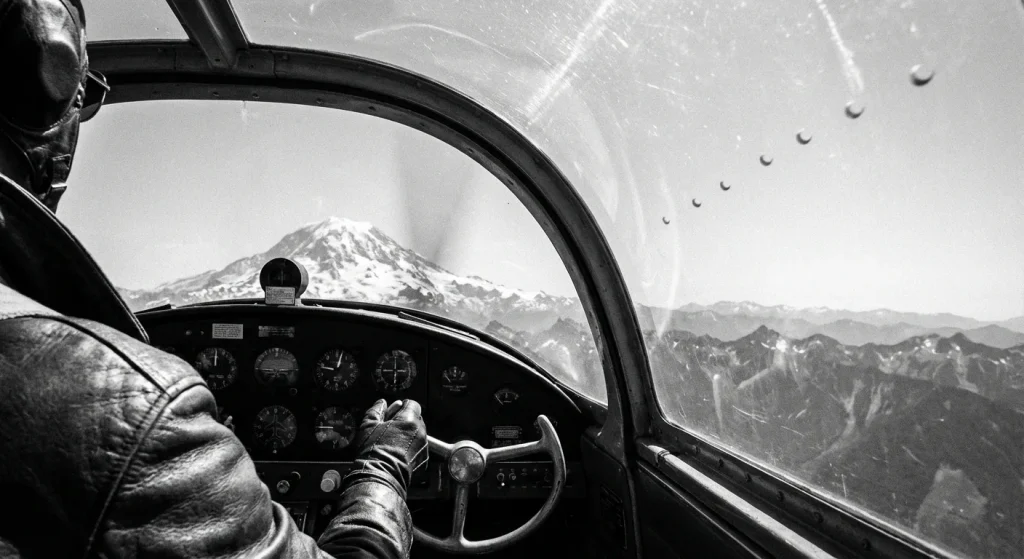
You keep seeing “UFO disclosure” and “UAP disclosure” headlines, but the hard part is never the buzzword. It is figuring out what is genuinely new versus what is culturally preloaded since 1947. The disclosure conversation still runs on a labeling problem: one report did not just add another mystery to the pile, it helped mint a sticky category, “flying saucers,” that still shapes how people sort anything unusual in the sky before the facts are even on the table. Contemporary accounts and later histories trace the phrase’s popular spread to press coverage of Kenneth Arnold’s June 24, 1947 report, in which Arnold compared the objects’ motion to “a saucer if you skip it across water” and the press adopted variants such as “flying saucer” and “flying disk” to describe the story (see Smithsonian Air and Space and Wikipedia entries on the sighting and the 1947 disc craze).
Start with what is anchored. The well documented basics are these: the sighting occurred on June 24, 1947, during a Washington-state flight in the vicinity of Mount Rainier; Arnold was on a private flight from Chehalis bound for Yakima; and his motion analogy is the formulation journalists picked up and popularized. Those points are documented in primary and secondary accounts of the event and the early press coverage (see Smithsonian Air and Space and History.com).
Kenneth Arnold and the 1947 Context
Arnold’s report carries weight for a simple reason: it came from a private pilot making a real, date-and-place-specific flight rather than from anonymous hearsay. Contemporary scholarship identifies Kenneth Arnold’s sighting as occurring near Mount Rainier on June 24, 1947, and connects his description to the wave of press coverage that summer that popularized the “flying saucer” label (Smithsonian Air and Space; Wikipedia).
The postwar setting shaped how people received the report. In 1947 the public and officials were newly attuned to high-performance aviation and to possible foreign aeronautical capabilities; those conditions made unusual aerial reports more consequential and prompted institutions to treat the phenomenon as a potential national-security issue rather than purely folklore (Smithsonian Air and Space).
What Arnold Said He Saw
Handle the observation with careful labeling: separate what witnesses explicitly described from what later analysts calculated. Arnold said the objects were “flat like a pie pan” and likened their motion to “a saucer if you skip it across water” while reporting a sighting near Mount Rainier on June 24, 1947 (Smithsonian Air and Space; Arnold interview transcript).
Identify Johnson. Some contemporary accounts name David N. “Dave” Johnson, then Aviation Editor of the Idaho Statesman in Boise, Idaho, as a correspondent who was contacted by Arnold after a refueling stop; later reporting and recollections link Johnson to the early reporting chain around Arnold’s account (see a collected excerpt and discussion in the Feral House excerpt and contemporaneous group recollections). Some sources also cite Fred Johnson as a corroborating local witness in Washington State in related accounts (see Feral House excerpt).
Timing and distance claims are treated differently in different sources. Arnold later provided timing material in interviews and statements that have been reproduced in archival interview transcripts; one contemporaneous estimate circulated that the objects were observed for about one minute (see Arnold interview transcript). Other summaries and secondary-source extracts place relative positions and give distance-and-bearing figures—one secondary compilation describes a “45 miles NNW” relation in the retelling of positions used by some analysts—but that particular directional-mileage wording is found in secondary-source summaries rather than a single primary police report (see Martin Shough analysis and The UFO Evidence summary).
Those distinctions matter because speed, distance, and size calculations scale directly with assumed duration and range. Arnold reported that the objects covered a long apparent arc between terrain features in a short interval, which led to later speed estimates; those reconstructions depend on assumptions about the objects’ range relative to the mountains and on the timing anchors used in the calculation (Arnold interview; Smithsonian Air and Space; Martin Shough analysis).
| Bucket | What it means in practice | What belongs here (from the cited sources) |
|---|---|---|
| Anchored | Supported by stable references like date and place; does not depend on timing precision or range assumptions. | Reported near Mount Rainier on June 24, 1947 (Smithsonian Air and Space; Wikipedia). |
| Estimated | Given as an approximation by a witness or account; usable for context but not a precision input. | An estimate circulated that the objects were observed for about 1 minute (Arnold interview transcript). |
| Inferred | Constructed by combining anchors and estimates with assumptions (especially distance and alignment); should always be labeled as conditional. | Distance, speed, and any specific mileage-and-bearing claims (examples of a “45 miles NNW” phrasing appear in secondary summaries) (Martin Shough; The UFO Evidence summary). |
How Headlines Created Flying Saucers
Once a vivid metaphor reaches a newsroom, nuance is often compressed into a noun phrase. Arnold’s “skipping like a saucer” comparison described motion; press headlines and wire-service copies turned that image into a short, concrete label, variously printed as “flying saucer” or “flying disk,” and the term quickly spread through syndicated reporting across North America (Smithsonian Air and Space; History.com; Wikipedia 1947 flying disc craze).
The mechanism is clear: simplification plus distribution plus repetition turns a descriptive analogy into a durable category. That public label then feeds back into how later witnesses describe their experiences, making “flying saucer” a culturally available shorthand for ambiguous aerial phenomena.
Later neutral terminology, like “Unidentified Flying Object” and, more recently, “Unidentified Anomalous Phenomena (UAP),” reflects an institutional effort to avoid shape-based inferences in reporting language. The persistence of “flying saucer” in popular culture can be seen in many later references and popular books; some popular treatments cite a 1966 Bantam Books reference to “Flying Saucers, Serious Business” (page 47), but the specific edition and page-level citation are not available in the sources used here (1966 Bantam Books reference).
The 1947 Wave and Official Attention
Public attention created administrative pressure. Within weeks of Arnold’s report, newspapers were running many related reports, and the influx of reports prompted federal attention because unknown aerial phenomena fall inside the same operational concern as potential foreign aircraft or sensor anomalies. That logic led the U.S. Air Force to create Project Sign in 1948 as an initial official effort to collect and analyze reports of unidentified flying objects for national-security implications (Smithsonian Air and Space).
Roswell is an illustrative case of how early press coverage and official statements intersect. On July 8, 1947 the Roswell Army Air Field public information officer issued a press release stating the military had recovered a “flying disc” near Roswell; the Army quickly retracted the initial announcement the next day and stated the crashed object was a conventional weather balloon in its official follow-up (DAF History documentation; DTIC report; Wikipedia Roswell incident). Later researchers have examined the chain of custody and competing explanations in detail, including Project Mogul balloon material as a likely source for the debris originally reported by some personnel (DAF History; DTIC).
Why Arnold Matters in 2025 and 2026
Kenneth Arnold’s 1947 report continues to matter because it supplied a durable framing: an image-based label that reshaped how witnesses, reporters, and institutions categorized ambiguous aerial observations. That framing persists in modern debates about disclosure and evidence standards, where public expectations about what counts as convincing often mirror the visual vocabulary that emerged in 1947 (Smithsonian Air and Space; History.com).
Institutional responses have evolved; current U.S. Department of Defense structures use different terminology and different offices to manage reporting and analysis. The All-domain Anomaly Resolution Office (AARO) is the DoD office responsible for coordinating the receipt, analysis, and resolution of UAP reports across domains, and contemporary congressional and executive attention has focused on recordkeeping, reporting, and oversight rather than cinematic disclosure narratives (DoD public materials; see also congressional sources below).
- Track the vocabulary: “UFO” versus “UAP” signals different scopes and assumptions.
- Identify the implied evidence standard: eyewitness framing, sensor data, or formal casework.
- Confirm the responsible process: which office, which pipeline, and what “resolution” actually means in that context.
A Metaphor That Shaped a Century
A pilot’s June 24, 1947 report near Mount Rainier gave the press a compact image that became the public framework for subsequent reports: a motion metaphor was recast as a shape, syndication and reprints amplified the phrase, an early investigative pipeline formed (Project Sign), and modern UAP governance and oversight now emphasize standardized reporting and records. Labels arrive early; the documentary record often arrives more slowly. That is why separating anchored facts from estimates and inferences remains a practical way to evaluate both historical and contemporary claims.
The National Defense Authorization Act (NDAA) process is where recordkeeping and reporting requirements are commonly formalized. The Senate bill S.2296 in the 119th Congress is the FY2026 NDAA; as of July 15, 2025 the bill contained several proposed UAP-related provisions described as modest at that stage. Readers should track the bill text and specific amendments as they move through committee and floor consideration (see the official Congress.gov bill page and amendment records linked below).
Sources and method
The article relies on primary and secondary accounts of the Kenneth Arnold sighting and the 1947 press wave, as well as official and archival materials about midcentury and contemporary institutional responses. Key sources used here include:
- Smithsonian National Air and Space Museum, “1947: The Year the Flying Saucer Arrived” — overview of Arnold sighting and press reaction.
- Wikipedia, Kenneth Arnold UFO sighting — summary and citations for original accounts and the 1947 disc craze.
- History.com, Kenneth Arnold article — concise narrative of the sighting and its immediate press effects.
- Kenneth Arnold interview transcript (archival transcript) — primary-source interview material on timing and descriptive language.
- Martin Shough analysis of the Arnold case — analytical treatment and discussion of secondary summaries, including distance/bearing phrasing found in later compilations.
- Illinois Library blog on the 1947 flying saucer craze — discussion of newspaper syndication and the spread of the phrase.
- NPS, climate monitoring and in-park weather stations — reference for Mount Rainier in-park weather-station context.
- Park study reporting weather stations in Mount Rainier National Park — note on the number and distribution of in-park stations used in park climate monitoring studies.
- Department of the Air Force history materials on Roswell and related press releases — documentation of the July 1947 Roswell press release and subsequent retraction.
- DTIC report on Roswell and Project Mogul analyses — archival technical review and later assessments.
- Scott Bakal, Kenneth Arnold sighting summary — compilation and context for the original reports (supplementary).
- Secondary historical analysis collections (selected) — background and historiography.
- Martin Shough analysis (repeat link for convenience) — used for discussion of secondary-source distance/bearing phrasing.
- Congress.gov, S.2296 text (119th Congress, FY2026 NDAA) — official bill text and context for FY2026 NDAA provisions.
- Congress.gov, text of Senate amendment SA 3759 (119th Congress) — referenced amendment text and actions.
- The UFO Evidence summary (secondary compilation via Yumpu and other archives) — secondary-source compilation that includes phrasing later reproduced by others.
- Feral House excerpt and related collected materials — used for reporting on early correspondents and reportage chains (e.g., references to David N. Johnson).
Where a specific page-level bibliographic link was not available in the sources used here, a placeholder link of [URL NOT FOUND] is provided in the one instance above; readers should consult library catalogs and primary print editions for page-level verification of later popular references.
Frequently Asked Questions
-
When and where did Kenneth Arnold’s famous 1947 UFO sighting happen?
The sighting is anchored to June 24, 1947, near Mount Rainier in Washington state. The article also places it during a private flight from Chehalis to Yakima.
-
Why is Kenneth Arnold’s report treated as historically important in UFO history?
It came from a private pilot during a real, time-and-place-specific flight, which makes it a localized, dated report rather than anonymous folklore. The article says this single report helped mint the sticky cultural category “flying saucers.”
-
What did Kenneth Arnold actually mean by “flying saucers” in his description?
The article explains the famous phrasing was primarily a motion metaphor-“skipping like a saucer”-rather than a precise claim that the objects were disc-shaped. It argues the key data is the verb (“skipping”) and that headlines later collapsed motion into shape.
-
How long were the objects reportedly observed in the 1947 account?
The article cites an estimate that the objects were observed for about 1 minute. It emphasizes that this short duration strongly affects any later speed or distance calculations.
-
What is the “45 miles NNW” detail in the Arnold sighting, and how should it be treated?
One reported account places Arnold about 45 miles NNW of Johnson’s position on Mount Adams. The article classifies this kind of positioning used for geometry-based reconstructions as “inferred,” not a settled measurement.
-
What did the U.S. government do after the 1947 “flying saucer” wave, and what program started in 1948?
The article says the growing volume of reports pushed federal attention toward investigation and workflow, not immediate conclusions. It states that by 1948 the U.S. Air Force initiated Project Sign to collect and analyze UFO reports for national security implications.
-
What should I look for when evaluating modern UFO/UAP disclosure claims using this article’s framework?
The article says to separate “anchored” facts (like June 24, 1947 near Mount Rainier) from “estimated” elements (like “about 1 minute”) and “inferred” outputs (like speed or size derived from landmark geometry). It also advises tracking vocabulary-“UFO” versus “UAP”-and confirming the responsible office and process, including AARO as the DoD office for coordinating UAP reports.
