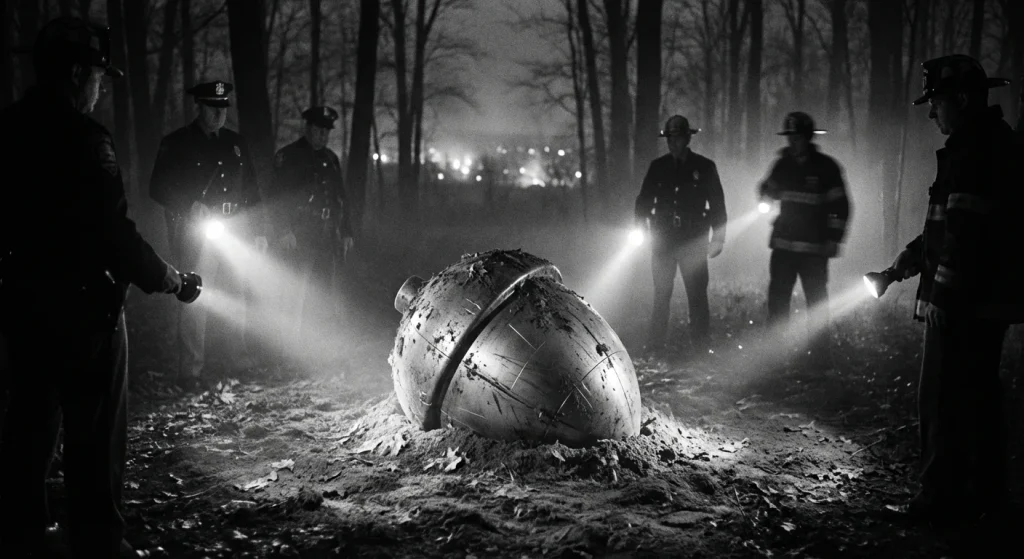
If you keep seeing Kecksburg resurface in UFO news and UAP news, you have the same problem every reader hits: the story has a clean, memorable “crash” reputation, but the evidence splits into two very different buckets: what’s broadly documented in the sky, and what’s argued on the ground.
Kecksburg persists because the baseline facts are simple, but the ground-story remains contested. The simple part is a wide-area sky event on December 9, 1965: a bright fireball significant enough to be studied later for its trajectory and orbit. The contested part is what, if anything, happened after that spectacle reached the Kecksburg area.
The wide-area context matters because Kecksburg was not an isolated, single-town sighting. The same late-afternoon to early-evening event was reported across multiple U.S. states and Ontario, Canada. Contemporary and retrospective coverage identifies Michigan, Wisconsin, Illinois, Indiana, Ohio, Pennsylvania, and New York among the states where observers reported the event. Local reporting such as the Pittsburgh Post-Gazette retrospective and broadcast archives from WTAE document regional attention to the sighting, while scientific compilations of fireball reports like the American Meteor Society track individual public reports and assign event identifiers for analysis (see the AMS fireball pages for the 1965 archive).
The stakes rise because the recurring cover-up template starts right here: many accounts report that authorities arrived soon after in or near Kecksburg, typically described as state or local police and sometimes military personnel. That claim drives the crash-retrieval narrative, but it also immediately runs into the hard limit of this case: the most repeated details are not the same as the most verifiable documentation.
This article treats Kecksburg as a tradeoff you can actually evaluate: dramatic local crash-retrieval stories versus what the record can support. The same event is discussed in sources that also circulate competing explanations, including space hardware and satellite-related claims, while technical reconstruction work and organized searches underline how quickly certainty can evaporate once you move from “something crossed the sky” to “we know what hit the ground.” You’ll leave able to separate the strongest claims from the weakest, and to identify the specific kinds of documentation that would resolve the case.
Timeline of the Kecksburg event
Before weighing what may have happened in the woods, it helps to pin down what can actually be placed on a clock. The cleanest chronology sits overhead: a bright, fast event seen across a wide region in the late afternoon to early evening of Dec. 9, 1965. The moment it drops into the Kecksburg woods is where the clock turns elastic, because local sequences are reconstructed from scattered vantage points, uneven documentation, and later retellings that add order after the fact.
Contemporaneous and retrospective coverage converges on one stable baseline: witnesses across a wide region reported a bright fireball in the sky on Dec. 9, 1965, and Ontario is routinely included in that footprint. That matters because it sets expectations for scale: one atmospheric event can be seen from far beyond any single town. Scientific and citizen-science compilations of fireball reports, such as the American Meteor Society fireball database, collect public witness reports and assign event identifiers for later analysis; see the AMS fireball pages for the 1965 archive.
A bolide (fireball) fits that baseline because extreme brightness and fragmentation can produce a multi-state “the sky lit up” signature while still leaving observers with different impressions of direction, speed, and end-point. That is the first timeline friction: people in different locations are timing different parts of the same luminous passage, then later talking as if they all witnessed the same final second.
Report counts are another built-in source of variance. Public-facing meteor reporting tallies and press roundups are commonly summarized in contemporary material and later summaries; local outlets such as the Pittsburgh Post-Gazette and broadcast coverage archived by WTAE document many local calls and follow-ups. The American Meteor Society database records individual witness submissions that researchers can analyze for timing and geometry. Treat those totals as a measurement of attention, not a stopwatch reading.
Near the end of the regional sighting path, local Kecksburg-area claims tighten the story from “seen in the sky” to “ended nearby.” The key shift is not object detail, but perceived termination: witnesses describe a drop below the treeline, a descent into a wooded area, or a loss of visibility consistent with terrain. Those impressions are time-sensitive in a way the regional reports are not; once a witness decides they saw an “end,” every later recollection tends to backfill a precise sequence leading to it.
The local witness categories that show up early, then amplify later, tend to cluster into a few repeating elements: sound (a boom, rumble, or prolonged roar), trajectory impressions (low, fast, and descending), and post-event cues (smoke, fire, or a glow reported from the woods). The forensic point is that these categories do not timestamp themselves. A boom can lag a bright passage, smoke can be mis-timed to dusk, and “it went down there” can be an inference made from line-of-sight rather than a direct view of impact.
Separate the reported response activity into evidence tiers, because the response narrative is where Kecksburg’s timeline gets most story-shaped. Tier 1, contemporaneous reports, tends to emphasize fast-moving uncertainty: people call neighbors, local authorities get alerted, and reporters frame the situation using the most legible word available, “crash.” Once that frame lands, later ambiguity gets interpreted through it, even when the underlying data is just “bright sky event plus local commotion.”
Tier 2, near-term follow-ups, is where the response story often gains structure: references to organized searching, officials arriving, and movement toward a specific wooded area. These accounts commonly introduce the idea of access control and a defined search zone, but the timing and sequence vary across tellings, especially when writers compress hours into a single paragraph.
Tier 3, later recollections compiled through interviews in books and documentary programs, is where the response timeline typically becomes most cinematic: a cordoned area, a controlled perimeter, and a communications center operating from the volunteer fire department. Those details may reflect genuine memories, but they also reflect the incentives of narrative coherence. Later compilations assemble many accounts into a single continuous storyline, which can add specificity that is not present in 1965-era reporting and can quietly smooth over conflicts between witnesses who were not describing the same moment.
Timeline disagreements in Kecksburg come from three predictable mechanisms: memory contamination (later information re-labels what an earlier sensation “must have been”), secondhand retellings (a neighbor’s story becomes “what happened”), and a media feedback loop (early “crash” framing makes later witnesses interpret uncertain cues as confirmation). The sky-side chronology tolerates this noise because the event is regionally consistent; the ground-side chronology magnifies it because it depends on short, local, hard-to-verify sequences.
Concrete example of a timeline discrepancy: a retrospective account in the Pittsburgh Post-Gazette (Dec. 6, 2015) summarizes local recollections anchored to the late-afternoon period and cites times commonly reported as roughly 4:45 p.m., while other compiled public reports and broadcast accounts archived by WTAE and/or in national summaries give slightly different minute marks for when observers first noticed the fireball. Those minute-level differences show up in multiple local writeups and in public fireball-report databases; the evidence-tier method handles such a conflict by privileging same-day logged materials (newsroom tape, police dispatch logs, or dated wire reports) over later recollections, and by seeking independent corroboration from multiple unaffiliated vantage points before treating any single minute as definitive.
- Pin each claim to an evidence tier: same-day or next-day reporting first, near-term follow-ups second, later interview compilations last.
- Demand a time anchor that is external to memory: a dated article, a logged call, a dispatch note, or a broadcast timestamp, not a “we figured it was about 4:45” estimate.
- Corroborate across independent vantage points: treat “seen across multiple states and Ontario” as strong for the sky event, and treat single-location woods sequences as provisional unless multiple sources align on the same order of actions.
- Separate sensations from conclusions: “I heard a boom” is different from “it crashed,” and “there was smoke” is different from “I saw impact.”
- Discount detail that only appears late unless it is backed by a contemporaneous record; later narratives often add crisp sequencing that early reporting simply does not contain.
The acorn-shaped object and evidence
That elastic, ground-side timeline is where the case acquires its most famous visual claim. Kecksburg’s object description is famous; its evidentiary record is not. The “acorn-shaped craft” sits first and foremost in the witness-description category, and the real evidence problem is less about what people remember than what can be verified decades later from records, images, measurements, and preserved materials.
The signature report centers on an acorn- or bell-shaped metallic object, often described as having visible seams and symbol-like markings. Those details should be treated as witness-reported attributes, not established physical facts, because the public record does not contain a reliably documented physical artifact that can be independently examined today. The description’s strength is its specificity: a single, distinctive silhouette plus “manufactured” cues like seams and markings. The catch is that specificity alone does not substitute for verifiable documentation.
Accounts also commonly include alleged ground and vegetation effects: scorched ground, broken branches, and impressions consistent with an impact or landing. Those are exactly the kinds of transient traces that become persuasive only when they are captured immediately and systematically. Standard scene practice treats perishable pattern evidence, including impressions, as something that must be protected for later evaluation and documented through measurement and photography at the time it is found; without that contemporaneous documentation, later descriptions rarely support reliable comparisons.
If Kecksburg involved a recoverable object or meaningful physical traces, the credibility hinge in 1965 would have been basic, durable documentation: clear photographs and/or video with known provenance, measured dimensions of any impressions, written logs of who observed what at the site, and physical evidence records that track what was collected and where it went.
For trace claims like scorching or burn effects, the gold standard is material that can be analyzed and associated with a place or object, such as fire debris, soil, or residues collected and preserved for scientific examination. Without chain of custody, a documented record of who collected, handled, stored, and transferred evidence, later claims about recovered fragments, soil, or metal never graduate from story to verifiable material evidence.
WTAE-TV (Pittsburgh) reported locating and airing old film footage from the night of the incident. Treated responsibly, that archival material demonstrates contemporaneous interest and on-the-ground reporting conditions, such as the presence of people, lighting limits, and the general atmosphere. It does not, by itself, demonstrate that an exotic craft was recovered, because archival news footage can be compelling without showing an identifiable object, measurable trace evidence, or documented handling of physical materials.
Kecksburg also illustrates folklore accretion in concrete ways: reenactments, anniversary retellings, and local memorialization can lock a single, vivid version of events into place even when the underlying record is fragmentary. Over time, repeated tellings smooth out uncertainties and merge variations into one standard narrative, which feels consistent even if the original documentation is thin.
The practical takeaway for any crash claim is straightforward: ask what was collected, what was photographed or measured at the time, where the materials are now, and what documentation proves their handling and provenance. By those criteria, Kecksburg remains a case with a memorable object description and persistent trace claims, but without the durable, verifiable evidence needed to carry a physical-recovery conclusion.
Official explanations and secrecy claims
The thin physical record helps explain why official-sounding accounts tend to emphasize the sky event, while public suspicion concentrates on the reported response. Kecksburg’s controversy is driven by a gap between official explanations of what crossed the sky and public perception of an on-the-ground security response. The fight is not over what lit the sky; it’s over what happened on the ground and what officials documented.
Kecksburg landed in an era when the U.S. Air Force routinely routed unusual aerial reports through formal channels, and that bureaucratic posture shaped how the public later judged silence, delays, and denials. Project Blue Book, the Air Force program that investigated and cataloged UFO reports, ended in 1969; its files were declassified after closure; it compiled 12,618 reported sightings and listed 701 cases as “unidentified”; and its stated objectives included assessing whether reports posed a threat to U.S. security while pursuing scientific explanations. That context matters because a case can be “handled” in official systems without leaving the kind of public-facing trail people expect when they believe a ground scene was secured and managed.
The baseline “official narrative zone” starts with a straightforward framing: many people across a wide area reported a fireball, which fits the public’s mental model of a meteor or bolide event. The sky phenomenon is relatively easy to explain in ordinary terms, which is why early summaries commonly settle there.
Within the space-hardware bucket, some quoted accounts go further and float a “Russian satellite” explanation. One source that lists multiple hypotheses (including space hardware, a meteorite, or terrestrial material) also quotes an officer saying he was convinced the object was a Russian satellite. Those are claims and hypotheses recorded in secondary sources, not an established identification supported by a contemporaneous public record.
Cover-up interpretations persist because the public story often reads like two different events: an explainable light in the sky, followed by a ground response that people describe as controlled, urgent, and hard to reconcile with a routine meteor report. Four specific drivers keep the template alive:
- Restricted-area stories: repeated allegations that access was limited or managed in a way that felt more like a protected scene than a curiosity.
- Rapid-response narratives: recurring accounts of uniformed personnel and vehicles that sound like coordinated deployment, not informal observation.
- Inconsistent messaging: variations in what different officials or offices reportedly said over time, which people interpret as shifting explanations rather than clarification.
- Record gaps: when the paper trail is thin, hard to locate, or doesn’t map cleanly onto the scale of response people believe occurred.
FOIA (Freedom of Information Act) is the mechanism people use to force a search for agency-held records, typically aiming at specific sets such as Project Blue Book files, NASA correspondence, or military logs tied to operations, transport, or communications. The most common outcomes are unglamorous: partial releases, redactions under statutory exemptions, and “no responsive records” results that can reflect lost files, fragmented custody, incomplete indexing, or searches constrained to particular offices and time windows. None of those outcomes prove a secret retrieval, and none of them disprove it either; they mostly demonstrate how difficult it is to reconstruct a mid-century incident from institutional archives.
Credible evaluation comes from document quality, not document volume. Treat broad official reassurances as posture until they are anchored to contemporaneous logs, dated memos, and consistent agency statements that cite specific record series. Treat missing records as an evidentiary gap, not as evidence of intent. If the ground response is the disputed center of gravity, the most probative materials are mundane: dispatch entries, duty rosters, radio logs, and written coordination notes that can be cross-checked across offices. That is the line between an enduring story and a testable historical claim.
Competing theories and plausibility checks
The official explanations and secrecy claims only get you so far because Kecksburg is two events layered together: a sky-wide, multi-state fireball with better instrumentation, and a reported ground incident near Kecksburg with far weaker documentation. The rubric that keeps the theories honest is simple: start with what multiple states observed in the sky, reconcile timing variability across witness reports, test whether the ground-incident story adds independent, contemporaneous support, weigh reported rapid authority response (including the often-repeated “communications center at the Kecksburg Volunteer Fire Department”) by how much contemporaneous corroboration exists, and downgrade any claim that relies on evidence that is missing, degraded, or only appears in later retellings.
As an explanation for what most people saw, the bolide baseline is strong. A 1967 study in the Journal of the Royal Astronomical Society of Canada (JRASC) used photographic triangulation to calculate the trajectory and orbit of the December 9, 1965 fireball, anchoring the regional “something crossed the sky” reports to an instrumented reconstruction rather than memory alone.
That cleanly fits the core visual mechanism: meteoroids become visible from intense heating as they decelerate in the atmosphere, producing dramatic brightness and, in larger events, fragmentation that can be seen over long distances.
Where the bolide explanation strains is not the sky event but the handoff to a specific, local ground incident. Modern references note that critical pre-atmospheric orbit information is no longer available, and they also indicate that a search for a possible meteorite fall was organized. That combination matters: it supports the idea that a fall was taken seriously, while also illustrating why closure is hard when key trajectory inputs cannot be rechecked.
Space debris belongs on the shortlist because reentry (space hardware) can mimic classic “UFO-style” visuals: a bright, moving source with breakup, sparks, and changing intensity that reads like a controlled object to ground observers. Brightness and fragmentation are not diagnostic by themselves.
The sticking point is the ground narrative. Reentry explains luminous passage and potential debris, but it does not inherently predict a single, specific object description at a single site. To carry this theory past “plausible sky event,” you need a matchable hardware candidate with track data, plus a recovery chain that ties any recovered material to that object.
“Classified hardware” gets invoked because it neatly absorbs the most escalation-prone claims: rapid authority response, restricted access, and a removal narrative. It also has historical plausibility as a Cold War reflex; at least one account quotes an officer convinced the object was a Russian satellite, which shows how quickly observers could map an ambiguous event onto strategic hardware rather than astronomy.
The catch is evidentiary, not imaginative. Classified programs still produce logistics: unit movement records, dispatch logs, radio traffic, named personnel, and multiple independent contemporaneous witnesses who agree on basic details without relying on later media framing. If a “communications center at the Kecksburg Volunteer Fire Department” was established as some witness and later media narratives claim, it should leave corroboration in the form of contemporaneous local documentation and converging testimony from multiple unaffiliated participants. Absent that, the theory stays in the realm of narrative fit rather than demonstrated fact.
Non-human intelligence persists culturally because Kecksburg contains the ingredients people associate with retrieval stories: the reported ground incident, accounts of rapid response, and recurring folklore like symbol-marking claims. Those elements create a coherent plot even when the underlying data are uneven.
The threshold problem is that the hypothesis demands the strongest evidence while currently resting on the least instrumented layer of the case. The sky event has an anchored scientific reconstruction; the alleged recovery does not. Without verifiable physical provenance, contemporaneous documentation, and independent corroboration that survives cross-checking, “NHI” functions as an interpretive label applied after the fact, not an explanation compelled by the record.
Ranked by explanatory power under the same rubric, the most defensible order is: (1) bolide for the regional sky event (JRASC triangulation anchors this), (2) reentry as a competing sky-event mechanism that remains unpinned without an identified object and corridor, (3) classified hardware as an attempt to explain response narratives that currently lack strong contemporaneous corroboration, and (4) non-human intelligence because it requires the most extraordinary, verifiable ground evidence and has the weakest.
What changes the ranking is not another vivid retelling; it is new, checkable material: instrumented sky data that closes timing disputes, a specific reentry candidate with trackable parameters, contemporaneous local records that independently corroborate the communications-center and rapid-response claims, or a documented recovery chain for any material tied to a known object. Apply that test to any new UAP crash-retrieval allegations story and you will usually separate what was instrumented, what was contemporaneous, and what was independently corroborated within minutes.
Kecksburg in the UAP disclosure era
The same evidence-first rubric also clarifies what modern disclosure efforts can and cannot change about a 1965 case. Disclosure-era policy changes the questions people ask about Kecksburg. It raises the temperature around a 1965 story and resets what people expect the government to have on file, but it does not automatically create Kecksburg-specific proof that never existed in the first place. The current disclosure conversation, amplified by figures like Grusch, Elizondo, Mellon, and Burchett, spikes attention; the policy mechanisms determine whether that attention produces documents that actually move the case.
The FY24 NDAA matters because it directs the creation of an “Unidentified Anomalous Phenomena Records Collection” and establishes an “Unidentified Anomalous Phenomena Records Review” mechanism. For a legacy event like Kecksburg, that combination sets up two practical pathways: agencies are pushed to gather scattered UAP-related records into a defined collection, and a review process is set up to evaluate what can be released. That is about consolidating and adjudicating records, not guaranteeing that a particular incident will suddenly acquire dispositive new files.
AARO (All-domain Anomaly Resolution Office) is mandated to prepare and release to Congress a report reviewing executive records relating to UAPs from 1945 onward. For Kecksburg, the realistic upside is archival synthesis: cross-referencing logs, correspondence, and preexisting investigative files across agencies into a clearer historical picture. The friction is simple: record reviews do not conjure contemporaneous sensor data, pristine chains of custody, or missing primary documentation.
The proposed UAP Disclosure Act set expectations for a much more forceful disclosure pipeline, but commentary notes it was significantly weakened, with only minimal aspects retained in what ultimately passed. The result is a familiar mismatch: the word “disclosure” reads like resolution, while the enacted tools often yield partial releases, summaries, and heavily contextual records rather than case-closing exhibits (FOIA requests aside).
Watch for three outputs that would genuinely change the Kecksburg evidentiary posture: release of record-collection subsets that explicitly index Kecksburg by name, documents with clear provenance and verifiable custody histories, and corroborated archival logs that independently align on the same time, place, and handling trail. Treat today’s “non-human intelligence” framing as an interpretive risk: it can create retroactive certainty about 1965 claims that the surviving evidence still cannot support.
What Kecksburg still teaches us
Kecksburg is a lesson in how mysteries survive when documentation fails. Its lasting value is what it teaches about evidence, memory, and institutional trust, not a settled verdict about non-human intelligence.
The most defensible baseline from the timeline is straightforward: on Dec 9, 1965, many people across a wide region reported a brilliant fireball, and later analysis treated it as a trackable event with a reconstructable path. Kecksburg then became the focal point for local reports of a ground incident and responder activity, but that focal-point status is more persistent in retellings than it is documentable in primary records. The specific “recovered acorn craft” claim remains harder to substantiate under the evidence limits laid out earlier, especially against the gap between what the official narrative acknowledges and what later stories assert. The rubric-based plausibility checks left mundane explanations more evidence-aligned than exotic ones, and the modern-disclosure context section’s expectation-setting still applies: releases and headlines are not the same thing as authentication.
That is why the ground-incident core stays plausible but unproven: the bottleneck never moved, and the case still turns on time discrepancies, later-memory contamination, and limited verifiable physical evidence with a credible chain-of-custody.
The “acorn craft recovered and removed” layer reads more like mythologized certainty than a claim anchored to earliest, checkable sourcing. Without contemporaneous documentation of recovery, custody, and disposition, the story cannot graduate from narrative to evidence.
- Locate the earliest contemporaneous mention of responders at a specific site near Kecksburg (dated log, dispatch record, or newsroom copy).
- Identify the earliest source that describes an “acorn-shaped” object, and whether it is independent of later interviews.
- Find the earliest claim of “recovery” language (not “seen” or “searched”) and document who recorded it first.
- Confirm the earliest reference to physical material being handled, and whether any custody documentation exists.
Kecksburg resolves when the evidence does: authenticated records, contemporaneous logs, sensor or photographic corroboration, and documented handling of any materials to establish chain-of-custody. Until then, the only responsible posture is evidence-first: promote what can be sourced early, and quarantine everything that cannot.
Sources & key references
- David J. Krause, “Photographic Triangulation of the December 9, 1965 Fireball” (abstract), Journal of the Royal Astronomical Society of Canada, August 1967. ADS bibliographic entry: 1967JRASC..61..184C. https://adsabs.harvard.edu/full/1967JRASC..61..184C
- Project Blue Book official historical summary and statistics: U.S. National Archives – UFOs and Project Blue Book overview, including the program total of 12,618 reported sightings. https://www.archives.gov/research/military/air-force/ufos
- U.S. Air Force Project Blue Book fact sheet (historical context and totals). https://www.secretsdeclassified.af.mil/Fact-Sheets/Display/Article/459832/project-blue-book/
- WTAE-TV archival coverage of the Kecksburg incident, including WTAE reporting and video materials marking the incident’s anniversaries (Dec. 9). WTAE article and archival video. https://www.wtae.com/article/kecksburg-ufo-pennsylvania-4-the-record/69631280
- American Meteor Society fireball database and 1965 event listings (public fireball report archive and reporting methodology). https://fireball.amsmeteors.org/ and specific 1965 event browse: https://fireball.amsmeteors.org/members/imo_view/event/2022/1965
- FY2024 National Defense Authorization Act (text), including the provisions directing an Unidentified Anomalous Phenomena Records Collection and review. Full law text. https://www.congress.gov/118/plaws/publ31/PLAW-118publ31.pdf
- FY24 NDAA executive summary addressing UAP-related provisions (House-Senate conference summary). https://www.armed-services.senate.gov/imo/media/doc/fy24_ndaa_conference_executive_summary1.pdf
- National Archives guidance and overview for the Unidentified Anomalous Phenomena Records Collection and related FAQs. https://www.archives.gov/research/topics/uaps and https://www.archives.gov/records-mgmt/uap-guidance
Frequently Asked Questions
-
What happened in the Kecksburg UFO incident on December 9, 1965?
A bright fireball was reported across multiple U.S. states and Ontario, Canada, in the late afternoon to early evening of Dec. 9, 1965 (often cited around 4:45 p.m.). Kecksburg became the focal point for later local claims that the event ended in nearby woods and triggered an official response.
-
Which states and regions reported seeing the 1965 Kecksburg fireball?
Reports commonly include Michigan, Wisconsin, Illinois, Indiana, Ohio, Pennsylvania, and New York, plus at least one New England state such as Massachusetts or Maine, along with Ontario. Witness-report totals vary by source from dozens to several hundred.
-
What did witnesses say the Kecksburg object looked like?
The signature description is an acorn- or bell-shaped metallic object, often said to have visible seams and symbol-like markings. The article notes these are witness-reported attributes and not supported by a publicly verifiable physical artifact today.
-
What evidence would be needed to prove an object was recovered at Kecksburg?
The article says the hinge would be durable contemporaneous documentation: clear photos/video with known provenance, measured dimensions of any impressions, written logs of who saw what, and physical-evidence records with chain of custody. For trace claims like scorching, preserved samples (soil/debris/residues) tied to the site and documented handling would be required.
-
What are the main official or conventional explanations discussed for the Kecksburg event?
The strongest baseline is a bolide/meteor-like fireball seen over a wide region, which is easier to explain than the disputed ground story. Competing explanations mentioned include space hardware/reentry (including “Russian satellite” claims in secondary sources) and “classified hardware,” while “non-human intelligence” is treated as requiring the strongest ground evidence.
-
What did the 1967 JRASC study conclude about the December 9, 1965 fireball?
A 1967 paper in the Journal of the Royal Astronomical Society of Canada used photographic triangulation to calculate the fireball’s trajectory and orbit. This anchors the regional “something crossed the sky” reports to instrumented reconstruction rather than memory alone.
-
How do you evaluate Kecksburg crash-retrieval claims versus a meteor or reentry explanation?
The article’s rubric is to prioritize contemporaneous records and independent corroboration: dated news reports, logged calls/dispatch notes, radio logs, and measured/photographed trace evidence with chain of custody. It also says to separate “I heard a boom” from “it crashed,” and to discount details that only appear in later retellings unless backed by 1965-era documentation.
