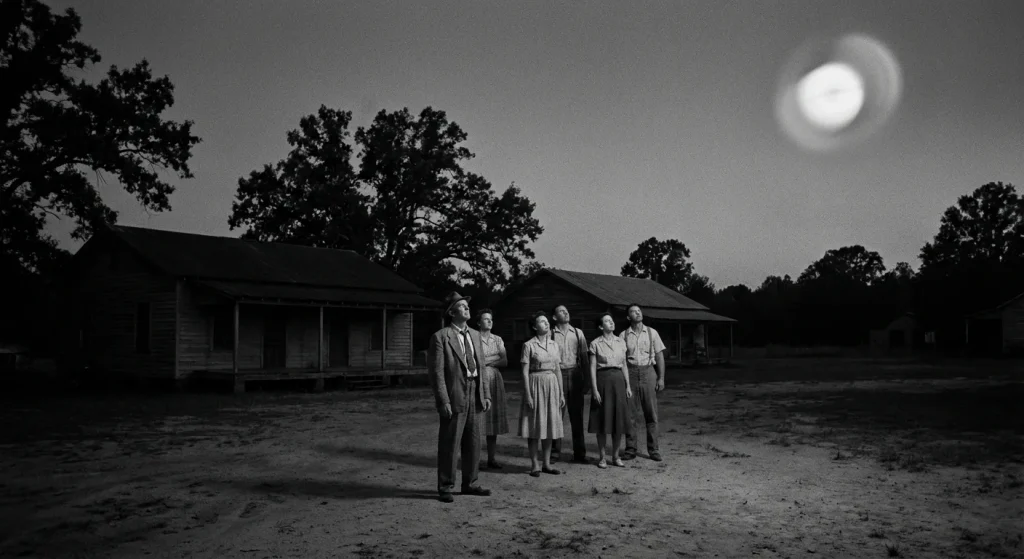
If you follow UFO news or UAP news long enough, Jimmy Carter’s name keeps getting dragged back into “disclosure” arguments as if it settles the question. It does not. What it does provide is rarer and more useful: a documented, high-trust public figure putting his name on an unexplained aerial observation, then repeating it later on the record.
The paper trail starts with a specific, checkable anchor: Carter filed a written UFO report with the International UFO Bureau on September 18, 1973. That matters because most viral retellings are citation-free, while a dated filing forces the conversation back to what was actually reported, not what the internet wishes had been reported. The 1973 written report and a hosted scan are available from the National Investigations Committee on Aerial Phenomena (NICAP), which posts the Carter sighting report scan at Nicap.
The second anchor is audio, not lore: a verifiable recorded interview in which Carter discussed the sighting is dated November 29, 1982 (Miller Center oral history record). A scholarly citation to that Miller Center interview appears in F. Viola’s 2015 document, which cites a “Jimmy Carter interview conducted at the Miller Center, University of Virginia, November 29, 1982” (see the citation in the Viola paper at Digitalcollections Drew).
Language adds another layer of drift: UAP (Unidentified Anomalous Phenomena) is the current U.S. government umbrella term for reported phenomena that cannot be immediately identified, not a synonym for extraterrestrial craft, and UFO (Unidentified Flying Object) is the older, widely used term for an aerial object a witness cannot identify at the time of observation.
This case study stays useful precisely because it is bounded by those two dated anchors. The goal is not to inflate the story, but to separate what Carter actually reported from what later summaries add.
You will come away knowing what Carter actually reported, what the record supports, and how to evaluate similar claims by starting with documents, not belief.
What Carter Reported in 1969
Carter’s account is anchored to a public Lions Club appearance in Leary, Georgia, not a private, hard-to-check moment. Multiple writeups place the sighting outside a Lions Club event in Leary, a small South Georgia town tied directly to the gathering where Carter was scheduled to speak.
In the version Carter later put on record, the timing is specific in one practical way: he said it happened before he made a dinner speech at the Lions Club. That context matters because public events produce a mix of observation quality. People are looking around, arriving, socializing, and moving between indoor and outdoor lighting, which can sharpen some details (shared attention) while muddying others (no controlled vantage point, uneven dark adaptation).
The written record most often cited traces back to Carter’s decision to formalize the incident in 1973, when he was Governor of Georgia, by filing an official report (dated September 18, 1973) with the International UFO Bureau. That matters because it pins the story to a dated document rather than a purely oral retelling. The NICAP-hosted scan of that report is at Nicap.
Inside that 1973 report, Carter gave a direct time reference: he said the sighting occurred in October 1969 at about 7:15 pm EST. That single line creates the backbone for any chronology based strictly on Carter’s own stated timing, because it is the closest thing in the available record to a timestamp.
What stays consistent across the versions tied to Carter’s report is the basic sequence: before his dinner speech, something in the sky drew attention outside the Lions Club setting, and Carter considered it unusual enough to preserve in a written report years later. The available excerpts do not supply instrument-based measurements, precise bearings, or a contemporaneous sketch, so the case’s “shape and motion” detail level is uneven by design: it includes a precise clock time, but not the kind of quantitative observational data that would lock down distance, speed, or altitude.
The biggest friction point is internal to the paper trail: Carter’s 1973 report says October 1969 around 7:15 pm EST, while some later accounts assert a January 6, 1969 date tied to Lions Club activity. Those January 1969 claims appear in secondary sources such as Wikipedia and news summaries, but I was not able to locate a primary Lions Club chapter minute, program, or contemporary newspaper clipping in the cited research to quote verbatim. Therefore the January 6, 1969 association should be treated as an unverified secondary claim until a primary Lions Club record or contemporaneous notice is produced (see secondary summaries at Wikipedia and reporting such as Politico).
That conflict is not a trivial bookkeeping error. If the date is October 1969, sky conditions, sunset timing, and what bright objects were available in that part of the sky need to be evaluated against an October evening. If the date is January 6, 1969, the same evaluation lands on a different season and a different sky. Confident online claims that “this was X” often smuggle in a date choice without acknowledging that the record itself gives you two competing anchors.
One numeric detail frequently associated with the case is a size estimate: an “average estimated diameter of 5 meters.” Treat that number as what it is, a field estimate recorded in the reporting paperwork rather than a measurement derived from known distance and angular size. It is still worth carrying forward because it is part of the case file’s descriptive content, but it does not create precision the observation itself did not generate.
Witnesses are another area where retellings often outrun what can be cleanly supported. Some accounts describe Carter as being with about two dozen other observers. What the available excerpts do not provide are contemporaneous witness names, a verified headcount tied to a sign-in sheet, or a set of independent statements that can be cross-compared for consistency. The responsible way to state it is simple: the setting implies other people were present, later accounts claim a group, but the excerpted record does not let you lock down a specific number or identity list.
The case remains notable for reasons that do not require exaggeration: a future U.S. president took the step of submitting a written report in 1973, and the story has sustained public interest ever since. The actionable takeaway is to carry only the stable, attributable elements into any later discussion: a Lions Club context, a time Carter stated (about 7:15 pm EST), and the central date conflict (October 1969 versus January 6, 1969). If a later explanation is presented with total confidence while skipping that conflict, you already know the argument is built on a selectively edited timeline.
The Paper Trail and Retellings
The 1969 description only stays legible if you pin it to documents with fixed dates, because most later retellings splice details from different decades into one “definitive” narrative. That is why the Carter story is best handled as a document-first exercise, not an anecdote-first debate.
Anchor #1 is a written report dated September 18, 1973, filed with the International UFO Bureau. That document is the earliest fixed, dated point where the Carter account is preserved as a discrete record rather than as a media retelling, and it is where you start when a later source claims a specific duration, direction of travel, or quote. The NICAP-hosted scan of the 1973 filing is available at Nicap.
Anchor #2 is an oral history record dated November 29, 1982, recorded at the Miller Center. That second date matters because it is a later recollection on the record, and it is the cleanest way to test whether a detail is stable over time or a product of later compression. A scholarly citation to the Miller Center November 29, 1982 interview is reproduced in F. Viola’s 2015 thesis and can be seen at Digitalcollections Drew, which cites the Miller Center oral history entry for that date.
A practical way to use “primary” is this: if a claim can be checked directly against the 1973 written report or the 1982 oral history record, treat the claim as primary-checkable and verify it at the sentence level before you repeat it.
A “secondary” source is anything that restates the account after those dated anchors, including database blurbs, book summaries, and blog posts, and the verification rule is mechanical: if the secondary version does not quote the anchor text exactly, you do not accept its added precision as a fact.
This is where the Carter record mutates. Secondary write-ups routinely add fields that read authoritative, such as a minute-by-minute duration, an exact witness list, or a polished “what I’ll do if elected” campaign line, even when the anchors only support a higher-level description.
The location framing is consistently anchored to Leary, Georgia, with multiple accounts placing the sighting outside a Lions Club setting.
The group context is also stable in the case’s mainstream framing: many accounts describe Carter as being with about two dozen observers outside the Leary Lions Club, which keeps the case categorized as a public observation rather than a solitary report.
Those stable elements are the pieces you can responsibly carry across versions: a specific town (Leary), a specific setting (Lions Club), and a reported observation in front of other people (a group rather than one witness). If a retelling cannot preserve even those basics consistently, it is not a reliable vehicle for finer-grain claims.
Witness count illustrates how drift starts: “about two dozen” sounds concrete, but it is inherently rounded, so later summaries tend to launder it into an exact number and then treat that new number as documentary.
Duration, motion, and color descriptions are the next common drift zone because they are observational parameters, not measured values. A written report and a later oral history are separated by years, so memory compression, paraphrase, and the urge to resolve ambiguity into a clean storyline naturally push later versions toward sharper edges than the anchors justify.
Mechanics also matter more than motives. Copy and paste replication turns one mistaken detail into a “standard” detail across dozens of pages. Cataloging conventions in databases encourage editors to fill fixed fields (time, duration, direction, witness count) even when the anchor text is qualitative. Incentives for dramatic retellings reward the version that reads like a prepared anecdote, not the version that matches dated paperwork.
The workable discipline is to carry only anchor-supported elements forward and label everything else as a later addition until it is traced back to the 1973 report or the 1982 oral history record.
Stop stating the campaign pledge quote with certainty unless you can point to the exact sentence in one of the two dated anchors and reproduce it verbatim; a polished line repeated in a modern article is not evidence.
Stop publishing a precise witness roster. The stable record supports a group setting, but turning “about two dozen” into a named list is an upgrade in certainty that requires contemporaneous documentation, not a later compilation.
Stop claiming “official confirmation” or an “agency investigation” as a documented fact unless the documentation is produced. If a source asserts briefings, investigations, or identifications without tying them to the two dated anchors or to published primary documentation, treat the assertion as unverified and keep it out of the factual timeline.
- Pull the September 18, 1973 International UFO Bureau written report and treat it as the baseline text for specific details.
- Cross-check any later retelling against the November 29, 1982 oral history record before accepting new precision.
- Demote every summary, database entry, and article to “secondary” status until it quotes the anchors accurately.
- Log which elements remain stable (place, setting, group context) and which inflate (durations, rosters, soundbite quotes, “official confirmation”).
What It Could Have Been
Once you restrict yourself to what the dated anchors can actually support, the next question is narrower than “aliens or not”: what conventional explanations could match an observation with limited geometry and a disputed date.
You can argue the Carter sighting in several conventional directions, and none wins cleanly because the inputs that decide “fit vs friction” are not locked down. The reported date and time are themselves in conflict across sources, and that uncertainty matters because sky position, air traffic, and local lighting all change quickly. The atmosphere also changes on short time scales, which is why even professional observers minimize the time between comparisons when judging brightness or color. Without a confident timestamp, any one-shot identification is overconfident by construction.
Retrospective work also runs into basic geometry problems: you need the witness’s exact viewing direction (azimuth), height above the horizon (elevation), and an approximate range to turn “over there” into a testable candidate. If those angles are unknown, you cannot reliably rule in or rule out a planet near the horizon, an aircraft aligned with the observer, or a light seen through thin cloud. The same limitation applies to missing local weather and visibility, and to unknown flight paths: if you cannot reconstruct what the air and the airspace were doing, you cannot honestly claim you have reconstructed what the observers saw.
Bright celestial objects are a standard hypothesis because they can look “impossibly bright” to a casual observer, especially when low in the sky. Atmospheric turbulence and small-scale vertical temperature fluctuations produce scintillation, which creates apparent rapid brightness changes and even fast color shifts in point-like celestial sources, so a report of flickering or color-changing light can arise from nothing more exotic than unstable air between the observer and a bright star.
The friction point is structure. Planets are extended bodies rather than true point sources, which is why they generally twinkle less than stars and are less prone to dramatic, rapid color-flash impressions. If the established description emphasizes a clearly bounded shape, distinct “sections,” or a sense of the object presenting a surface rather than a spark, a bright star explanation strains. If the description reads more like a single intense light that shifts hue and seems to “move” in small jumps near the horizon, the astronomical fit improves because low-angle viewing exaggerates both refraction effects and apparent jitter.
The practical test is simple: lock down the timestamp and horizon direction first. Without that, “it was Venus” and “it was a star” are both just labels attached after the fact, not explanations matched to geometry.
Aircraft are the most flexible conventional match because they combine bright lights, changing apparent color, and motion cues that humans routinely misread at night. Approach and departure lighting can present as a single dominant light at distance, then “split” into multiple lights as the viewing angle changes. A plane flying toward you can look stationary for long stretches because its angular position barely changes even while range closes; when it turns, it can appear to “shoot off” laterally in a way that feels like sudden acceleration.
The friction is duration and behavior. If the established report includes a long period of near-stationary appearance followed by a clean departure, aviation fits the timing logic well. If it includes repeated hard stops, sharp right-angle turns, or rapid changes without any corresponding change in brightness or sound, the aircraft hypothesis has to rely on perspective illusions plus missing context about distance and wind, and that quickly turns into hand-waving unless you can place known air traffic in the correct azimuth and elevation.
Balloons and other drift objects explain a specific cluster of cues: slow movement, apparent hovering, and intermittent brightness changes as a reflective surface rotates. If the object was seen near dusk, the sun can still light high-altitude material while the ground is already dim, producing the “self-luminous” impression that witnesses often emphasize.
The friction is control and exits. Balloons do not perform purposeful maneuvers, and their motion is constrained by wind layers, so any account that stresses deliberate movement, a directed approach, or a fast, coherent departure pushes balloons down the list. The only disciplined way to keep balloons on the table is to treat the maneuvering cues as potentially perceptual, then check whether the implied drift direction and speed are compatible with whatever weather data can be recovered.
Many “high-strangeness” details are created by the brain doing forced interpretation with weak inputs. Night viewing removes depth cues, so size and distance get coupled: a small nearby light and a large distant object can look identical. Autokinesis, the well-documented illusion where a fixed light appears to drift when you stare at it against a dark background, can supply convincing “movement” even when the source is stationary.
Group settings add another layer. Once one person confidently labels a light as moving, changing shape, or “coming closer,” the group tends to converge on that framing. That is not dishonesty; it is normal social perception. The takeaway is that witness count improves confidence that something was seen, but it does not automatically improve accuracy about range, size, or kinematics.
Modern UAP work treats “unidentified” as a data quality category, not a conclusion about non-human intelligence. The Office of the Director of National Intelligence published a Preliminary Assessment titled “Preliminary Assessment: Unidentified Aerial Phenomena” on June 25, 2021 that examined 144 UAP sightings, mostly recorded since 2004, and reported that investigators were able to identify only one of those 144 incidents; the report is available at DNI.
That distinction matters because today’s strongest UAP cases are sensor-rich: multiple radars, infrared video, time-synced logs, and corroboration across platforms. An eyewitness-only report from a 1969-style setting does not have that scaffolding, so its ceiling is lower even when the witness is credible. Some observers jump to non-human intelligence because the experience feels intelligent and because conventional options sound “too ordinary” for how startling it was in the moment. The disciplined conclusion is narrower: “unidentified” means the record cannot support a confident identification, not that it supports verified extraterrestrial evidence.
- Pin down the exact local time window and date, including any conflicts in retellings.
- Record the viewing direction (azimuth) and height above the horizon (elevation), even as rough angles.
- Check weather and visibility, including cloud layers and turbulence indicators that affect apparent flicker.
- Query nearby air traffic and known flight corridors for that time window.
- Seek independent corroboration beyond eyewitnesses: photos, logs, sensor records, or geographically separated observers.
Carter in Office and After
The moment Carter’s account entered presidential-era conversation, it stopped being just a sighting report and became a test of what the public thinks high office can compel.
Once Carter moved from state politics to the national stage, his UFO story stopped being a quirky anecdote and started functioning as a proxy fight over trust in government. A public figure who says, on the record, “I saw something I can’t explain” creates an expectation of insider access: if he becomes president, people assume he can force answers and then publish them. That expectation keeps generating headlines long after the underlying evidence stops changing.
The cleanest, verifiable political fact in the record is administrative: Carter filed a dated report with the International UFO Bureau while serving as Governor of Georgia.
Later interviews and retrospective commentary exist, and they keep the story in circulation, but they are not the same thing as a contemporaneous policy act by a president. The recurring claim that “Carter promised disclosure in the 1976 campaign” is exactly where repetition outruns documentation: the provided research excerpts do not include a verbatim 1976 campaign quote, a dated appearance, or a named outlet where Carter makes that pledge. Treat “Carter promised to release UFO files” as a commonly repeated assertion that requires a sourced, word-for-word citation before it deserves any weight.
Presidential authority does not equal omniscience. Even a president is constrained by classification rules, compartmentalization, and need-to-know access controls that limit who can see specific intelligence sources and methods. Add bureaucratic silos: UFO or UAP related material, if it exists in government systems, is rarely in one neat folder labeled “UFO Truth.” It is scattered across agencies, programs, contractors, and decades of recordkeeping practices.
Then there is political risk. Any public statement about “aliens” carries immediate reputational cost, creates diplomatic and domestic distractions, and invites demands for proof a president may not have in hand. Those governance realities explain why public detail is often limited without needing a cover-up narrative to do the work.
NARA states it holds UFO-related records across numerous collections. That matters as a process point, not as a punchline: the existence of archives is an invitation to verify claims through finding aids, collection-level descriptions, and document requests, not a confirmation that a specific “Carter briefing” memo is sitting in a known box (see NARA guidance on UAP records at National Archives).
Apply a simple standard: demand verbatim sourcing for campaign “promises,” and treat “he was briefed” lore as unproven until a document, date, and custodian archive are produced. The pattern persists because UFO becomes a political promise repeatedly; major outlets reported contemporary promises by later politicians. For example, Reuters reported on February 20, 2026 that then-President Trump said he was “directing agencies to identify and release government files on aliens” (see Reuters, Feb 20, 2026, Reuters).
Why the Story Matters Now
The Carter case is one data point, but it highlights the larger question that drives modern UAP politics: what gets documented, who has to search, and what the public can audit.
Carter’s story still matters in 2025 and 2026-era UAP (unidentified anomalous phenomena) discourse because the disclosure fight is fundamentally about records, process, and oversight, not one man’s sighting. The fact pattern people keep returning to is simple and high-trust: a future President filed an official report in 1973 while serving as Georgia’s governor, and the government never produced a clean, public, end-to-end investigative file that resolves it for everyone.
The friction is that modern UAP governance has matured into institutions that produce partial outputs: summaries, briefings, and declassified slices that rarely satisfy either skeptics or true believers. That gap is where “cover-up” narratives and certainty about extraordinary explanations take root. The practical response is not another viral retelling; it is tightening the pipeline that turns reports into accountable government work products.
AARO (All-domain Anomaly Resolution Office) exists because anecdotes scale only when an office is tasked to receive, investigate, and report on UAP across air, sea, space, and other domains inside the Department of Defense framework. Its credibility lives or dies on what it publishes and what it can document, not on speculation about what any single incident “really was.”
On the record, AARO published an institutional historical report. The official AARO PDF of “Report on the Historical Record of U.S. Government Involvement with Unidentified Anomalous Phenomena, Volume 1” (2024) is hosted on AARO.mil at https://www.aaro.mil/Portals/136/PDFs/AARO_Historical_Record_Report_Volume_1_2024.pdf. A third-party mirror of that report is available on the Department of Defense media mirror at Department of Defense (third-party mirror).
Most “disclosure” arguments resolve into a records problem: who must search, what must be preserved, and what the public can later review. The UAP Disclosure Act is best understood as an NDAA-associated legislative concept aimed at expanding UAP records collection and review mechanisms, including a National Archives and Records Administration centered records approach.
In the FY2024 NDAA process, specific UAP Disclosure Act language appeared in Senate amendment text. For example, Senate amendment S.Amdt.2610 proposed the “Unidentified Anomalous Phenomena Disclosure Act of 2024” and included language proposing a NARA UAP Records Collection (this was proposed in the Senate version; the amendment text is available at Congress.gov). Public summaries note that Schumer and Rounds introduced related disclosure proposals; proponents described the effort as intended to model a records collection similar to the JFK Assassination Records Collection Act (see the Senate Democrats press release at U.S. Senate). However the House Rules Committee summary and final FY2024 NDAA negotiation removed the Schumer-Rounds provision from the enacted FY2024 NDAA, meaning the proposed Senate amendment language was not enacted into the final law.
There are also standalone legislative efforts and related proposals. For example, members have proposed standalone bills and provisions in various sessions to create records review mechanisms; readers should treat each item with an explicit status label: “proposed in the Senate version,” “not enacted into final NDAA,” or “standalone bill introduced on [date]” until text is enacted and signed. For process guidance on creating records collections and assigning identifiers for transferred archival materials, see NARA guidance at National Archives.
Oversight is where trust is won or lost, because it creates incentives for agencies to produce auditable answers. Congress has advanced a UAP Whistleblower Protection Act intended to shield people who want to share UAP-related information but fear retaliation, and public materials reference a House Oversight hearing titled “Restoring Public Trust Through UAP Transparency and Whistleblower Protection” occurring on September 9. Protections matter because they test governance: if systems punish disclosure through official channels, the public should expect leaks and narrative warfare.
High-profile testimony and commentary, including David Grusch, Lue Elizondo, Christopher Mellon, and George Knapp, shapes public expectations by turning process disputes into belief disputes. That influence is real, but it does not convert transparency demands into certainty about non-human intelligence; it raises the political cost of non-answers.
The actionable way to follow this topic is procedural: track named official publications (including AARO’s historical report), watch whether records-collection mechanisms are actually implemented as policy, and treat whistleblower frameworks as signals about institutional accountability, not automatic confirmation of extraordinary claims.
A Credible Witness, Open Questions
Carter’s sighting holds up as a credible first-person account, but it does not stand up as a closed-case piece of evidence for non-human intelligence.
The reconstruction problem is structural: Carter put the event on record in a formal UFO report filed September 18, 1973, describing an October 1969 sighting, yet some secondary sources associate the same story with a January 6, 1969 Leary Lions Club appearance, and the commonly repeated “1969” version often glosses over that date conflict and venue-specific context.
That paper-trail discipline matters because the record still lacks the observational inputs that settle hard questions: precise direction of travel, angular size, duration, weather, and independent instrument data. In that gap, conventional explanations remain plausible without being provable, and the most confident retellings routinely overstate what the documentation can support. Carter’s later public discussions, including a widely cited 1982 exchange, keep the story alive, but they do not add the missing measurements.
The government’s own framing reinforces the same limit: “unresolved” is a category that follows from incomplete inputs, not a conclusion that extraordinary explanations have been proven.
- Prioritize primary documents (Carter’s 1973 report form; verifiable interview dates; AARO Historical Record Report Vol. 1 (2024) at Aaro).
- Confirm dates and venues before repeating a narrative (the Carter timeline hinges on that).
- Separate “unidentified/unresolved” from claims of non-human intelligence.
- Track official outputs from AARO and ODNI, not every headline about every hearing.
Meaningful transparency looks like more accessible underlying records and clear, consistent investigative standards for what gets labeled unresolved and why, not promises of imminent alien disclosure.
Frequently Asked Questions
-
What’s the difference between UFO and UAP in government terminology?
UAP (Unidentified Anomalous Phenomena) is the current U.S. government umbrella term for reported phenomena that can’t be immediately identified. UFO (Unidentified Flying Object) is the older term for an aerial object a witness can’t identify at the time of the observation.
-
When and where did Jimmy Carter say he saw a UFO?
Carter’s written report says the sighting occurred in October 1969 at about 7:15 pm EST, outside a Lions Club setting in Leary, Georgia. He also described it as happening before he gave a dinner speech at the Lions Club.
-
What are the two primary dated records for Jimmy Carter’s UFO sighting?
Anchor #1 is Carter’s written UFO report filed with the International UFO Bureau dated September 18, 1973. Anchor #2 is a recorded oral history interview dated November 29, 1982 (Miller Center) where he discussed the sighting.
-
Why is there a date conflict in the Jimmy Carter UFO story?
Carter’s 1973 report states “October 1969,” but Lions Club records indicate the sighting must have occurred on January 6, 1969, the date he spoke to the Leary, Georgia Lions Club. The article emphasizes that both cannot be correct and the conflict changes what sky conditions should be checked.
-
How many people witnessed Jimmy Carter’s UFO sighting, according to the article?
Many retellings claim Carter was with “about two dozen” observers, implying a group setting outside the Lions Club. The article notes the available excerpts do not provide verified names, a firm headcount, or independent statements to confirm an exact number.
-
What size was the object in Jimmy Carter’s UFO report?
A number often associated with the report is an “average estimated diameter of 5 meters.” The article explains this is a field estimate recorded in paperwork, not a measurement based on known distance and angular size.
-
What should you verify first when evaluating claims like Carter’s UFO sighting?
Start by pulling the dated anchors: the September 18, 1973 report and cross-checking against the November 29, 1982 oral history record. Then confirm the exact date/time window and collect basics like viewing direction (azimuth), height above the horizon (elevation), weather/visibility, and nearby air traffic before accepting any “definitive” identification.
