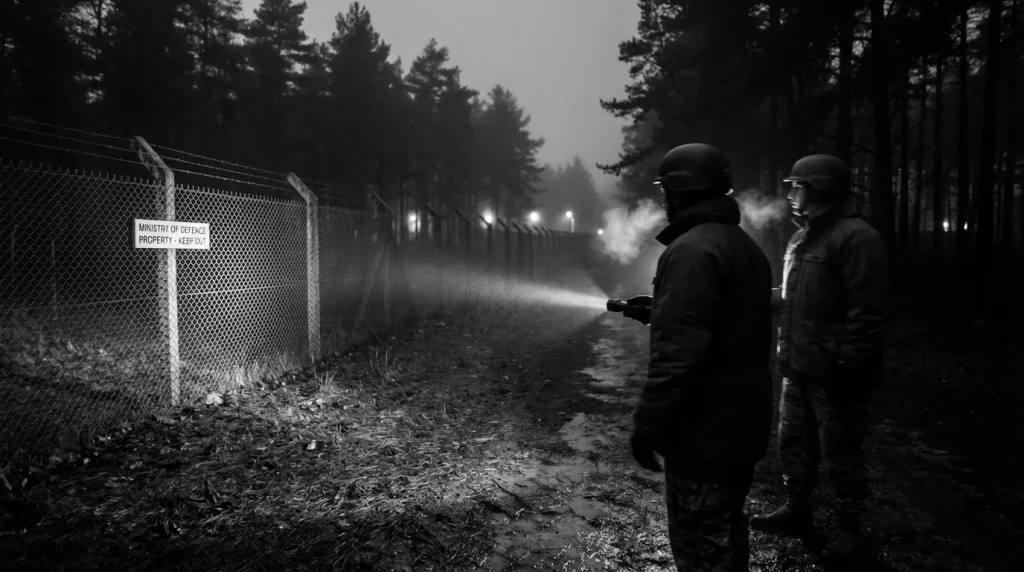
Jim Penniston is one of the most frequently cited U.S. Air Force witnesses in the Rendlesham Forest incident , a late-December 1980 series of reports near the twin U.S. Air Force facilities of RAF Woodbridge and RAF Bentwaters in Suffolk, England. People researching “Jim Penniston Rendlesham Forest” usually want to understand what he says he saw, how his account fits into the multi-night timeline, and what documentation exists. This article summarizes Penniston’s reported observations, why his testimony remains notable, and how supporters and skeptics interpret the record.
Who Jim Penniston is
Jim Penniston was an American serviceman stationed in the United Kingdom with the U.S. Air Force at the time of the events. In most retellings, Penniston is described as a security policeman involved in the initial response to unusual lights reported in or near Rendlesham Forest, close to RAF Woodbridge. Because the incident involves U.S. personnel on U.K. soil, it sits at the intersection of base security procedures, local geography, and later public interest in UFO/UAP claims.
Penniston’s account matters in part because he is commonly presented as a firsthand witness to the earliest night’s close-range activity. While other participants emphasized lights at a distance, Penniston is often associated with the claim that something structured was encountered on the ground—an assertion that, if accurate, would place the event beyond the category of a brief sky sighting.
What Penniston reportedly did and observed
Accounts vary by source, but the narrative most often attributed to Penniston includes several core elements:
- Responding to reports of unusual lights: He is said to have been part of a small group sent toward the forest after reports of lights or an apparent downed aircraft in the direction of Rendlesham.
- Entering the forest to investigate: Penniston is frequently described as moving into the wooded area with one or more other airmen to check what base personnel believed could be an emergency or security issue.
- Observing a lighted object at close range: In later tellings associated with him, Penniston reports seeing an object that appeared to be on or near the ground, emitting light. Some versions describe it as having a defined shape (often described as triangular) and unusual surface markings.
- Noting environmental effects: Supporters of the encounter often point to mentions of strange lights, intense brightness, and impressions in the ground as indications the group believed something physical had occurred.
Why this is notable in Rendlesham discussions: the case is sometimes called “Britain’s Roswell,” and Penniston’s claimed proximity and detail are a major reason. The more an account resembles a close-range structured encounter, the more it attracts claims about extraordinary technology or non-human intelligence. At the same time, the more detail that accumulates over time, the more important it becomes to separate what was reported promptly in official paperwork from what entered the story through later interviews and recollections.
Why Penniston’s account is notable in the Rendlesham case
Penniston is consistently highlighted for three reasons:
- Closeness and specificity: Many UFO cases involve distant lights. Penniston is one of the names most associated with a near-field observation and the claim that an object was encountered at ground level.
- Position and context: As a service member connected to base security, his role is often presented as operational rather than casual—he was not simply stargazing but reportedly responding to an incident.
- Connection to the multi-night sequence: Rendlesham is not one single sighting but a cluster of reports over multiple nights. Penniston is linked mainly to the earliest night, which becomes foundational in later interpretations of what happened on subsequent nights.
Timeline: late-December 1980 sequence and Penniston’s role
Public narratives often compress Rendlesham into one night, but the most commonly cited sequence spans multiple late-December nights in 1980. The details differ depending on source, but the outline below reflects the standard structure referenced in many summaries and discussions.
Night 1: late December 1980 (often cited as Dec. 26–27)
- Time window: Late night into early morning hours.
- Who was present: U.S. Air Force personnel assigned to base security are commonly named in retellings; Jim Penniston is typically placed among the responders, often alongside other airmen who entered the forest.
- What was reported: Unusual lights in/near Rendlesham Forest, sometimes described initially as a potential aircraft crash or a security incident. In Penniston-centered versions, the group moves toward the lights and encounters a bright object at close range. Some accounts add that the object departed rapidly or vanished, leaving the witnesses to search for traces.
- Penniston’s role: Penniston is most closely tied to this first night—he is often described as part of the team that approached the lights and later discussed what they believed they saw on the ground.
Night 2: following night (often cited as Dec. 27–28)
- Time window: Late night.
- Who was present: Reports commonly describe a larger response or heightened attention due to the previous night’s events.
- What was reported: Additional sightings of lights in the area are frequently mentioned in secondary accounts. Some versions describe intermittent lights, beams, or bright sources moving through or above the forest.
- Penniston’s role: Penniston is less consistently centered in these “second night” retellings; many summaries emphasize that other personnel became involved as the story spread and curiosity increased.
Night 3: later in the same period (often cited as Dec. 28–29)
- Time window: Late night into early morning.
- Who was present: This night is frequently connected to then–Deputy Base Commander Lt. Col. Charles Halt, who documented events in an official memorandum. Other personnel accompanied him in the field.
- What was reported: Observations of lights and attempts to locate their source; some accounts describe directional readings, distant flashing, and at least one instance of unusual light behavior. This is the portion most directly associated with official documentation (see below).
- Penniston’s role: Penniston is generally not the principal figure in this “Halt night” documentation, but his first-night story often serves as the backdrop that made subsequent nights more consequential in the eyes of participants.
Important context: the timeline above is “commonly cited,” not universally agreed. Even the date labeling can vary across sources depending on how witnesses counted the nights (e.g., whether the “first night” began before midnight and ended after midnight). For evaluation, it helps to compare each claim to dated records and contemporaneous notes where available.
Evidence and documentation: what exists and how to read it
Rendlesham has both official records and a large body of later interviews and recollections. A careful approach distinguishes between (1) what was written down at the time, (2) what witnesses later said publicly, and (3) interpretations added by third parties.
Official records (contemporaneous or near-contemporaneous)
- The Halt memo: Lt. Col. Charles Halt’s memorandum (“Unexplained Lights”) is often treated as the primary official document associated with the incident. It summarizes reports and observations and is commonly reproduced and analyzed in public sources. Because it is an official memorandum, it carries a different evidentiary weight than later media accounts, even though it still reflects what was reported/observed rather than proving a specific explanation.
Firsthand claims (witness statements)
- Penniston’s interviews and statements: Penniston’s account is mostly known through later public statements and interviews. These materials are central to why he is a key name in the case, but they should be read with attention to when the statement was made, whether it is consistent with earlier descriptions, and what details are corroborated by other witnesses or records.
Later recollections and secondary materials
- Media retellings and books: Rendlesham has been retold in documentaries, books, and articles for decades. These often blend multiple witnesses’ accounts across multiple nights into a single storyline, which can unintentionally shift who saw what and when.
- Public archives and databases: Some documents and summaries are widely circulated online and in archives. These can be helpful, but they also vary in sourcing quality; a document scan or a verbatim reproduction is generally more reliable than an unsourced paraphrase.
Credible starting points for readers who want to cross-check documentation and mainstream coverage include:
- The National Archives (UK) (for locating U.K. government records and guidance on archival materials)
- BBC (for reporting and explainers that often summarize both claims and counterclaims)
- Smithsonian Magazine (for historical and science-oriented coverage that typically includes skeptical perspectives)
- New Scientist (for science journalism that sometimes addresses famous UFO cases and their interpretations)
Disclosure, cover-up, and “non-human intelligence” claims (attributed and contextualized)
Rendlesham is frequently brought up in modern UFO/UAP disclosure discussions. Some proponents argue the involvement of U.S. military personnel, the proximity to sensitive installations, and the persistence of the story suggest either a cover-up or evidence of advanced technology, sometimes framed as “non-human intelligence.” Penniston’s close-encounter-style narrative is often used to support these arguments because it implies more than distant lights.
However, official records like the Halt memo document reports of unexplained lights and observations, not definitive conclusions about origin. The leap from “unexplained” to “non-human” is an interpretation that goes beyond what any single memo can prove, making it essential to keep claims clearly attributed to their sources.
Skeptical explanations and alternative interpretations
Skeptical analyses of the Rendlesham Forest incident generally emphasize that the reports occurred at night under conditions where misperception is plausible, and that multiple ordinary stimuli could have been interpreted as extraordinary—especially after an initial alarm raised the group’s expectations.
- Astronomical and navigational lights: One common line of skepticism is that bright stars, planets, or aircraft lights could appear unusual through trees and atmospheric haze, especially if observers were moving through uneven terrain.
- Lighthouses and distant beacons: Another frequently cited explanation is that a lighthouse beam or other periodic light source could account for reports of rhythmic flashes or sweeping lights, particularly from certain vantage points.
- Memory and narrative accretion: Rendlesham is a decades-old case with many retellings. Skeptics often argue that later, more detailed versions may incorporate assumptions, suggestions from interviewers, or conflations of different nights and different witnesses.
- Limited physical evidence: Claims of marks on the ground or radiation readings are debated in secondary literature; skeptics typically note that ambiguous traces are not unique to extraordinary causes and can be difficult to interpret after the fact.
FAQ
-
Who is Jim Penniston in relation to the Rendlesham Forest incident?
Jim Penniston is a U.S. Air Force serviceman most commonly cited as a firsthand witness on the first night of the late-December 1980 Rendlesham Forest reports near RAF Woodbridge. He is notable because his later public accounts describe a close-range encounter with an unusual lighted object, making him one of the central names associated with a “structured object” claim rather than a distant light sighting.
-
What was the 1980 Rendlesham Forest incident near RAF Woodbridge/Bentwaters?
The Rendlesham Forest incident refers to a sequence of reported unusual lights and related observations over multiple late-December nights in 1980 near the U.S. Air Force bases RAF Woodbridge and RAF Bentwaters in Suffolk, England. Witnesses included base personnel who reported lights in the forest and sky; one of the best-known official documents associated with the events is Lt. Col. Charles Halt’s “Unexplained Lights” memorandum.
-
Where did the Rendlesham Forest incident take place?
The events were reported in and around Rendlesham Forest, a wooded area in Suffolk, England, adjacent to RAF Woodbridge and near RAF Bentwaters (then used by U.S. Air Force units). Many accounts describe responders leaving the base area and moving toward lights seen beyond or near the perimeter, with some activity described from forest paths and clearings.
-
When did the Rendlesham Forest incident happen?
The reports most commonly cluster in late December 1980, often summarized across three nights in the Dec. 26–29 period (exact date labeling can vary by source due to the events spanning midnight). Jim Penniston is most strongly linked to the first night’s response when security personnel reportedly went into the forest to investigate unusual lights.
-
How is the Rendlesham Forest incident connected to UFO/UAP disclosure topics?
The case is repeatedly cited in UFO/UAP disclosure conversations because it involves military witnesses, a well-known official memo, and decades of public debate about what was observed. Some proponents present it as evidence of a hidden truth about advanced technology or non-human intelligence, while others view it as a classic example of how ambiguous night-time stimuli can become a long-running mystery through retelling and interpretation.
-
What should you look for when evaluating a Rendlesham Forest UFO disclosure claim?
Start by separating sources into categories: official records (such as the Halt memo), contemporaneous notes (if available), and later interviews or reconstructions. Check whether a claim specifies which night it refers to, who the direct witness was, and whether the detail appears in early documentation or only in later recollections. Claims that cannot be tied to a date/time window, named witnesses, or a traceable source are harder to evaluate reliably.
