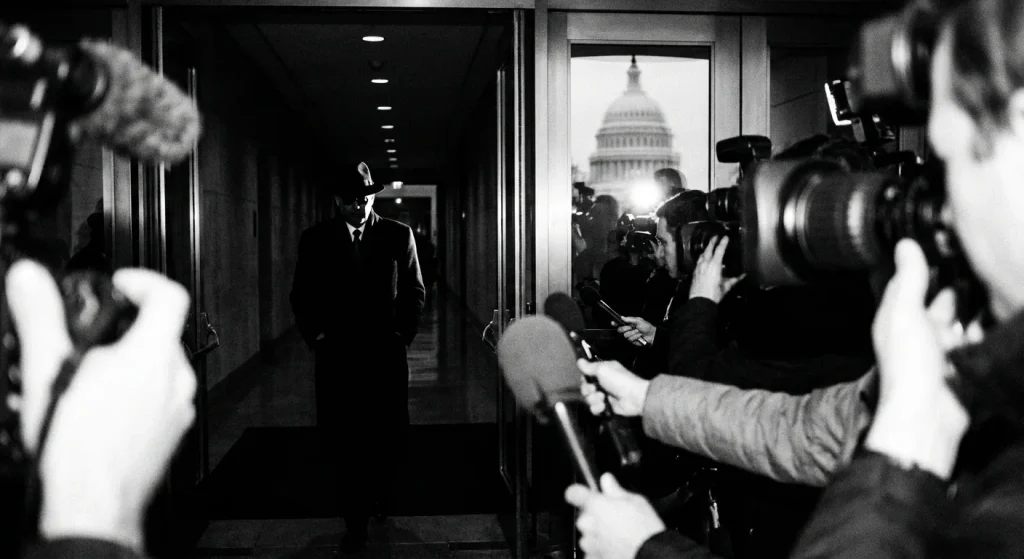
This was the moment the conversation changed. You watched the clip, saw “cover-up” trending, and still couldn’t tell what was actually documented versus what was being alleged under the banner of UFO disclosure and UAP disclosure.
In June 2023, NewsNation aired an exclusive interview with David Grusch alleging a long-running U.S. government cover-up involving secret UAP programs. The government calls these unresolved cases Unidentified Anomalous Phenomena (UAP), a catch-all for anomalous observations that still aren’t identified after initial review, which is why every new claim instantly turns into a fight over what counts as evidence. Grusch also said he filed a whistleblower complaint before going public, and said he provided classified information to Congress and the intelligence community through formal channels.
What made it different from the usual viral cycle was the escalation path: after the interview, Grusch later testified under oath to Congress in July 2023. Congressional hearings are the formal mechanism committees use to gather and analyze information for oversight and policymaking, and that oath-based setting pushed the story into a lane where allegations trigger process, not just debate.
Here’s the tradeoff that drives most of the confusion: the allegations are high-impact, but much of what would verify or falsify them is locked behind classification, compartmented access, and rules that restrict what can be shown publicly. Grusch has also stated he has not personally seen alien craft or bodies and that his assertions were based on testimony from “more than 40 witnesses,” as he said in a June 2023 NewsNation interview and reiterated during his July 26, 2023 congressional testimony (see NewsNation interview and the House Oversight hearing transcript linked below), which means the public is often evaluating secondhand claims while the underlying material stays out of view.
This isn’t “proof of aliens.” It’s a story about allegations, oversight, and what can be corroborated on the public record. The payoff for you is simple: you’ll be able to keep confirmed milestones, alleged claims, and the government’s documented reactions separate as you read the next wave of UAP news.
To do that, it helps to start with the basics: who Grusch is, what he plausibly had access to, and what that does (and doesn’t) tell you about his claims.
Who is David Grusch and why it matters
David Grusch drew real attention in 2023 for a simple reason: his resume makes it plausible that he sat close enough to sensitive programs to hear serious claims. That same resume does not, by itself, prove any specific claim is accurate. If you keep those two ideas separate, you can read the story with a lot more clarity.
David Charles Grusch is a former U.S. Air Force intelligence officer who served on active duty and held the rank of Major; his role and background are summarized in his July 26, 2023 congressional testimony and related witness materials (see House Oversight hearing page and transcript linked below). Those are the basic, verifiable career markers that tell you he lived inside the national security system, not on the internet’s fringe.
Grusch’s UAP relevance is also structural, not just biographical: he served as the National Reconnaissance Office (NRO) representative to AARO and the predecessor UAP Task Force (UAPTF). That matters because those are the pipelines built to receive, coordinate, and deconflict UAP (unidentified anomalous phenomena) reporting across government. You don’t need to assume anything extraordinary to see why people would take an allegation more seriously when it comes from someone positioned near those channels.
Here’s the friction: access is not evidence. Even when people mention Top Secret/Sensitive Compartmented Information (TS/SCI), a clearance category plus compartmented controls, you should hear “he may have been eligible for certain channels,” not “therefore every statement is verified.” Holding the right clearance level is only the starting line, because actual Sensitive Compartmented Information (SCI) access is granted compartment by compartment by the information owner.
In practice, you can have TS/SCI eligibility and still not be read into a given compartment, because compartment access is controlled and granted separately.
When you evaluate anything Grusch says, the key question is whether he’s describing firsthand knowledge or reporting what others told him. Whistleblowing often works exactly like that: you surface testimony, documents, and patterns you encountered in an official role, then investigators try to corroborate it independently.
He has framed his knowledge as information he was informed about during his official duties, rather than personal observation.
Secondhand reporting is not worthless, but it changes what “proof” looks like. Instead of “Do I trust this person?”, the smarter question becomes “Can anyone else, on the record, confirm the underlying facts?”
- Separate what he says he personally saw from what he says he was told.
- Ask what documentation is claimed to exist, and whether any of it is public.
- Check what’s on the public record from agencies or oversight bodies, not just commentators.
That distinction between role, access, and evidence is exactly why the story didn’t stay in interview-land. The next step mattered because it created a fixed, quoteable record.
From interviews to congressional testimony
This is where the story became official enough to cite. Media interviews can move a narrative fast, but a congressional hearing locks people into a public record, on camera, with rules, a chair, and a transcript. That upgrade in formality is exactly why the July 26, 2023 appearance mattered, and why it also exposed the hard ceiling classified programs put on what the public is allowed to hear.
The hearing was formally titled “Unidentified Anomalous Phenomena: Implications on National Security, Public Safety, and Government Transparency.” It occurred July 26, 2023 at 10:00am in 2154 Rayburn, and both the video and the written transcript are available via the House Oversight Committee’s hearing page (https://oversight.house.gov/hearing/unidentified-anomalous-phenomena-implications-on-national-security-public-safety-and-government-transparency/). If you’re trying to separate what was actually said from what got summarized on social media, that official page is the clean starting point.
That setting changes the stakes because it ties the testimony directly to oversight and policymaking, not just the news cycle. Once something is said in that forum, it becomes part of the committee’s work, not just a talking point.
Grusch provided sworn testimony. “Under oath” doesn’t magically verify claims, but it does attach personal accountability to the words: deliberate false statements can trigger perjury exposure, and evasive answers are easier for lawmakers to flag on the record. The practical difference for you as a reader is simple: the hearing gives you exact phrasing, in context, instead of soundbites filtered through hosts, editing, or secondhand retellings.
That same formality also makes the gaps more meaningful. In the open session, Grusch declined to answer certain questions publicly because he said the information was classified. That’s not a throwaway dodge, it’s the core friction in this whole episode: Congress is trying to do public oversight, while the underlying details live behind classification rules that punish public disclosure.
He also indicated he could provide more detail in a secure setting, specifically a Sensitive Compartmented Information Facility (SCIF), a locked-down room approved for certain classified discussions. When a witness says, “I can answer that in a SCIF,” that’s basically the system’s way of saying, “we can’t do this part on YouTube.”
Institutionally, the hearing ran under House Oversight leadership, with James Comer as Chairman and Robert Garcia as Ranking Member. Their framing, echoed by members across the dais, leaned on three ideas that don’t require you to buy any particular conclusion: national security risk if unknown objects are in sensitive airspace, public safety risk if hazards aren’t being tracked and shared, and transparency risk if information is being over-classified or walled off from legitimate oversight.
That’s the thread to hold onto: the hearing wasn’t just “tell us the wild stuff.” It was lawmakers saying the oversight relationship itself is what’s at stake, because public trust erodes when the government can’t, or won’t, explain what it knows and why it can’t say more.
Use the House Oversight transcript and video as your filter. Quote directly from the transcript when someone claims “Grusch said X,” and pay attention to the moments where he explicitly declines to answer due to classification and points to a SCIF for details. Those aren’t empty spaces; they’re boundary markers that tell you exactly where public testimony ends and where interpretation begins.
Disclosure laws, NDAA provisions, and oversight push
Whatever you think of the allegations, the policy story is bigger than one whistleblower. Post-2023, Congress responded by trying to build a disclosure machine: repeatable processes for collecting records, forcing reviews, and creating safer lanes for lawful reporting inside government.
The friction is that “transparency” in Washington is usually procedural before it’s dramatic. Language gets negotiated, narrowed, or reshaped in conference. Even when lawmakers agree on the headline goal, they fight over who decides, what qualifies as a record, and what deadlines actually mean in practice.
The clearest example of this process-first approach was the Schumer-Rounds UAP Disclosure amendment. Its stated purpose was “expeditious disclosure” of UAP records, which tells you the design target: move the conversation from ad hoc leaks to an organized records pipeline.
What the amendment proposed: it aimed to create an independent review structure to identify, collect, and review UAP-related records across agencies and contractors, and to accelerate decisions about what could be released to Congress and the public. For the text proposed in the Senate amendment and related legislative language, see Congress.gov search results on UAP and amendments (https://www.congress.gov/search?q=%7B%22source%22%3A%22legislation%22%2C%22search%22%3A%22UAP%22%7D).
What changed in negotiation: several provisions from initial proposals were narrowed or removed during committee and conference negotiations, including aspects of independent board authority and specific disclosure timetables. Drafts and amendment histories are tracked on Congress.gov and in committee reports, which is the place to confirm which language survived.
What was enacted: the final text that became law differed from early amendment drafts in scope and detail. For the enacted language, consult the final NDAA conference text and the public law on Congress.gov to confirm what reporting, review, or briefing requirements were adopted for that session’s NDAA (see Congress.gov search results and the final bill text).
Whistleblower protection talk shows up in the same oversight push, often discussed in connection with NDAA and IAA activity, including proposed measures described in press coverage as a “UAP Whistleblower Protection Act.” That label has primarily been applied to proposals and amendments under consideration, not to a standalone enacted statute. For bill text or proposals, search Congress.gov for “UAP whistleblower” and proposed amendments (https://www.congress.gov/search?q=%7B%22source%22%3A%22legislation%22%2C%22search%22%3A%22UAP%20whistleblower%22%7D). Treat those as proposals unless you confirm enactment in the final public law.
Here’s the nuance that keeps getting lost online: proposals are not outcomes. Big frameworks can be introduced with ambitious structures, then trimmed in negotiations, delayed in implementation, or left contested in how agencies interpret them. If you want the real state of play, you track what actually gets enacted and what reporting is truly mandated by the final statutory text and committee reports.
Newer attempts reinforce that this oversight campaign kept moving. Rep. Eric Burlison submitted a UAP-related disclosure amendment effort described as a “UAP Disclosure Act of 2025.” Treat that as proof of continued legislative pressure, not proof of what passed. Verify the final status on Congress.gov before you treat it as law.
The simplest way to track disclosure progress without being a lawyer is to follow three artifacts: the final bill text after conference, committee reports that explain intent, and any required briefings or periodic reports listed in official congressional records on Congress.gov (https://www.congress.gov/).
Those process changes are one side of the picture. The other side is what the executive branch, especially the Pentagon’s UAP office, says when it’s asked to verify the big claims.
AARO, the Pentagon, and competing narratives
The past few sections focused on what was alleged and how oversight reacted. Here’s what the government says when asked directly, and why it keeps turning into a trust problem: the official posture is basically “show us verifiable evidence,” and that message competes head-to-head with crash-retrieval and reverse-engineering allegations. The public keeps falling into the gap between those two storylines.
After the crash-retrieval and reverse-engineering allegations hit the mainstream, the Pentagon response wasn’t subtle. In a statement to The Debrief, Defense Department spokesperson Susan (Sue) Gough said: “To date, AARO has not discovered any verifiable information to substantiate claims that any programs regarding the possession or reverse-engineering of extraterrestrial materials have existed in the past or exist currently.” The key word there is verifiable: not “we’ve disproven it,” but “we have not been shown evidence we can validate.”
The All-domain Anomaly Resolution Office (AARO), the Pentagon office tasked with investigating UAP reports and reporting to Congress, describes its work in plain bureaucratic terms: rigorous, scientific, and data-driven. That framing matters because it sets the standard for what “counts” as an answer: sensor data, corroborated documentation, and cases you can track end-to-end, not just compelling testimony.
AARO’s annual report covering the period May 1, 2023 through June 1, 2024 states it had been reviewing more than 1,600 UAP reports as of that report; read the report and summary at AARO’s site for the exact wording and context (https://www.aaro.mil/ and the AARO annual report linked from that page). That volume explains why the office defaults to triage and categories. It also explains what the numbers do not do: a big caseload does not validate any single headline claim, and a “no verifiable information” conclusion does not automatically satisfy people who think the decisive material is fenced off.
Critics and skeptics tend to argue about scope and access, not math. The concern is that even a well-run office can only assess what it is allowed to see, and that highly compartmented programs, if they existed, could sit outside normal reporting channels. The counterargument from the institutional side is straightforward: extraordinary allegations still require documentation that can be authenticated, audited, and cross-checked, or you just get dueling stories forever.
- Look for records you can verify: budget lines, contracting documents, tasking orders, photos with provenance, and anything with an auditable paper trail.
- Demand chain-of-custody: who had the material or data, when they had it, how it was stored, and how it was transferred.
- Insist on independent review: inspectors general, cleared congressional staff, and multi-agency corroboration beat anonymous claims and vague references every time.
If that sounds unglamorous, it’s because it is and that’s the point. The next chapters of this story will mostly be fought in filings, briefings, reports, and what finally makes it onto the public record.
What to watch in 2025 and 2026
The best way to follow this story is to track paperwork, not vibes. You can follow UFO sightings 2025, UFO sightings 2026, and the broader UAP news cycle without getting played by every viral clip if you anchor yourself to official deliverables, oversight events, and credible documentation signals.
Start with outputs that have to exist in writing. AARO (Pentagon UAP office) operates on an annual report cycle, and the congressionally directed historical review framework implies future deliverables that can harden the public record over time. The catch is timing: these processes move at government speed, and summaries can be vague. Your takeaway: treat each new PDF as a snapshot of what’s formally on the record, then compare it to prior versions for what changed, not what got teased on social media.
Public hearings are useful, but the real signal is what lawmakers demand afterward: subpoenas, follow-up questions, and access requests. House Oversight’s hearing wrap-up emphasized analyzing ways Congress can better protect UAP whistleblowers, which tells you where their leverage is pointed. Also watch defense legislation, but track the enacted NDAA text for any specific briefing or reporting requirements instead of assuming proposed language survived conference.
IG actions are a separate lane because they create paper trails: complaints, investigation openings, referrals, and findings. The friction is that IG work is often non-public. The actionable read: an acknowledged investigation or published finding matters more than anonymous “IG confirmed” chatter.
UFO news thrives on clips and eyewitness accounts. Log sightings as data points, but don’t treat them as proof of non-human intelligence (NHI). If a claim never cashes out into documents, sworn testimony, or an official response, it’s entertainment, not evidence.
- Weekly: Check House and Senate committee sites for letters, transcripts, and hearing notices.
- Monthly: Read primary PDFs yourself, then compare summaries against the source.
- Always: Ask, “What official deliverable would confirm this, and where would it appear?”
Conclusion
The biggest thing the 2023 Grusch moment changed is that the argument moved into official channels and into the public record, even while the central allegations stayed unproven in public.
The same split you felt at the start-what’s documented versus what’s alleged-is still the most useful way to read everything that followed. Congress did hold a July 26, 2023 hearing with a public record, and Grusch testified under oath about UAP-related matters, which means you can anchor your understanding in primary documents instead of clips.
- Confirmed (public record): Grusch gave under-oath testimony to congressional bodies on UAP/UFO matters, and the July 26, 2023 hearing is documented publicly (House Oversight hearing page and transcript linked above).
- Claimed by Grusch (his account): He submitted a classified whistleblower complaint to the ICIG and says he provided classified details to oversight bodies.
- Alleged/unverified: Crash-retrieval and reverse-engineering programs involving non-human intelligence and recovered biologics remain allegations, not independently verified in the public materials discussed here.
- Read transcripts and official filings before hot takes; treat summaries as pointers, not proof.
- Track process-first signals (mandated reports, briefings, and written responses) because that’s where evidence standards get enforced.
- Handle sightings as data, not conclusions: log what’s observable, and wait for corroboration.
If you keep one habit, make it this: stay curious, but let documentation, not adrenaline, decide what’s real.
Frequently Asked Questions
-
Who is David Grusch and what was his role in UAP reporting?
David Grusch is a former U.S. Air Force intelligence officer who served about 14 years on active duty and held the rank of Major. He also served as the National Reconnaissance Office (NRO) representative to AARO and the predecessor UAP Task Force (UAPTF).
-
What did David Grusch claim in the June 2023 NewsNation interview?
In June 2023, Grusch alleged a long-running U.S. government cover-up involving secret UAP programs. He also said he filed a whistleblower complaint and provided classified information to Congress and the intelligence community through formal channels.
-
Did Grusch say he personally saw alien craft or bodies?
No-Grusch stated he has not personally seen alien craft or bodies. He said his assertions were based on testimony from more than 40 witnesses.
-
When was the 2023 UAP congressional hearing and where can I find the official transcript?
The hearing took place on July 26, 2023 at 10:00am in room 2154 Rayburn and was titled “Unidentified Anomalous Phenomena: Implications on National Security, Public Safety, and Government Transparency.” The video and written transcript are available on the House Oversight Committee website (oversight.house.gov).
-
What is a SCIF and why did it matter in Grusch’s testimony?
A SCIF (Sensitive Compartmented Information Facility) is a secure room approved for certain classified discussions. Grusch said he could provide more detail in a SCIF after declining to answer some questions publicly because the information was classified.
-
What did the Pentagon and AARO say about crash-retrieval or reverse-engineering claims?
A Defense Department spokesperson said that, to date, AARO has not discovered any verifiable information substantiating claims of programs involving possession or reverse-engineering of extraterrestrial materials. AARO also describes its work as rigorous, scientific, and data-driven.
-
What should I look for to evaluate new UAP disclosure claims in 2025 and 2026?
The article recommends tracking verifiable records like budget lines, contracting documents, tasking orders, and evidence with a clear chain-of-custody. It also says independent review (inspectors general, cleared congressional staff, and multi-agency corroboration) matters more than viral clips or anonymous claims.
