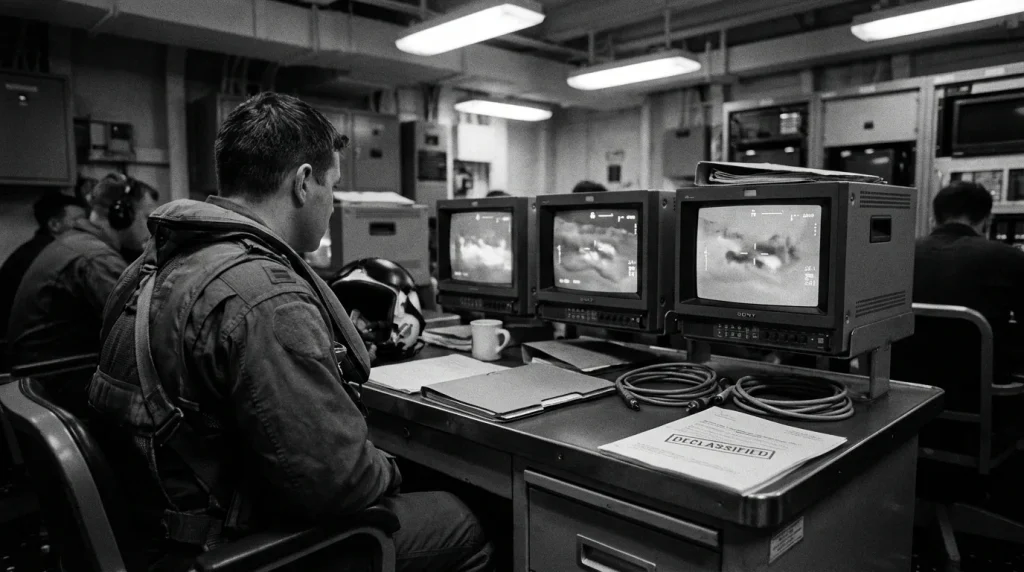
Background: Training Workups off Southern California
The incident commonly referred to as the 2004 USS Nimitz “Tic Tac” encounter is tied to pre-deployment training workups involving the USS Nimitz Carrier Strike Group off the coast of Southern California. Commander David Fravor, then the commanding officer of Strike Fighter Squadron 41 (VFA-41) flying F/A-18F Super Hornets, has said the event occurred while the group was conducting training evolutions in the area. Fravor’s account has been widely disseminated through on-the-record interviews and later summarized in U.S. government reporting and hearings, making it one of the best-known modern UAP cases.
Fravor has “detailed” the encounter in multiple venues, including his long-form interview on History Channel’s “Unidentified: Inside America’s UFO Investigation” (2019), his interview with Lex Fridman (2021), and through sworn testimony in the July 26, 2023 U.S. House hearing on UAP (Fravor appeared as a witness). For a contemporaneous government overview of the broader 2004–2021 UAP reporting landscape that includes discussion of Navy incidents, see the Office of the Director of National Intelligence (ODNI) Preliminary Assessment: Unidentified Aerial Phenomena (2021). These sources don’t “prove” an explanation, but they do document what Fravor and others have said, and what has been officially acknowledged about UAP reports.
Fravor’s Account of the “Tic Tac”: What He Said He Saw
In Fravor’s telling, he was airborne with other Navy aircraft when he was directed toward an area where something unusual had been reported. He has said that as he approached, he observed a patch of disturbed water—like a “whitewater” or “frothing” area—suggesting something large or fast-moving just beneath the surface. Above that disturbance, Fravor reported seeing a small, smooth, white object with an oblong “Tic Tac”-like shape, with no visible wings, rotors, or obvious exhaust plume.
Fravor has described maneuvering to get closer and attempting to visually assess the object’s size, shape, and motion. He has said the object moved in a way that appeared reactive—mirroring or responding to his jet’s turns—before accelerating rapidly and leaving the area. In interviews, Fravor has emphasized that the encounter was short and dynamic: he claims there was no gradual departure; rather, the object seemed to “zip” away in a manner he considered beyond what he expected from conventional aircraft.
What Radar/Sensors Reported (and What’s Public vs. Claimed)
Beyond Fravor’s visual description, the incident is often discussed alongside claims that shipborne radar and other sensors detected unusual tracks around the same timeframe. Public reporting and witness recollections often point to the USS Princeton (a cruiser operating with the Nimitz group) as a key platform associated with radar detections in the days leading up to the intercept. However, detailed sensor data from the event is not broadly available in full-resolution form to the public, and much of what is repeated online comes from interviews, secondhand summaries, or partially released materials rather than a complete, official data package.
It is also widely reported that later, another Navy flight captured infrared video often associated with the broader “Nimitz” narrative. The U.S. Department of Defense has acknowledged the authenticity of certain Navy UAP videos that circulated publicly (i.e., the videos are genuine government footage), but authenticity of footage is not the same thing as a confirmed identification of what the object is. The best-sourced, public, government-facing material tends to establish that Navy personnel reported unusual aerial objects and that some imagery exists—while stopping short of validating extraordinary interpretations about propulsion, origin, or intent.
What Happened Afterward: Reporting, Attention, and Ongoing Debate
Fravor has said the incident was discussed and reported within the Navy’s chain of command, becoming part of the internal lore surrounding UAP reports among aviators and operators. Over time, the account moved from service-member recollection into mainstream media and congressional discussion, especially as UAP reporting processes became more formalized and as journalists and documentarians revisited earlier incidents. Fravor’s public statements have remained fairly consistent in describing (1) the “Tic Tac” appearance, (2) the disturbed water below it, and (3) the sudden departure/acceleration he perceived.
At the same time, the case remains controversial because key elements are not fully settled in public evidence: not all relevant sensor data has been released; some claims rely on memory years after the fact; and reasonable analysts disagree on what can be inferred from limited public materials. Fravor himself has generally framed his account as an eyewitness and participant description—what he saw and how it behaved—rather than a definitive identification of the object’s origin.
Key Takeaways: What We Know vs. What We Don’t
- What we know (well-sourced): David Fravor, a Navy aviator and squadron commander at the time, has publicly described an encounter during 2004 workups involving a white, oblong object he likened to a “Tic Tac,” observed near disturbed ocean water. His account has been recorded in major interviews and discussed in official contexts, including a 2023 U.S. House UAP hearing and reputable media/documentary coverage (History; Lex Fridman interview).
- What we know (official framing): The U.S. government has publicly recognized that UAP reports exist and that some military imagery associated with UAP discussions is authentic footage, while still leaving many cases “unidentified” in the released assessments (ODNI Preliminary Assessment (2021)).
- What we don’t know (or isn’t publicly confirmed): A complete, publicly releasable sensor dataset tying all radar tracks, communications logs, and aircraft systems together for the specific intercept Fravor describes. Without that, precise performance claims (speed, altitude changes, acceleration) remain debated in public analysis.
-
What remains interpretation: Explanations that go beyond “unidentified object observed under unusual circumstances” (for example, claims of non-human technology) are not established by publicly released evidence, even if some witnesses personally consider the behavior extraordinary.
-
What was the 2004 USS Nimitz “Tic Tac” encounter?
It refers to a U.S. Navy incident during 2004 training workups off Southern California in which aviators, including Cmdr. David Fravor, reported seeing an unusual white, oblong object with no visible wings or exhaust. Fravor has said the object was observed near a patch of disturbed water and that it maneuvered in unexpected ways before departing rapidly. The case later became widely known through interviews and documentaries and has been discussed in government-facing contexts, including UAP reporting and congressional attention.
-
Who is Commander David Fravor and what did he describe?
David Fravor was a U.S. Navy fighter pilot and the commanding officer of VFA-41 at the time, flying the F/A-18F Super Hornet. He has described seeing a smooth, white “Tic Tac”-shaped object during an intercept, with unusual movement that he perceived as responsive to his aircraft’s maneuvers. Fravor has detailed his account in recorded interviews (including a long-form interview with Lex Fridman) and in widely viewed media coverage such as History’s “Unidentified”, and he later appeared as a witness in a U.S. House UAP hearing in 2023.
-
When did the USS Nimitz “Tic Tac” incident take place?
Fravor and other accounts place the event in 2004 during pre-deployment training workups for the USS Nimitz Carrier Strike Group off the U.S. West Coast. Public discussions often associate it with a series of unusual reports over days in that period, not necessarily a single isolated moment. Exact times, tracks, and full logs have not been released as a complete public record, which is one reason timelines can vary slightly across retellings.
-
Which U.S. Navy ship is connected to the “Tic Tac” UAP report?
The incident is most commonly associated with the USS Nimitz carrier strike group. In many accounts, the USS Princeton is also mentioned as an important ship in the group because it is frequently linked to radar detections and cueing that reportedly helped direct aircraft toward the intercept area. Publicly available government summaries acknowledge the broader reality of military UAP reporting, but ship-by-ship sensor records for this specific event are not available in a single complete, official public release.
-
Why is the object called the “Tic Tac” in this USS Nimitz case?
Fravor and others have used “Tic Tac” as a nickname because they described the object as white, smooth, and oblong—similar to the shape of the candy. In Fravor’s retellings, the label is descriptive, not an official designation, and it does not imply a confirmed type of craft. The nickname persists largely because it is a succinct way to reference the visual appearance reported by witnesses.
-
What should you look for when judging UAP disclosure claims like the USS Nimitz “Tic Tac” story?
Prioritize sources that clearly separate witness statements from confirmed documentation: for example, distinguish “Fravor said he saw…” from “the government confirmed…” and look for on-the-record interviews or sworn testimony. Check whether reputable outlets and official summaries corroborate basic context (unit, timeframe, operating area) and whether primary materials exist (contemporaneous logs, full sensor data, unedited recordings). For this case, good starting points include Fravor’s own recorded interviews (e.g., Lex Fridman), major documentary coverage that identifies witnesses on camera (History’s “Unidentified”), and official public assessments that explain what the government does and does not claim to know (ODNI’s 2021 UAP report).
