Background
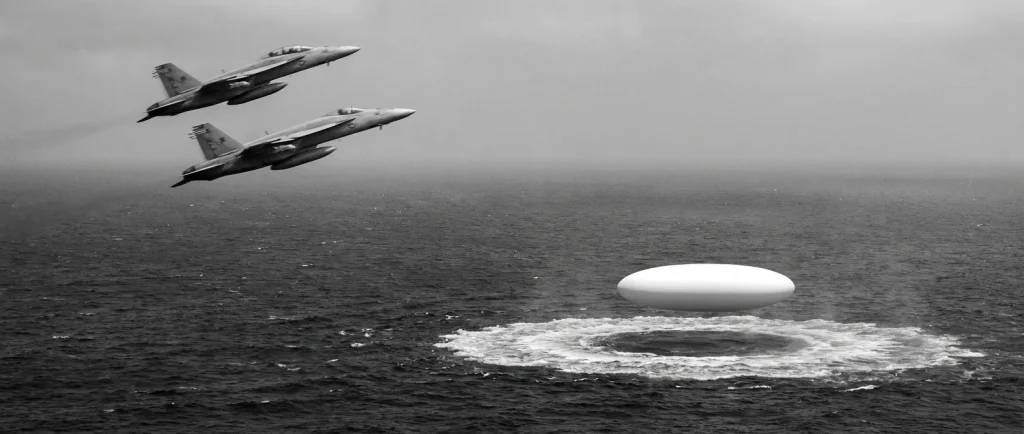
In late 2004, during pre-deployment training exercises (“workups”) off the coast of Southern California, personnel connected to the USS Nimitz Carrier Strike Group reported a series of unusual aerial contacts. The best-known incident occurred while USS Nimitz and the guided-missile cruiser USS Princeton (CG-59) were operating in the Pacific, with Strike Fighter Squadron 41 (VFA-41) flying F/A-18F Super Hornets from the carrier.
The encounter later became widely known as the “Tic Tac” incident after descriptions of a smooth, white, oblong object. Public attention increased after investigative reporting and after the U.S. Department of Defense (DoD) publicly released UAP videos in 2020, including one associated with the 2004 Nimitz-related events.
What Happened (Timeline)
Approx. date range: mid-to-late November 2004 (during the Nimitz strike group’s workups).
- Days leading up to the intercept: According to multiple accounts, including statements by Navy personnel, USS Princeton detected anomalous radar tracks over a period of days while the strike group trained off Southern California.
- Intercept tasking: Two F/A-18F Super Hornets from VFA-41 were directed to investigate. One jet was flown by then-Lt. Cmdr. David Fravor (as pilot/flight lead) with a weapons systems officer (WSO) in the back seat; a second Super Hornet flew as wingman with its own two-person crew.
- Visual encounter: The jets were vectored to an area where a disturbance on the ocean surface was reported/observed. Pilots described seeing a white, “Tic Tac”-shaped object maneuvering above the water.
- Maneuvering and departure: Fravor has described attempting to close on the object; the object appeared to respond by accelerating and departing rapidly. Accounts describe it leaving the area at speed and/or “disappearing” from view.
- Subsequent sensor capture: A later flight from the carrier recorded infrared video of a UAP (the “FLIR1” video), which DoD later released. The video is associated with the 2004 Nimitz-related incidents, though it is not the same moment as Fravor’s close-in visual intercept as he has described it.
What Was Observed
- Object description: Witness descriptions commonly characterize the object as smooth, white, oblong—likened to a “Tic Tac”—with no clearly visible wings, rotors, or exhaust plume.
- Behavior: Pilots reported abrupt, rapid movements and an ability to depart the area quickly. Some accounts describe it changing position in a way that seemed instantaneous from the observers’ perspective.
- Sea-surface disturbance: Fravor and others have described noticing a patch of roiling/foaming water below the object, as if something were occurring just under the surface or interacting with the water.
What Evidence Exists (Radar/FLIR/Witnesses)
- Witness testimony: The encounter has been described publicly by Cmdr. David Fravor in multiple interviews and under oath in public congressional testimony. Other Navy personnel have also spoken publicly about radar observations and shipboard tracking.
- Infrared video: DoD released three UAP videos in 2020, including “FLIR1”, which is associated with the 2004 Nimitz-related events.
- DoD confirmation of authenticity (videos): The Pentagon confirmed the released videos depict “unidentified aerial phenomena.” See DoD’s release: DoD Releases Three UAP Videos (Apr. 27, 2020).
- Investigative reporting: Detailed early public reporting on the Nimitz case appeared in major outlets, including The New York Times (Dec. 2017) and Politico, summarizing witness accounts and U.S. government interest and review.
- Official UAP reporting framework: The U.S. government has since created formal mechanisms for UAP reporting and analysis; for context see DoD’s All-domain Anomaly Resolution Office (AARO): Aaro.
Official Statements and Reporting
Officially, the U.S. Department of Defense has acknowledged the authenticity of the released UAP videos and described them as depicting “unidentified aerial phenomena,” without endorsing a specific explanation for what the objects were. The DoD’s 2020 release and subsequent establishment of UAP investigative/reporting entities provide the most direct on-the-record government context for the Nimitz-related footage and broader UAP reviews.
Separately, congressional interest in UAP has grown, including public hearings in which witnesses such as David Fravor have described their experiences and observations. These proceedings add sworn testimony but do not, by themselves, settle questions of origin or capability.
Key Debates/Alternative Explanations
- Misidentification vs. unknown craft: Skeptics argue the observed object and sensor data could be explained by misperception, sensor limitations, or conventional phenomena, while others argue the combined witness and sensor accounts suggest something not easily explained.
- Sensor and interpretation limits: Infrared video and radar data can be difficult for non-specialists to interpret and may not capture full context (distance, altitude, wind, and tracking mode details). This complicates definitive conclusions from the public materials alone.
- Incomplete public record: Much of the underlying data (raw radar tracks, full mission telemetry, complete debrief materials) is not publicly available, meaning outside analyses are often based on partial information and retrospective accounts.
What We Can and Can’t Conclude
- We can conclude: Multiple U.S. Navy personnel have described a 2004 training-period encounter involving unusual aerial observations connected to the Nimitz strike group; DoD has released and authenticated UAP videos, including “FLIR1,” associated with that era and context.
-
We can’t conclude (from public info alone): The precise identity, origin, or technology behind what was observed; whether all reported sensor tracks refer to the same object; or whether any single hypothesis fully explains every reported detail.
-
What is Commander David Fravor’s 2004 USS Nimitz “Tic Tac” encounter?
It refers to a late-2004 training-period intercept during the USS Nimitz strike group’s workups off Southern California in which then-Lt. Cmdr. David Fravor (flying an F/A-18F Super Hornet as flight lead) and another Navy Super Hornet crew were vectored to investigate unusual contacts. Fravor and others have said they observed a smooth, white, “Tic Tac”-shaped object maneuvering near a visible disturbance on the ocean surface before it rapidly departed.
-
When did the USS Nimitz Tic Tac encounter discussed in the article take place?
The best-known visual intercept described by Fravor occurred in late November 2004 during pre-deployment workups. Reports describe unusual radar contacts over a period of days, followed by fighter launches to investigate, with later flights capturing infrared video (“FLIR1”) that DoD released in 2020.
-
Which Navy ship is associated with the Tic Tac encounter in this article?
The incident is associated with the USS Nimitz Carrier Strike Group, particularly the aircraft carrier USS Nimitz (from which the Super Hornets launched) and the cruiser USS Princeton , which has been widely reported as tracking anomalous contacts on radar and helping direct aircraft to investigate during the 2004 workups off Southern California.
-
Who is the main figure featured in the USS Nimitz Tic Tac article?
Cmdr. David Fravor is central because he was the flight lead/pilot in one of the F/A-18F Super Hornets directed to intercept the unknown object. His account—along with those of other pilots/crew and shipboard personnel—describes a close-range visual observation of a white, oblong object exhibiting unusual maneuvering and an abrupt departure.
-
What disclosure-related topics does the article connect to the Nimitz Tic Tac encounter?
This article focuses on the documented encounter, the evidence that is publicly available (including DoD’s authenticated UAP videos), and credible reporting and testimony. It does not assume a cover-up or non-human explanation; where claims exist in public debate, they require specific evidence and attribution to be treated as more than speculation.
-
Should you search for “UFO disclosure” or “UAP disclosure” to find related coverage to this article?
For closely related, high-quality coverage, it’s more reliable to follow primary and major-outlet sources tied to the Nimitz case and UAP reporting, such as DoD’s UAP video release (defense.gov), the Navy’s FOIA video repository (navair.navy.mil), AARO (aaro.mil), and long-form investigative reporting like The New York Times.
-
What should you look for if you want this article’s coverage style applied to newer UFO sightings?
Look for reporting that includes named witnesses, direct documentation (official releases, transcripts, or data), and transparent sourcing—rather than keyword-driven summaries. Official updates and context are often published through DoD and AARO, while major investigative outlets sometimes compile timelines, interviews, and document-based reporting.
