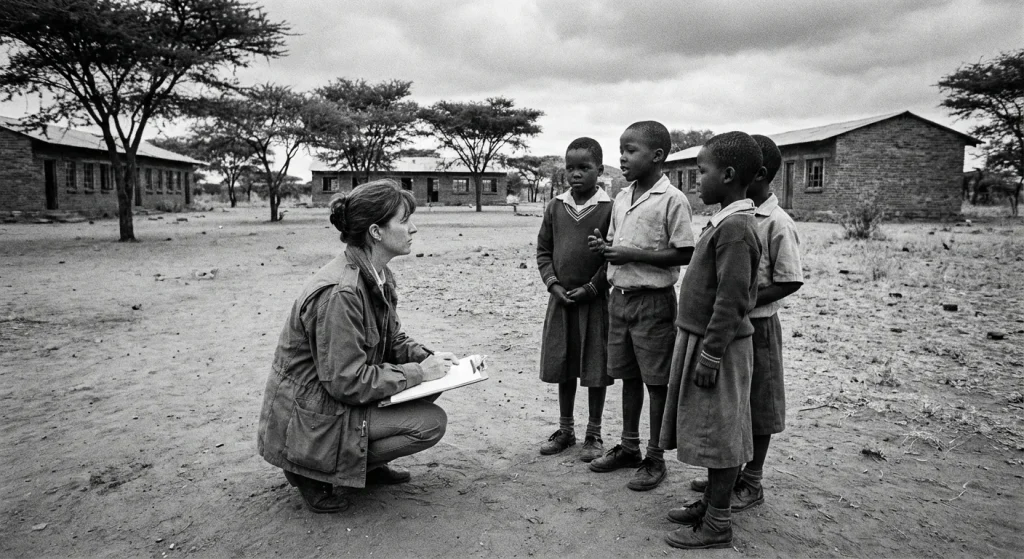
The Ariel School incident refers to an event reported on 16 September 1994 at Ariel School in Ruwa, Zimbabwe, where a group of schoolchildren said they saw an unusual craft and figures near the edge of the school grounds during a mid-morning break. The case is widely discussed because it involves multiple child witnesses describing a similar sequence of events, and because it was followed up by investigators and journalists shortly afterward.
Cynthia Hind matters to this case because she was a prominent Zimbabwean UFO researcher and the founder/editor of the UFO Afrinews newsletter. She is often described as one of the first civilian investigators to take the children’s reports seriously, to collect initial testimony, and to help connect the witnesses with additional interviewers.
In this context, “early investigation” means the first days and weeks after 16 September 1994—before the story became an international talking point and before later documentaries and retrospective interviews. The scope of this early phase is primarily on-the-ground witness work: contacting the school, arranging access, taking notes, gathering or preserving children’s accounts (including drawings), and coordinating with other interviewers who recorded longer interviews.
Background of the incident (Ariel School 1994)
According to widely circulated accounts, the reported sighting occurred while many children were outside during morning recess. Teachers were not present at the specific location where the children said the event happened, and the accounts are primarily based on the children’s descriptions given in the immediate aftermath and in later interviews. The number of children who said they witnessed something varies across retellings; what is consistently emphasized is that multiple students independently reported an unusual event near the school perimeter.
Cynthia Hind’s investigation process (what she did early on)
Publicly available accounts describe Hind as engaging with the case shortly after the incident and seeking to document what the children said while memories were fresh. The most consistently referenced elements of her early work include: making contact with Ariel School; speaking with witnesses and school staff; taking notes; collecting or facilitating the collection of the children’s drawings; and helping to connect the case to other investigators and media who later conducted recorded interviews.
However, some specific operational details are not consistently documented in accessible, primary form. For example, the exact date and time Hind first arrived at the school, the full list of students she personally interviewed (versus those interviewed by other parties), and the complete contents of her notes are not all clearly published in a single, verifiable archive. Where later summaries describe her role, they often do so at a high level (early responder/organizer) rather than with a full, itemized log of her activities.
What was documented and preserved
Based on commonly cited summaries of the case, the early documentation associated with Hind’s involvement includes children’s drawings and written or noted descriptions of what they believed they saw. These materials are frequently referenced as part of the early record because drawings can capture how witnesses—especially children—conceptualized shapes, distance, and sequence shortly after the event.
It is important to distinguish between materials Hind directly recorded and materials produced later by other interviewers. The best-known recorded interviews from the period are widely associated with subsequent interview work conducted with the children on camera; Hind is often described as having helped initiate or facilitate follow-up access. Still, unless a given interview segment is explicitly attributed to her or her notes are published alongside it, it should not be assumed she personally conducted every interview that appears in later compilations.
Critiques and alternative explanations
As with many high-profile witness cases—especially those involving children—critics raise issues such as memory contamination, group influence, leading questions, and the effects of intense attention after a story breaks. Some commentators also point to the broader context of mid-1990s UFO reporting in southern Africa and how that environment could shape expectations and interpretations.
This article does not assert a government cover-up or confirm “non-human intelligence” as an explanation. Those ideas appear in some popular retellings of the Ariel School story, but they are speculative and are not established by the early witness documentation alone. A careful reading of the early investigation record supports, at most, that multiple children reported an unusual experience and that investigators attempted to document their accounts—without proving what the stimulus or ultimate cause was.
Why the case remains discussed
The Zimbabwe school UFO incident remains a frequent point of discussion because it combines (1) multiple young witnesses, (2) a reported close-range event, and (3) an early investigative response that attempted to preserve testimony soon after the date of the claimed sighting. Cynthia Hind’s role is part of that continuing interest because she is often portrayed as an initial coordinator and collector of early accounts, helping to move the story from a local report into a documented case that later interviewers and researchers continued to revisit.
-
What is the 1994 Ariel School UFO encounter described in the article?
The Ariel School incident (Ariel School 1994) refers to reports from schoolchildren in Ruwa, Zimbabwe, who said that on 16 September 1994 they saw an unusual craft and figures near the school grounds during recess. The case is discussed primarily through the lens of early witness documentation—what was collected soon after the report, and how those first interviews and drawings shaped later retellings.
-
Who is Cynthia Hind and what did she do in the Ariel School case?
Cynthia Hind was a Zimbabwean UFO researcher and publisher of UFO Afrinews. In accounts of the case, she is described as an early investigator who contacted the school shortly after the incident, sought statements from witnesses and staff, took notes, and helped gather or preserve children’s drawings. She is also commonly described as coordinating with other investigators/journalists who conducted additional recorded interviews. The precise list of which children Hind personally interviewed, and the full contents of her notes, are not consistently available in a single published primary-source archive.
-
When did the Ariel School UFO encounter happen?
The reported event occurred on 16 September 1994 at Ariel School in Ruwa, Zimbabwe. “Early investigation” in this article refers to the first days and weeks after that date, when initial witness accounts and drawings were collected and follow-up interviews were arranged.
-
What kind of witnesses reported the Ariel School UFO sighting?
The core witnesses were schoolchildren who were outside during recess. Adults (such as teachers) are not generally described as having been present at the specific location of the claimed encounter, which is why the early investigation focused heavily on child witness interviews, comparing accounts, and preserving contemporaneous drawings and descriptions.
-
How is the Ariel School incident linked to UFO disclosure and UAP disclosure in this article?
This article does not treat the Ariel School case as evidence of a government cover-up or confirmed non-human intelligence. Instead, it focuses on what is more clearly documentable: early witness interviews and the collection of drawings and notes soon after the report. Broader “disclosure” narratives may reference Ariel School in popular culture, but those claims go beyond what the early investigation materials alone can establish.
-
What should you look for when evaluating a high-profile schoolchildren UFO report like Ariel School?
Look for (1) timing (how soon after the event testimony was collected), (2) method (who interviewed whom, whether questions were documented, and whether accounts were recorded), (3) preservation of contemporaneous materials (notes, drawings, dated documents), and (4) clear attribution (which investigator created which record). In the Ariel School case, Cynthia Hind is significant mainly for being described as an early organizer/documenter, but careful evaluation requires distinguishing her documented contributions from later interviews and later interpretations.
-
Is this article about recent UFO sightings, or mainly about the 1994 case?
It is about the Zimbabwe school UFO incident in 1994 (Ariel School 1994) and Cynthia Hind’s early involvement in documenting witness accounts. It is not a roundup of recent sightings, and it does not focus on unrelated modern “UFO sightings” keywords.
Sources / Further reading
- Skeptoid: “The Ariel School UFO Incident” (overview and critical analysis)
- BBC coverage and archives (search: “Ariel School Ruwa 1994” and “Cynthia Hind” for relevant segments and references)
- IMDb entry for The Phenomenon (2020) (includes the Ariel School segment; useful for locating interview footage and credits)
- IMDb entry for Ariel Phenomenon (2022) (focuses on the case; useful for identifying interviews, participants, and cited materials)
- Internet Archive / Wayback Machine (search for “UFO Afrinews” and “Cynthia Hind” to locate preserved references to her newsletter and reported case work)
