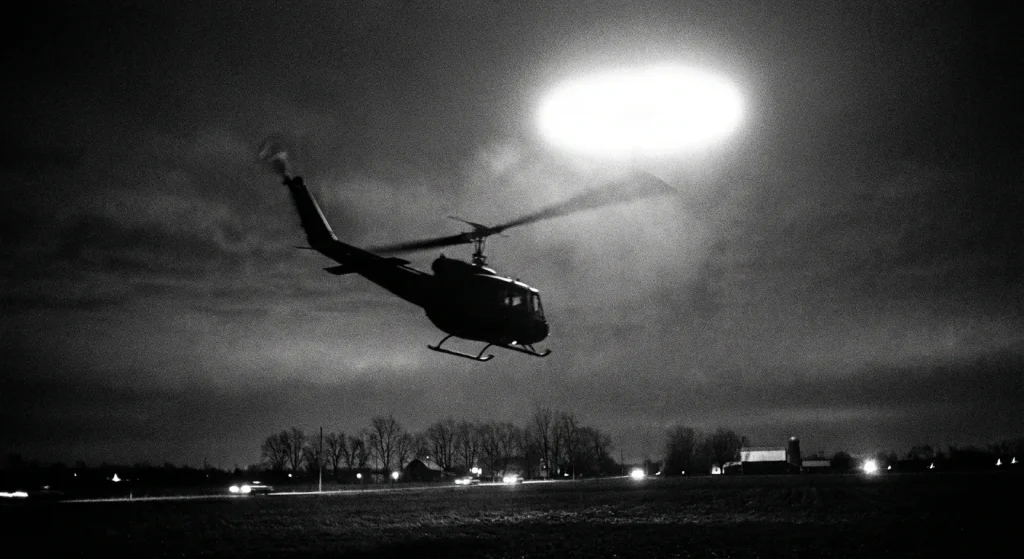
The Coyne story circulates with confident, cinematic details, and those details often vary across retellings until two supposedly “definitive” versions no longer match. The decision point is straightforward: treat it as credible aviation history, dismiss it as folklore, or use it as a disclosure talking point about what the government did or did not disclose. That choice matters because the core claim is high-stakes and specific: an Army Reserve helicopter crew reported their aircraft rose upward against their control inputs over Ohio in 1973. A trained military crew asserting an uncommanded climb is not just a UFO narrative; it is an aviation-safety anomaly that, if documented as described, demands serious scrutiny. The complication is that the most-circulated accounts often present polished certainty while the sourcing is thin, inconsistent, or simply not shown.
This piece resolves that tradeoff by treating the dramatic flight-safety claim as separate from documentation quality, and by refusing to let repetition substitute for records. To keep those threads from tangling, the analysis uses evidentiary tiers-a method used here to sort claims by separating primary accounts, official records, and later commentary-so it is clear where certainty is earned versus where it is performed. Based on the provided research snippets, there is no usable Coyne-specific primary documentation in hand about the incident itself, which is why every claim is labeled as documented versus merely repeated. The result is a disciplined way to audit legacy UFO cases without either rubber-stamping dramatic retellings or hand-waving trained-witness reports out of existence.
What the Crew Reported
Sourcing note: This article uses a simple labeling scheme to indicate provenance: “Primary” or “Early” marks contemporaneous or near-contemporaneous source material; “Later” marks accounts appearing in secondary summaries; and “Unsourced” flags widely repeated claims with no cited primary artifact in the materials reviewed here. Where possible the article prefers Primary over Later or Unsourced claims and avoids repeating the same provenance caveat for every line item.
Here is the clearest version of what the crew said happened, separated from later embellishment. Retellings vary, so each detail below is explicitly labeled by sourcing strength, and any specific numbers or quotes that are not backed by accessible primary documentation in the reviewed material are flagged as such.
Later summaries commonly anchor the event to an Oct. 18, 1973 nighttime flight involving a U.S. Army Reserve UH-1H traveling between Columbus and Cleveland, often placing the encounter over north central Ohio near Charles Mill Lake and naming the aircraft commander as Larry Coyne. Those are the stable reference points in circulation; the problem is that contemporaneous flight paperwork, ATC logs, or first-person statements that would lock down the planned route, precise track, or time-stamped waypoints were not present among the documents reviewed for this article (Primary/Early: none found in the reviewed set).
Conditions and visibility: Beyond the basic fact that the reported time is nighttime, specific weather, cloud layers, moon illumination, and visibility are not documented in the contemporaneous material reviewed here (Primary/Early: not located). Any claims about ceilings, haze, or exceptional visibility conditions circulating in later retellings are therefore treated as unsettled unless tied to a primary meteorological report.
Object description and lighting: No contemporaneous crew description (shape, size estimation method, surface details, color, or documented light configuration) was found in the reviewed materials (Primary/Early: not located). Descriptors appearing only in later summaries are treated as Later or Unsourced unless a dated crew statement or official report is produced.
- Later summary: Crew was in a U.S. Army Reserve UH-1H and the time is commonly given as about 10:30 PM on Oct. 18, 1973.
- Later summary: Four crew members were reportedly flying from Columbus to Cleveland.
- Later summary: The aircraft commander is identified as Larry Coyne.
- Later summary: The encounter is most often placed over north central Ohio near Charles Mill Lake.
- Unsourced retelling: Crew reported an unidentified object/light was observed before the close approach.
- Primary or early account not located in the reviewed set: Exact altitudes, airspeeds, distances, and the precise wording of any radio calls were not found among the contemporaneous artifacts examined for this article.
Core claim (Unsourced or Later in reviewed materials): A helicopter crew reported being pulled or raised upward against their control inputs over Ohio in 1973. That is the central allegation preserved in later summaries. Details that drive the narrative-scale impressions in popular retellings-especially numerical altitudes, exact climb rates, and verbatim radio calls-are not verifiable from the contemporaneous records available to this review.
Communications during the event: While some later retellings cite radio traffic, no ATC transcript, recorded intercom, or official communications log tied to the incident was found in the reviewed set (Primary/Early: not located). Any exact phrasing of radio calls or named facilities cited in later accounts remain unverified here.
Immediate aftermath and who they contacted: The reviewed materials did not include unit after-action reports, post-flight statements with chain-of-custody, or a verified filing that documents who was notified first (Primary/Early: none located). If a retelling claims a specific contact such as an ATC facility or military command post, that claim should be treated as Later or Unsourced until a contemporaneous record is produced.
The practical takeaway from this timeline is straightforward: the stable elements across later summaries are the date, general Ohio location, aircraft type, and basic mission endpoints, while object descriptors, distances, altitudes, and radio-call wording hinge on Later or Unsourced material in the reviewed set.
Records, Reporting, and Official Response
Sources checked / recommended sources
- FAA Helicopter Flying Handbook (FAA page) and the FAA PDF front material at hfh_front.pdf
- FAA Pilot’s Handbook of Aeronautical Knowledge (PHAK) PDF and the FAA spatial disorientation/visual illusions pamphlet at spatiald_visillus.pdf
- Public Law 117-263 (FY2023 NDAA) text (contains Section 1673 UAP reporting language)
- Senate Amendment 2610 (Schumer-Rounds UAP Disclosure Act amendment text) and the Senate Democrats summary at uap_amendment.pdf
- NARA Advisory Committee memorandum AC-26-2024 and the NARA UAP guidance page at NARA UAP guidance
Note: the article’s working set did not include a contemporaneous Coyne ATC transcript, unit ops log, or sworn crew statement. The links above are the authoritative sources consulted to check aviation human-factors guidance, the FAA helicopter handbook, the FY2023 NDAA statutory text, and the Schumer-Rounds amendment and NARA policy materials referenced in the disclosure-era discussion.
Narratives are easy to repeat; documentation is harder to demonstrate. The hard part is proving what was recorded, who was notified, and what any investigator actually had in hand afterward. On that score, the documents actually reviewed for this article were mostly about how aviation recordkeeping and human-factors guidance work in general, not a documented reporting chain for Coyne.
Many helicopters, especially historically, were not equipped with cockpit voice recorders (CVRs) or flight data recorders (FDRs) as standard gear, and even when recorders exist they are subject to wear, erasure, or programmatic exclusion from routine missions. For historical Army rotorcraft in particular, CVR/FDR carriage cannot be assumed. In practice, the highest-value artifacts for reconstructing a 1970s helicopter event are more likely to be ATC recordings or logs, unit operations logs, maintenance and mission records, and contemporaneous written statements or after-action reports that carry clear provenance. Those are the items to prioritize when they exist because they provide time-stamped, chain-of-custody evidence that recorder media alone may not supply.
The evidence package reviewed for this article does not include a Coyne-specific ATC transcript, unit log entry, FAA filing, or a scanned incident form that can be tied to a chain of custody. The same constraint applies to “who was notified.” The research context mentions reporting norms and agencies in broad terms, but it does not provide a citable document naming which tower, which military operations desk, or which civil authority was contacted first in the Coyne case. Any immediate-reporting timeline circulating online should be treated as claimed but not citable under this evidence set.
For this article’s evidentiary tiers, Tier 1 is chain-of-custody primary material, where provenance is the difference between documentation and folklore. Tier 2 is an official investigation product that synthesizes inputs. Tier 3 is everything that lacks custody, including retellings and anonymous uploads. FOIA can only retrieve what an agency actually has indexed and releasable; absent a citable, custody-backed record, the responsible conclusion is narrow: the story persists, but the paper trail in the materials reviewed here does not.
In practical terms, that leaves two parallel tasks: keep the reported aviation-effect claim clearly labeled as a reported claim, and evaluate how plausible conventional mechanisms might produce the same experienced outcome when the record set cannot arbitrate between them directly.
Aviation Factors and Alternative Explanations
Aviation history shows that “impossible” aircraft behavior often reduces to perception, workload, and system-state misunderstandings. Helicopters intensify that risk because small power changes translate into large vertical-rate changes, and night operations reduce the outside cues that normally keep motion sense and instrument scan honest. The goal here is not to “solve” a case from the armchair; it is to map the plausibility envelope using the FAA helicopter handbooks as the baseline framework for controls, performance, systems categories, and decision-making under stress.
“Uncommanded climb” has three distinct meanings that get conflated: a real climb caused by pilot input, a real climb caused by the environment, or a perceived climb created by interpretation errors. In FAA control terms, the first category is straightforward: collective is the power axis, and increasing collective increases blade pitch, rotor thrust, and climb rate when power available exceeds power required. A crew can honestly experience “we were pulled up” while actually making a compensatory collective input during surprise, turbulence, or fixation on an external light.
The second category is real aircraft response without a deliberate climb command. Vertical gusts, wind shear, and mechanical or convective turbulence can produce abrupt changes in vertical speed, especially at low airspeed where the aircraft is more “at the mercy” of the airmass. Helicopters also experience large performance changes with airspeed and power margin; a transition into effective translational lift, or a change in tailwind/headwind component, can alter required power and rotor efficiency quickly enough to feel like an external force even though the rotor system is doing exactly what physics dictates.
The third category is an instrument and workload problem. At night, pilots often fly a hybrid of outside references and instruments; if attention narrows to a light source while the scan degrades, the aircraft can deviate in pitch and power unnoticed until the altimeter or vertical speed indicator finally “catches up,” at which point the crew experiences a sudden, emotionally salient climb event.
The non-obvious complication is that helicopters at night, with limited outside cues, are especially vulnerable to powerful motion illusions that feel physically external. Spatial disorientation is “the inability of a pilot to correctly interpret aircraft attitude, altitude or airspeed in relation to the Earth or other points of reference.” Once the visual horizon is weak or ambiguous, vestibular sensations can dominate even when they are wrong, and the error can be compelling enough to drive control inputs that “confirm” the false sensation.
Autokinesis is a classic pathway: a single light against a dark background appears to drift, and the pilot unconsciously “chases” it with small cyclic and collective changes. A false horizon is another: sloping cloud decks, distant light domes, or patchy layers can be misread as level, prompting a correction that produces a real climb or pitch change. The black-hole illusion adds a vertical component; in featureless terrain with sparse ground lights, the aircraft can feel lower than it is, biasing the pilot toward adding power and climbing.
These illusions do not require poor airmanship; they require the normal human sensory stack operating in conditions it was never designed for. Under stress and startle, decision-making compresses into a few high-salience cues, and a bright object becomes a powerful attention magnet that competes directly with instrument cross-check.
Without model-specific system facts, the disciplined approach is to stay at the category level the FAA uses: flight controls and trim, powerplant governing, stability augmentation, and flight instruments. A stuck or mis-set trim system, excessive friction, or an inadvertent control displacement can create a sustained climb that feels “uncommanded” if the pilot believes the controls are neutral. A governing anomaly that changes rotor RPM or power response can also alter climb performance, especially if it occurs during high workload when the crew is heads-out.
Instrument errors can mimic a climb even when none exists. A wrong altimeter setting shifts indicated altitude; lag and acceleration effects can produce short-term misreads on vertical speed. More importantly, selective attention can function like an “instrument failure” even when all gauges are correct: if the scan collapses, the first reliable cue of climb may arrive late, and the late recognition is experienced as a sudden, external event.
Misidentification hypotheses live or die on reconstructable external conditions, not on rhetoric. Meteorological and astronomical conditions should be retrieved and used to evaluate these pathways, using concrete variables: ceiling and visibility, cloud layers, winds aloft (including shear), temperature and dew point (for haze and layer formation), moon phase and position, and the azimuth and elevation of bright objects.
On the weather side, you need surface observations near the route and time window, plus a vertical profile such as a radiosonde or model reanalysis for winds aloft and stability. That combination lets you test whether the air mass supported turbulence, wave action, or sharp wind shifts that can produce abrupt vertical-speed changes. On the astronomy side, you need the sky geometry for that location and time: if a bright planet or the Moon sat low over a sloping cloud deck, the ingredients for false-horizon and autokinesis amplification are present; if not, those explanations lose traction.
| Explanation | What it fits | What it doesn’t | What data would test it |
|---|---|---|---|
| Pilot collective increase under startle/workload | Rapid climb with strong “external force” sensation | Does not explain a climb if controls and power were verified unchanged | Contemporaneous cockpit statements, instrument readings, control/friction checks |
| Vertical gusts, turbulence, wind shear | Short, abrupt vertical-rate excursions and noise/vibration | Does not explain sustained climb without added power | Ceiling/visibility, winds aloft profiles, radar/satellite for convective or layered structures |
| Spatial disorientation with false horizon | Confident misperception of attitude/vertical motion at night | Fails if a strong natural horizon and stable instrument scan were maintained | Cloud layer geometry, moon position, ground-light environment, crew scan discipline evidence |
| Autokinesis fixation on a bright light | Perceived object motion prompting unconscious aircraft maneuvering | Does not explain correlated radar returns at the same position | Visibility/haze, relative bearing stability, astronomical azimuth/elevation or traffic light patterns |
| Bright planet or Moon misidentified through haze/cloud | Persistent bright “target” that seems to pace the aircraft | Does not explain close-range depth cues or rapid relative geometry changes | Moon phase/position, bright object azimuth/elevation, haze and cloud layers |
| Conventional aircraft lights at night | Bright, attention-grabbing lights with deceptive closure rates | Does not explain climb unless it triggers pilot response or turbulence interaction | ATC/radar tracks, nearby airports/traffic flows, reported traffic advisories |
| Instrument setting/interpretation error (altimeter/VSI/scan collapse) | Late recognition of altitude change, or false indication of climb | Does not explain physical sensations unless combined with vestibular illusion | Altimeter setting history, instrument cross-check notes, maintenance/instrument test status |
The key takeaway is discriminators, not slogans: radar or ATC-derived track and altitude data, a weather reconstruction, and a time-and-place sky model would sharply narrow the plausible explanations. If external data supports turbulence or a false-horizon setup, human-factors mechanisms move to the top. If external data contradicts those conditions and independent tracking confirms an anomalous climb profile, the analysis shifts toward aircraft-state and system explanations.
Those discriminator-driven methods are not unique to Coyne; they are exactly what makes some aviation-UFO cases legible to outsiders and leaves others dependent on narrative strength. Seeing where Coyne sits relative to better-instrumented incidents clarifies what can and cannot be concluded from the materials available here.
How Coyne Compares to Other Cases
Coyne’s value is that it tests how aviation-effect claims are weighed when deep sensor records are not available. The only responsible way to compare aviation incidents is to score them on the same metrics every time: documentation quality, sensor involvement (radar and ATC recordings), witness training and count, and any claimed aircraft effects. Based on the documents reviewed for this article, no comparator cases with contemporaneous, chain-of-custody documentation were available to include here, so this piece does not present an unsourced table of other headline cases. Where a comparison is offered, it should be supported by primary documents such as FAA investigation records, ATC tapes, or official military reports; absent those, the comparison is speculative and was omitted.
This metrics-first approach matches how serious government and military work treats unusual aerial reports: systematic analysis is built around evidence that can be checked, including radar and other physical records, not just narrative consistency.
The through-line across verifiable cases is trained witnesses reporting an airborne encounter, which keeps the discussion anchored in aviation operations rather than pure spectacle. Coyne is the outlier in this review because it is a rotorcraft case with a reported aircraft-performance effect but lacks the depth of sensor and record material that would make it legible to outside scrutiny.
What It Means in the Disclosure Era
Modern UFO disclosure arguments rise or fall on two inputs: who can access primary records, and whether every office reports the same kind of incident the same way. Viral anecdotes drive spikes in UAP news, but transparency depends on file custody, classification rules, and reporting standards that make incidents comparable across time and agencies.
Standardization starts with statutory language. The FY2023 National Defense Authorization Act defines the covered phenomena in statute. The law uses the phrase “sources of anomalous detections in one or more domains” when anchoring reporting obligations for unidentified anomalous phenomena; see Section 1673(d)(8) of Public Law 117-263 for the statutory wording and context (Public Law 117-263).
That statutory hook matters because it narrows what gets routed into UAP reporting pipelines. The Schumer-Rounds legislative proposal was advanced as Senate Amendment 2610 and is titled in its text as the “Unidentified Anomalous Phenomena Disclosure Act of 2023”; the amendment text proposed creating an Unidentified Anomalous Phenomena Records Collection at the National Archives to centralize agency records (Senate Amendment 2610 text, Senate Democrats summary).
Status and what changed: the Schumer-Rounds language was proposed and debated as a Senate amendment and influenced floor action, but when elements were carried into final NDAA provisions the precise language and mechanisms were modified before enactment. In short: the Schumer-Rounds amendment represented a proposed approach to centralized records collection and expedited declassification, while the ultimately enacted NDAA language and implementation choices differ from the original amendment text; see the Senate amendment text and subsequent implementation commentary for details (Amendment 2610, analysis of FY2024 changes, and public remarks such as the Senate colloquy summarized in available press clips on C-SPAN).
Agency implementation and records guidance followed. The Office of the Director of National Intelligence and the Department of Defense have produced consolidated reports and reporting procedures tied back to the FY2023 requirements, and the National Archives has issued guidance for agencies about public releasable UAP records and metadata requirements (see the ODNI consolidated report and NARA AC-26-2024 and UAP guidance pages for implementation details: ODNI consolidated report, NARA AC-26-2024, NARA UAP guidance).
Legacy incidents like Coyne keep getting pulled into modern disclosure debates because older reporting pipelines did not reliably preserve the artifacts that would settle disputes: consistent logs, standardized summaries, and auditable custody. Centralized collections and clear statutory definitions raise the ceiling on what future cases can prove, but they do not retroactively create contemporaneous records for events where those records were never produced or were not preserved.
The practical test for any disclosure claim is mechanical: what mechanism would surface the underlying records, and what standard forces agencies to report the same kind of anomaly the same way. If an argument cannot answer those two questions with reference to chain-of-custody documents or statutory reporting mechanisms, it is commentary, not accountability.
What We Know and What We Don’t
Coyne remains compelling because the core aviation claim is stark and the sourcing is exactly where the story fractures.
What holds: the central reported claim across the timeline is uncommanded upward movement against pilot inputs, not a routine climb. The story’s key details vary across retellings, but the through-line is the same: the crew described an anomalous, unwanted vertical response during a close-in encounter.
What remains disputed and why: the altitude-change magnitude stays unsettled because many versions cite numbers without a traceable, contemporaneous artifact. Whether an emergency was declared, whether ATC tracked anything on radar, and whether official paperwork exists all remain disputes for the same reason: provenance is thin and the documents reviewed here do not include the citable, time-stamped records that would lock those points down. Aviation analysis still leaves plausible conventional buckets-human factors, systems, environment-but discriminating between them requires the hard data this record set does not consistently provide.
Use this checklist on Coyne and the next “can’t be explained” aviation or UAP claim:
- Demand primary-source artifacts: ATC tapes, radar plots, maintenance logs, sworn contemporaneous statements.
- Flag uncited numbers, shifting timelines, and added details that don’t appear in first-source accounts.
- Track provenance: who recorded it, when, and in what channel (news, FOIA, official log).
- Separate “reported by crew” from “asserted later” and keep them in different buckets.
- Prefer records that can be independently cross-checked over narrative consistency.
Standardized definitions and record-collection mechanisms, including statutory NDAA-driven definitions and post-enactment agency guidance, raise the ceiling on what future cases can prove, but they do not retroactively settle Coyne. If more case recaps in this documentation-first format would be useful, subscribe for updates.
Frequently Asked Questions
-
What is the Coyne Helicopter Incident of 1973?
It’s a 1973 Ohio UFO/UAP case in which an Army Reserve helicopter crew reported their aircraft rose upward against their control inputs. The article treats the aviation-safety claim as distinct from the documentation problem because widely circulated details vary and primary records are not provided in the working set.
-
When and where did the Coyne helicopter UFO incident reportedly happen?
Later summaries commonly place it at about 10:30 PM on Oct. 18, 1973, during a nighttime flight over north central Ohio near Charles Mill Lake. The article notes these anchor details are widely repeated but are not backed by contemporaneous, examinable documentation in the provided working set.
-
What helicopter model and route are usually cited in the Coyne incident?
Popular retellings identify the aircraft as a U.S. Army Reserve UH-1H traveling between Columbus and Cleveland with four crew members, and the aircraft commander is often named as Larry Coyne. The article flags that route specifics beyond “Columbus to Cleveland” and other operational details are not secured by primary documents in the working set.
-
Did the Coyne incident include verified ATC tapes, radar data, or official incident reports?
No Coyne-specific ATC transcript, unit log entry, FAA filing, or scanned incident form with chain-of-custody is included in the provided evidence package. The article emphasizes that claims like “a tape exists” are not the same as an accessible, citable record.
-
What does the article say could cause an “uncommanded climb” in a helicopter at night without any UFO involvement?
It outlines three categories: pilot input under startle/workload (collective is the power axis and increasing it increases rotor thrust and climb rate), environmental effects like vertical gusts/turbulence/wind shear, and perception/instrument-scan problems at night. It specifically highlights spatial disorientation and illusions such as autokinesis, false horizon, and the black-hole illusion as mechanisms that can feel like an external upward pull.
-
What specific data would best test the Coyne incident claims and narrow the explanations?
The article says the key discriminators are radar or ATC-derived track/altitude data, a weather reconstruction (ceiling/visibility, winds aloft, and cloud layers), and a sky model for that time and place (moon phase/position and bright objects with azimuth/elevation). Those inputs would help determine whether turbulence or illusion conditions were present or whether an anomalous climb profile is independently supported.
-
What should you look for to judge whether the Coyne incident is credible aviation history or mostly folklore?
Use provenance-based artifacts first: ATC tapes, radar plots, maintenance logs, and sworn contemporaneous statements, and flag uncited numbers and shifting timelines. The article’s checklist also stresses separating “reported by crew” from “asserted later” and preferring records that can be independently cross-checked over narrative consistency.
