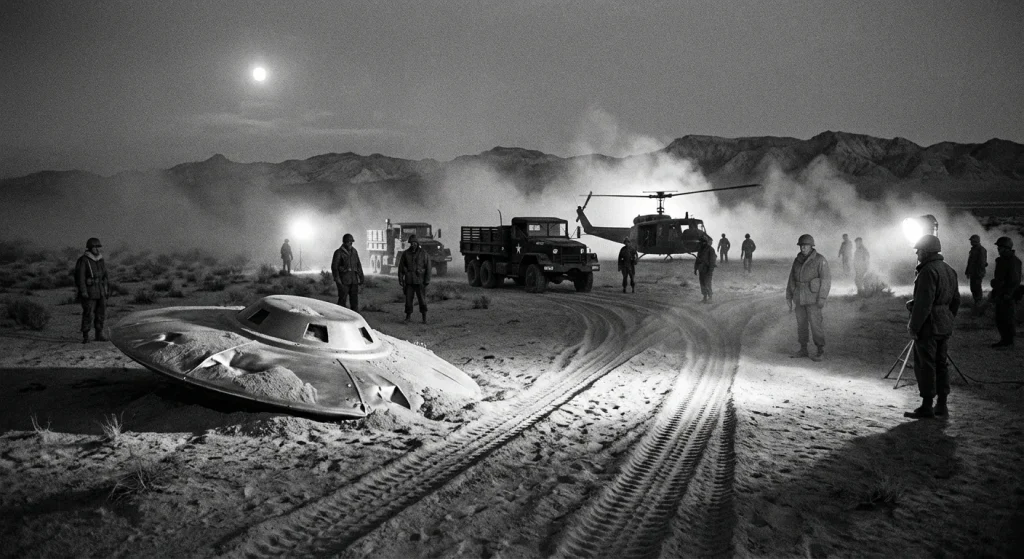
You keep seeing the “Coyame 1974 crash retrieval” resurface in UFO news and UAP news because it reads like a complete case file: a named town, a border location, an alleged U.S. operation, and rumored bodies. Then you go looking for the paperwork, the contemporaneous reporting, the radar logs, the death records, the chain of custody, and you hit the same wall every time: lots of confident retellings, very little you can independently verify.
The reason this one sticks is the stakes baked into the allegation. The incident is widely reported as occurring in 1974 near Coyame, Chihuahua, described as just south of the U.S.-Mexico border. The core claim is simple and dramatic: a collision between an unidentified object and a small aircraft, followed by an alleged recovery operation. Add the recurring extras that tend to ride along with it, the bodies rumor and the implication of U.S. military activity on Mexican soil, and the story starts to sound specific enough to be documentable. The friction is that the public record most readers can actually touch is thin, inconsistent, and often circular, with later accounts repeating earlier ones without adding hard, traceable documentation.
This article resolves that mismatch head-on: a high-impact cross-border crash retrieval allegation sitting on top of a low-quality, heavily recycled public record. The disclosure climate is exactly why the mismatch matters. Senators Chuck Schumer and Mike Rounds introduced the Schumer-Rounds UAP Disclosure Act on July 14, 2023, and the release of videos purporting to show U.S. military naval aviator encounters with unknown objects has kept public attention locked on official secrecy and crash-retrieval lore. In a moment when Unidentified Anomalous Phenomena (UAP) functions as an umbrella term for airborne, space, or undersea objects or events not immediately identified, Coyame gets treated as a “missing chapter” people assume must exist. The disciplined approach is to separate three buckets: what’s alleged, what’s checkable, and what’s pure speculation built from gaps.
You will leave able to evaluate Coyame claims with a standard that rewards documentation over narrative momentum.
Where the Coyame story originates
Coyame persists because its public footprint is built from retellings rather than primary records. In public circulation, the baseline framing is consistent: rumors circulate about a 1974 collision between a small private plane and a disc-shaped UFO near Coyame, Chihuahua.
The story then propagates through the channels that reliably preserve compelling UFO lore: researcher retellings, magazine and book write-ups that summarize prior summaries, and later internet recirculation that strips away any remaining sourcing context. The friction is that these channels are optimized for narrative continuity, not documentation. Once a version becomes quotable, later references tend to point to the quote, not to an original report, log, affidavit, or named first-hand witness.
Some reports state additional anchoring details, including a date and a radar hook: the night of August 25, 1974, and U.S. radar stations in Texas detecting a fast-moving object over the Gulf of Mexico. Those specifics read like traceable telemetry, but in circulation they typically arrive as secondhand assertions attached to the same core legend, not as a surfaced record with provenance attached.
A bibliographic pointer shows how this lore gets formalized without being validated: a book titled The Coyame incident is listed on Open Library as a 150-page publication from Edinburg, Texas, with the publisher given as Roswell Books.com. A catalog listing helps you map circulation, not confirm that any claim inside the covers is supported by primary documentation.
Coyame matches the most durable “government UFO cover-up” beats with high meme-efficiency: a crash retrieval (a physical object to recover), quarantine or contamination fear (a reason for lockdown), secrecy (a reason no records surface), and cross-border jurisdiction conflict (a reason responsibility is blurred). That pattern-match is exactly why the story spreads. It packages uncertainty as intentional suppression, which makes missing evidence feel like evidence.
The complication is structural: repetition is not independent corroboration. A claim echoed across books, blogs, and forum posts often traces back to the same originating retelling. The surface area of repetition inflates perceived certainty, even when the underlying sourcing tree is a single trunk with many branches.
The story also benefits from “specificity plus secrecy.” Details like a precise night, radar stations, speeds, body counts, and named agencies give readers handles that feel testable. But in practice, those details are frequently presented as uncheckable because they are classified, off-the-record, or attributed to unnamed insiders. Reliability does not increase just because the teller projects certainty. One common failure mode in online retellings is treating an anonymous “insider” as a self-authenticating authority, while a competing caution from skeptical communities is that sensational secret insider information is disproportionately hoaxed or garbled, especially when it is not first-hand. The actionable point is simple: confidence is not a substitute for documentation.
That is why you need a claims inventory: a way to separate distinct allegations from each other so each can be tested against the type of evidence that would actually settle it, instead of swallowing the legend as an all-or-nothing bundle.
- Midair collision claim: Some retellings assert a small private plane collided with a disc-shaped craft near Coyame in 1974. Evidence needed: named first-hand witness statements, flight plan data, accident reports, or contemporaneous local reporting.
- Specific date claim: Some reports state the event occurred on the night of August 25, 1974. Evidence needed: contemporaneous time-stamped records that tie the date to an incident, not just to a retelling.
- U.S. radar detection claim: Some reports state U.S. radar stations in Texas tracked a fast-moving object over the Gulf of Mexico. Evidence needed: radar logs, chain-of-custody documentation for those logs, or testimony from identifiable operators tied to specific stations and shifts.
- Extreme speed claim: Some accounts specify the object was traveling around 2,000 mph before the collision. Evidence needed: the underlying instrument source (radar/telemetry) and the calculation method that produces that figure.
- Crash site recovery claim: Some retellings assert a secured crash site and a retrieval operation occurred. Evidence needed: identifiable unit participation, mission documentation, photos with verifiable metadata, or consistent named witness testimony.
- Jurisdiction conflict claim: Some versions allege a dispute or overlap between Mexican authorities and U.S. military personnel in the response. Evidence needed: official communications, identifiable participants, or contemporaneous diplomatic or law-enforcement records.
- Mass casualty claim: One circulated account describes a classified recovery mission near Coyame in which 23 soldiers died. Evidence needed: casualty records tied to names and units, death certificates, or contemporaneous reporting that can be independently cross-checked.
- Quarantine or contamination claim: Some retellings include quarantine-style perimeter control or contamination fears as the reason for secrecy. Evidence needed: medical logs, hazmat documentation, or identifiable personnel describing specific protocols used.
- Long-term secrecy claim: Some versions assert the incident remained hidden due to classification and intimidation. Evidence needed: verifiable documentation of classification actions, credible named testimony about threats, or declassified material that maps to specific claims.
If you can name these claims separately, you stop evaluating “Coyame” as a single legend and start evaluating discrete propositions. It also clarifies what should be verifiable in principle, and where the story is currently carried mostly by repetition.
What’s verifiable and what isn’t
Coyame is testable in principle because a real cross-border air incident in 1974 would have produced routine paperwork across multiple institutions. The first filter is provenance: a documented origin and custody trail that shows where a record came from, who held it, and how it was transmitted. Without provenance, even a convincing photocopy is just an artifact with no accountability.
Start with contemporaneous news. A crash, a cordon, a quarantine claim, or a convoy large enough to be noticed should surface in dated local reporting, wire pickups, or archived radio logs from both sides of the line. The friction is that “everybody heard about it” is not a searchable record; the practical test is whether any report can be pulled with a publication name, date, page, and byline that stands up to library or microfilm retrieval.
Aviation records are the next obvious residue. A conventional aircraft loss tends to touch air-traffic control notes, NOTAM-like warnings, search-and-rescue coordination, and accident reporting channels. As a reminder of the kinds of official artifacts that can exist without proving Coyame itself, referenced material notes the FAA issued safety or airspace alerts to airlines about military activity and potential navigation interference over parts of Mexico. That is what “paperable” activity looks like when it crosses aviation safety thresholds.
Radar logs, if retained, are a separate lane from narrative. Primary radar returns, transponder data, and ATC facility logs can confirm traffic patterns or anomalies even when nobody writes a story about it. The catch is retention: some radar products were never archived long-term, and what survives is often distributed across FAA, military, and contractor systems.
Then there is movement and medical documentation. If a substantial number of personnel or vehicles deployed, there are unit diaries, duty rosters, fuel logs, maintenance records, and base entry control logs. If bodies were recovered, there are death certificates, chain-of-custody forms, autopsy or forensic summaries, and hospital intake records. Photographs can help only if they carry metadata, original negatives, lab receipts, or other markers that lock them to a time and place rather than a caption.
Most crash-retrieval stories collapse at corroboration, meaning independent confirmation by separate sources that are not relying on the same origin story. Classification can explain some silence, but it cannot substitute for parallel traces that normally appear when many people, vehicles, and agencies interact. When the only “independent” accounts turn out to be restatements, the record looks crowded while the evidence remains singular.
Cross-border incidents add a second failure mode: fragmented archives. Bilateral security work has run through cooperative phases and periods of deterioration, which affects how, whether, and where records are shared and stored. When collaboration tightens, joint operations generate synchronized paperwork; when it frays, each side retains its own file trail and may restrict access or simply never integrate records at all.
That documented variability is exactly why a Coyame claim needs independent records from both countries, not a single narrative thread that pretends the archive is unified.
Rumor cascades are the third trap. A vivid detail set can mimic documentation because it produces false specificity: a named town, a date range, a medical outcome, a disposal method. The way out is mechanical: demand primary identifiers such as document numbers, issuing offices, signature blocks, case IDs, and verifiable chain-of-custody. When those identifiers never appear, the story is behaving like folklore, not like a recoverable incident file.
The referenced material places the story in a broader border-security context that includes claims like “as many as 160,000 soldiers patrolling” the border region during the period. Treated correctly, that context cuts both ways: heavy militarization increases the odds that movements and alerts generate paperwork, but it also increases the odds of restricted handling. Context is not confirmation.
For Coyame specifically, the decisive missing elements are concrete and countable:
- Named witnesses on the record with roles, dates, and contactable institutions, not anonymous “officials” or “soldiers” described only in retrospect.
- Primary documents tied to an issuing office (municipal, state, military, aviation, or health) with file numbers or registry entries that a third party can request and authenticate.
- Independent aviation traces such as ATC facility logs, radar summaries, or accident registry entries that match time and location claims, not just a story about a “blip.”
- Mexican-side local government artifacts like incident reports, civil protection logs, or prosecutor filings that would normally exist if deaths, contamination fears, or cordons were real operational concerns.
- U.S.-side movement indicators such as base gate logs, convoy manifests, flight line records, or duty rosters that can be tied to specific units and dates.
- Forensic or medical chain-of-custody for any alleged bodies, including where remains were examined, who signed, and where they were stored.
These gaps persist partly because access regimes change. Mexico built broad federal-level access-to-information capacity and a formal transparency architecture, but the framework is in flux: INAI’s autonomous status has been removed and new public information access laws have been enacted, with additional concerns raised in 2025 about civil-society impacts. Even when records exist, getting them can become slower, narrower, and harder to appeal.
Those shifts do not prove anything about Coyame, but they directly affect how verifiers can chase 1970s-era claims today.
AARO (All-domain Anomaly Resolution Office) is the current U.S. government benchmark for how UAP cases are received, analyzed, and reported within a defined mandate, using a records-based process rather than ad hoc lore. That helps investigators by clarifying what “an official channel” looks like in 2026: a case intake, a data request trail, and an analytic product that can be cited and compared over time.
Its limits matter just as much. AARO is not omniscient, and non-mention is not disproof: an incident can fall outside its remit, lack ingestible data, remain compartmented, or never have been reported into the system in the first place. The only responsible inference from silence is that no publicly attributable AARO record has been produced for that claim, not that the underlying event is impossible.
The practical standard is simple: move Coyame from legend toward substantiation by asking for “show me” thresholds that create provenance and corroboration across borders.
- Demand at least one primary document with an issuing office, date, and file number that a third party can request from an archive.
- Insist on named witnesses on the record whose roles can be checked against unit rosters, agency employment, or local office registries.
- Require one independent aviation or movement trace from each side of the border that aligns on time and geography without sharing a common narrative source.
- Verify photos or artifacts only with metadata, originals, lab trails, or custody documentation that survives contact with an archive.
Those thresholds also sharpen a point the Coyame story often blurs: if the claim depends on action inside Mexico, the documentation has to make that jurisdictional reality legible.
Why the Mexico angle matters
The Mexico angle is not flavor text. A claimed U.S. recovery operation on Mexican soil is the force multiplier that turns a strange story into an extraordinary sovereignty problem, because sovereignty is the legal authority a state exercises inside its own territory and it is not something a foreign military borrows by improvisation.
Even along a heavily managed frontier, U.S. military activity has historically been concentrated on the U.S. side in support roles. The baseline is clear: the U.S. Army has been employed on the southern border since the mid-19th century, which demonstrates that border military involvement exists without implying any particular cross-border incident occurred.
Crossing the line is different. It expands the operational footprint from domestic support to foreign presence, which triggers diplomatic permission requirements, coordination risks, and immediate chain-of-custody questions: who recovered what, under which legal authority, who controlled the site, and which country’s procedures governed handling and transfer.
“Hot pursuit” sometimes gets invoked as a shortcut in these narratives, but it is narrowly characterized in international law and does not create a general exception for crossing borders or ignoring another state’s control. That framing matters because it pushes any real operation into the permission-heavy, exceptional category: formal clearances, tight coordination, and high political sensitivity.
Cross-border claims are resilient because missing paperwork can look like suppression even when it is routine friction: two governments, different transparency regimes, and strong incentives to keep sensitive operations quiet. Mexico in the early 1970s faced national security and public safety challenges, which is the kind of environment where both governments default to need-to-know handling rather than public-facing documentation.
On the U.S. side, anything involving foreign territory tends to be split across agencies and channels. Even if records exist, they can be compartmentalized (distributed in pieces), classified, or filed under diplomatic traffic rather than operational reports, which changes what researchers can realistically discover.
Bilateral security collaboration itself is not a constant. Policy and historical commentary documents phases of cooperation and periods of deterioration, which means a researcher cannot assume a steady, well-documented pipeline of joint activity for any given year.
On the U.S. side, FOIA (Freedom of Information Act) is the workhorse tool because it lets you request federal records across departments, but it is bounded by exemptions that protect classified national security information, sources and methods, and certain law-enforcement equities. A serious records strategy treats FOIA as jurisdiction-specific: it can pry loose U.S. paperwork, not compel Mexican releases, and it cannot override classification just because a story is famous.
On the Mexico side, access constraints are now a practical limiter for researchers. INAI’s autonomous status was eliminated, and on March 20, 2025, Mexico enacted three new laws governing access to public information and data protection. Regardless of intent, that legal change reshapes process, oversight, and timelines, and it makes cross-border research harder precisely where you would expect the most sensitivity.
The takeaway is simple and testable: a credible cross-border recovery claim has to produce jurisdiction-aware documentation. That means permission artifacts (diplomatic notes, authorizations, or recorded clearances), contemporaneous reporting that can be time-anchored, and some form of bilateral confirmation that survives two different record systems and two different incentives to stay quiet.
Coyame through the disclosure lens
Coyame’s renewed circulation tracks the disclosure era’s biggest change: reach. Congressional attention, proposed declassification pushes, and whistleblower narratives give legacy crash retrieval legends a larger audience without upgrading their evidentiary status. The “permission structure” is real: once UAP (unidentified anomalous phenomena) is treated as a legitimate oversight topic, older stories get reposted, remixed, and treated as “part of the file” even when they are not in the file. Readers searching for David Grusch UFO testimony, Lue Elizondo UFO, Christopher Mellon UAP, or the House Oversight Committee UFO hearing are often looking for exactly that connective tissue. None of those public touchpoints, on the record, confirms Coyame specifically.
The cleanest policy anchor is legislative text. UAP declassification legislation has a stated purpose that includes requiring the public release of UAP-related documents, reports, and records. Separately, a House hearing examined how the executive branch handles reports of UAPs, including debate over Department of Defense and intelligence community transparency, and a transcript exists. Those are concrete, verifiable artifacts: introduced legislation with an explicit release mandate, and a hearing record that can be read line-by-line. What they do not do is name-check every legacy incident circulating online; Coyame is not validated simply because “disclosure” is a live policy topic.
Modern interest has also been prompted by videos purporting to show U.S. naval aviator encounters with unknown objects, which keeps “UFO news” and “UAP news” on a permanent simmer. Layer in ongoing sightings chatter and search-trend terms like “UFO sightings 2025” and “UFO sightings 2026,” and you get a predictable outcome: older crash-retrieval narratives resurface because they fit the moment’s expectations, not because new documentation has surfaced. In that environment, a story’s longevity gets mistaken for corroboration.
The practical guardrail is simple: treat primary records as the baseline. Read the legislative text itself, and use the House UAP hearing transcript (including the copy hosted on Rev.com) to separate what witnesses and members actually said from what social media implies they said. If a Coyame claim cannot be anchored to those official records, it stays in the unverified bucket until documentation appears.
A careful takeaway for readers
Coyame is best understood as a persistent cluster of claims with a compelling cross-border premise, but thin public documentation.
The body sections support a disciplined endpoint: the timeline works best as a retelling composite, not as a single, anchored chain of primary records; the claims inventory only holds up when you separate “who said what” from “what can be independently checked”; and the Mexico angle introduces real sovereignty and records-access friction that can be mistaken for confirmation. Mexico’s access-to-information environment also is not static, including structural changes affecting the autonomy of INAI and a March 20, 2025 decree enacting new public information access and data protection laws, which complicate assumptions about what records should be easy to obtain today. Layer modern disclosure dynamics on top of that and you get the current loop: old claims circulate faster, while the public record stays largely unchanged.
Use this before you invest hours in a fresh “recovery” story:
- Primary records: contemporaneous documents, logs, photos, or filings, not retrospective summaries.
- Independent corroboration: two or more sources that do not share the same origin chain.
- Clear timeline: dated events with traceable provenance, not a narrative that only coheres after the fact.
- Named witnesses: on-the-record testimony beats anonymous retellings every time.
- Verifiable access: the witness can demonstrate role, location, and permissions consistent with what they claim to know.
- Custody trail: who held the records or materials, when, under what authority, and how that changed.
- Cross-border permissions and records: if another sovereign is involved, look for the paper trail that makes the alleged operations legally and administratively legible.
Strong confirmation would look like contemporaneous accident documentation, declassified cables or orders, or named on-the-record witnesses with verifiable access; anonymous retellings are weak indicators. Declassification does not solve this automatically: Army records may be subject to automatic declassification, but exemptions exist, and reviewed-and-exempted material is not automatically declassified or released. If Coyame ever moves from rumor to substantiated case, it will be because official releases start producing those artifacts, or because congressional records force them into the open. For credible updates, watch official agency releases and congressional records first, then treat unverified recirculation as noise until it points to a checkable document.
Frequently Asked Questions
-
What is the Coyame UFO incident (1974) supposed to be?
The Coyame story is a set of claims about a 1974 incident near Coyame, Chihuahua, just south of the U.S.-Mexico border, involving an unidentified object and a small aircraft. The core retelling says a collision occurred and a recovery operation followed, sometimes with rumors of bodies and U.S. military activity on Mexican soil.
-
When did the Coyame UFO crash allegedly happen?
Some versions place it on the night of August 25, 1974. The article notes that this date usually appears as a secondhand assertion rather than being tied to surfaced, time-stamped primary records.
-
What are the main claims people repeat about the Coyame 1974 crash retrieval?
The article breaks it into discrete allegations: a midair collision, a specific date, U.S. radar detection from Texas, extreme speed, a secured crash-site recovery, cross-border jurisdiction conflict, mass casualties, quarantine/contamination, and long-term secrecy. It stresses that repetition across books and online posts is not independent corroboration.
-
How fast was the object claimed to be going in Coyame reports?
Some accounts specify the object was traveling around 2,000 mph before the collision. The article says that number would require the underlying instrument source (radar/telemetry) and the calculation method to be validated.
-
What evidence would actually verify the Coyame radar-tracking claim from Texas?
The article says verification would require radar logs plus chain-of-custody for those logs, or testimony from identifiable radar operators tied to specific stations and shifts. It also notes retention is a practical obstacle because some radar products were not archived long-term.
-
If there was a real cross-border recovery in 1974, what records should exist?
The article lists expected residues like contemporaneous news reports, aviation traces (ATC logs, accident reporting), unit movement records (duty rosters, fuel/maintenance logs, base entry control), and medical/forensic chain-of-custody if bodies were involved. It emphasizes that strong confirmation would look like contemporaneous accident documentation, declassified cables or orders, or named witnesses with verifiable roles.
-
What should I look for to judge whether a Coyame crash-retrieval claim is credible today?
Use “show me” thresholds: at least one primary document with an issuing office, date, and file number; named witnesses whose roles can be checked; and independent aviation or movement traces from both the U.S. and Mexico that align on time and geography. The article adds that photos only help with metadata/originals/lab trails and that cross-border claims should show permission artifacts like diplomatic authorizations or recorded clearances.
