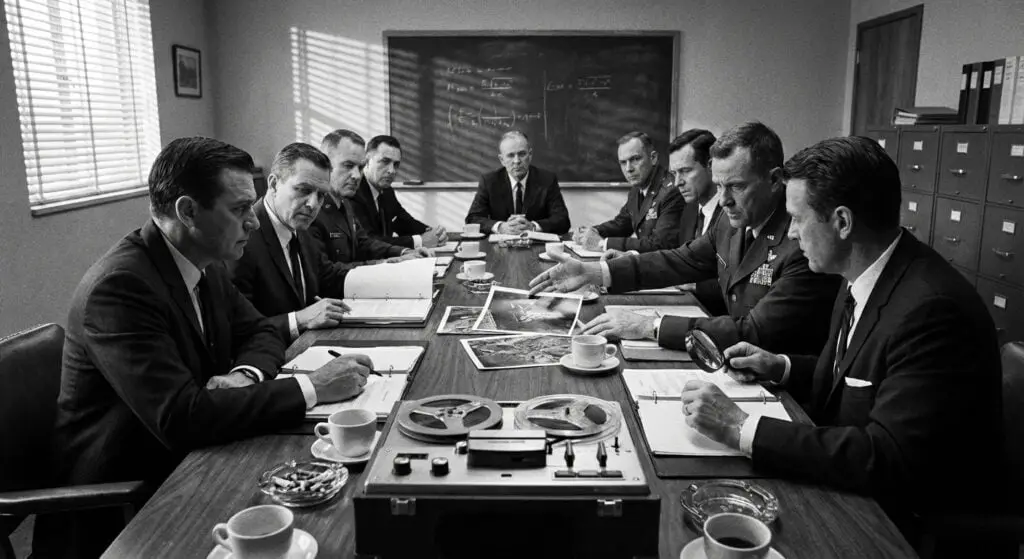
Every “new” UFO disclosure or UAP disclosure flare-up collapses into the same argument within hours: one side hears “independent review” and expects hard science; the other hears the same phrase and sees a managed narrative with better branding. You can watch it happen in real time across UFO news and UAP news cycles, regardless of what the underlying incident is.
The pressure on you as a reader is practical, not philosophical. When an official study is announced, you have to decide what to do with the headline: treat it as genuine transparency, or treat it as a credibility exercise designed to end the conversation. That decision shapes everything else, from which sources you trust to which details you dismiss as noise.
The template for that trust fight was set in one move that still hasn’t stopped echoing: the U.S. Air Force funded an “independent” university study of UFO reports. The University of Colorado UFO Project, better known as the Condon Committee, ran from 1966 to 1968 and operated under an Air Force contract set at $325,000 (Condon Report, Univ. of Colorado / DTIC). The word “independent” did the heavy lifting. It promised autonomy and rigor, while also carrying the unavoidable friction of sponsor-funded science: the same institution seeking public reassurance also controlled the money.
That tradeoff is why this episode keeps resurfacing whenever alien disclosure claims spike or government UFO cover-up arguments heat up. People aren’t relitigating the 1960s for nostalgia. They’re reaching for the closest precedent to today’s core question: what does “independent” actually mean when the sponsor has a stake in the outcome?
The public record does not include a clear, single text of an initial press release that launched the Colorado project as a standalone marketing document; the primary official materials available are the contract and the multi-volume Condon final report (Condon Report, DTIC; Condon Report, The Black Vault).
This post gives you a usable lens: what happened, what the project was at a high level, and why “Air Force-funded independence” remains the reference point for judging modern UFO disclosure and UAP disclosure claims.
The pressure cooker of 1966
1966 forced the Air Force into a legitimacy contest it could not win with internal messaging. The issue was no longer whether individual sightings had prosaic explanations; it was whether the institution controlling the explanations deserved to be believed. That shift in stakes is what made an external scientific review the only move with a chance of resetting public confidence.
- Amplify public attention: the 1966 Michigan sightings did not stay local. The “swamp gas” episode in the Dexter-Hillsdale area occurred on March 20 and 21, 1966 and generated significant publication interest, helping turn UFO reporting into a national story with a fast feedback loop: more headlines, more reports, more demands for answers (Bentley Historical Library, Univ. of Michigan; Wikipedia: Michigan “swamp gas” UFO reports).
- Trigger political scrutiny: Congress treated the controversy as more than tabloid noise. A Congressional UFO hearing was held on April 5, 1966 before the House Armed Services Committee; the official hearing record and transcript document J. Allen Hynek’s testimony that day (House Armed Services Committee hearing transcript, April 5, 1966).
- Convert explanations into backlash: in 1966, J. Allen Hynek suggested “swamp gas” as a likely explanation for the Michigan sightings. The phrasing drew national attention and then snapped into open backlash, with strong negative reactions aimed at Hynek and the Air Force and with members of Congress pressing for scrutiny (Bentley Historical Library, Univ. of Michigan).
Project Blue Book was the credibility bottleneck because it was the long-running Air Force program that collected and evaluated UFO reports while also serving as the public-facing voice of “case closed.” Its stated objectives included determining whether UFOs posed a threat to U.S. security and the records of that program are part of the National Archives holdings on military UFO investigations (National Archives: UFOs and the U.S. Air Force; USAF Project Blue Book objectives and records).
By early 1966, the pressure was visible inside government as well: internal briefings and committee agendas show the issue had moved into formal “what do we do about this” territory. In that environment, an outside scientific verdict was not a luxury. It was the only credible way to separate “the Air Force’s conclusion” from “a conclusion the public might accept.”
The practical diagnostic for today’s debates is straightforward: when the institution commissioning a review is also the institution whose credibility is on trial, independence becomes the central question. If the review cannot credibly contradict the sponsor, it will not restore trust, no matter how technical the final report sounds.
That is the context the Colorado project inherited: a public already primed to treat official explanations as performance, and a government looking for a verdict that could travel farther than Blue Book ever could.
Bias claims and credibility fractures
The committee’s lasting impact is less about any single UFO report and more about a rupture in trust over process. Even among readers who accept the project’s headline conclusion, the fight never really ended because the argument shifted from “What did the sky contain?” to “Was the outcome managed?” That process question is why the committee became a permanent credibility battleground, not just another government-funded study.
Critics don’t need to relitigate individual cases to make their point. Their allegations cluster into three process claims. First, a predetermined-conclusion narrative: they argue the committee functioned as confirmation, aiming to validate a “nothing to see” posture rather than genuinely test competing explanations. Second, selective framing: they argue ambiguity was treated asymmetrically, with conventional explanations granted benefit of the doubt while anomalous interpretations were held to a higher standard of proof in write-ups and summaries. Third, internal dissent: they argue disagreement inside the project signaled more than normal scientific debate, reflecting tension over how results were characterized publicly versus how uncertain edges were handled privately. These are categories of critique; nailing down who said what, when, and in which document requires primary, citable records.
The “Trick Memo” dispute sits inside this same bias argument as a sourcing and interpretation flashpoint. No verified primary-source text of the so-called “Trick Memo” has been located in public archival collections cited in the Condon corpus and related Air Force records, so claims that rely on that memo require a provenance chain before being treated as established evidence.
Defenders frame the same dynamics as normal scientific friction under public pressure. Disagreement among researchers is expected when data quality is uneven, witness reports vary, and instrumentation is inconsistent. More importantly, they draw a bright line between concluding a line of inquiry is “not promising” and claiming “nothing happened.” The committee’s core posture can be read as methodological caution: an insistence that extraordinary claims require clear, reproducible evidence, especially when conclusions could ripple into policy and public anxiety. Under that reading, critics are mistaking skepticism for pre-commitment.
The distrust hardens because there is a documented precedent for official panels shaping the narrative space. The Robertson Panel, a CIA-convened Scientific Advisory Panel that met January 14 to 18, 1953, issued a report and recommendations that influenced later government and media handling of UFO reports (Robertson Panel report, CIA Reading Room).
If you want to evaluate sensational documents like the “Trick Memo” without getting played, use a provenance-first test:
- Identify the earliest verifiable appearance: archive, box, folder, scan metadata, or publication record.
- Date it from primary markings and corroboration, not from retellings or copied excerpts.
- Contextualize the intended audience and purpose (draft, briefing, personal note, official memo) using surrounding records.
- Verify the chain: who held it, who reproduced it, what is missing, and whether independent repositories match.
Until that chain exists, treat viral “gotcha” memos as leads, not verdicts.
Those process disputes are loud, but they can also obscure something simpler: what the committee actually did when it sat down with reports, witnesses, and records.
What the study examined
The committee’s real product was not “answers.” It was a disciplined way to grade messy reports against the evidence actually available, and to record uncertainty as a legitimate end state rather than forcing a clean story. That discipline shows up in how the Condon Report is built: “Field Studies” sit in Section III (including Chapters 1, 3, and 4), while reports of field investigations are presented in Section IV. Section III, Chapter 1 (“Field Studies”) is explicit about presenting cases as field case reports and about the practical headache investigators faced most often: conflicting information (Condon Report, DTIC).
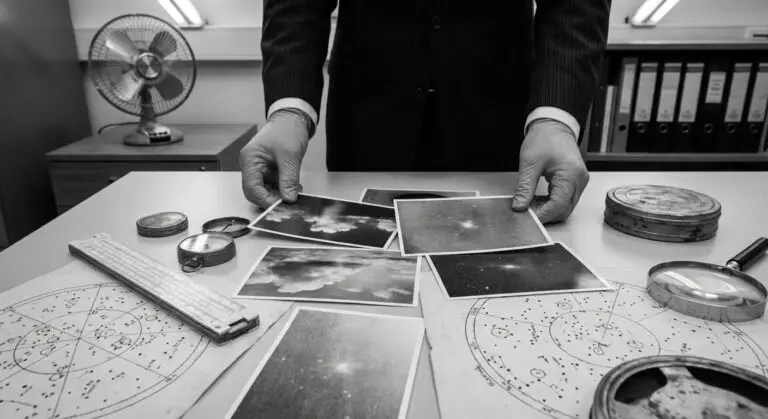
Cases did not arrive as tidy lab experiments. They arrived as letters, phone calls, secondhand summaries, and referrals from military or civilian channels, each with different levels of time-stamping, documentation, and access to primary witnesses. That intake reality is the first reason report quality varies inside the same project: one file might include names, locations, weather context, and original photos, while another amounts to a few sentences retold days later.
Section III’s “Field Studies” structure makes that unevenness visible because it treats each incident as a data packet with known gaps, not as a vote on what “really” happened. Section III, Chapter 1 even flags situations where statements conflict, which is exactly what you expect when multiple observers reconstruct a brief event after the fact, sometimes after talking to each other.
Field work, as reflected across Section III’s field-study chapters and the field investigation reports in Section IV, is procedural: identify the core claim, identify the primary sources, and then try to break the claim by checking it against the environment and records. That typically meant interviewing witnesses directly, documenting who said what and when, and capturing contradictions rather than smoothing them over. Conflicting descriptions are not a footnote in this kind of work; they are evidence about how reliable the narrative is.
Investigators also had to treat “instrumental” claims with the same skepticism they applied to human memory. A radar claim is not automatically stronger than testimony because radar can produce returns that depend on operating mode, reporting practices, and interpretation by the operator. Likewise, a photograph is not self-validating. The key questions are chain of custody (who handled it), provenance (when and where it was captured), and whether the image contains enough reference information to constrain size, distance, and motion. Site visits and follow-up interviews add another layer: checking sight lines, lighting conditions, local aircraft activity, and whether later retellings drifted from the earliest account.
Inside this workflow, “unidentified” is not a synonym for “non-human intelligence.” It is a statement about the record: after analysis, the committee could not make a specific identification with the information in hand. “Insufficient information” is even more blunt: the file lacks the minimum detail needed to test hypotheses, so the correct output is not mystery, it is an evidence failure.
The report also contains outcomes that are effectively “explained” in the practical sense: the available evidence supports an identification or a mundane mechanism consistent with the observations. Just as importantly, some cases remain unresolved because witness accounts conflict, key timing is missing, imagery lacks calibration, or instrumentation claims cannot be verified back to original logs. Uncertainty enters the record through those gaps, and the methodology treats that uncertainty as reportable, not embarrassing.
For a concise quantitative snapshot, see the report’s “Summary of the Study” (Section II). The final report states that it reviewed more than 10,000 sightings recorded and classified over a 19-year period and presents a focused summary table for the project’s detailed case work: Table 1 summarizes the final disposition of 35 cases examined in depth (see Section II, p. 11 and the table in the DTIC copy of the report) (Condon Report, Section II; DTIC).
A case that remains “unidentified” is a prompt for better collection, not a license to declare alien disclosure. If you want UAP claims to survive contact with serious review, demand the basics that prevent uncertainty from being the default outcome.
- Capture timestamps down to the minute, with time zone and duration, so records checks are possible.
- Use calibrated sensors (or document settings) so “what the instrument saw” is reproducible.
- Preserve chain of custody for photos and video, including original files and metadata, not screenshots.
- Document context (location, sight lines, weather, nearby airports) so ordinary explanations can be tested.
- Seek corroboration from independent observers and independent systems, not a single shared story.
That investigative posture – treating uncertainty as an output and demanding better inputs – also helps explain why the final language landed so cleanly in Washington.
The conclusion that closed Blue Book
The Colorado study did not just review UFO reports. It created an institutional exit ramp: a scientifically framed conclusion that could be translated into an administrative decision without re-litigating individual sightings case by case.
The Condon Report’s bottom line was blunt: further study of UFO reports is not likely to advance science. In a bureaucracy that had spent years absorbing political heat for ambiguous files, that sentence functioned like a stop order (Condon Report, DTIC).
The report also carried a nuance that rarely survived the headlines. It explicitly warned that “Scientists are no respecters of authority,” and that “Our conclusion that study of UFO reports is not likely to advance science will not be uncritically accepted by them” (Condon Report, DTIC).
Public discourse compressed that two-part message into a single takeaway: “science said UFOs aren’t worth it.” The nuance about scientific skepticism, and the possibility of continued disagreement over specific cases, was not the part that traveled. The portable version was the most administratively useful one.
That portability mattered because the U.S. Air Force did not end Project Blue Book in a vacuum. Its official rationale for discontinuing UFO investigations explicitly cited its evaluation of the University of Colorado report, the Condon Report. Project Blue Book was terminated on December 17, 1969; at the program’s close the Air Force reported 12,618 sightings recorded from 1947 to 1969 and noted 701 cases remained unexplained at termination (National Archives: Project Blue Book summary; USAF termination memorandum and statistics).
A “not worth further study” conclusion, wrapped in scientific language and then embedded in an official termination decision, becomes a durable rhetorical weapon. In later UFO disclosure debates, it gets deployed as a conversation-ender: not a claim about a specific incident, but an institutional permission slip to stop looking.
The practical way to read that kind of claim is to interrogate what it conveniently supports. Ask what data was actually available, what constraints shaped the evaluation, and what decision the conclusion enabled. You learn more by tracing the policy use of the conclusion than by arguing over whether every file in the archive was resolved to everyone’s satisfaction.
Why it matters in 2025 and 2026
Modern UAP disclosure fights in 2025 and 2026 repeat the Condon-era argument almost exactly: independence is the battleground. The dispute is less about any single sighting and more about governance: who controls the data, who can speak without career risk, and whether an “independent” body can actually see the relevant material and publish what it finds.
Independence is not a label; it is a set of permissions. The Condon setup taught readers that “outside” work can still be structurally dependent if the sponsor controls scope, access, and timelines. The modern echo is obvious: every new proposal rises or falls on whether investigators are operationally independent, not rhetorically independent.
Access is the first choke point. If the body doing the review cannot compel production across programs and contractors, the public gets a debate about credibility instead of a contest over records. Independence without enforceable access is a press release, not oversight.
Classification is the second choke point. The classification system is a real national security tool, but it also functions as an information gate. That creates an inherent asymmetry: officials can claim “we looked” while outside audiences cannot verify what was actually reviewable or releasable.
Credibility is the output of the first three. When audiences distrust the process, they start litigating motives. When the process is legible, the argument shifts to evidence quality, where it belongs.
Two current trust mechanisms target those choke points directly. First, whistleblower pathways. The enacted James M. Inhofe National Defense Authorization Act for Fiscal Year 2023 (Public Law 117-263) and related statutory language include a carve-out for authorized disclosures; for example, Section 1673(b)(1) states that an authorized disclosure “shall not be subject to a nondisclosure agreement entered into by the individual who makes the disclosure” (see Public Law 117-263, James M. Inhofe NDAA for FY2023; see also a DoD FOID summary of FY2023 UAP reporting provisions at DoD FOID summary (23-F-0241)).
Second, records control. Senator Schumer’s amendment text introduced in the Senate (see Senate Amendment 2610, “Unidentified Anomalous Phenomena Disclosure Act of 2024”) proposed creating an Unidentified Anomalous Phenomena Records Collection at the National Archives and establishing an independent review board to evaluate and declassify records (Senate Amendment 2610 text). That amendment text was proposed to consolidate custody and standardize review. Reporting on the FY2024 NDAA process indicates the final enacted package kept some related oversight and reporting mechanisms while other proposed language was revised or removed during negotiations (analysis of UAP amendment in FY2024 NDAA; Schumer amendment text).
AARO (All-domain Anomaly Resolution Office) sits inside this same design fight because it is the statutory node for reporting and synthesis. The AARO Historical Record Report: Volume 1 (cleared for open publication March 6, 2024) is publicly available as an unclassified PDF from the Department of Defense prepublication repository (AARO Historical Record Report, Volume 1 (2024), media.defense.gov) and the AARO site lists its congressional and press products (AARO: Congressional and Press Products).
- Ask what data the authors could actually access, across compartments, contractors, and legacy holdings.
- Check who has publication control, including what must remain classified and who decides that boundary.
- Verify what protections exist for reporting, including the FY2023 NDAA 1673(b)(1) NDA carve-out and whether the channel is usable in practice.
- Identify the oversight mechanism, such as a National Archives collection model and any independent review board authority to compel, review, and release.
Lessons for reading official UFO studies
The enduring lesson of 1966 isn’t whether any single sighting was “real,” it’s how official studies earn or lose legitimacy. Public trust cracked under credibility pressure, from congressional scrutiny to the swamp gas backlash, because the argument stopped being about lights in the sky and became about whether the process deserved belief.
That brings the story back to the word that did so much work in the beginning: “independent.” The Condon era shows that “independent science” inside a government-funded project always runs through operational choke points: security-clearance rules can bar personnel from classified access, classified work triggers mandatory compliance with federal security clauses, contract structures can formalize what gets produced as deliverables, and uniform mechanisms like DD Form 254 exist precisely to control classified handling. Independence is real, but it is bounded.
It also shows that uncertainty is not a flaw to hide, it’s a category to record. The Condon Report’s definition is procedural: a UFO is “the stimulus for a report made by one or more individuals of something seen in the sky.” When “specific information describing an unidentifiable object is presented,” the report says reliability must be evaluated and corroboration sought (Condon Report, DTIC). That framing forces a discipline: separate conflicting information from insufficient information, and treat both differently from a strong, corroborated record.
Finally, the same conclusion that reads as a scientific summary can function as an institutional off-ramp. The Condon Report even flags its own limits, noting its conclusion might not be uncritically accepted by the scientific community. That is permission to keep scrutinizing the next official claim, not a reason to stop.
- Trace data control: Who owns the raw sensor data, and who can deny access?
- Demand evidentiary thresholds: What counts as “good enough” to identify or rule out?
- Require corroboration: Are claims cross-checked across independent sources (radar, EO/IR, logs, witnesses)?
- Audit uncertainty labels: Are cases explicitly tagged as conflicting vs insufficient vs unidentified, with reasons?
- Expose publication constraints: What was withheld for classification, contract terms, or clearance, and how much?
- Clarify oversight: Who can challenge findings, compel documentation, and publish dissent?
Credible transparency in the next wave of UFO news and UAP news means three things, every time: high-quality data you can interrogate, uncertainty stated plainly instead of laundered into certainty, and governance designed so the system can’t be gamed by selective access, selective labeling, or selective release.