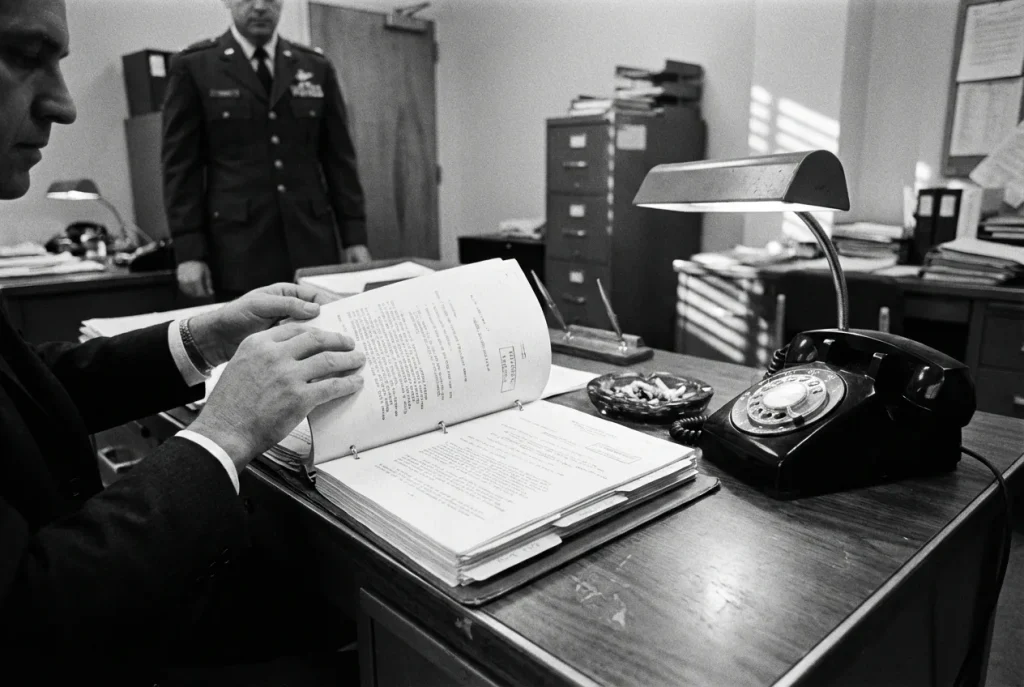
In the mid-1960s, public interest in “flying saucers” and a steady stream of reports to the U.S. Air Force (USAF) created pressure for a more rigorous scientific assessment of UFO reports. Although the Air Force had already been investigating sightings under Project Blue Book , critics argued that the program lacked scientific credibility and that its conclusions were not persuasive to the public.
To address that credibility gap, the Air Force sponsored an independent study at the University of Colorado, led by physicist Edward U. Condon—commonly called the “Condon Committee.” The committee reviewed selected cases and the broader question of whether UFO reports warranted additional, government-funded scientific investigation. The study ran primarily from 1966 to 1968 and culminated in the publication of Scientific Study of Unidentified Flying Objects (1968), widely known as the “Condon Report.”
The “policy shift” refers to the U.S. Air Force’s practical decision—based largely on the report’s conclusions—to end its formal, ongoing UFO investigative role. In concrete terms, this meant the Air Force moved to discontinue Project Blue Book, and it publicly stated that further systematic study of UFO reports was not justified on national-security or scientific grounds.
-
What was the 1968 Condon Committee study about?
The Condon Committee was a USAF-sponsored, University of Colorado study (conducted mainly 1966–1968) that evaluated whether UFO reports warranted further scientific investigation. Its work was published as Scientific Study of Unidentified Flying Objects (1968)—the “Condon Report”—edited by Edward U. Condon and released through the University of Colorado/US Government Printing Office.
Condon Report (archived text and supporting material via NCAS) | Historical overview (Condon Committee, Wikipedia)
-
Why is the Condon Committee report important in UFO disclosure discussions?
Historically, the Condon Report mattered because it became the major scientific-style review most often cited by the U.S. Air Force when it concluded that further government-funded UFO study was unlikely to produce useful scientific knowledge or national-security value. In “disclosure” debates, it is frequently referenced as the document that helped justify the government’s retreat from a standing, public-facing UFO investigation program at the end of the 1960s.
Primary source: Condon Report text (NCAS archive)
-
How did the 1968 Condon Committee study affect official UFO research policy?
After the Condon Report was released in 1968, the U.S. Air Force cited its conclusions as a basis for ending its long-running UFO investigative program. In 1969, the Air Force announced it would discontinue Project Blue Book and stop routine investigation of UFO reports, stating that: (1) UFOs studied to date did not pose a threat to national security, (2) there was no evidence UFOs represented technology beyond modern scientific knowledge, and (3) further study was unlikely to yield major scientific discoveries. In practical terms, official USAF funding and posture shifted away from maintaining a dedicated, continuing public UFO research project, and Project Blue Book was wound down and closed.
Credible sources: U.S. National Archives: Project Blue Book records | Project Blue Book (historical summary)
-
Is the Condon Committee study relevant to UAP news and UAP sightings today?
Yes. Even though today’s discussions often use “UAP” rather than “UFO,” the Condon Committee study remains relevant as a historical benchmark for how and why the U.S. Air Force reduced and ultimately ended a formal public UFO investigation program. Modern UAP reporting can be better understood by knowing that, after 1968–1969, there was no longer a standing Air Force program equivalent to Project Blue Book that routinely collected and investigated civilian sighting reports.
-
What does the article connect to government UFO cover-up or alien disclosure claims?
Documented history: the Condon Committee was a publicly known, USAF-sponsored study whose final product (the Condon Report) was published and widely distributed, and the Air Force later used its conclusions when discontinuing Project Blue Book. Those are matters of record, and the report itself can be read in full.
Speculation vs. evidence: claims of a coordinated “cover-up,” “alien disclosure,” or confirmed “non-human intelligence” go beyond what the Condon Report establishes. The report does not provide verified proof of extraterrestrial craft or beings; rather, it evaluates the scientific value of continued UFO study based on the cases the committee examined. Readers should distinguish between (a) declassified archival records and official statements and (b) interpretive or speculative claims that are not supported by primary documentation.
Primary/credible sources: Condon Report (full text archive) | National Archives: Blue Book and related UFO records
-
What should you look for in forward-looking UAP/UFO coverage that references the Condon Committee?
When a new article or broadcast invokes the Condon Committee, check for concrete, verifiable markers:
(1) Direct citations to the 1968 Condon Report (title, editor Edward U. Condon, and quotations tied to specific sections/pages).
(2) Accurate dates : study period (mainly 1966–1968), report publication (1968), and the 1969 Air Force decision to discontinue/wind down Project Blue Book.
(3) Clear attribution of sponsorship: the study was sponsored by the U.S. Air Force but conducted at the University of Colorado.
(4) Distinction between claims and records : official statements and declassified archives (e.g., National Archives Blue Book files) versus unverified assertions about “disclosure” or non-human intelligence.
(5) Agency statements and documents : links to official repositories (National Archives) or other primary documents rather than unnamed sources.
Useful starting points: U.S. National Archives: UFO/Project Blue Book records | Condon Report (text archive)
