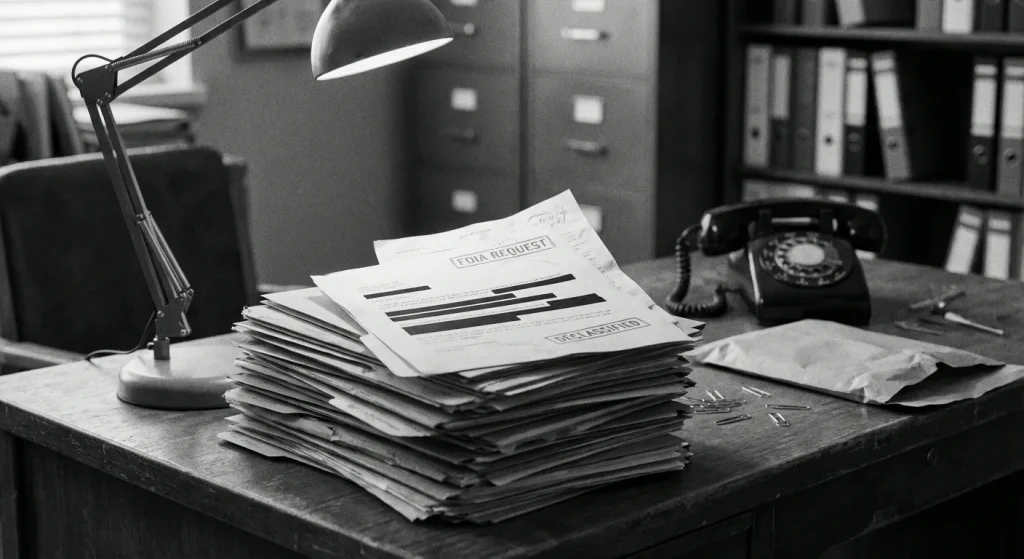
You keep seeing the same line recycled in UFO news and UAP news: “the CIA released 800 pages in 1978.” Then the details collide: one post says “hundreds,” another swears it was “forced out,” and most of them wave around the same low-resolution screenshots instead of a record you can check.
The decision is straightforward: treat “1978” as evidence of non-human intelligence, or treat it as a case study in how declassification actually travels through the internet. Those are different claims, and they require different standards of proof.
The tension is disclosure-by-records versus disclosure-by-narrative. Records are verifiable objects with identifiers, dates, and page counts. Narratives are packages: “800 pages,” “forced out,” “vault cracked.” Once the packaging takes over, the same event can be retold to imply anything from routine transparency to “alien disclosure.”
Your baseline for verification is the CIA FOIA Electronic Reading Room, the CIA’s primary official online repository for released records: https://www.cia.gov/readingroom/home. Start with what the CIA itself lists. For example, a CIA Reading Room entry with identifier or FOIA number 0000015340 shows a release date of October 5, 1978, and that specific record entry is listed as 6 pages long.
That is why page counts splinter in secondary retellings. Some descriptions collapse 1978 into “hundreds of pages,” while other secondary figures point to a much larger CIA UFO document corpus across time, often cited around 2,780 pages. The number changes with the tranche or collection being counted, not with the story being told.
You will leave able to verify CIA document claims and separate “unknown” from “proven.” To do that, you also need to understand why a release happens at all-because “the CIA released it” and “the CIA was compelled to release it” are not the same event.
How FOIA forced CIA transparency
FOIA only becomes decisive when it creates consequences for noncompliance. Routine requests can be slow-walked, narrowed, or answered with heavy redactions, but FOIA pressure, especially when escalated into litigation, forces an agency to run an accountable search and defend each withholding in a way that stands up in court. That enforcement posture is the real reason releases like the CIA’s 1978 UFO tranche happen at all, because the agency has to move from discretionary “we’ll get to it” to legally testable obligations.
The Freedom of Information Act (FOIA), codified at 5 U.S.C. § 552, is a U.S. law that gives the public a right to request records from federal agencies, but only to the extent those records are not covered by specific exemptions. The leverage is procedural: you are not asking for a favor, you are triggering a process with deadlines, appeal rights, and, if necessary, a judge.
- Request records from the agency that is reasonably likely to have them, with a scope that can actually be searched (topics, date ranges, offices, record systems).
- Receive an agency determination, which can be a release, a partial release with exemptions and redactions, a “no records” response, or a non-response that functions as a constructive denial.
- Appeal administratively inside the agency, challenging the search, the withholdings, or the failure to meet FOIA’s requirements.
- File in federal district court after remedies are exhausted (or constructively denied), turning the dispute into a FOIA lawsuit, meaning a federal court case seeking an order that the agency search for and release responsive records as required by FOIA.
FOIA litigation does not ask a court to rule on whether a document’s claims are “true.” It asks whether the government followed the law. In practice, three pressure points matter because they are enforceable: the adequacy of the agency’s search, the requirement to produce responsive non-exempt material, and the requirement to justify each exemption it invokes.
Search adequacy is where “we looked and found nothing” stops being a conversation and becomes a record. Agencies have to explain what systems were searched, using what terms, and why that was reasonably calculated to find responsive documents. That requirement is uniquely consequential for intelligence agencies, where records are fragmented across components and where the instinct is to limit exposure by limiting the search.
On withholdings, courts require the agency to connect redactions to statutory exemptions. FOIA Exemption 1 (b)(1) permits withholding information properly classified for national defense or foreign policy under an executive order, which is why national-security releases frequently contain thick blocks of redaction even when the subject matter feels innocuous. Intelligence releases also commonly invoke Exemptions 6 and 7(C) for privacy-related redactions, covering identifying information about individuals that has no business being broadcast in a public release.
The same dynamic applies to operational equities. When an agency takes the position that certain disclosures would reveal previously unacknowledged presences or liaison relationships, that is not “mystery,” it is a predictable litigation posture built around protecting sensitive relationships and methods, and it will be defended as such in the exemption record.
The 1978 release did not occur in a vacuum. Post-Watergate, the 1974 FOIA amendments significantly strengthened disclosure obligations and the ability to challenge withholdings, shifting leverage from agency discretion toward requester enforcement. That period also produced a broader accountability climate, where courts and Congress were more willing to scrutinize secrecy claims and require agencies to show their work.
You can see the institutional reality behind that conflict in the era’s classification apparatus itself, including CIA-internal work on classification practices by the mid-1970s. A transparency statute with sharper teeth, paired with agencies that were actively managing classification, is exactly the environment where litigation-driven releases become more plausible than voluntary disclosures.
Read any CIA UFO release through that lens. A release is not an endorsement of the underlying content, and a redaction is usually the ordinary operation of national security and privacy rules, not a coded confession. The actionable takeaway is simple: expect released UFO files to reflect what is legally releasable under a defined search and enumerated exemptions, not what is most narratively satisfying, and judge the record accordingly.
What those 800 pages contained
FOIA explains the “how”; the documents answer the more practical question of “what, exactly, did that pressure produce?” The quickest way to get oriented is to treat the file set as a record of intelligence handling rather than a curated set of solved cases.
These files show how intelligence work treats UFO reports: as inputs to be triaged, not revelations to be announced. The real value in the CIA’s UFO document releases sits in the plumbing, not the punchline. You learn what gets captured as a report, how it gets routed, what language analysts use when they do (and do not) evaluate a claim, and how uncertainty is preserved in the record. If you go hunting for a single “smoking gun,” the paperwork will disappoint you. If you want to see the reporting pipeline and the Agency’s analytical handling, the paperwork is exactly the point.
Most pages in these collections read like office work because they are office work: memos, cables, summaries, analytical notes, and enclosures that may include press items or excerpts. The easiest way to orient yourself is to treat the page as a record with metadata signals. Dates matter because they tell you whether you’re reading a contemporary report or a later retrospective summary. Addressees matter because “to” and “cc” lines often reveal whether a UFO item was treated as an operational concern, an analytic curiosity, or simply something to be tracked. Routing and handling marks matter because they show internal movement: who touched it, who filed it, and whether someone flagged it for further action or simply acknowledged receipt.
Those cues are also where readers get misled. A stamped marking or a distribution list can look like gravitas, but it is often just bureaucratic hygiene. A cable format can look “official” in the way people mean “verified,” but cables are designed to move information fast, not to certify it true. The trick is to read the document as a snapshot of process: what was reported, to whom, and with what stated level of confidence.
Many documents in CIA UFO file collections concern CIA cables reporting unsubstantiated UFO sightings in foreign press, plus intra-agency memos about how the Agency handled them. That mix is the strongest clue to what the collection is and is not. It is not a curated dossier of solved cases. It is an accumulation of incoming claims and the internal mechanics of tracking them: forwarding, filing, requesting context, and occasionally commenting on how to treat recurring reports.
The friction is that “the CIA has a document about X” is frequently treated as “the CIA concluded X.” In this file set, the more common reality is “the CIA received a report that someone else published X” and then recorded how it was handled. When you see foreign press as the originating context, the action you can take as a reader is simple: separate the underlying claim (a sighting story) from the CIA’s act (recording and routing the story). Those are different evidentiary categories, even when they sit on the same page.
Even in a collection dominated by reporting and handling, a few anchors recur because they connect the paperwork to named moments and named interpreters. The released material includes a direct reference to the “Robertson Panel,” and one item characterizes it as “the beginning of the end for Project Blue Book and objective UFO research.” That line gets cited because it is not a mere sighting relay; it is an explicit framing of institutional trajectory, tying a policy-relevant review to the narrowing of what counted as “objective” inquiry inside official channels.
A second anchor is the appearance of J. Allen Hynek and Jacques Vallée, including a citation to their 1974 work “The UFO Experience.” That matters because it shows the file set is not sealed off from public UFO literature; it intersects with the same authors modern readers already treat as canonical. The inference you can make is limited but real: someone inside the orbit of these records was aware of, and referenced, Hynek and Vallée’s published synthesis. What you cannot make from a citation alone is the leap to “the Agency endorsed their conclusions.” A citation establishes contact with an argument, not acceptance of it.
The third anchor is the way these references get reused as shorthand in later debates. A single phrase about Blue Book’s “end” and a single bibliographic pointer to “The UFO Experience” are easy to screenshot and circulate because they look like admissions. In the documents, they function more like coordinates: a pointer to where the conversation was situated, not proof that the conversation reached a definitive institutional conclusion.
The cleanest way to read this material is to apply inference discipline. A record that says “reported” is evidence that a report existed and was transmitted; it is not evidence that the underlying event happened as described. An internal memo showing interest is evidence of internal attention; it is not evidence of institutional belief. A routing slip showing distribution is evidence of circulation; it is not evidence of validation. When the text shifts from relaying a claim to evaluating it, the language usually shifts too, and that is where you should slow down and separate descriptive recitation from analytic judgment.
Removed text is the other place readers overreach. “Redaction” means text removed from a released document, typically marked with the legal basis for withholding, and that label should force you into narrower, not broader, speculation. A redaction is an unknown, not a hidden confirmation. The only defensible inference is that something met a withholding standard in the release context; you cannot truthfully infer what the missing words say, and you definitely cannot treat the absence itself as proof that the withheld content was extraordinary.
- Identify what the document is: cable, memo, summary, or analytical note. Format tells you whether it is built to transmit claims or to evaluate them.
- Locate the source of the underlying allegation. If it traces back to foreign press, treat it as an unsubstantiated report unless the document adds verification steps.
- Separate handling from conclusions. Routing, distribution lists, and filing marks demonstrate movement of information, not endorsement.
- Quote the verbs, not the nouns. “Reported,” “alleged,” “according to,” and “unconfirmed” carry more evidentiary weight than “UFO” in a subject line.
- Treat redactions as unknowns. If the claim depends on what is missing, the document does not support the claim.
Before you accept any “CIA confirms” framing, force the document into one of three buckets: reporting a claim, evaluating a claim, or merely filing a claim. The collection’s enduring relevance to disclosure arguments comes from how often that basic distinction gets blurred, even though the paperwork itself keeps trying to preserve it.
Public reaction and enduring myths
The 1978, FOIA-driven CIA UFO release of roughly 800 pages is a case study in how ambiguity manufactures myths. When a declassified packet contains real Agency paper but thin, secondhand content, readers can project certainty into the gaps and walk away with opposite conclusions that feel equally “supported.”
In 1978, journalists, researchers, and skeptics often walked away with different headline truths from the same packet. Because so much of the material fits the reporting-and-handling pattern described above, some coverage treated it as a paper trail of incoming claims while other coverage framed it through a government cover-up narrative. That single tension explains a lot of the long tail: one reader sees “paper trail of reports,” another sees “paper trail of concealment.”
The friction is structural. A cable can be authentic government paperwork and still be an evidentiary dead-end on the question people actually care about. If your prior is “they’re hiding craft,” administrative handling reads like suppression. If your prior is “agencies log noise,” the same routing and filing reads like routine triage. The release doesn’t settle the argument; it supplies more material for it.
Redactions and partial releases turn motive into the main character because the reader can’t see what was excluded. The CIA itself treated classification as a serious internal problem, including a 1976 Center for the Study of Intelligence monograph titled “Secrecy vs. Disclosure: A Study in Security Classification,” and the existence of that kind of work underscores the bureaucratic reality: many withholdings are about process and protection, not about validating extraordinary claims.
That dynamic isn’t hypothetical. Official history shows the CIA sometimes declined to clear documents specifically to avoid disclosing previously unacknowledged CIA presences or liaison relationships with foreign intelligence services. That kind of withholding is about sources, methods, and partnerships, not about “non-human” proof, but it predictably trains audiences to treat missing context as intentional misdirection.
Distrust accelerants also mattered. Longstanding allegations that the CIA influenced media narratives, including claims about paying journalists and planting stories, gave conspiracy-minded readers a ready-made frame for interpreting the 1978 release as perception management. Use that context to understand the reaction, not to launder it into evidence of a UFO-specific program.
A CIA reading-room document states that U.S. government disinformation has been used on a relatively widespread basis to build public acceptance for certain policies. Treat that as a cautionary lens: it justifies skepticism toward viral narrators and overconfident summaries. It does not, by itself, prove a UFO deception campaign.
- Start at the top of the sourcing chain. Prefer primary documents; then official transcripts; then reputable reporting; treat screenshots and influencer summaries as leads, not evidence.
- Check provenance like evidence. Who held the document, when, and how did it move? If chain-of-custody is unknown, treat any conclusion as a claim, not a fact.
- Quote-check against the original. Match the exact sentence and surrounding paragraph, and look for omitted qualifiers, footnotes, and bracketed edits.
- Separate “unknown” from “non-human intelligence.” “Unknown” describes an unresolved identification problem, not an identified origin.
- Demand independent corroboration. One memo plus one narrator is a story; multiple independent records pointing the same direction is evidence.
Actionable takeaway: treat every viral “disclosure” as a sourcing problem first, not a belief test. Pull the primary record, run the checklist, and only then decide whether the claim deserves your time or your amplification.
From 1978 to today’s UAP fights
The same ingredients that shaped the 1978 reaction-partial records, heavy inference, and fast-moving narrative packaging-also shape the modern UAP debate. The vocabulary has shifted, and the institutions have been reorganized, but the evidentiary problem is recognizably the same.
Today’s UAP disclosure debate is a systems fight, not a single revelation. The pattern is familiar: public pressure demands records and clarity; institutions answer with constrained releases, tightly scoped reports, and language designed to limit what can be inferred. The friction is structural. Disclosure is treated as an information management problem, so the output is almost always partial, qualified, and framed to control interpretation.
That same dynamic now plays out across a larger ecosystem than the FOIA era alone: congressional hearings generate quotable lines, official offices centralize intake and messaging, and media amplification turns fragments into narratives faster than primary records can be checked. The result is heat without reliable consensus, unless readers enforce their own discipline about what counts as evidence.
“Unidentified anomalous phenomena (UAP)” is the government-preferred umbrella term for observed phenomena not immediately identified, without implying an extraterrestrial origin, and that word choice is doing real work. “Unidentified” describes a knowledge gap, not an answer. Treating UAP as synonymous with “alien craft” is how public interpretation outruns the actual claim being made, and it is exactly how ambiguity survives every news cycle.
Institutionally, the center of gravity is the All-domain Anomaly Resolution Office (AARO), a U.S. Department of Defense office tasked with coordinating aspects of UAP reporting and analysis across domains. Centralization has a clear upside: one office can standardize intake, triage cases, and publish bounded conclusions. The catch is just as clear: when one office becomes the funnel, its scope statements, definitions, and release policies become the practical limits of “disclosure,” regardless of what the public wants.
Hearings add something FOIA alone cannot: sworn testimony in a public venue, with members able to ask direct questions and build an official record. The tradeoff is that hearings are optimized for statements, not for authentication. A compelling claim can be newsworthy and still be unverified, especially when supporting materials are classified, withheld, or never entered into the record.
David Grusch’s public testimony is a clean example of why this distinction matters. He testified that he has not personally seen alien vehicles or bodies and that he relies on accounts from over 40 witnesses. That is secondhand testimony by his own description. It can justify investigation, but it is not itself verified evidence of what was described to him.
Luis (Lue) Elizondo is described publicly as a former military counterintelligence officer associated with AATIP; he resigned in 2017 as a senior intelligence official tied to a Pentagon UAP effort. Those are credential claims about role and proximity. They do not, by themselves, validate any specific extraordinary assertion unless the underlying documents, materials, or corroborated firsthand records are produced.
- Separate firsthand evidence (photos, sensor data, documents) from secondhand testimony (someone reporting what others told them) and from speculation (interpretations without source material).
- Read primary records before summaries; a full transcript of the House UAP whistleblower hearing has been published by a third-party transcript provider (Rev.com), which lets you verify exact wording without relying on clips.
- Demand the underlying document when a “report year” is cited; if someone invokes an “AARO report 2025,” treat the year as a retrieval task and do not accept claimed conclusions until you can quote the primary text directly.
The practical rule is simple: track the primary record, and label every claim by whether it is firsthand evidence, secondhand testimony, or speculation. Modern disclosure increasingly moves through statutes and mandates, not just ad hoc releases, and the only durable advantage a reader has is rigorous sourcing.
The new rules for UAP disclosure
That shift toward mandates is not accidental. When FOIA produces piecemeal releases and recurring interpretive fights, the policy response is often to change the system that governs what gets collected, where it lives, and when it must be reviewed.
If FOIA is a crowbar, legislation is an architecture plan. FOIA can pry loose specific records from a specific agency, but statutes can force system-level disclosure behavior across the federal government: standardized record handling, centralized repositories, and recurring reporting that agencies cannot ignore by defaulting to silence.
FOIA is reactive by design: someone asks, an agency searches, and the output depends on that agency’s internal recordkeeping and interpretation. NDAA-style mandates and “disclosure act” proposals work differently because they can require proactive collection and review, not just production upon request. They can also define a formal repository for an entire topic area and set reporting deadlines that create an audit trail Congress can measure. Many proposals also contemplate structured pathways for witnesses to submit information into a defined process, instead of forcing everything into ad hoc interviews or one-off closed briefings.
The centralization lever shows up most clearly in repository language. The National Archives and Records Administration (NARA) is the U.S. agency that preserves and provides access to federal records, and certain legislative texts propose it as the host for a UAP records collection. That is not a cosmetic choice. A NARA-hosted collection changes verification because claims about “what the government has” can be tested against a single aggregation point, with standardized transfer and cataloging expectations rather than scattered holdings across dozens of components.
That mechanism is explicit in the Schumer amendment text, which proposes an “Unidentified Anomalous Phenomena Records Collection” at NARA. The practical implication is straightforward: disclosure becomes less about winning one FOIA fight and more about enforcing whether agencies actually identify, review, and move records into the collection on schedule.
Records do not move themselves; people report what exists and where it sits. The Whistleblower Protection Act, 5 U.S.C. § 2302(b)(8), protects federal employees and applicants from retaliation for protected disclosures. In practice, many disputes route through the Office of Special Counsel (OSC) and the Merit Systems Protection Board (MSPB), which means “whistleblower protection” often looks like administrative litigation timelines, evidentiary standards, and corrective action orders, not instant public confirmation of the underlying claims.
The friction point is that legislation gets narrowed through amendments and negotiations, and the label “UAP disclosure act” can hide material differences between drafts. Multiple amendment submissions, including S.Amdt. 2610 and S.Amdt. 797, contained NARA UAP Records Collection language, illustrating how disclosure frameworks get negotiated and reshaped across versions even when the headline concept stays constant.
Track the text, not the buzz. Read each published version on Congress.gov, compare amendment numbers and dates, and watch for four signals: (1) an explicit repository mandate naming NARA, (2) defined deadlines for agency review and transfer, (3) required recurring reports to Congress, and (4) any structured witness submission channel. Readers should track bill text versions and repository mandates, not headlines, when judging whether disclosure is actually expanding.
What the 1978 release still teaches
The 1978 CIA release still matters because it demonstrates how transparency is extracted: disclosure moves when enforceable mechanisms apply pressure and when readers insist on disciplined verification, not because a document dump “settled” the UFO question.
The hard lesson from the case is procedural: FOIA requests that escalated into litigation pressure produced movement where voluntary openness did not. The second lesson is documentary: much of what emerged was mundane reporting and handling, which is exactly why overconfident readings fail. When ambiguity collides with distrust accelerants, myths outlive the paper; and today’s UAP framing shows the same institutional muscle memory, even as statutes try to centralize and standardize how records are handled and released.
That returns you to the verification baseline from the beginning: check the CIA FOIA Electronic Reading Room for identifiers, dates, and page counts, and treat viral numbers and screenshots as prompts to retrieve the underlying record-not as substitutes for it.
- Set alerts on Congress.gov using “Get Alerts” to track bills, the Congressional Record, and committee activity tied to UAP disclosure and claimed UFO sightings 2025 and UFO sightings 2026.
- Verify hearing claims by pulling transcripts on Congress.gov once they’re published by GPO on GovInfo.gov.
- Check primary documents in the CIA FOIA Electronic Reading Room and in NARA’s Catalog and Guide to Federal Records before trusting any summary.
The strongest narratives are built on verifiable records, not recycled headlines.
Frequently Asked Questions
-
Did the CIA really release 800 pages of UFO documents in 1978?
Yes-this is commonly cited as a roughly 800-page, FOIA-driven CIA UFO release dated to 1978. The article notes that page counts vary because people conflate different tranches, including a larger CIA UFO corpus often cited around 2,780 pages across time.
-
Where can I verify the CIA’s 1978 UFO document release date and page counts?
Use the CIA FOIA Electronic Reading Room at https://www.cia.gov/readingroom/home and verify by identifier/FOIA entry. The article gives an example: CIA Reading Room entry 0000015340 shows a release date of October 5, 1978, and that specific entry is listed as 6 pages.
-
What does a FOIA lawsuit actually force the CIA to do?
A FOIA lawsuit in federal district court forces the agency to run an accountable search and justify each withholding under FOIA exemptions. The article describes the core enforceable pressure points as search adequacy, production of responsive non-exempt material, and legally defensible explanations for redactions.
-
What types of documents were in the CIA’s 1978 UFO release?
The collection is described as mostly routine paperwork such as memos, cables, summaries, analytical notes, and enclosures (including press items or excerpts). Many items are CIA cables relaying unsubstantiated UFO reports from foreign press plus internal memos showing how those reports were routed and filed.
-
Do CIA UFO documents mean the CIA concluded the sightings were real or non-human?
No-the article stresses that “the CIA has a document about X” often means the CIA received and routed a report, not that it verified or endorsed the underlying claim. It recommends sorting each item into “reporting a claim,” “evaluating a claim,” or “merely filing a claim” before drawing conclusions.
-
What FOIA exemptions explain heavy redactions in CIA UFO files?
The article highlights FOIA Exemption 1 (b)(1) for properly classified national defense/foreign policy information, plus Exemptions 6 and 7(C) for privacy-related redactions. It also notes agencies may withhold to avoid revealing unacknowledged presences or liaison relationships.
-
What should I look for when judging whether a CIA UFO document is evidence or just paperwork?
The article’s checklist says to identify the document type (cable, memo, summary), locate the source (often foreign press), and separate routing/handling from conclusions. It also advises “quote the verbs” like “reported” or “unconfirmed” and treat redactions as unknowns rather than proof.
