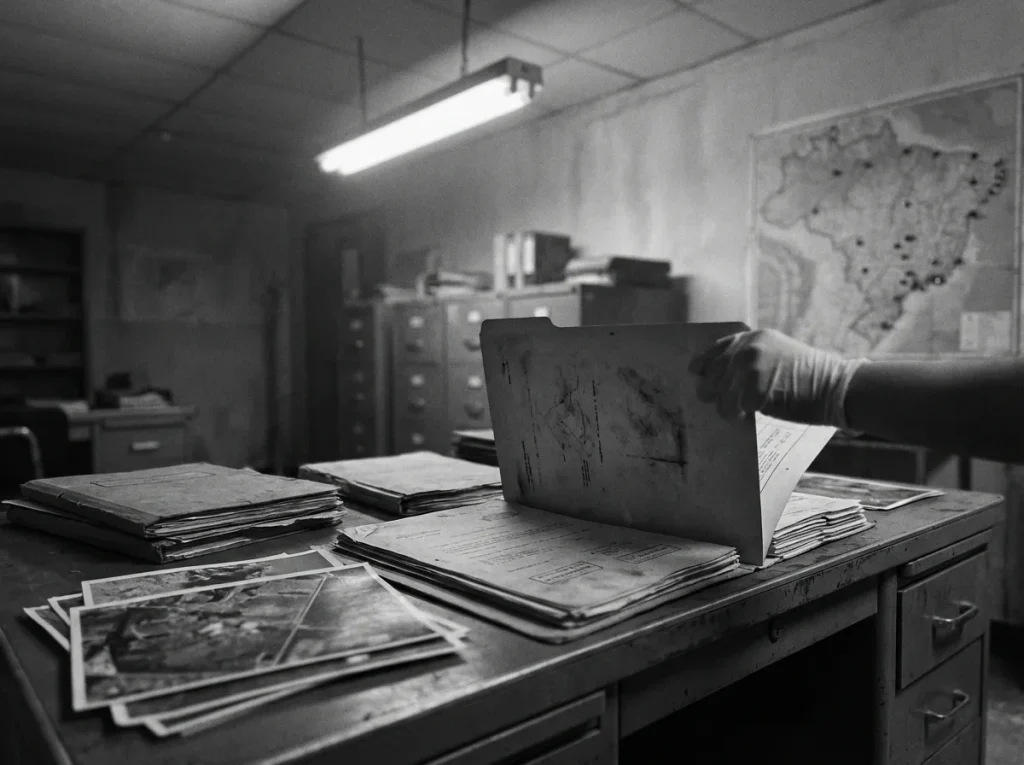
Brazil’s 2005 release of official material includes language that reads like an institutional admission of long-running tracking, and that should immediately raise your attention threshold. The frustration is that the internet treats every screenshot as “disclosure,” so you end up stuck between two bad options: dismissing everything as recycled lore or accepting a viral quote as settled fact.
The tradeoff this article resolves is simple. The archive release is real enough to deserve careful reading, but the most-circulated lines floating around social media demand verification discipline, not applause. You can respect the existence of a government paper trail and still refuse to treat a popular English excerpt as the final word.
The anchor claim driving so much of the current buzz comes from a Scribd compilation titled “The Bob Pratt Files” (Scribd). The uploaded file contains the English-language excerpt that is widely shared, but the Scribd viewer and the dataset provided here do not tie that excerpt to a stable, reproducible page number in the upload, and I was not able to locate a side-by-side Portuguese original inside that Scribd item. Concretely, the publicly viewable Scribd upload, as presented, does not show a stable archival page number for the specific “H traffic since 1954” sentence, and it does not display issuing-office metadata, signatures, stamps, or an archival finding-aid reference at the quoted location. Those missing metadata fields mean the English excerpt cannot be traced back to a dated, unit-attributed Portuguese primary without further archival confirmation.
Here’s the limitation that changes how responsibly you can use that line: at the quoted location, the Scribd source is in English and does not show a Portuguese original line side-by-side for verification. In the excerpt as circulated, you also do not get the basic archival anchors that close the loop fast, such as an originating unit or office, a clear date, or signatures and stamps that let you trace the document’s chain of custody without guesswork.
This matters because “UFO” and “UAP” language often becomes a rhetorical shortcut in a fast news cycle, standing in for observations that the observer or system could not immediately identify. Without the original-language line in view, the “H traffic” sentence functions as a lead worth chasing inside a larger archive, not a standalone proof-text you can responsibly cite as conclusive.
The distinction between an authentic archive release and an unaudited, highly shareable excerpt is where the 1954 start-date claim either gains footing or collapses. What follows treats the line as an archival question-one that rises or falls on provenance-not as an internet slogan.
H traffic and the 1954 timeline
The claim that Brazil tracked “H Traffic” since 1954 changes the entire story only if it rests on a dated, contemporaneous record trail. “Since 1954” is a start-date claim. Start dates are evidentiary claims, not vibes: they live or die on documents created at the time the program supposedly began.
Some later materials attribute the claim to an individual named “Azambuja.” However, I could not verify a full name, role or title, a document name, date, page number, or an archival reference for that attribution in the provided sources; therefore treat any attribution to “Azambuja” in the circulating excerpts as unverified until a primary Portuguese document with explicit provenance appears. The available dataset does not provide a contemporaneous 1950s-era primary record demonstrating that systematic monitoring began in 1954 under that name.
A separate item in the set also repeats the same framing and ties that statement to Brasília. That raises an anachronism flag worth noting: Brasília became Brazil’s capital in 1960, so a later compilation or index that includes the word “Brasília” alongside a claim that something existed “since 1954” can represent a later compilation location or editorial note rather than proof the operational program used that label in 1954. For context on the Brasília timeline, see a historical overview: Library Brown. Until you can show a dated 1954 Portuguese unit product that uses “H” in an operational log, the correct reading of the dataset is that later documents attribute a 1954 start date, not that we have the 1954 paperwork itself.
Within this dataset, the earliest explicit visible “1954” citation appears as a bibliographic entry in later materials; a bibliography date shows something was published in 1954, but it does not prove a Brazilian monitoring program existed that year or that any 1954 operational log used an “H” category.
No document identified in the provided materials is a contemporaneous 1950s-era primary record demonstrating that systematic monitoring began in 1954. In this set, “1954” shows up as retrospective referencing or as bibliographic dating, not as a scanned 1954 unit product: not a 1954 directive that creates an “H” category, not a 1954 logbook that uses “H traffic” as a track label, not a 1954 message that orders reporting procedures, and not a 1954 summary with a verifiable archive stamp.
That gap matters because a later statement can be accurate while still being unproven inside the boundaries of the documents you have in hand. The evidentiary floor here is “later sources say the start date was 1954,” not “we have the 1954 paperwork that starts it.”
The set shows “H Traffic” functioning as a label attached to UFO reporting and tracking, but it does not lock down what the “H” expands to, or even whether it is an acronym at all. Treat any expansion as a hypothesis until a Portuguese primary record (or a clearly sourced translation) is produced at the quote location.
Three interpretations remain plausible, but unproven, on the face of what is shown: (1) internal shorthand used by a unit to flag a recurring reporting bucket, (2) a track category applied inside an air-defense or air-traffic picture to separate this class of report from routine traffic, or (3) a classification or handling label used to route reports and files. The dataset does not provide the definitional document that would let you choose among these with confidence.
If you want to treat “H traffic since 1954” as established fact, demand provenance: a dated, unit-attributed Portuguese original (or a translation that cites the exact archival reference) showing the term in operational use in the 1950s. Until that appears, the honest read is narrower and firmer: the set supports that later sources attribute to unnamed individuals and Air Force-linked materials a claim of systematic tracking under an “H traffic” label dating back to 1954, but it does not itself supply the 1954-era document that proves the program began then.
How the Air Force tracked reports
The missing piece in the 1954 claim, as presented here, is not a lack of narrative-it’s a lack of contemporaneous operational paperwork. That is why procedure matters: it tells you what kinds of records should exist if tracking was systematic, and what metadata would typically accompany them.
Procedure is the difference between a story and a case file. The most credible UFO or UAP reporting is built from how observations are logged, cross-checked, and investigated, not from a single dramatic quote or a single pilot’s recollection. That procedural backbone matters because air-defense work is designed to reduce ambiguity: you try to turn a fleeting sighting into a tracked event with timestamps, sensor context, and a decision record.
CINDACTA is Brazil’s regional air-defense and air-traffic surveillance system, and it matters here for one plain reason: a distributed network can generate independent records for the same incident. Brazil has four CINDACTA centers (I to IV) located in Brasília, Curitiba, Recife, and Manaus. In practice, that means an event that crosses sectors, occurs near a boundary, or is relayed through higher command can leave parallel traces: controller notes, radar track data, and communications logs held at different nodes.
The friction is that “multiple centers exist” does not automatically mean “multiple centers saw it.” Radar coverage is line-of-sight limited, filters vary by facility, and what gets retained depends on operational workload. The actionable point is simple: when a narrative claims CINDACTA involvement, the strongest versions specify which center (or centers) were engaged and what kind of record was created there.
Air-defense style investigation usually starts with an operational trigger, not a UFO label. A pilot calls an object in proximity, a controller sees an unusual return, or an operations desk receives a report through an established channel. The question becomes: is this something that affects flight safety or airspace security?
- Receive the initial report with the minimum usable metadata: who observed it, where, when, altitude, heading, and duration.
- Check local and adjacent radar scopes for any coincident returns, including primary radar (skin paint) and any associated transponder data if present.
- Log what the system shows at that moment: track behavior, estimated speed, altitude if available, and whether the return is stable, intermittent, or being dropped by filters.
- Coordinate through the reporting chain so the event is visible beyond one console: supervisor, sector lead, and if warranted, the regional center.
- Decide whether to vector an aircraft for identification based on proximity risk, persistence, and corroboration.
This is not a rigid checklist because real operations are messy. Controllers prioritize separation, pilots prioritize flying the airplane, and an intercept decision has thresholds. Some events die on the vine because they do not persist long enough to re-check, or because the location and timing are too vague to reconstruct.
Radar-visual correlation means a radar track and a human observation line up in time and location closely enough that they plausibly refer to the same object, not two unrelated anomalies. That raises evidentiary weight because it forces you to explain both the sensor record and the sighting together. A single observer can misjudge range, closure rate, or aspect. A radar return can be clutter, processing artifacts, or an intermittent track. When both converge, the “one-system error” explanation narrows sharply.
Correlation still has friction. A pilot’s bearing call can be imprecise at night. Radar plots can lag, drop, or be subject to filtering that makes motion look jumpy. The decision insight is to look for the glue that makes correlation real: explicit timestamps, consistent bearings or headings, and a clear statement that the sighting and the track were contemporaneous, not reconstructed later from memory.
Technical status is part of that glue. Some accounts assert that CINDACTA I and CINDACTA IV submitted radar maintenance reports indicating no failures were found in the inspected equipment; I could not locate exact report references, dates, or archival identifiers for those maintenance claims in the provided materials. If verifiable maintenance reports tied directly to an event timeline exist, they can narrow the “broken radar” escape hatch by demonstrating inspected equipment was operational at the relevant time, but the current dataset does not supply those primary-report citations.
An intercept is a standardized identification maneuver, not a movie scene. Standard interception procedure includes approaching from behind, approaching on the pilot’s side, and matching speed and heading. At night, intercepting fighters may use flashing external lights or landing-light flashes as part of visual signaling; these methods are described in international intercept guidance such as ICAO Annex 2 (see ICAO Annex 2). These visual practices are meant to reduce closure risk and make the intercept visible and unambiguous to the other crew.
The nuance is that an intercept can still end without a clean identification. Targets can be lost due to geometry, fuel limits, weather, tasking changes, or the simple fact that not every radar track corresponds to something visually obvious.
| Evaluation factor | What it looks like in records | How to weight it |
|---|---|---|
| Radar-visual correlation | Radar track and observer reports share time and location | High weight because explanations must fit both |
| Multiple witnesses | Pilot plus controller, or multiple crews reporting independently | Higher weight if accounts are consistent on basics |
| Consistent time and location | Precise timestamps, coordinates, headings, altitude context | Higher weight because it enables reconstruction |
| Clear reporting chain | Recorded escalation through operational channels (not rumor) | Higher weight because it implies contemporaneous handling |
| Single observer only | No controller confirmation, no second crew, no sensor tie-in | Lower weight; perception errors stay on the table |
| Missing metadata | Unclear time window, vague location, no headings or altitude | Lower weight because it cannot be re-checked |
| No corroboration | No radar, no logs, no intercept record, only narrative | Lowest weight regardless of how vivid the story is |
If you want a baseline standard for weighing any cited “H traffic” incident, treat cross-corroboration and an operational paper trail as the entry price. Cases that combine radar-visual correlation, consistent metadata, and technical context like maintenance status are the ones that deserve attention before anyone frames them as headline-level “disclosure.”
Brazil’s files in today’s disclosure era
A Brazilian archival release in 2005 did not change on the page, but its perceived meaning changed after 2017. The post-2017 disclosure era trained audiences to scan institutional paperwork for “signals” that look like admissions: program structure, chain-of-command language, and phrases that sound like official acknowledgment. That habit reshapes how older foreign archives get re-read, often treating routine archival phrasing as a disclosure breadcrumb trail rather than what it usually is: an administrative record of what an institution chose to file and preserve.
That re-reading is not happening in a vacuum. Modern, U.S.-centric disclosure discourse now supplies the default lens: recurring references to the UAP Disclosure Act and related proposals (often framed through the Schumer UAP Disclosure Act language), annual NDAA UAP provisions, and ongoing discussion of UAP whistleblower protection. Those proposals and terms do not tell you what Brazil’s 2005 files “really mean,” but they do explain why many readers approach any older archive expecting programmatic revelations, hidden authorities, and a neat endpoint called “disclosure.”
The strongest projection pressure comes from policy-era taxonomy. “Non-human intelligence” is the statutory label used in U.S. congressional record definitions for “any sentient intelligent non-human life form regardless of nature or origin, that may be presumed responsible for unidentified anomalous phenomena,” and that framing tempts readers to retrofit modern categories onto older “UFO” paperwork that was never drafted to separate “unknown aircraft,” “misidentification,” and extraordinary hypotheses into clean buckets. When you read a 1950s-to-1990s era memo as if it were written under a 2020s definition set, ambiguity starts to look like confirmation, and mundane recordkeeping starts to look like coded confession.
A disciplined comparison starts by admitting what you actually have in hand. The material surfaced in the provided snippets points to U.S. federal web analytics and U.S. government page titles, not Brazilian archival documents themselves. That means this dataset is suitable for discussing how attention and framing travel, but it does not support document-specific claims about what Brazil released, how complete it was, or what any particular file “admits.”
| Fair comparison point | What Brazil’s 2005 release can fairly illustrate | Where modern U.S. discourse distorts expectations | What is not comparable from this dataset |
|---|---|---|---|
| Public access as a governing choice | Institutional record release can be treated as an administrative act: selecting, organizing, and making records available. | U.S. debates often treat “disclosure” as a single decisive event tied to legislation and enforcement. | Any claim about the exact access method, scope, or restrictions of Brazil’s 2005 release. |
| Archival completeness versus narrative completeness | An archive can be real and still incomplete, because archives reflect what was kept, not everything that happened. | U.S. framing primes readers to expect “the program” to appear if it ever existed. | Any conclusion about missing Brazilian files, gaps, or intentional withholding based on the evidence provided here. |
| How claims travel through translations and compilations | Once records circulate, secondary summaries and translated excerpts can become more influential than the source file. | U.S. policy vocabulary (UAP, non-human intelligence) gets layered onto older “UFO” terms, changing perceived intent. | Verifying specific translated quotations or attributing specific statements to Brazilian officials using this dataset. |
Brazil’s 2005 release belongs in your toolkit as archival context, not as direct validation of any specific U.S. allegation or testimony. Treat it as a model for what institutional record release can look like and a reminder of the earlier principle that documentation and interpretation move at different speeds. The reader rule is simple: use Brazil’s files to calibrate standards, provenance, and chain-of-custody habits in UFO and UAP news, and refuse the impulse to “score points” in another country’s political argument by over-reading archival ambiguity as modern-policy confirmation.
What the files prove and don’t
The released Brazilian materials are strongest as evidence that officials treated unusual aerial reports as something worth logging, routing, and sometimes investigating over long stretches of time. That is a real, defensible signal of institutional attention. It is not proof of extraterrestrials, and it is not a solved “government cover-up” narrative.
First, Brazil documented and tracked unusual aerial reports over time. The operative point is continuity: reports were not handled as one-off folklore, but as items that could enter an institutional workflow and be preserved.
Second, the paperwork shows operational handling rather than purely anecdotal storytelling. Some records tie observations to the air-defense and air-traffic system, which is built around named centers rather than a generic “the military” abstraction. That kind of structure matters because it anchors at least part of the reporting ecosystem to real operational entities, not just to later retellings.
Third, some incidents remained unresolved in the paperwork. “Unresolved” is a legitimate bureaucratic endpoint: the report entered the system, evidence was insufficient for a confident identification, and the record stayed open or inconclusive.
These materials do not, by themselves, establish confirmed aliens or confirmed non-human intelligence. An “unidentified” conclusion in a record is a statement about the limits of the available data, not a positive identification of origin.
They also do not establish recovered materials, a verified technology provenance, or a definitive cover-up. Those claims require independent corroboration that is categorically stronger than an unresolved sighting report: chain-of-custody physical evidence, instrument logs that can be audited end-to-end, and documentation that proves intent to conceal rather than routine uncertainty or classification.
Evidence weight rises and falls with provenance. There is no single, universal set of metadata for files or documents; metadata exists on a continuum across collections. Missing fields therefore change evidentiary weight rather than automatically debunking authenticity.
Use a structured research practice as your rubric: selection for quality and verification for validity. Selection for quality filters for primary-source origin and completeness; verification for validity checks internal consistency and external cross-support. In practice, that means preferring original archive-hosted scans over reposts, and preferring records that preserve timestamps, locations, routing marks, and institutional context over decontextualized screenshots.
When the material includes operational supporting documents, treat them as supporting context, not as a magic stamp of certainty. Maintenance documentation, for example, can narrow equipment-failure explanations in cases where it is directly tied to an event timeline, but it still does not identify what was observed.
Do not treat the word “unidentified” as a UFO determination unless it is clearly sourced to Brazilian Air Force or Arquivo material and clearly refers to an aerial object. Within the provided research materials, “unidentified” appears in unrelated contexts such as “unidentified presumed victims,” “missing and unidentified individuals,” and “unidentified police officers.” That wording is common bureaucratic English and Portuguese, and it can be a keyword trap when people search and paste excerpts without confirming scope.
Source drift is real. Some circulated snippets point to U.S. federal pages and logs rather than Brazilian archive holdings, which is a provenance mismatch you can catch quickly by checking the hosting domain and the record context.
Share only what survives a “quality selection plus validity verification” standard. If a claim cannot show primary provenance to Brazilian Air Force or Arquivo sources and cannot withstand basic metadata and context checks, it does not deserve to be repeated as UFO or UAP disclosure, and it does not justify conclusions about non-human intelligence or a cover-up.
Conclusion
Brazil’s 2005 opening matters, but the viral “H traffic…since 1954” line still sits in the gap between an archive that exists and a quotation that can be verified.
The discipline here is the same one applied throughout: read for provenance, accept redaction and partial releases as operational reality, and separate what the 2005 opening actually put on record from what later summaries imply. On the timeline, this set does not identify a contemporaneous 1950s record that independently anchors “since 1954,” and the quoted “H traffic / since 1954” line, as currently sourced, appears in English at that location without the Portuguese original, so it cannot be treated as settled. Claims earn weight when they carry chain-of-custody markers (signatures, stamps, dates, office or unit identifiers) and when incidents cross-corroborate through radar plus visual reporting plus maintenance context.
- Locate official archival finding aids or indices, then verify representative documents before drawing broad conclusions when inventories or access paths are unclear.
- Prioritize cases with radar-visual correlation and supporting maintenance or operations documentation.
- Treat modern “non-human intelligence” framing as context, not proof, until the primary record supports it.
Frequently Asked Questions
-
What did Brazil release in 2005 about UFOs/UAP?
Brazil released official archival material in 2005 showing a government paper trail where unusual aerial reports were logged, routed, and sometimes investigated over time. The article treats the release as real but emphasizes that viral excerpts still need provenance checks.
-
What does “H traffic” mean in the Brazil UFO files?
In the provided materials, “H traffic” is used as a label tied to UFO/UAP reporting and tracking, but the dataset does not define what the “H” stands for. The article lists three unproven possibilities: internal shorthand, an air-defense/air-traffic track category, or a classification/handling label.
-
Did the Brazilian Air Force really track “H traffic” since 1954?
The dataset supports that later sources attribute to Azambuja (and Air Force-linked material) a claim of systematic tracking of “H traffic” beginning in 1954. It does not include a contemporaneous 1950s primary document (e.g., a 1954 directive, logbook, or message with stamps/signatures) that proves the program began then.
-
Why is the viral “H traffic since 1954” quote considered hard to verify?
The key circulated passage appears in English in a Scribd compilation (“The Bob Pratt Files”) without a Portuguese original shown side-by-side. The excerpt also lacks fast-verification anchors like an originating unit/office, a clear date, and signatures or stamps that establish chain of custody.
-
How is CINDACTA structured, and why does it matter for UFO/UAP records in Brazil?
Brazil has four CINDACTA air-defense/air-traffic surveillance centers (I to IV) located in Brasília, São Paulo, Recife, and Manaus. Multiple centers can create independent records for the same event (controller notes, radar tracks, communications logs), so strong claims should specify which center(s) were involved.
-
What evidence factors does the article say give a UFO/UAP case the most weight?
High-weight cases combine radar-visual correlation, consistent timestamps/location/heading details, multiple witnesses, and a clear reporting chain through operational channels. The article notes maintenance reports from CINDACTA I and CINDACTA IV finding no equipment failures, which can narrow “broken radar” explanations when tied to an event timeline.
-
What should you look for before citing Brazil’s 2005 files as “UFO disclosure”?
Prioritize primary, archive-hosted scans with chain-of-custody markers (dates, unit identifiers, signatures, stamps) and incidents with cross-corroboration (radar plus visual reports plus operational context). Avoid treating decontextualized screenshots or untranslated English excerpts as conclusive, and don’t equate “unidentified” in paperwork with confirmed non-human intelligence.
