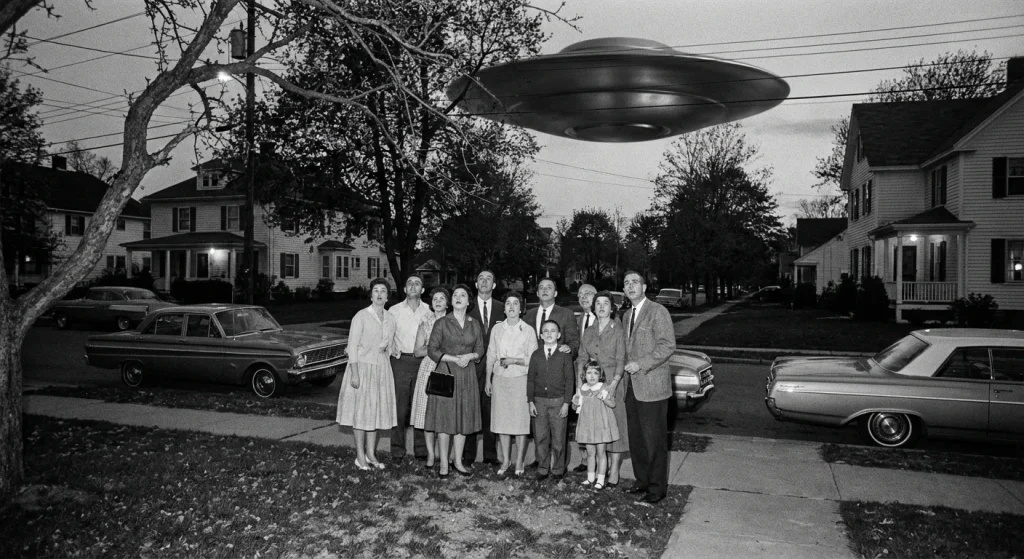
You keep seeing “UFO disclosure” and “UAP news” headlines, and the same historical stories get recycled with total certainty. The Beverly, 1966 close-encounter claim is one of them, and your decision is simple: trust the repeating headline, repeat it yourself, or stop and check whether the sourcing actually supports what gets quoted.
Disambiguation: this article examines reporting tied to Beverly, Massachusetts, USA, and treats the event commonly dated to April 1966 as a claimed nighttime close-encounter report; the supplied packet does not, however, verify the headline specifics about distance or witness roster.
Sources in the supplied research packet (as provided):
- The packet includes local retrospectives and UFO-focused writeups referencing a Beverly, Massachusetts, 1966 incident (for example, local coverage and UFO-interest writeups). Examples in the packet include WickedLocal and other local or UFO-focused posts. Wickedlocal, Ufoinsight, Patch.
- The packet also contains assorted non-incident materials and social posts that reuse similar language in unrelated contexts (for example, Facebook posts and other retrospective items).
- The packet does not include contemporaneous primary incident documents for Beverly that would decisively anchor the claim: no original police log or dispatch record from the event, no contemporaneous newspaper clipping that is the original report, and no Project Blue Book case file in the supplied materials that documents a Beverly witness roster or a measured “about 40 feet overhead” distance. For Project Blue Book holdings, NARA is the canonical archive. National Archives.
“Close range” plus “multiple witnesses” is the perfect sharing formula. A report framed as a craft directly over a group reads like the cleanest kind of case: immediate, collective, hard to dismiss in one sentence.
This case sits at the intersection of vivid retellings and thin documentation.
The popular framing the article examines is specific: “Beverly Close Encounter 1966: nine witnesses report a craft about 40 feet overhead.” The supplied research packet, however, does not currently document those two attention-grabbing specifics as Beverly-specific facts. The provided research does NOT include a Beverly-1966 primary or near-contemporaneous source that cleanly documents the phrase “about 40 feet overhead” for a craft; the “40 feet overhead” phrases supplied appear in unrelated contexts. The packet also does NOT include a Beverly-specific primary witness roster; “nine witnesses” appears in unrelated legal and committee contexts and cannot be treated as verification for this case.
What the packet does contain is demonstrably non-Beverly usage of the same language: a domed ceiling that “peaks at 40 feet overhead,” a narrative passage using “40 feet overhead” while describing navigating upstairs, and photographic observation setups that placed cameras “about 40 feet overhead” above models over a basin.
It also contains “nine witnesses” in contexts that have nothing to do with a 1966 Beverly sighting, including proceedings where the province called nine witnesses, the Division of Enforcement called nine witnesses, and a tribunal recorded that it heard testimony from nine witnesses. The packet also lists additional unrelated “nine witnesses” examples, including a committee hearing (Canada DND/JAG interim report) and a bench trial record (TaxNotes).
You will leave with a disciplined way to separate allegation, documentation, and inference: strict source hierarchy, a reconstruction template that forces dates and provenance, witness-quality checks, elimination logic for lookalikes, and a standard for what “modern relevance” looks like when the archive is the constraint. Use it to judge Beverly without certainty-by-repetition, and to audit the next headline that tries to borrow authority from an old case.
That discipline starts by taking 1966 seriously as an information environment, because the way reports were captured and transmitted then is exactly where modern retellings tend to outrun the paperwork.
1966 and the UFO reporting climate
In 1966, the meaning of a UFO report was shaped as much by the reporting pipeline as by what anyone saw. Information moved without search engines, upload timestamps, or embedded audio. A call went to a police switchboard, a local reporter, a radio desk, or a nearby base public affairs office; then it moved again as a short item on the wire or a paragraph in a morning paper. Each handoff rewarded compression: a witness’s long description became a dispatcher’s summary, then an investigator’s paraphrase, then an editor’s headline that selected the “hook” and dropped the qualifiers.
This is where chain of custody (for accounts) matters: the practical trail of who recorded the description, when they wrote it down, and how it traveled from witness notes to an investigator’s file to publication. Every step introduces predictable distortion points, including memory-based retellings, “cleaned up” wording, and editorial framing that makes a tentative detail read like a settled fact. Once the paraphrase is printed, later retellings often cite the printed version instead of the original notes, and the story outruns the paperwork.
The shorthand that colored later coverage was born in Michigan. In March 1966, reports near Dexter, Michigan were publicly linked to what became the “swamp gas” controversy associated with astronomer J. Allen Hynek; contemporary drafts and press materials document Hynek advancing a swamp-gas explanation at the time. See Hynek’s draft/press materials and retrospective discussion available in the Ford Library collection and at the University of Michigan Bentley retrospective. Fordlibrarymuseum, Bentley Umich.
New England also had aviation activity that complicated interpretation: nearby training and operational activity at regional air facilities is a real-world reason unfamiliar aircraft could be present, seen at odd angles or lighting conditions, misidentified by civilians, or over-attributed once a UFO label entered the conversation.
By the mid to late 1960s, regulatory authorities were implementing aircraft noise standards and formal rules for aircraft certification of noise. The Federal Aviation Administration documents its noise-policy history, and the noise-certification rulemaking for new subsonic jet aircraft was promulgated around 1969 as FAR Part 36; see the FAA noise history page and the Federal Register promulgation. Faa, Archives Federalregister.
That matters for UFO reporting because witnesses carry a baseline assumption about what “should” be audible; when sound does not match expectation, people reach for extraordinary explanations, and editors lean into the mismatch because it reads like proof.
One more marker of 1966’s climate: organized civilian interest increased circulation even when conclusions did not, which raised public attention for reports even when institutional records were sparse.
Demand disciplined sourcing, especially for modern reposts. A Facebook-sourced post claims Project Blue Book received 12,618 sightings and that 701 remained “unidentified”; treat any social-post statistic as unverified unless corroborated. Before accepting any repeated 1960s close-encounter detail as established, insist on the document trail: who wrote the first account, the date and time recorded, whether it is verbatim or summarized, and which later publications can be traced back to that first piece of paper.
Those same compression pressures explain why a modern packet can contain a lot of adjacent material and still fail to anchor a specific local incident. That constraint is exactly what drives the reconstruction approach below.
Reconstructing the Beverly encounter
A credible encounter timeline is only possible when you separate three buckets: (1) reported observations recorded at the time, (2) later retellings that compress and simplify events, and (3) unknowns that have to stay unknown until sourced. This packet does not contain Beverly-specific primary material that would anchor a minute-by-minute chronology. The sources available here are not Beverly-timeline documents; they include items such as a climate-smart planning cycle document, an Embry-Riddle Aeronautical University impact piece, the FAA OUFPMS report, Umatilla County’s Emergency Operations Plan, and a Federal Register proposal on BVLOS unmanned aircraft rules. None of those provide a Beverly witness narrative with timestamps, bearings, or a reporting chain.
That absence forces a disciplined choice: this section is a reconstruction framework, not a definitive narrative. Close-range stories invite confident scene-setting, but confidence is earned by contemporaneous notes, logs, recordings, and traceable provenance, not by repetition.
One detail often attached to this case, “about 40 feet overhead,” must be treated as an estimate used in later claim-framing unless a primary source documents how that distance was measured (paced baselines, known object size, angular measurement, or instrumented survey). Without a documented method, it stays in the “later retelling or unverified estimate” bucket rather than in “reported observation.”
The goal of a reconstruction is not to tell a story; it is to capture time-ordered fields that can be checked. Below is the chronological template you would use if the underlying Beverly reports, statements, or logs were in hand. Each stage includes the specific data points that turn recollection into a testable sequence.
- Fix the pre-sighting setting: Record the date and local time window as stated by each witness, the exact observation location(s) and vantage point(s), and what the witness was doing immediately before noticing anything. Capture environmental descriptors as quoted (for example, “clear,” “hazy,” “windy”), but keep them separate from verified meteorology, which is not established here.
- Capture the attention trigger (initial notice): Identify who first noticed the object and what specifically drew attention (light, shape, motion, sound, interruption of routine). Log where in the sky it was first seen using concrete references: compass direction or a landmark bearing, elevation angle above the horizon, and whether it was moving relative to stars, terrain, or structures. Note whether the witness reports any sound, and if so, the character of the sound (steady, intermittent, directional, Doppler change) and whether it arrives before, during, or after visual acquisition.
- Document the approach and any overhead or closest-pass segment: This is where close-range claims tend to harden into lore, so it needs the tightest sourcing. Extract the stated path of travel (direction of travel, changes in heading), speed changes (accelerations, stops, hovering claims), and the witness’ basis for distance and size judgments. “Approximately 40 feet overhead” belongs here only as a quoted estimate tied to a stated method; otherwise it is logged as an unverified distance claim. Capture angular size (“thumb-width at arm’s length,” “covered the moon,” “smaller than a dime”), because angular size is the piece that later allows comparisons to known objects without rewriting anyone’s words.
- Record observable characteristics at closest range: Log shape description (disc, oval, triangle, indistinct), edge definition, surface detail, number and arrangement of lights, light color and behavior (steady vs pulsing), and any emitted beams or reflections. Note “silence” as a positive observation, not an absence of memory: silence at close range is only meaningful if the witness explicitly commented on it. Track any reported effects on people or equipment, but keep the reporting separate from interpretation.
- Lock the departure sequence: Extract the direction of departure, whether it climbed, descended, or leveled off, and whether the apparent speed changed smoothly or abruptly. Capture the final point of loss (behind trees, into cloud, into distance, “blinked out”), and whether multiple witnesses lost sight at the same moment or in sequence from different vantage points.
- Immediate aftermath and reporting steps: This is the chain-of-custody stage. Record who spoke to whom first, whether any calls were made (police, local officials, media, military), whether anyone wrote notes the same day, and whether there are logs, dispatch records, or dated letters that can be requested. The time between sighting and first report is a factual field; it matters because it controls how much the account relies on memory versus documentation.
Done correctly, this template produces a timeline where each entry is labeled as either “reported observation” (quoted, attributable, time-stamped), “later retelling” (secondary summary, date unclear), or “unknown” (not present in the materials). That labeling discipline is what prevents a reconstructed chronology from quietly turning into a narrative.
Weather and sky conditions are not established here. No verified NOAA or local-station environmental conditions for Beverly at the reported date and time are present in the provided sources, so cloud cover, ceiling, visibility, wind, and precipitation cannot be treated as known inputs. Sky brightness and astronomical context also cannot be asserted from this packet. Any responsible reconstruction must either obtain station observations for the relevant window or explicitly label conditions as “not established here.”
Exact time is not anchored. The provided research does not include a Beverly-specific minute-by-minute narrative source, so there is no authoritative timestamp sequence to reconcile across witnesses. Without time anchors, duration claims cannot be cross-checked against other records (calls, dispatch logs, shift logs, diaries), and even the order of events can drift in later summaries.
Locations and vantage points are unspecified. Close-range descriptions change meaning when you know the baseline: the distance between witnesses, the presence of obstructions, and the directionality of sound. A properly sourced timeline must include coordinates or address-level locations and the witness’ viewing orientation, not just a town name.
The reporting pathway is missing. This packet includes materials that are procedural or regulatory in nature, not incident-specific reporting. Without a documented pathway of who reported what, to whom, and when, you cannot distinguish first-generation observation from later compilation. That is the difference between a report you can audit and a story you can only repeat.
Distance claims need methods. Treat “about 40 feet overhead” strictly as an estimate attributed to later claim-framing unless the primary record documents a measurement method. If a source does provide a method, the method itself becomes part of the timeline entry, because it determines whether the distance is a grounded estimate or a rhetorical shorthand.
Details that matter for later evaluation are the ones that can be mapped to geometry and consistency without rewriting the event: shape, light arrangement, presence or absence of sound, direction of travel, speed changes, angular size, duration, and the post-event reporting steps. Those fields are what later allow analysts to test for internal coherence and check against external records, but this section does not attempt that evaluation. It defines what you must extract so evaluation is even possible.
A properly sourced Beverly timeline requires: date and local time window; exact locations and viewing bearings; a verbatim sequence of initial notice, closest approach (with the method behind any “40 feet” estimate), and departure; duration with a stated timekeeping basis; sound notes; angular size cues; and a documented reporting chain with timestamps and retrievable records.
Once the timeline is treated as a scaffold rather than a settled story, the next pressure point becomes obvious: the witness count and whether it represents independent observation or recycled consensus.
Nine witnesses and consistency checks
“Nine witnesses” sounds like a self-validating consensus. It is not. Multi-witness cases only strengthen a report when the witnesses are demonstrably independent, interviewed correctly, and preserved in traceable notes or recordings. If those controls are missing, the appearance of agreement can be manufactured by group discussion, interviewer cues, or later compilation.
Handle the “nine witnesses” framing as a claim about the Beverly story, not as a proven roster. A packet can repeat the number without establishing who the nine were in a Beverly-specific list, whether they were all direct observers, or whether any accounts are duplicative or secondhand. In other settings, legal records routinely record that “nine witnesses” testified, which shows how easily the number can function as a headline rather than a quality signal.
The practical test is independence. Police and investigator training treats witness management as a core discipline: secure witnesses and interview them separately so they do not influence each other’s statements. Guidance also recommends separating multiple witnesses to minimise the risk of memory contamination between them.
Witness contamination is the key failure mode in group sightings: once co-witnesses talk, details heard from someone else can be reported later as if personally observed. Investigators treat this as a standard risk, not a theoretical one. Separation matters most immediately after the event, when accounts are still forming and when confirmatory feedback or leading prompts can lock in a shared narrative.
Before giving weight to any “nine witnesses” claim, profile the witness group at a high level without naming anyone. Use three filters:
- Relationship types: family members, neighbors, co-workers, and friends tend to exchange details quickly; strangers or independently situated witnesses tend to cross-check each other less.
- Vantage-point diversity: nine people in the same yard are one observation with nine retellings; nine people in separated locations are nine partially independent observations.
- Observational constraints: lighting, obstructions (trees, buildings), distance, and attention focus (driving, supervising children, reacting to sound) bound what anyone could reliably report.
Not all “agreement” is equally diagnostic. In close-range reports, the highest-value variables are the ones least likely to be filled in by assumption and most likely to diverge if accounts are truly independent: direction of travel, duration (start and end anchors, not rounded guesses), sound (presence, character, timing), lighting conditions, and motion changes (hovering to acceleration, stops, turns). Agreement on these variables carries more evidentiary weight than agreement on generic labels or after-the-fact interpretations.
Apply the same discipline used in other forms of lay testimony: confidence is not the metric, conditions and method are. As with non-expert voice identification, weight rises or falls based on exposure time, signal quality, distractions, and documentation of what was actually said, not on how forcefully it was asserted.
Documentation quality decides whether “consistent witness statements” is a finding or a slogan. Research comparing verbatim contemporaneous accounts from investigators’ notes against audiotaped recordings in forensic and investigative interview literature shows why later summaries and retellings must be weighted below contemporaneous verbatim capture; see a recent review of investigative interview practices. PubMed.
This is where content analysis earns its place. Content analysis is a potentially important research technique in the social sciences, and content analysts treat data as representations rather than direct reflections of reality. In practice, that means every statement is handled as a representation that requires corroboration: who produced it, from what source material, under what constraints, and with what opportunity for drift.
Protocol: questions to ask of any “nine witnesses” claim
- Identify whether a Beverly-specific roster exists (names not required publicly), and whether each person was a direct observer versus a relay of someone else’s account.
- Verify who interviewed them, and whether interviews were conducted separately or in a group.
- Pin down timing: how soon after the event each account was captured, and whether witnesses spoke to each other beforehand.
- Demand the preservation format: audio recording, verbatim notes, signed statement, or later summary, and weight them in that order.
- Extract independently attested agreements on high-value variables (direction, duration, sound, lighting, motion changes) and mark where agreement depends on shared discussion rather than separate observation.
If the witness-control questions cannot be answered from the file, the next step is not a louder claim about what happened; it is a structured look at what each conventional explanation would require, and what evidence would be needed to test it.
What could it have been
The fastest way to improve signal-to-noise in a legacy close-encounter claim is an elimination matrix: write down what each conventional explanation would predict, then compare that against what the report implies. This discipline blocks overconfident storytelling because it forces every hypothesis to declare its required inputs. In Beverly, the friction is immediate: sourcing is thin and the packet does not lock down a verified time window or weather conditions, so several eliminations can only be framed as “what would be checked,” not “what was ruled out.”
Conventional aircraft predict a specific bundle of cues: continuous engine noise that rises and falls with range, navigation or anti-collision lighting patterns consistent with known configurations, and a trajectory that makes sense for an aircraft maintaining lift and separation. Helicopters tighten the prediction set further: a distinctive rotor cadence and often a strong illusion of “hovering” when the aircraft is simply slow or moving along the observer’s line of sight.
The main tension in close-range reports is proximity perception. A lighted object at distance can read as “right over the treeline” or “just above the road,” especially at night, while the sound arrives delayed and smeared by terrain and wind. If the Beverly report implies very low altitude, then the elimination hinge is not the story’s vividness but whether the packet preserves a sound profile, a clear lighting description (colors, blinking vs steady, symmetry), and an observed track (straight line, arc, climb, sudden stop). Without those inputs, “aircraft” remains a live model rather than a resolved one.
A blimp-like craft predicts slow apparent motion, long dwell time over the same area, and lighting behavior oriented to visibility rather than navigation. It also predicts an acoustic footprint that is usually less “jet-like,” but still present at close range, and it predicts constraints on abrupt acceleration and tight turns.
The complication is that witness language compresses time. “It hung there” can mean seconds, not minutes, and “it moved off” can hide a gradual drift. The actionable discriminator is duration: if the object’s presence was sustained long enough to observe stable lighting behavior and a slow, consistent translation, this category climbs. If the report implies rapid transit or a sharp, geometric maneuver, it drops.
Balloons and lanterns are wind-dependent systems. They predict drift aligned with wind aloft, minimal or no self-generated sound, and motion that looks smooth rather than piloted. Lanterns add an illumination predictor: a warm, flickering source that can appear to brighten and dim as it rotates or as the flame changes.
The tension is that observers often infer intent from motion even when the driver is wind shear. With no verified weather snapshot, the correct move is to treat “it followed us” or “it kept pace” as a perception claim that needs wind direction and speed at the relevant altitude to test. If the report implies tight station-keeping relative to landmarks, that is where balloons strain, but you cannot cash that out without bearings, time, and wind.
The packet’s sources do not supply Beverly time-window moon or planet positions, so astronomy elimination must stay at the level of checks, not asserted specifics. The test is straightforward: pin down the time window and viewing direction, then compare against the Moon’s and bright planets’ presence in that sector, and then ask whether apparent motion could be observer motion (walking, driving, head turns) rather than object motion. Documented common misperceptions and identification failures in the astronomical-UFO literature illustrate how quickly observers can adopt non-mundane explanations for ambiguous celestial sightings; see skeptical and scientific discussions. Theness, Skepticalinquirer, PubMed.
Ball lightning is studied and, in some recent work, has been operationalized in computational geonomy-style workflows that describe environmental “state vectors” for rare-atmosphere phenomena; that literature is specialized and requires environmental inputs not present here. See a recent research overview. Researchgate.
Distance and altitude estimation errors are common in sky observations, which is why any very-close estimate attached to the Beverly framing cannot be treated as measured unless a primary record documents the method. Absent that baseline, a fixed number can become a felt proximity driven by angular size, brightness, sound delay, and stress.
This cross-cutting factor does not “debunk” anything by itself. It sets guardrails. If the distance estimate is elastic, then speed, size, and threat implications become elastic too, and categories that seemed impossible at very close range can re-enter the matrix once the range expands.
Modern readers default to “drone” because it is today’s shorthand for small, low-altitude lights and buzzing sounds. A 1966 report cannot be mapped onto consumer multirotors, so the translation has to stay period-correct: small aircraft, helicopters, hobbyist devices available at the time, and lighter-than-air objects. The point is not technology trivia; it is category hygiene. Swap the modern label for the underlying cues you would actually test: sound, lighting, trajectory, and wind dependence.
- Lock the time window (start, end, and confidence) so sky objects and air traffic constraints can be evaluated without guesswork.
- Record direction and elevation (bearing to the object, angle above horizon, and movement relative to fixed landmarks).
- Capture sound detail (continuous vs pulsed, rotor-like cadence, perceived direction changes, and any silence during “maneuvers”).
- Recover weather and wind (surface observations plus wind aloft if available) to test drift-based explanations and to gate any atmospheric-electrical hypothesis.
- Quantify duration and track (seconds vs minutes; straight, arc, hover-like, acceleration claims) because time is the lever that collapses the hypothesis space fastest.
Those required inputs are not just academic. They are exactly what modern “disclosure” debates rise or fall on: whether institutions can produce auditable records instead of leaving the public to arbitrate between vivid anecdotes and missing files.
Why this case matters now
For cases like Beverly 1966, “disclosure” is a records problem before it is an aliens problem. The hard questions are procedural: Who logged the report, what metadata was captured, what supporting material existed at the time, who had access, and what adjudication standard was used to close it out. Thinly documented close-encounter stories matter now because modern disclosure debates are fundamentally about record quality, access, and repeatable decision-making, and older cases show exactly where the system fails when documentation is sparse.
“UAP (unidentified anomalous phenomena)” isn’t a cosmetic rebrand; it is an umbrella category designed to triage reports by observable characteristics, data sources, and confidence levels instead of forcing every incident into a single culturally loaded bucket. That categorization is how you earn public trust: you separate aviation safety issues, sensor artifacts, and genuinely unresolved observations with consistent criteria, then you show your work. Beverly-type incidents get reinterpreted every time “UFO news” or “UAP news” spikes, and the same thin packet gets repackaged as either proof of a cover-up or proof of mass misperception. A standardized category system makes that rhetorical recycling harder because it demands comparable fields, not just compelling anecdotes.
Centralized triage only works if one office is responsible for intake, cross-domain correlation, and publishing what it can responsibly publish. According to the Pentagon’s public site, the All-domain Anomaly Resolution Office (AARO) is the office intended to consolidate and triage UAP records. See the AARO homepage and its public records pages. Aaro, Aaro.
That impulse is older than the current cycle. A 1999 congressional record excerpt described the job as “laying the groundwork of the historical record,” a reminder that record-building is an explicit governmental practice, not a conspiracy flourish. The limit is structural: even a well-run office cannot confirm what was never captured, preserved, or made accessible in the first place.
That is why the policy lane keeps circling the same mechanisms: transparency requirements, record-collection mandates, and enforceable pathways for protected testimony. References to legislative efforts and NDAA provisions all point at process goals like inventories, declassification review workflows, and timelines. Work by members of Congress is best read through that same lens: tightening the pipeline from report to record to accountable release.
According to filings and public documents posted in FOIA releases and archived procedural filings, David Grusch submitted an inspector-general complaint that investigators described as “credible and urgent.” See the DNI FOIA release and the procedural filing posted in the public archive. DNI, Ia903401 Us Archive.
According to reporting in The Intercept that relied on FOIA documents, some records discussed by sources included material about Grusch’s security-clearance adjudication; readers should treat those FOIA-based reports as partial, attributed fragments of the public record. Theintercept.
Public congressional hearings and transcripts also provide sourced testimony and context for modern policy debates; for example, the July 26, 2023 House Subcommittee hearing transcript includes witnesses such as David Grusch and former Navy pilots. See the congressional hearing transcript. Congress.gov.
Read AARO’s public releases about historical cases as boundary-setting: they can confirm what records exist, what was reviewed, and why an explanation met an adjudication standard; they cannot retroactively manufacture missing logs, chain-of-custody, or contemporaneous instrumentation. Better disclosure would not “solve” a 1966 claim; it would change what survives into the file, so future debate is about evidence quality rather than inherited gaps that headlines can launder into certainty.
Against that backdrop, a responsible conclusion about Beverly is necessarily narrower than the headline-but it is also more useful, because it tells you exactly what would have to change for the claim to become auditable.
What we can responsibly conclude
The only responsible conclusion from this packet is simple: the Beverly-1966 close-encounter framing is compelling, but the headline specifics are not document-supported here at the level the wording implies, and the fix is straightforward: better access to primary records and better modern reporting discipline.
That constraint is visible across the same points the introduction flagged. The packet never verifies a measured “about 40 feet overhead” claim or a Beverly-specific “nine witnesses” roster, so the encounter remains a reconstruction scaffold rather than a locked timeline. The 1966 reporting climate explains why chain-of-custody discipline matters: once a claim is repeated without the originating report, you lose the ability to audit what was written when, by whom, and from which notes. The witness-analysis filters show why a number can read like corroboration even when independence and interview conditions are unknown. And the elimination matrix makes the final limitation explicit: conventional explanations can only be tested against inputs the packet does not provide, like precise timing, bearings, meteorology, and traceable contemporaneous documentation.
Authoritative sources and next-step levers to follow up on this case include the Project Blue Book holdings at the National Archives (T1206 microfilm), FOIA and the text of the Freedom of Information Act, FAA UAP reporting guidance, NASA’s UAP Independent Study Team report, and AARO’s public site and records pages. See these primary reference pages for follow-up research: NARA Project Blue Book/UFO research page National Archives, T1206 microfilm index reference Minotb52Ufo, FOIA statute text at Cornell LII Law Cornell, FAA UAP reporting notice Faa, NASA UAP Independent Study Team final report NASA, and AARO official site Aaro.
Share this case like a responsible investigator: demand source-first claims, ask for the underlying records, and support transparency efforts that move the Beverly story from repetition to record.
Frequently Asked Questions
-
What is the Beverly close encounter 1966 case supposed to be about?
It’s commonly framed as a 1966 Beverly incident where “nine witnesses” saw a craft “about 40 feet overhead.” The article says the supplied research packet does not document those Beverly-specific headline details with a primary or near-contemporaneous source.
-
Does the research packet actually prove the claim that a craft was about 40 feet overhead in Beverly in 1966?
No-the packet does not include a Beverly-1966 primary or near-contemporaneous source that cleanly documents “about 40 feet overhead” as a craft distance estimate. The article notes the “40 feet overhead” phrasing in the packet appears in unrelated contexts like a domed ceiling and a camera setup placed “about 40 feet overhead.”
-
Does the research packet confirm there were nine witnesses in the Beverly 1966 sighting?
No-the packet does not include a Beverly-specific primary witness roster. The article says “nine witnesses” appears in unrelated legal and committee contexts (for example, proceedings where an agency “called nine witnesses”).
-
What does the article mean by chain of custody for UFO/UAP accounts?
It means tracking who recorded the description, when it was written down, and how it moved from witness notes to an investigator’s file to publication. The article explains each handoff encourages compression and distortion, with later retellings often citing printed paraphrases instead of original notes.
-
What information is missing that prevents a verified timeline for the Beverly 1966 encounter?
The packet doesn’t anchor exact time, exact locations/vantage points, verified weather/sky conditions, or the reporting pathway (who reported what to whom and when). The article says those gaps prevent a minute-by-minute chronology and block cross-checks against logs, dispatch records, or station observations.
-
What specific fields should be captured to reconstruct a close-range UFO/UAP sighting like Beverly?
The article’s template includes a dated time window, exact location and viewing orientation, attention trigger, track and closest-pass segment, angular size cues, sound profile, observable characteristics (shape/lights), departure sequence, and immediate reporting steps. It also requires tying any “40 feet overhead” distance claim to a documented measurement method.
-
How do you evaluate whether “nine witnesses” actually strengthens a UFO/UAP report?
The article says it only helps if witnesses are independent and their statements were preserved in traceable formats, prioritizing audio, verbatim notes, signed statements, then later summaries. It recommends checking interview separation, timing, witness relationships, vantage-point diversity, and agreement on high-value variables like direction, duration, sound, lighting, and motion changes.
