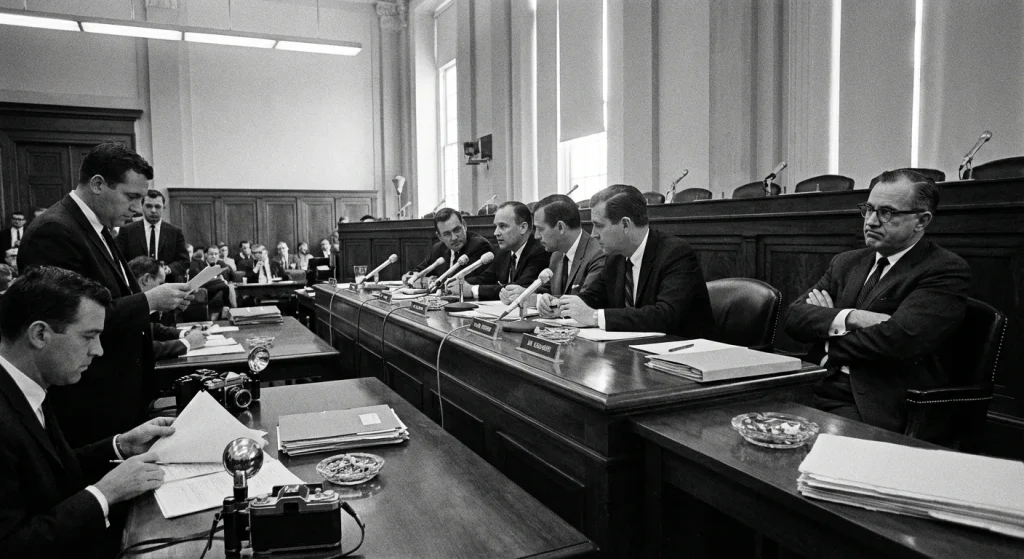
Every wave of UAP news gets treated like the first time Congress ever took this seriously, then the record resets. You get a spike of headlines, a hearing framed as unprecedented, a fresh round of government cover-up claims that never actually resolve, and the same argument about what “counts” as evidence. The result is predictable: the public debate churns, while the standard for proof stays blurry enough that almost any claim can survive another news cycle.
The overlooked fix is sitting in plain sight in the House record: “Symposium on unidentified flying objects: hearings” (90th Congress, 2nd session), held July 29, 1968. Several participating scientists pressed for more rigorous, sustained inquiry rather than simple dismissal, and that matters because it shows Congress already hosted a scientific argument for disciplined follow-through, not just spectacle. Modern disclosure fights keep replaying the same mistakes because this precedent is routinely omitted, so people act like there was never a moment when the terms of a disciplined inquiry were put on the public record.
This symposium did not happen in a vacuum or as a curiosity hour. It landed during an era when the U.S. Air Force was still treating UFO reports as an administrative workload: Project Blue Book was cataloging reports as part of a standing intake-and-triage operation. Project Blue Book totals and closure dates are recorded in official sources, which show the scale of the data the government was handling at the time. For the official Project Blue Book totals and related archival material, see the Air Force fact sheet and National Archives materials.
The practical payoff is simple: you will know what happened on July 29, 1968, why scientists asked for disciplined inquiry, and how to use their standards to judge modern UAP claims and sightings without getting trapped in endless “cover-up” loops.
What happened in 1968
On July 29, 1968, the House treated “UFO” reports as a governance problem: what standards should the government use to evaluate public sightings responsibly, separate weak claims from actionable anomalies, and decide what deserves sustained resources. That framing explains why Congress used a symposium format, putting expert methods and evidentiary thresholds on the record instead of chasing sensational conclusions.
Congress does this work through formal hearings, and the July 29, 1968 session was held before the Committee on Science and Astronautics, U.S. House of Representatives, Ninetieth Congress, Second Session. The official hearing materials and transcript are the primary source for the meeting and contain the hearing title page, witness roster, and the prepared statements that were submitted to the committee. See the government hearing entry and the symposium PDF for the official record.
The point of that hearing format was institutional accountability: a public venue where agencies, contractors, and researchers hear the same questions and can be pressed toward clear criteria for “unknowns” that affect safety and security. The government was already collecting and classifying reports, which shaped incentives. If citizens believe they will be mocked, fewer will report. If personnel believe reporting triggers paperwork with no payoff, reports get minimized. If investigators assume most cases are explainable, marginal cases are deprioritized. In that environment, Congress was trying to audit a live system and force clarity about how “unknown” determinations were being made.
That timing matters. Project Blue Book was still operating in mid-1968 and did not end until late 1969, and the University of Colorado study commonly called the Condon Committee was active in the same period. The House symposium therefore was oversight conducted while other official and university reviews were underway, which raised the stakes for methodological transparency and public record keeping.
In 1968, the term in common use was UFO, shorthand for Unidentified Flying Object, describing an observation not yet identified. Today the US government often uses UAP, for Unidentified Aerial Phenomena, which broadens the analytic frame beyond a single “object” and is meant in part to reduce stigma so that reports from aviation and defense personnel are less likely to be suppressed.
The modern milestone often cited is the May 17, 2022 public hearing in the House, which returned sustained congressional attention to UAP in an open forum. That hearing and subsequent work also led to standing organizational changes in how the executive branch coordinates UAP-related activity. The record of the May 17, 2022 open hearing and its transcript are available from the congressional committee materials.
Witnesses and what the record shows
The official transcript and hearing folder list the witnesses and include prepared statements. Researchers and readers who want exact spellings, affiliations as printed, testimony order, and verbatim testimony should consult the official hearing PDF and the transcript entry on the government site. Among the scientists identified in the hearing materials and related submissions are James E. McDonald and James A. Harder, who submitted prepared statements in the record; other witnesses and written contributions are documented in the same hearing folder.
Multiple sources in the historical record show scientists urging careful investigation and better reporting standards, but accounts differ on how to summarize the group consensus numerically. The safe, evidence-based approach is to rely on the printed transcript and pagination in the official hearing PDF to extract exact quotes and to attribute positions precisely. The official hearing entry and a scanned symposium PDF are available in the public record for that purpose.
What testimony emphasized
While this article does not republish verbatim transcript passages here, the testimony and prepared statements in the official record emphasize recurring themes that are still relevant:
- Data quality and corroboration: witnesses stressed that multi-sensor corroboration such as simultaneous pilot reports, radar returns, and instrument logs matter far more than single, anecdotal descriptions.
- Preservation and reporting incentives: testimony highlighted the need to preserve records, reduce stigma for witnesses, and standardize intake procedures so cases can be reexamined later.
- Independent assessment and peer review: several scientists urged that conclusions be subject to independent review by qualified analysts to avoid premature resolution of ambiguous cases.
- Careful treatment of photographic and film evidence: experts warned that images are often no better than the circumstances of capture and the credibility of the photographer, and that hoaxes and misinterpretations are common without corroborating data.
Readers who want exact language, page citations, and the full roster of witnesses should consult the printed hearing PDF and the archived prepared statements to verify attributive claims and to extract verbatim quotations with printed page numbers.
From 1968 to UAP disclosure
The 1968 scientists were blunt about the bottleneck: method and access determine what can be proven in public. Half a century later, “UAP disclosure” arguments still collide with the same constraint. Hearings can surface claims and apply pressure, but they cannot, by themselves, turn classified holdings into publicly checkable evidence. That gap is where certainty goes to die and speculation thrives.
In summer 2023, David Grusch testified under oath and alleged concealment of a long-running retrieval and reverse-engineering program. During his public testimony he repeatedly indicated that classification limits constrained what he could say in open session. That illustrates the same structural problem the 1968 testimony sought to expose: a claim that cannot be independently interrogated in the open remains an assertion, even when delivered under oath.
The post-2021 institutional timeline is more precise than saying “AARO established in 2022” without context. The Department of Defense announced a coordination body called the Airborne Object Identification and Management Synchronization Group, AOIMSG, in a memo dated November 23, 2021. In 2022 the Department and Congress moved toward a standing office model, and the All-domain Anomaly Resolution Office, AARO, was publicly stood up in 2022 as the executive branch focal point; subsequent FY2023 National Defense Authorization Act provisions further codified and expanded statutory authorities and deliverables tied to UAP work. For the AOIMSG establishment memo, see the DoD release and the establishing memo. For the FY2023 statutory text that sets related reporting and preservation requirements, see the enacted FY2023 NDAA.
Congressional activity has continued. For example, a House hearing listing for November 13, 2024 related to UAP matters appears in the official congressional meeting records; check the House documents for the meeting listing and supporting materials for exact titles and witness lists.
The ODNI Preliminary Assessment on Unidentified Aerial Phenomena, delivered to Congress in 2021, reviewed 144 reports collected between 2004 and 2021 and is the modern comparator for reporting volume and analytic challenges. That assessment is publicly available as an official PDF.
Transparency tools Congress is testing
Congress is operationalizing modern UAP oversight through mandates that force paperwork to exist: preserved records, standardized reporting pipelines, and time-bound historical accounting. “Transparency” stops being a slogan once agencies have to generate deliverables that can be audited, compared year to year, and challenged when they are missing.
The FY2023 National Defense Authorization Act contains provisions that require record preservation and historical reporting related to UAP. Two requirements from the FY2023 NDAA illustrate how oversight becomes work products. Section 1673 directs acceptance and preservation of records for historical purposes, and Section 1683 requires production of a Historical Record Report by the designated office. Those statutory provisions and the enacted law are available in the official FY2023 NDAA texts.
In practice, these mandates do three concrete things: they require agencies to retain relevant records instead of purging or informally “handling” them; they route new UAP reports into an accountable intake process; and they compel periodic outputs to Congress that create a paper trail for follow-up.
Member-driven initiatives and caucus activity matter politically, but formal compulsion turns on committee authority, statutory mandates, and executive-branch implementation. Subpoena power and formal record requests require committee action and are the mechanisms that produce auditable deliverables.
- Track deliverables: publication or acknowledged transmittal of required reports, including the Historical Record Report required by FY2023 NDAA Section 1683.
- Look for compliance signals: clear record-preservation implementation consistent with FY2023 NDAA Section 1673 and agency-wide records organization deadlines that make missing files visible.
- Follow protected reporting channels: whether whistleblowers can use secure mechanisms that generate investigable records, not just media narratives.
The 1968 lesson for today
July 29, 1968 still sets a useful bar: in that House forum, scientists and witnesses pushed for method-first discipline, emphasizing better reporting, preservation, and independent review. The durable lesson is that “serious” inquiry is a method-and-oversight commitment, not a mood or a media cycle.
The through-line is internal discipline: testimony and prepared statements from 1968 focus on data quality, corroboration, and governance that makes inquiry auditable over time. Modern reforms have converted some of those ideas into deliverables through statutory and administrative changes, but the basic obstacles persist: data access limits, inconsistent reporting, and stigma that discourages standardized documentation.
- Demand corroboration: Prioritize multi-sensor records and contemporaneous logs over summaries.
- Verify provenance: Without provenance, even dramatic materials and stories cannot be independently evaluated.
- Insist on independent review: Use qualified, conflict-checked analysts with access to raw data.
- Track accountable oversight: Look for dated outputs, open-item lists, and follow-up audits, not one-off statements.
Applied to future claims, those checks keep the standard of proof from drifting back into the same unresolvable pattern described at the outset: loud allegations, thin public evidence, and a debate that survives by staying blurry.
Frequently Asked Questions
-
What was the 1968 House UFO Symposium and when did it happen?
It was the House hearing record titled “Symposium on unidentified flying objects: hearings” (90th Congress, 2nd session), held on July 29, 1968. The session treated UFO reports as a governance problem focused on standards, evidence thresholds, and responsible evaluation.
-
How many UFO sightings did Project Blue Book catalog and when did it end?
Project Blue Book began in 1952 and cataloged 12,618 UFO sightings. It remained active during the July 29, 1968 symposium and did not end until December 17, 1969.
-
What was the Condon Committee and what years did it run?
The Condon Committee was a University of Colorado study funded by the U.S. Air Force to review or reinvestigate Blue Book-era data. It ran from 1966 to 1968, overlapping with the 1968 House symposium.
-
What’s the difference between UFO and UAP in government usage?
In 1968 the term was UFO (Unidentified Flying Object), meaning an observation not yet identified as a specific object. Today the government often uses UAP (Unidentified Aerial Phenomena), which broadens the scope beyond a single “object” and is intended to reduce stigma that discourages reporting.
-
When did Congress hold a modern public UAP hearing and what office was created for UAP work?
Congress held a modern public hearing framed around UFO/UAP on May 17, 2022. In 2022 it also established AARO (the All-domain Anomaly Resolution Office) as a standing office with an explicit UAP mandate.
-
What did the ODNI Preliminary Assessment report about UAP incidents?
The ODNI Preliminary Assessment covered incidents from 2004 to 2021 and discussed 144 reports. The article uses this as a modern benchmark showing high report volume while highlighting that attribution depends on data quality and access to raw information.
-
What should I look for to judge UFO/UAP claims in 2025 and 2026?
Use the article’s checks: prioritize multi-sensor records and contemporaneous logs, verify provenance (chain of custody), insist on independent review with access to raw data, and track accountable oversight via dated outputs and follow-up audits. It also advises treating sworn testimony as a trigger for audits and document production rather than as publicly checkable proof by itself.
