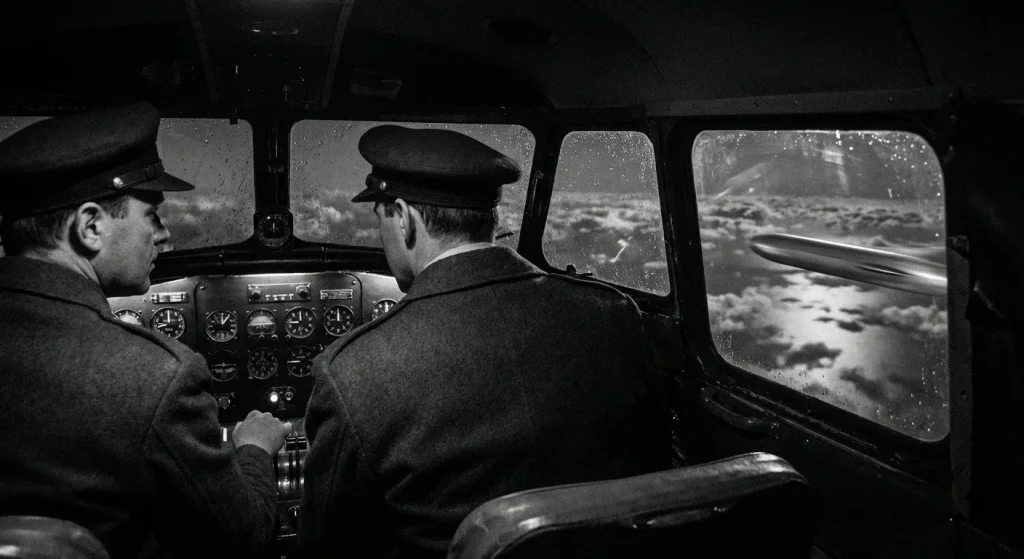
The aviation-safety question behind every “UFO disclosure” or “UAP disclosure” headline is simple: what, if anything, still matters for collision risk in the cockpit at night, when identification and avoidance happen in seconds. The 1948 Chiles-Whitted incident endures for that reason. It is framed first as a near midair collision, meaning a closing encounter where separation shrinks to the point that impact becomes a plausible outcome without immediate clearance, not as a casual light seen from the ground.
A recurring problem with famous UAP cases is that public claims expand faster than the record you can actually verify. Multiple secondary sources place the encounter at about 2:45 A.M. on July 24, 1948, and that timestamp is part of why the case stays sticky: night operations compress decision time, and a close-in report from trained pilots carries different weight than a story that begins and ends with “something was in the sky.”
The cockpit context also matters. The Douglas DC-3 is a propeller-driven airliner introduced in 1935, and it sits at the center of 1930s to 1940s air transport history. Put a high-stakes encounter in a DC-3 and you are automatically in an operational world where sightlines, lighting, and closing rates are not abstract. You are dealing with professional scan, instrument cross-check, and the constant requirement to avoid conflicting traffic.
The tradeoff this article resolves is the one that disclosure debates usually dodge: credible witness testimony versus hard evidentiary gaps. Older reports use the historical label UFO, meaning “unidentified flying object,” because that was the period language for an aerial sighting that defied immediate identification; modern official framing prefers UAP, “unidentified anomalous phenomena,” to keep the category broader than “objects.” Either way, the provided research does not supply an altitude for the Chiles-Whitted sighting, and it also lacks a precise location fix and defensible kinematics. You will leave with a disciplined way to sort what is known, what is uncertain, and what is merely repeated in this case.
The Case File and Timeline
The headline timestamp is clear, but the supporting record is thinner than most retellings imply. Secondary sources commonly cite approximately 2:45 A.M. on July 24, 1948, and that should be treated as an approximate marker rather than a logged cockpit time based on the materials available here.
The case is conventionally attributed to two cockpit witnesses, Chiles and Whitted, and this section treats them as the primary witnesses because the article’s subject is the “Chiles-Whitted” encounter. The provided research set, however, does not include a contemporaneous incident report excerpt that names them directly or ties specific quoted statements to them.
Beat 1 (around 2:45 A.M.): Initial noticing. The encounter enters the record as a sudden aerial observation by the cockpit witnesses. The sources available here do not provide the first moment of detection as an instrument-logged event, and they do not preserve a precise “first seen” clock time beyond the approximate 2:45 A.M. window.
Beat 2: Closing and collision-risk moment. The narrative core is a near-collision dynamic: the object’s apparent approach became close enough to be understood, in the moment, as an immediate hazard to the aircraft. The provided material does not supply the aviation variables that would normally let an analyst quantify that risk (altitude, closure rate, relative bearing, or duration).
Beat 3: Separation. After the closest approach, the object and the aircraft separated, ending the immediate hazard condition. The provided research set does not include a time-to-separation figure, a measured track, or any radar correlation that would allow the separation to be plotted.
Witness boundary. Chiles and Whitted remain the only clearly identified witnesses for purposes of this timeline. Any additional crew or passenger witnesses are not established in the provided research set, and no other-aircraft corroboration is documented in the materials provided here.
Perception caveat (kept narrow). All near-miss accounts depend on human observation under operational workload; without the missing flight specifics, this timeline stays at the level of “what is claimed happened,” not “what the geometry must have been.”
Beat 4: Reporting and attention (high level only). The provided research set does not contain a documented chain-of-reporting that identifies who received the first report (airline operations, air traffic control, military channels, or press), who interviewed the crew first, or what forms were completed. It also does not provide follow-up dates for Air Force contact, memos, or investigative file actions tied to this specific event.
Documentation boundary (hard line). None of the provided sources include an aviation incident report with flight specifics. There is no origin or destination, no departure time, no airway or planned route, and no precise location fix over Alabama available from this research set.
Research hygiene note. Several snippets in the provided bundle describe unrelated aviation or military items; they are not evidence about this 1948 case and are excluded from the timeline.
Altitude: None of the provided sources provide an altitude for the encounter. Any altitude you may have seen in popular summaries is not supported by the materials supplied here.
Location fix: The encounter is broadly described as occurring “over Alabama,” but the provided sources do not pin it to a specific point, waypoint, town, or coordinate. There is also no documented fix method in the provided materials (no radar plot, no dead-reckoning note, no logged position report).
Route and flight plan: The provided research set contains no flight-route specifics: no origin, no destination, no departure time, and no airways. That removes the normal ability to reconstruct where the aircraft should have been at 2:45 A.M. from scheduled progress alone.
Kinematics and duration: The most decision-critical variables for evaluating a near miss are exactly what is absent here: estimated distance at closest approach, time in view, relative motion, and any maneuvering by either party. Without those, the best way to read the “timeline” is as a set of claims with confidence levels: time window (moderate, secondary-sourced), encounter sequence (high as a narrative outline), and flight geometry (unsupported in this record).
That leaves one remaining handle on the event: what later accounts say the crew perceived in the moment, and how stable those descriptions remain when the primary record is missing.
What the Pilots Reported
The lasting pull of the Chiles-Whitted story is the pilot-witness framing: two trained airline crew members reporting something close enough to feel like a near-collision. The problem is that many of the most repeated “hard details” readers assume are locked down are not supported by the record contained in this research set, which does not preserve the pilots’ exact words or their own numeric estimates.
Most modern retellings are secondary source material (summaries and interpretations), not the pilots’ own contemporaneous wording. In that secondary layer, the encounter is typically described as a bright, fast-appearing object at night, observed from an airliner cockpit under time pressure, and treated by the crew as a collision concern rather than a distant light. Later accounts commonly attach interpretive labels such as “wingless,” “rocket-like,” or “cigar-shaped,” and they often circulate additional descriptive hooks that sound concrete because they are vivid and repeatable.
The friction is that vivid, repeatable details are not automatically stable details. Night viewing compresses your information: reduced depth cues, glare, and limited reference points all make shape and distance judgments harder than the confidence of the retelling implies. Relative-motion effects add another trap. When two objects move at different speeds and headings, apparent bearing changes can look like aggressive maneuvering or sudden acceleration even when the underlying geometry is ambiguous from a single viewpoint. Layer on the stress of a perceived near miss, and the human system prioritizes threat recognition over careful measurement, which is exactly what you would expect in a cockpit reacting in real time.
Pilot testimony still carries weight in aviation incidents because pilots are trained observers of traffic conflicts, exterior lighting cues, and abnormal hazards, and they are conditioned to report what matters for safety. That training is why a pilot-witness framing is meaningful here. It is also why you should separate the safety-relevant core, “we saw an object that presented a collision concern,” from the highly shareable fine-grain descriptors that depend on lighting, angle, and memory.
This research set contains no verbatim, primary-source wording for contested descriptive elements. A primary source is the standard you would need to lock down disputed details: the original pilot statements, recordings, or contemporaneous reports that preserve exact phrasing (not paraphrase). Because no verbatim pilot quotations are present here, you cannot responsibly treat any particular adjective, metaphor, or specific feature as “what the pilots said” rather than “what later summaries say they said.”
A specific research pitfall needs a hard correction: “windows” appearing in word-frequency lists is not case evidence. In the provided materials, “windows” shows up only as a token inside unrelated vocabulary or frequency datasets. It is not a pilot statement, not a contemporaneous report excerpt, and not documentation of what anyone saw. Treating that token as proof that the object “had windows” is a category error: a text-mining artifact mistaken for testimony.
How to weigh this kind of testimony: Keep two labels in your head as you read and share: “reported observation” versus “later interpretation.” If a detail cannot be traced to a primary source (original wording), treat it as provisional and say so explicitly when you repeat it. The safety-relevant claim can stand on its own; the viral fine print should not be promoted to fact without primary-source support.
When verbatim statements and flight specifics are missing, the next question becomes procedural rather than descriptive: what official handling existed, and what-if anything-can be shown in a case-specific file trail.
Investigation and Official Handling
After pilots put an anomaly into words, the “official story” often became a second, parallel event: how the report was repeated, summarized, and filed. In the late 1940s, a high-profile aviation claim could draw immediate media interest because it involved commercial air travel and perceived public safety risk, and it could also trigger military attention because military organizations tracked unusual aerial observations as an intelligence problem. Those two channels did not run on the same rails. Newspapers prioritized readability and speed, while military handling prioritized internal routing, interviews, and whatever documentation fit existing reporting practices.
The result is predictable friction. A public account can solidify into a widely repeated narrative before any formal review is complete, and later readers often treat “it was in the news” as proof of “it was fully processed through a specific military program.” Those are different claims. Public visibility shows circulation; it does not automatically show which office logged it, which analyst touched it, or what classification label was applied.
Institutional context matters here because it shaped what the public assumed “counted” as evidence. Project Sign is described as the first classified program aimed at explaining military-reported UFO sightings. U.S. National Archives and Records Administration, Air Force UFO records That framing alone tells you what the early goal was: take reports coming from military channels and force them into intelligible buckets, whether that meant conventional explanation, insufficient data, or something unresolved.
Later, the U.S. Air Force was responsible for handling Project Blue Book, and Project Blue Book investigated thousands of UFO sighting reports nationwide. U.S. Air Force fact sheet on Project Blue Book Those two facts explain why Blue Book became the default reference point in popular discussions: scale and centralization create the impression of a single national ledger. The nuance is that “Blue Book existed and investigated broadly” is not the same as “Blue Book definitely touched every notable report,” especially when information could move through multiple commands, formats, and informal summaries before it ever resembled a standardized case file.
Some readers want one decisive artifact: a case number, an intake memo, an interview transcript, and a final disposition, all traceable to a specific office. The provided research set does not include definitive case-file documentation that proves exactly how this specific report was processed, routed, or cataloged inside the military system. That evidentiary limit matters because institutional history is often mistaken for case-specific proof.
What can be said responsibly is narrower: late-1940s reports like this sat at the intersection of public attention and military interest, and programs such as Sign and Blue Book created an official-looking framework that people later used as a proxy for “the government’s full record.” What cannot be claimed from the materials provided is the exact paperwork trail for this incident, including which program handled it at each step, what internal summaries were produced, or whether any particular file survives in a complete form.
Documentation gaps are where durable controversy is born. When the public sees a famous incident but cannot see a clean, continuous file trail, the absence gets interpreted as intent, and that is how “government UFO cover-up” narratives harden. The disciplined read is simpler: separate “a program existed” from “a program definitively handled this exact report” until someone produces verifiable case documentation.
Once you put those documentation limits on the table, the explanatory debate looks less like a single solved mystery and more like competing hypotheses constrained by missing inputs.
Competing Explanations Then and Now
The debate persists because multiple explanations remain live when kinematics and primary documentation are missing.
Popular retellings treat the Alabama near-miss like a single mystery with a single answer; the case file reads more like a measurement problem. Each hypothesis only “fits” if specific observations and records exist, and most summaries skip the inputs: the object’s track relative to the aircraft, the duration of key phases, any contemporaneous radar or tower notes, and whether other observers saw the same thing from other angles. Without that scaffolding, several conventional buckets stay on the board.
If it were a fireball (a very bright meteor): the baseline requirement is brightness and behavior consistent with what the American Meteor Society calls a fireball, defined as a very bright meteor generally brighter than magnitude -4. In practice, a fireball explanation wants (1) a short-lived luminous event with a fixed sky track, (2) no maneuvering against background stars, (3) widespread corroboration because bright meteors are visible across large areas, and (4) a direction of travel and timing that multiple witnesses can align. The confirming data is not “someone else also saw something,” but consistent azimuth and elevation reports, timing within minutes, and regional clustering that implies one atmospheric path.
If it were another aircraft: this requires an airframe, lighting pattern, and closure geometry that produce a near-collision impression at night. The friction is that night depth cues are weak; a distant aircraft can look close if its lights are bright and its relative motion crosses your windshield quickly. The confirming data is documentary: flight plans, military and civilian traffic records, unit histories, and any radar returns. If an aircraft was there, somebody scheduled it, fueled it, maintained it, and logged it.
If it were atmospheric or astronomical: the explanation has to survive one hard constraint: stars, planets, and most skyglow do not generate rapid, structured “passing” motion unless the observer’s own motion and intervening clouds create that illusion. This bucket works best when the description emphasizes stationary or slowly drifting lights, color changes, twinkling, or “appearing and disappearing” near a horizon layer. Confirmation comes from contemporaneous weather observations (cloud layers, haze, thunderstorms), exact headings and bank angles from the aircraft, and an astronomy reconstruction for the reported time and direction.
If it were rockets or experimental technology: the necessary condition is not speculation about “secret tests,” but an actual operational chain that places a launch, flight corridor, or test vehicle within visual range at the reported time. The friction is the record gap: the research set used for this article does not establish 1948 rocket or missile test schedules over Alabama. Without dated range logs, unit orders, telemetry summaries, or declassified test reports tied to that specific night and location, this category stays an assertion rather than an explanation.
If it were non-human intelligence: this claim category carries a higher evidentiary bar because it asserts a new actor, not a misidentification. To clear that bar, the case needs instrumented data and provenance: correlated radar and visual tracks, traceable physical evidence, or official documentation that is specific enough to rule out conventional traffic and atmospheric events. The current record does not meet that standard, which is why “alien disclosure” framing remains rhetoric, not analysis.
Arguments about “impossible speed” collapse into guesswork unless you can define the geometry. Speed is distance ÷ time, which means you need a defensible distance estimate and a precise time interval, not just adjectives like “fast.” Resolution would come from primary materials that constrain distance and timing: the aircraft’s exact position, altitude, heading, and ground speed at key moments; any radar scope logs or tracking notes; air traffic control or operations desk entries; weather observations along the route; and any independent sightings that can be triangulated.
A modern habit that improves the fireball check (without proving anything about 1948): treat bright-meteor claims as testable against a crowd-sourced record. AMS maintains a public, searchable log of reported fireball events, and astronomy communities routinely point witnesses to it to see whether others reported the same bolide.
- Search the AMS fireball log by date range and a broad region that includes the flight corridor.
- Filter for clustered reports within a tight time window; single, isolated entries rarely anchor a trajectory.
- Compare reported directions of travel and duration across entries; consistent bearings matter more than dramatic descriptions.
- Demand the same discipline for any alternative claim: if a source cannot supply track, timing, and documentation, it is not “more advanced,” it is just less testable.
Those are the analytic constraints; the reason the case continues to circulate is that today’s reporting and archiving systems invite people to revisit older incidents through a modern safety lens.
Why It Matters in 2025 and 2026
The 1948 near-collision still gets traction for a modern reason: the public argument has shifted from belief to aviation safety and documentation. Once a report is framed as a cockpit hazard, people expect a defined reporting lane, a responsible federal office, and a paper trail that can be requested, audited, and compared.
Near-collision language lands differently in 2026 than it did in mid-century newsprint because it maps cleanly onto today’s safety vocabulary. The FAA’s Aeronautical Information Manual (AIM) update dated 1-22-26 explicitly formalizes UAP reporting and points reporters to an all-domain reporting site, and the same update references “near midair collision” in its safety framework. FAA AIM Basic w Chg 1 and 2 dtd 1-22-26 FAA Notice N7110.800 Unidentified Anomalous Phenomena (UAP) Reports
The catch is that safety framing raises the evidentiary bar. A safety system works best when it captures time, place, altitude, sensors, and follow-up. Historic cases often have vivid narratives but cannot meet today’s expectation for structured, comparable data.
The UAP pipeline is no longer informal. In its FY2024 report, AARO documented 757 UAP reports received between May 1, 2023 and June 1, 2024. All-domain Anomaly Resolution Office Annual Report on Unidentified Anomalous Phenomena (2024) DOPSR-2024-0263 AARO Historical Record Report Volume 1 (2024)
Volume also complicates interpretation. A large count tells you there is a reporting mechanism and demand to use it; it does not tell you what any single incident was. That distinction gets lost when UAP sightings are summarized as a single headline number rather than case-by-case dispositions.
Congress has also forced record centralization. The FY2024 NDAA, signed Dec 22, 2023, created an Unidentified Anomalous Phenomena Records Collection at the National Archives and required agencies to review and organize UAP records in their custody by Oct 20, 2024. Public Law 118-31 (FY2024 NDAA) National Archives guidance on UAP Records Collection
Public-policy attention has a calendar, too: the House Oversight Committee scheduled the hearing “Restoring Public Trust Through UAP Transparency and Whistleblower Protection” for Tuesday, Sept 9, 2025 at 10:00 AM EST (HVC-210). House Oversight Committee hearing Restoring Public Trust Through UAP Transparency and Whistleblower Protection (Sept 9, 2025, HVC-210)
None of these modern structures prove anything specific about the 1948 incident. They explain why old cases resurface in today’s search and media cycle: the current UAP disclosure debate rewards stories that can be mapped onto a modern intake path, a formal aviation reference, and an archive mandate that sounds enforceable in UFO news.
The practical filter is simple: treat any “disclosure” claim as stronger when it points to a reporting pipeline (FAA AIM guidance and AARO intake) and a record trail (the National Archives collection mandate), and weaker when it relies on recycled anecdotes detached from those systems.
That filter matters most when a story is repeatedly framed as a near midair collision, because safety language implies measurable parameters-and this case is remembered precisely because so many of those parameters are absent.
What the Near Collision Still Teaches
The Chiles-Whitted near-collision stays useful because it rewards evidence discipline: the story is dramatic, but the hard parameters are still missing.
- What’s solid: Secondary sources commonly place the encounter at about 2:45 A.M. on July 24, 1948, involving an airliner crew in a DC-3 context and framed as a near midair collision, not a distant light report.
- What’s unknown in this research set: The altitude, a precise location fix beyond the general Alabama framing, and any pilot kinematic estimates (speeds, closure rate, distances, angles) are not supplied in the provided sources. Without those numbers, you cannot responsibly turn narrative phrasing into flight physics.
- What’s easy to repeat but not supported here: High-confidence, quote-like detail about contested descriptive elements, especially claims about “windows” or “portholes” at a specific level of precision, is not anchored by primary-source verbatim descriptions in the provided research set. Treat those details as disputed until primary documents are consulted.
- What the case teaches about UAP news: Secondary retellings harden fast. If you cannot trace a claim to a primary document, you are tracking folklore, not a record.
Next time you see a fresh “UFO disclosure / UAP disclosure” claim, freeze the narrative, demand the primary documentation for any disputed detail, write down what key parameters are missing, and only then decide what the evidence actually supports.
Frequently Asked Questions
-
What was the 1948 Chiles-Whitted UFO encounter?
It was a reported near midair collision involving two cockpit witnesses (Chiles and Whitted) in a Douglas DC-3, described as a sudden nighttime aerial observation that became an immediate collision concern. Secondary sources commonly place it at about 2:45 A.M. on July 24, 1948, and broadly “over Alabama.”
-
What time and date did the Chiles-Whitted near-collision happen?
Secondary sources commonly cite approximately 2:45 A.M. on July 24, 1948. The article emphasizes this should be treated as an approximate marker rather than a precisely logged cockpit time based on the provided materials.
-
Where did the Chiles-Whitted incident occur, and do we have an exact location?
It is broadly described as occurring “over Alabama.” The article states the provided research set does not include a precise location fix such as a town, waypoint, coordinates, or a documented method like radar plotting or a logged position report.
-
What aircraft were the pilots flying in the Chiles-Whitted encounter?
They were flying a Douglas DC-3, a propeller-driven airliner introduced in 1935. The article uses that cockpit context to stress how night operations compress identification and avoidance time during a potential traffic conflict.
-
What key flight “specs” are missing from the Chiles-Whitted case file (altitude, route, speed, distance)?
The article says the provided sources do not supply an altitude, precise location fix, route or flight plan details (origin, destination, departure time, airways), or defensible kinematics such as closure rate, distance at closest approach, relative bearing, and duration. Without those numbers, the near-miss geometry cannot be quantified from this record.
-
Did the pilots actually say the UFO had “windows” or specific features like a wingless rocket shape?
The article says the provided research set contains no verbatim, primary-source pilot quotations for contested descriptive elements, so specific features cannot be locked to their exact wording here. It also states that “windows” appears only as an unrelated text-mining token in the materials and is not evidence of what the crew reported.
-
How should you evaluate UFO/UAP near-collision claims when the primary record is missing?
The article’s method is to separate the safety-relevant core claim (“an object presented a collision concern”) from later interpretations, and to treat any detail as provisional unless it can be traced to a primary source. It also recommends demanding measurable parameters-time, place, altitude, track/kinematics, weather, and any radar or traffic records-before accepting claims about “impossible speed” or specific craft features.
