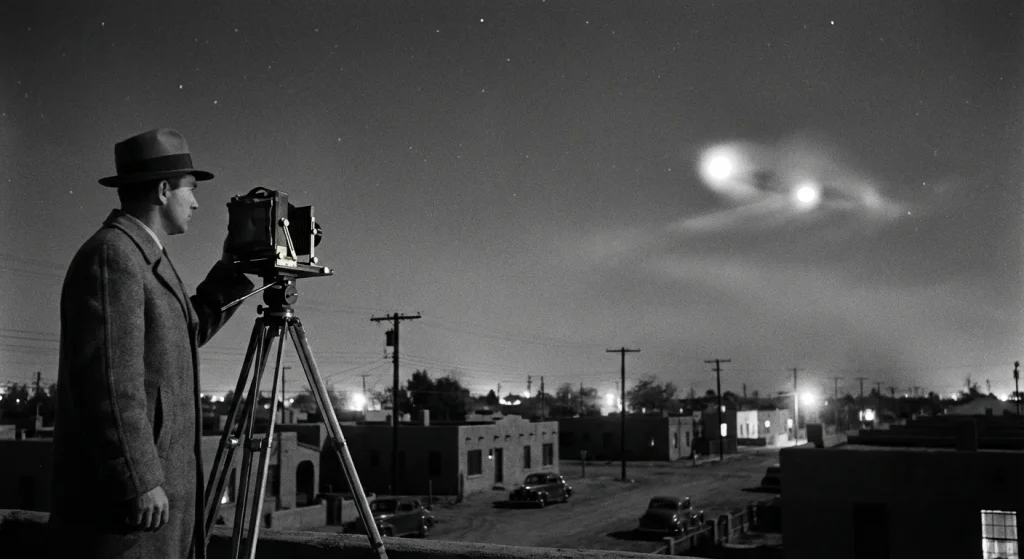
The Rhodes photographs are less about what’s in the sky and more about who controlled the evidence once the images existed. That’s why they keep resurfacing in UFO disclosure and UAP news: a single set of iconic frames gets treated as a proxy for a much larger claim, that the government moved fast, took possession, and then shaped what the public could verify.
The frustration is predictable: you keep seeing viral certainty, “the Air Force seized the first flying disc photos,” delivered with total confidence, then the “receipts” never show up. In the publicly available documentation I reviewed, the basic publication trail is not documented. There is no first-newspaper-publication record in those materials: no outlet name, no issue date, no page number, and no caption text. If you cannot point to those specifics, you are not citing a publication, you are repeating a retelling.
The real decision for a reader is not whether the story feels plausible; it is what to believe, what to share, and what to keep explicitly open. The article’s core tension sits right there: famous images plus immediate military-attention claims, paired with thin or missing primary documentation for two things that should be straightforward to prove, the publication pathway and the chain of custody.
Two anchors keep “Air Force” claims honest. First, 1947 is institutionally messy: the U.S. Air Force became independent of the Army that year, and “Air Force” is not automatically the same thing as the wartime “Army Air Forces.” That ambiguity matters when a story pins custody on a specific institution. Second, public records I reviewed do not show clear evidence that the Rhodes case itself was tracked and studied through 1990 in the archives I examined; that absence is exactly why custody disputes become the battleground in cover-up narratives: control the originals, control what can be checked. [Archives.gov: Air Force UFO Records][CUFOS: Classic Cases]
Custody matters because once you lose the originals, you are often arguing over second-generation copies, not the source material itself.
Use a strict standard of proof: demand publication details (outlet, date, page, caption) and custody documentation (who took what, when, under what authority, and where it is archived) before you treat any “seized by the Air Force” claim as more than a story.
Why 1947 Was a Flashpoint
Once a report crossed the line from “someone saw something” to “someone photographed something,” it carried more weight in a newsroom and in an intelligence inbox. Photographs make depicted objects feel materially real in a way verbal descriptions do not, so editors and officers treat them as higher-grade documentation even before anyone can verify what the camera captured.
That bias toward imagery is well documented: scholarship notes that photographs make subjects seem more real than other representations, and they function as documentary evidence that shapes what people accept as “what happened.” In a summer where the term “flying disc” itself was press-shaped shorthand for a fast, disc-like object people claimed to see in the sky, an image was a form of leverage because it looked like proof, even when context was thin.
June 24, 1947 is the hinge point: Kenneth Arnold reported seeing nine objects and estimated their speed at about 1,200 miles per hour, and his sighting is widely treated as the start of the 1947 “flying disc” wave[1947 flying disc craze][contemporary analyses]. Early summaries counted relatively few confirmed reports before Arnold, on the order of about 18 prior accounts in some contemporary reviews[Bloecher].
After a sighting that specific, the incentives snapped into place. Newspapers had demand for follow-on accounts, wire services had a template for writing them up, and military channels had a reason to pay attention because the reports were now framed as high-speed craft operating in controlled airspace. The same forces that increase reporting also degrade precision: copy gets rewritten, details get standardized into the most printable elements, and secondhand retellings outrun primary notes. The result is a high-impact paper trail with sharply uneven documentation quality.
July 1947 also produced a clear example of how quickly public-facing certainty could be issued and then fought over. The reproduced Roswell press-release language is blunt: “Roswell, N.M. – The army air forces here today announced a flying disc had been found on a ranch near Roswell and is in army possession.”
That sentence matters as context, not as evidence for any later Arizona handling. It demonstrates the volatility of the period: an authoritative statement could land in print, trigger immediate escalation in attention, and then become disputed terrain. Once audiences watch an “army possession” claim appear and then get contested, suspicion becomes part of the story mechanics, not an add-on.
Treat June to July 1947 “flying disc” claims as a media-military feedback loop: attention drives reporting, reporting drives official interest, and photographs amplify both because imagery persuades faster than human recollection. The actionable rule is simple: assume high impact, assume uneven records, and evaluate every document by provenance and chain of custody, not by how confidently it was described at the time.
Rhodes, the Camera, the Night
That 1947 feedback loop is the backdrop for why the Rhodes frames became durable: photographs were treated as higher-grade documentation even when the surrounding record stayed thin. The evidentiary weight attached to the images is precisely why missing capture details matter.
The Rhodes photographs are famous because the images reproduce well and circulate easily. Credibility, however, hinges on capture context: the photographer’s first-person account of the camera, the film, the exposure, and the conditions in which the frames were made. In the publicly available documentation I reviewed, Rhodes’ original statements or interviews documenting camera make or model, film type, or exposure settings are not present. That absence is decisive: without capture metadata, you cannot responsibly move from “striking picture” to “rigorously reconstructed event.”
Retellings commonly describe the core claim in simple terms: William A. Rhodes, described as a private citizen in Phoenix, photographed a disc-like object in the sky. In the sources I reviewed, that claim functions mainly as a caption, not as a documented observation record. The images and their reproductions can establish only that a particular visual artifact existed in a particular form and was circulated. They do not, by themselves, lock down what was in the sky, how far away it was, or how the camera rendered it.
That gap matters because most people encounter Rhodes through copies of copies: prints made from prior prints, halftones in publications, scans of those reproductions, and re-uploads. The evidence base here is explicit about the degradation problem: prints produced from originals that are not themselves the originals are second-generation copies, meaning they can diverge from the first-generation source in ways that look like “detail” but are actually reproduction artifacts.
Once an image has been printed using halftoning and other reproduction processes, tonal gradients are converted into dot patterns that rely on the viewer’s resolving limits to blend back into continuous tones. That mechanism can create apparent edges, banding, or surface texture that are properties of the print process rather than the photographed subject.
Digitization adds another layer. Scanning standards for cultural heritage materials are designed specifically to minimize equipment-induced variability and scanning artifacts, which is an implicit admission that the equipment can introduce variability and artifacts if the process is not controlled. If you do not know which generation of reproduction you are looking at, you do not know which “features” belong to the original negative and which belong to the copying pipeline.
For rigorous evaluation, the documentation I reviewed leaves out the minimum facts needed to test plausibility. None of the sources I examined supply the date or time of the Phoenix sighting, the object’s direction of travel, or the weather and astronomical conditions required for basic lighting and exposure checks. None of the sources I examined contain Rhodes’ original statements describing camera make or model, film type, or exposure settings. One note in the materials cautions that lens focal lengths are usually referenced to full-frame 35mm, which is why casual “it looks like a 200mm lens” claims are not credible without a verified camera format.
A second, non-obvious friction is sourcing identity. One source I encountered that names “William Rhodes” describes an applied econometrics scientist: a retired principal scientist and fellow at Abt Associates whose work centers on program evaluation and applied econometrics. Treat that as a sourcing warning, not as background on the 1947 Phoenix figure. If a source cannot disambiguate which William Rhodes it is citing, you should assume contamination until the document ties the person to the Phoenix photographs with contemporaneous identifiers.
- Pin down an exact date, time, and location for the exposure.
- Document camera make/model, lens, and film type or format.
- Record exposure parameters (shutter, aperture, focus distance if known).
- Establish viewing geometry: direction of travel, elevation angle, and observer position.
- Verify weather and astronomical conditions for that place and time.
- Trace image provenance: original negative/print versus second-generation copies.
- Disambiguate identities when names collide across biographies and databases.
From Newspaper Scoop to Military Hands
Missing capture metadata is only one break in the evidentiary chain. The other is where the photos first entered public circulation and how any transfer to officials was documented, because those steps determine which physical objects existed to be handled in the first place.
Calling the Rhodes originals “seized by the Air Force” is not a stylistic description of military interest. It is a chain of custody claim: a testable record of who possessed the material, under what authority, in what condition, and when it changed hands. Without that documented sequence, “seized” remains an allegation, even if the broader story feels plausible.
The first break in the chain appears before the military ever enters the narrative. In the sources I reviewed, there is no verified publication pathway for the initial newspaper appearance: no outlet name, no publication date, no page number, and no caption wording. That omission matters because newspaper reproduction is not a neutral step. Once a photo is copied for print, you now have multiple “originals” in circulation: camera negatives, newsroom prints, wire-service duplicates, and clipped halftones, each with different evidentiary value.
Provenance starts with identifiers. A documented first publication provides hard anchors: the exact image version published, the cropping, the caption claims, and the editorial context that often explains where the paper obtained the image. Without those anchors in the materials I reviewed, later statements like “the military took the originals” float free of the basic question: which physical object are we talking about, and how was it labeled before anyone in uniform ever saw it?
Once “government possession” enters the story, the details stop being semantic and start being administrative. “Requested,” “borrowed,” and “seized” are not interchangeable verbs; each implies a different authority posture and a different type of documentation that should exist if the transfer happened as described.
| Claim-type | What it asserts in practice | What documentation normally exists if true | What is missing in the sources I reviewed |
|---|---|---|---|
| Requested | The owner voluntarily provided originals or copies after an official or semi-official ask. | Letters or telegrams requesting material, appointment notes, signed receipt for items provided, lab submission notes if copied, return correspondence. | No official investigative file reference to the Rhodes photos (no case number, report title, or date) and no reproduced request letter or receipt. |
| Borrowed | The military took temporary custody to copy, analyze, or brief, then returned the items. | Chain-of-custody receipt showing “released by” and “received by,” photo-lab work orders, negative/print inventory, dated return log or acknowledgment. | No inventory list, no lab notes, no return record, and no dated administrative trail tying a specific set of originals to a specific office. |
| Seized | The items were taken without consent or under asserted authority and not returned. | Legal authority reference, property seizure record, evidence tag numbers, memorandum justifying retention, complaint or demand-for-return correspondence. | No authority citation, no seizure paperwork, and no traceable evidence identifiers linked to an investigative file. |
The bottom line is straightforward: the sources I reviewed do not supply the hard identifiers that would substantiate any of these pathways. There is no official investigative file reference to Rhodes photos in the materials I examined, and no verified publication pathway that pins down the first appearance in print.
Timing complicates the story in a way that cuts both directions. The U.S. Air Force’s formal UFO investigation began in 1948 as Project Sign and was later renamed Project Grudge. A 1947 contact, if it occurred, likely ran through precursor or ad hoc channels rather than a mature, standardized program with consistent case numbering and centralized evidence procedures. That makes undocumented handling easier to imagine, but it also raises the bar for proof, because “ad hoc” still leaves traces when physical property changes hands.
Project Blue Book’s microfilm collection is the clearest benchmark for what systematic logging looks like: the Air Force’s long-running investigation cataloged 12,618 reported sightings (of which 701 remained “unidentified” in the Air Force totals) and left preserved case and administrative records on 94 rolls of 35 mm microfilm published as NARA publication T-1206[AF fact sheet][NARA: Air Force UFO Records][NARA: textual and microfilm]. That ecosystem is what documentation looks like when a program matures: case files, indices, routing slips, attachments, and administrative correspondence that can be cross-referenced.
Nothing in the materials I reviewed provides that kind of handle for Rhodes: no case number, no report title, no date, no index entry. Blue Book’s existence does not prove Rhodes was logged there; it shows what should be findable when something was.
- Demand identifiers: a newspaper outlet, date, page, and caption wording for the first publication, plus the specific physical item allegedly taken (negative, print, or clip).
- Demand authority: the named office or personnel involved and the basis for custody (request, loan, or seizure).
- Demand documentation: receipts, letters, lab notes, or case-log references that establish chain of custody from owner to government possession.
- Classify the claim honestly: documented if the chain exists; unverified allegation if it does not.
What the Images Might Be
When publication and custody cannot be pinned down, the analysis question changes. Instead of treating the photographs as stable objects of record, you are forced to evaluate versions-prints, clippings, scans-and decide which “details” belong to the scene and which belong to the reproduction path.
The Rhodes photo debate is decided upstream of any argument about “what it looks like.” If you are judging from reproductions, you are not weighing the same object that an investigator with original negatives, first-generation prints, and capture metadata would weigh. Once originals and metadata are missing, the case stops being a contest of interpretations and becomes a contest of reproduction chains, each step adding its own distortions, crops, and contrast choices.
That distinction is practical: even when a version traces back to an original negative or print, most commonly encountered copies are still removed from the first-generation source, and newspaper printing adds another transformation step on top of that.
The practical consequence is simple: fragile inputs create confident outputs in both directions. A believer can “see” structure and intent; a debunker can “see” seams and fakery. Both are often interrogating the reproduction pipeline more than the photographed object.
Unknown craft is the highest burden claim, so it needs the cleanest foundation. To be persuasive, it requires consistency across frames and versions that can be traced back to first-generation material, plus capture details that let independent analysts check geometry, focus behavior, exposure, and any signs of retouching. Without those controls, “nonhuman” becomes an aesthetic impression rather than a falsifiable conclusion.
Hoax has the opposite burden profile: it does not need exotic performance, but it does need mechanics. A persuasive hoax case identifies a feasible fabrication method for the era, explains how that method would survive the specific reproduction path, and matches predicted artifacts to what appears across the best-available versions. “It looks like a model” is not a mechanism; a mechanism predicts where edges should break, where lighting should mismatch, and what changes should appear as copies degrade.
Misidentification wins when it produces a stable match. A strong mis-ID claim anchors to a candidate object with a consistent silhouette across frames, a plausible viewing geometry, and behavior that does not rely on a single ambiguous contour. The standard is not “something vaguely similar exists,” but “this specific class of object explains the recurring cues better than alternatives, across the least-manipulated sources.”
Printing or photographic artifact is the most underappreciated bucket because it sounds like a dismissal. It is not. It is an evidence-based claim that apparent structure can be manufactured by reproduction and enhancement. The persuasive version of this argument shows how specific “details” appear or vanish with changes in contrast, scale, and reproduction method, and why those changes track the pipeline rather than the scene.
The single biggest trap in newspaper-era UFO photos is halftone printing: it converts continuous tones into dots of varying size, and the tones you think you see are an optical blend at viewing distance because traditional halftone relies on limited resolving power to merge dots into a continuous image. That dot pattern can create false edges, apparent ridges, and “panel lines” where no such boundaries existed on the original photograph, especially after editorial contrast boosts.
Halftone screening for photographic reproduction emerged in the 19th century: William Fox Talbot proposed the idea around 1850, experimental processes and patents followed in the later 19th century, and the first broadly practical halftone screening methods for photo reproduction date from the 1880s[Getty: halftone atlas][Britannica: halftone][ScienceDirect: halftone]. Treating any single printed clipping as a faithful proxy for an original photograph confuses a reproduction technology with a camera record.
Digitization does not automatically rescue you. Scanning introduces its own variability, which is why digitization standards explicitly aim to minimize equipment-induced differences and artifacts. When you see online versions with aggressive sharpening, crushed blacks, or “clarity” style contrast, you are often looking at a modern artifact layered on top of an older one.
Photogrammetry is the practice of deriving measurements from photographs. It produces reliable size, distance, and speed only when the inputs are controlled: validated camera parameters, known reference dimensions in the scene, and documented assumptions that other analysts can replicate. In early photo cases, those requirements are often missing, so numeric certainty is frequently manufactured by choosing convenient, unverified inputs.
That constraint is not philosophical; it is mathematical. If the distance to the object, the focal length, and a trustworthy scale reference are not independently established, multiple real-world scenarios can project to the same 2D shape. Any claim that “the object was X feet wide at Y distance” is only as strong as the stated assumptions and the provenance of the image used for measurement.
Within the sources I reviewed, I found modern image-analysis methods described in general literature on classic cases, but no documentation demonstrating a traceable, reproducible application of those methods to the Rhodes frames. Modern techniques do not substitute for first-generation materials and clearly stated inputs; reproducibility is the point that matters.
- Demand originals or first-generation prints, not clippings or re-scans.
- Verify metadata and capture details: camera model, lens/focal length, exposure notes, and the sequence of frames.
- Document handling: who had the material, when it was duplicated, and what processing occurred (cropping, retouching, contrast).
- Require stated assumptions for any measurements (photogrammetry inputs and constraints).
- Compare multiple independent reproductions to identify which “details” persist and which track a specific print or scan.
If a claim about the Rhodes images cannot survive that checklist, it is not a conclusion. It is a narrative built on reproduction artifacts and assumption-driven math.
A Template for Modern Disclosure Battles
Those same weak links-missing originals, unclear handling, and thin paperwork-are exactly what modern disclosure fights orbit around. Rhodes keeps resurfacing for a reason that has nothing to do with re-litigating what the frames show. It illustrates the choke point that still defines UAP disclosure fights: whoever controls the original materials and the record system that describes them controls what everyone else is allowed to believe. The public asks for primary materials and documented custody pathways; institutions answer with summaries, conclusions, and selective releases. The argument is about credibility, but the battleground is evidence custody and record-keeping.
In the Rhodes story, the pressure point was alleged official possession: if originals sit inside a government system, access becomes discretionary. The modern version is explicit in proposed disclosure language. Senate Amendment 2610 (Schumer/Rounds) includes a provision proposing an “unidentified anomalous phenomena Records Collection” at the National Archives, framed as a purpose of the division. That is the same fight, modernized: not “who saw what,” but where the authoritative set of UAP records would live, who curates it, and whether the public can inspect the underlying material instead of receiving secondhand interpretations.
Rhodes also shows why “official wording” never settles public skepticism. In volatile eras of official language, people treat statements as negotiable and hunt for the underlying artifacts. Today’s terminology shift makes that dynamic sharper: UAP, the government’s broader term for unidentified anomalous phenomena, signals a scope wider than classic “UFO” framing, which increases the volume of material that can be summarized, and the amount the public will demand to see directly. When the release is a narrative without the supporting records, the credibility gap remains because the public cannot audit how the conclusion was produced.
The mechanics of access matter here. Even outside headline disclosure bills, U.S. public-records practice recognizes that disclosure can serve the public interest, including furnishing documents free or at reduced charge under 5 U.S.C. §552 when that standard is met.
Modern UAP disclosure is constrained by where it lives legislatively. The NDAA is the recurring vehicle because, per Congressional Research Service framing, it establishes policy and authorizes appropriations for the Department of Defense, nuclear weapons programs of the Department of Energy, and other defense-related matters. That reality cuts both ways: it is a powerful mandate channel, but it is also a high-traffic bill where language is negotiated, re-scoped, and traded.
House Rules procedural language makes the risk concrete: consideration procedures and further amendments can change what disclosure language survives to final enactment. Serious readers should treat draft text as a proposal, not an outcome, until the enacted statute locks in custody, access, and deadlines.
Use Rhodes as your filter. Track whether disclosure produces (1) primary materials, (2) documented custody pathways into durable record systems like the National Archives, and (3) enacted, enforceable requirements rather than promised language that can be rewritten before it becomes law.
Sources reviewed
- NARA: Air Force UFO records and Project Blue Book overview
- NARA: textual records and microfilm (Project Blue Book T-1206)
- U.S. Air Force Fact Sheet: Project Blue Book totals
- Fold3: Project Blue Book microfilm publication
- Contemporary analyses of the 1947 wave and early report counts
- Overview: 1947 flying disc craze (Arnold sighting summary)
- CUFOS: Classic UFO cases (reference material)
- Getty: history and technical overview of halftone
- Britannica: halftone process
- ScienceDirect: halftone
- Federal Rule of Evidence 901: Authentication and identification
- Federal Rule of Evidence 1004: Admitting other evidence of content
What We Can Say With Confidence
The Rhodes photographs remain significant because they show how a 1947 flashpoint becomes permanent controversy: capture metadata is missing, the publication pathway is not pinned down from primary documentation, custody becomes the battleground, print-process limits cap what later viewers can extract, and modern disclosure arguments still choke on the same point: missing originals plus missing paperwork. Even the institutional label at the center of the viral claim carries built-in ambiguity in 1947, because “Air Force” is not automatically identical to the wartime “Army Air Forces.”
What can be said with confidence is narrow and stable: the images matter as early artifacts, and photographs can function as high-leverage evidence when their provenance is intact. Courts commonly treat contemporaneous photographs as potentially persuasive evidence when they are properly authenticated; Federal Rule of Evidence 901(a) requires the proponent to produce evidence sufficient to support a finding that an item is what the proponent claims it is, and authentication is therefore a threshold requirement before weight can be assigned to a photograph in litigation[FRE 901].
That advantage collapses when the record around the image is absent: the sources I reviewed do not supply primary-source publication details for the first printings, and they do not supply verified custody logs for the Rhodes originals or negatives. Those gaps are the dispute.
The transparency lesson is already baked into the source material: where monitoring and meaningful transparency were absent, verification was impossible. The Rhodes case is the same pattern, just with photographs instead of declarations.
- Document a chain of custody with dated receipts, handler identity, and condition notes from first acquisition through every handoff.
- Identify publication endpoints with verifiable identifiers (issue/date/page or equivalent) and the reproduction source used.
- Confirm each transfer and disposition step in writing, mirroring records practice where institutions must report disposition results and receive confirmation before a proposed transfer can proceed.
Frequently Asked Questions
-
What are the 1947 Rhodes UFO photographs?
They are a set of widely circulated 1947 images attributed to William A. Rhodes in Phoenix showing a disc-like object in the sky. The article treats them as significant mainly because claims about government control of the originals are hard to verify without primary documentation.
-
Did the U.S. Air Force actually seize the Rhodes flying disc photos?
The article says the provided source set does not contain custody documentation proving any “seized by the Air Force” claim. It lists missing items like receipts, authority citations, lab notes, return records, and any traceable evidence identifiers tied to an investigative file.
-
What publication details are missing for the first newspaper printing of the Rhodes photos?
The article states there is no documented first-publication record in the supplied materials: no outlet name, issue date, page number, or caption text. Without those identifiers, the publication pathway cannot be verified.
-
What camera and exposure metadata is missing for the Rhodes photographs?
The article says the sources do not provide Rhodes’ original statements covering camera make/model, film type or format, or exposure settings. It also notes missing event data needed for checks, including the date/time, direction of travel, and weather/astronomical conditions.
-
Why does halftone newspaper printing matter when analyzing old UFO photos like Rhodes?
The article explains halftone printing converts continuous tones into dot patterns, which can create false edges, banding, and apparent “structure” that are print artifacts rather than scene details. It warns that scans and modern contrast/sharpening can add another layer of artifacts on top of the halftone.
-
What’s the difference between “requested,” “borrowed,” and “seized” in UFO photo chain-of-custody claims?
“Requested” implies voluntary delivery and should leave letters/telegrams and signed receipts; “borrowed” implies temporary custody with inventory and return logs; “seized” implies asserted authority and should leave seizure records and authority citations. The article says none of that documentation appears in the provided source set for Rhodes.
-
What should I look for before sharing a claim that the government took the Rhodes UFO originals?
The article’s checklist is to demand publication identifiers (outlet/date/page/caption) and custody proof (who took what, when, under what authority, and where it is archived). It also says to specify which physical item is involved (negative, print, or clipping) and require receipts, letters, lab notes, or case-log references.
